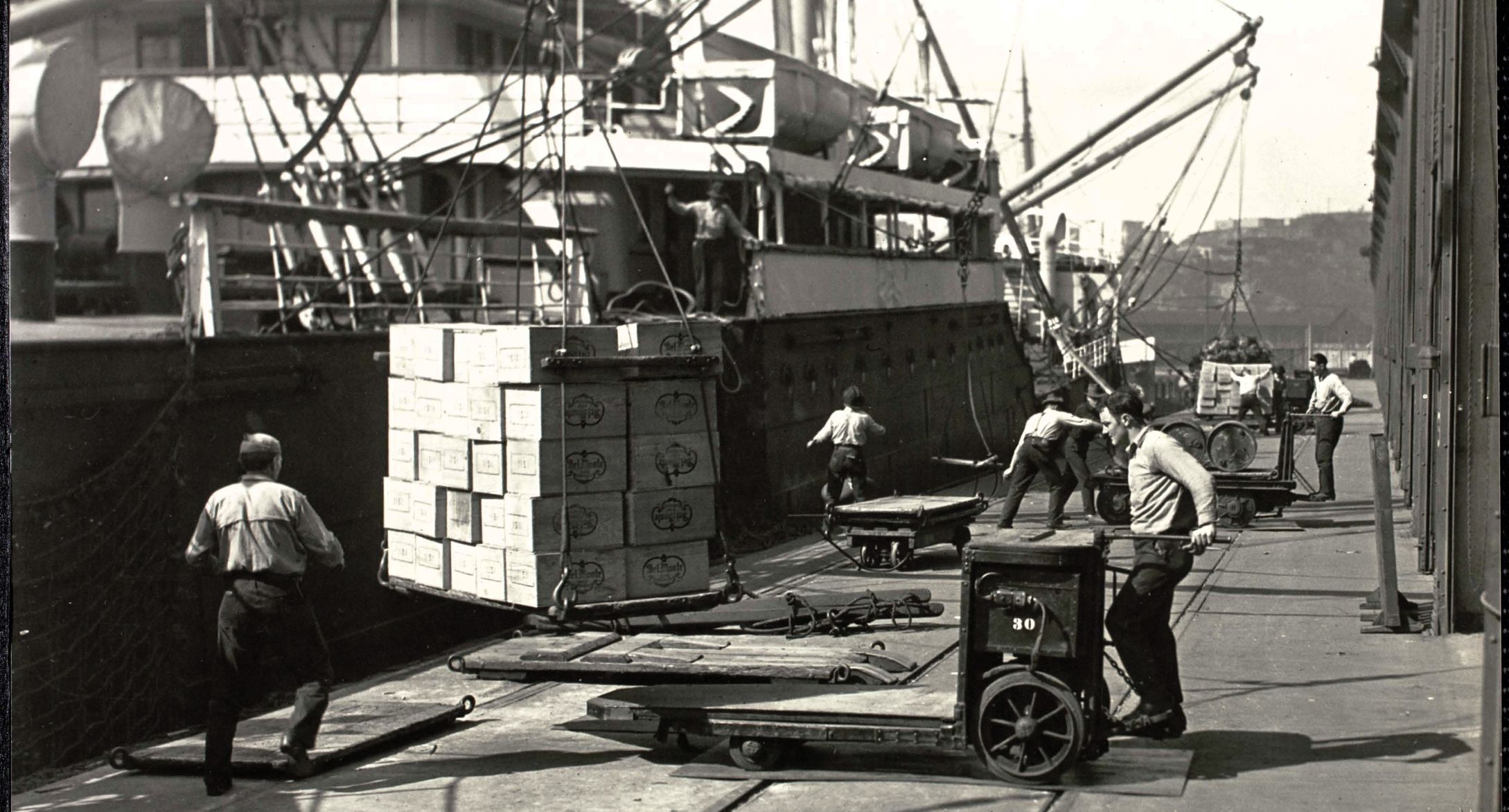
Sandgren enumerates example from around the world of the radicalization of marine transport workers, both on sea and on dock.
‘The Awakening of the Marine Transport Workers’ by John Sandgren from Solidarity. Vol. 6 No. 266. February 13, 1915.
The marine transport industry has been for ages, and is yet, a sort of social safety valve, in so far as it serves as an outlet for a great number of men who have been crowded off the board in the struggle for existence. The life of the marine transport worker, the sailor, the fireman, the seacook, the longshoreman, etc., is so hard and wretched that very few people voluntarily and deliberately drift into it. It is in most cases a last resort to maintain life.
For this reason there is hardly any other industry where we have such an heterogenous mass to deal with when it comes to organizing. In many a struggle of sailors and longshoremen their places have been quickly filled by that non-descript surplus humanity, which is on the very edge of social destruction. This manner of recruiting to the industry is one of the causes why the marine transport workers have come to form the lowest social stratum in every seaport.
This state of affairs is now beginning to change.
The light of the coming social revolution has penetrated to this bottom layer of the social sea, and in proportion as the sufferings of these men have surpassed the suffering of other proletarians, in the same proportion will they be champions of the new society, when revolutionary education shall have permeated and awakened the whole mass.
In support of the statement that there is such an awakening among these stepchildren of mankind let us enumerate a few facts which have come to our knowledge in recent years from all the corners of the earth.
1. In 1911 the marine transport workers of England, for the first time in history, united on industrial lines and fought as one man. All previous battles had been fought on craft lines and had been more or less local. But this time they saw the necessity of industrial solidarity. Sailors, enginemen, cooks, waiters, longshoremen and teamsters fought as one large industrial body, just as the I.W.W. would like to see them lined up. What was the result? It could be but one. All their demands were granted throughout England. In Liverpool alone the addition in wages amounted to $250,000 per week.
That is fact No. 1.
2. In 1912, according to the “Maoriland Worker,” “the marine transport workers of New Zealand, that socialistic paradise, threw overboard all the precious labor legislation, conciliation and arbitration, which had cost them so many years of hard efforts, and returned to the use of direct action.”
That is fact No. 2.
3. In 113 the union of firemen, oilers and watertenders of the Atlantic coast threw their old principles and methods to the winds, joined the I.W.W. and are now organizing the workers of their industry, irrespective of their occupations, into one big national industrial union.
That is fact No. 3.
4. In 1914 the so-called “Bodineoutfit,” which for years had been collecting dues on the Atlantic coast for the maintenance of a bunch of leaders, succumbed in the competition with the new I.W.W. union and collapsed for lack of support.
That is fact No. 4.
5. The so-called “International” Seamen’s Union, which properly speaking is nothing but Andrew Furuseth’s and his assistants’ private geschaft, fails to make further progress and Furuseth’s “Seamen’s Bill” meets everywhere with a jeering reception, being nicknamed “the Seaman’s Pill.”
That is fact No. 5.
6. The marine unions of the Latin countries, especially Spain and Portugal, who furnish a majority of the firemen and coal passers on the Atlantic coast, are becoming revolutionary and co-operate with the I.W.W. In this connection let us remember that the French union is syndicalist. They are our friends. Spanish and Portuguese fellow workers, on going home to their respective countries, are anxious to have a paid-up I.W.W. book with them to safeguard their standing in the old countries, where the books of other unions mean little or nothing.
This is fact No. 6, vouched for by the writer himself, from his experience as secretary of the New York local of the I.W.W. Marine Transport Workers.
7. In 1914, just as the war broke out, a communication reached us from Hamburg, Germany, notifying us of a break-away from the so-called “international” and the formation of a syndicalist organization of marine transport workers in this, the large seaport of Germany, at the same time requesting the co-operation of the I.W.W. men in America in their effort to reach their countrymen on these coasts. When the war is over this work will be taken up again.
This is fact No. 7.
8. In 1915, according to the last number of “Syndikalisten,” the official organ of the Swedish syndicalists, the Swedish firemen and sailors, who some time ago broke away from their social-democratic leaders and the “international,” have again organized, in close co-operation with the syndicalists and with their assistance. This effort was a signal success, and the new organization immediately had its baptism of fire, ending in a complete victory. The resulting increase in wages was 15-25 per cent and in addition they secured a special “war risk pay” amounting for North Sea vessels to 50-100 per cent of the monthly wages, and in some cases more than the regular wages. Add to this a “war life insurance “of 4000 kronon for married men and 3500 kronon, for unmarried,” and we get an idea of the shock imparted by this new body of men, sailing under syndicalist colors. Their formal absorption by syndicalist “one big union,” is said to be impending. There are other items of interest in connection with this veni-vidi-vici struggle.
They made no contract with the shipowners. They JUST ESTABLISHED these terms for an indefinite period, thus leaving their own hands free for further action.
Furthermore we note that the men did not have any long-drawn negotiations with the shipowners. They just left the ships without notice, in some cases just as the ships were to leave, thus giving no chance to secure strike breakers in advance. Thirdly, we note their peculiar way of getting round the difficulty of taking care of their interests in case of a struggle breaking out while the men are at sea. They just left this task in the hands of the other syndicalist organizations of the various seaports, an hitherto unexampled proof of confidence in and solidarity between workers, almost touching in its childlike simplicity.
The new organizations start with about 2700 men, who were all affected by the new form of settlement, which has nothing back of it except the will of the men to enforce it.
This is fact No. 8.
Other facts of a similar character may be added, but the above should be sufficient to warrant the statement that there is a general awakening going on among the marine transport workers and that the principles and tactics of the old “International” craft unions are losing ground.
If we now ask ourselves, what has been the cause of this awakening, we have no answer to give but–AGITATION AND EDUCATION, that agitation which sometimes looks so hopeless and useless. It is bearing fruit in the most surprising manner.
In fact the time seems to be ripe to establish formal relations between all these progressive bodies of marine transport workers, with a view to the formation in the near future of a new and real “INTERNATIONAL UNION OF MARINE TRANSPORT WORKERS OF THE WORLD” on the basis of INDUSTRIAL ORGANIZATION AND DIRECT ACTION.
That seems to be the only rational way of focusing the tendencies exemplified by the above mentioned facts.
The most widely read of I.W.W. newspapers, Solidarity was published by the Industrial Workers of the World from 1909 until 1917. First produced in New Castle, Pennsylvania, and born during the McKees Rocks strike, Solidarity later moved to Cleveland, Ohio until 1917 then spent its last months in Chicago. With a circulation of around 12,000 and a readership many times that, Solidarity was instrumental in defining the Wobbly world-view at the height of their influence in the working class. It was edited over its life by A.M. Stirton, H.A. Goff, Ben H. Williams, Ralph Chaplin who also provided much of the paper’s color, and others. Like nearly all the left press it fell victim to federal repression in 1917.
PDF of full issue: https://www.marxists.org/history/usa/pubs/solidarity-iww/1915/v06-w266-feb-13-1915-solidarity.pdf
 Revolution's Newsstand