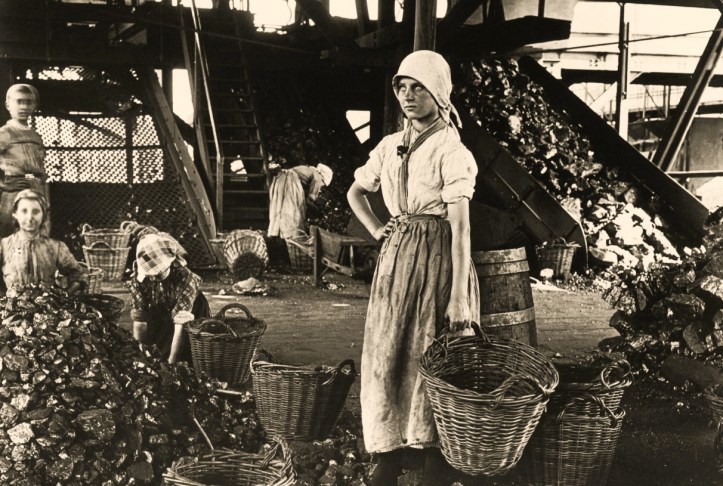
As in the U.S., where miners’ strikes often involve a whole community, women of Ruhr mining families play leading, and indispensable role in the fierce post-war struggle which saw 500,000 coal-diggers walk out in Germany.
‘The Mining Women in the Ruhr Struggle’ by Kl. S. from International Press Correspondence. Vol. 4 No. 33. June 12, 1924.
In the colossal struggle of the mining proletariat of the Ruhr area against mining capital, there were not only 500,000 miners but also hundreds of thousands of working women who took an active part in the conflict. The Communist Party has not yet sufficiently understood how to draw greater masses of women into the proletarian struggle and to lead them to become active members of the Party. For the most part it has only in theory maintained the important place of women in the revolutionary struggle, without itself being permeated throughout its member- ship with the sense of this importance and acting accordingly. For a long time the majority of the proletarian women have stood passively aside. But in the masses of the women there slumber unsuspected powers. The awful need, the starvation of their children, the absolute beggary and impoverishment of their families have shaken the mining women into wakefulness and released their powers. In an incredibly short time the mining women, who up till now stood absolutely apart from political life, grasped the tremendous significance of the miners’ fight and immediately, purposefully and courageously took the necessary steps for assuring its success.
In the whole of the Ruhr district the women Communist in every town, in every locality, informed the masses of the women, in public meetings of the significance of the miners’ struggle. The women understood that the attacks on wages and working hours, the deployment of the white troops in Germany, the mobilisations against Soviet Russia, the Experts’ Report–that all these are links in one chain forged for the shackling of the proletariat in eternal slavery and exploitation by International Capital. The response of the women in all resolutions was a hundred-fold; they solemnly pledged themselves to active participation in the miners’ struggle, to unconditional holding out until the seven hour shift and a decent human wage had been won. The women have put their vow into practice.
At the beginning of the Ruhr strike strike-breakers were to be found in many of the mines. The women immediately recognised the great danger which threatened the unity of the struggle from these strike-breakers who, by doing the most necessary work in the mines, kept the industry going. The women formed Information Detachments, which visited the strike-breakers in their homes, and made clear to them the injury they were doing to the workers. Not satisfied with this the women, armed with pick-handles, wooden laths and rubber piping, lined up before the mine gates, forced an entrance and gave the strike-breakers a good drubbing. Thereby they came into collision with the police. The women were indefatigable in discovering new methods of rendering the strike-breakers harmless. Thus in one place these fellows were marched through the town in a great demonstration procession, each bearing a card: “Strike-breaker” round his neck. In many places the windows of the houses in which the strike-breakers were living were smeared with tar or “decorated” with inscriptions. These energetic fighting methods of the working women resulted in there being no more scab work performed in the majority of the mines. Also the officials, who did emergency work, left the mines for fear of a rough handling.
The procuring of necessary provisions was largely a task for the women, as they are most seriously concerned with the hunger of their children and the cares of maintaining the home. The women therefore applied by delegations, supported by demonstrations, to the town and municipal authorities with the demand that the latter should assure the feeding of the strikers. In many cases the municipalities yielded to the pressure, fitted up kitchens, and distributed provisions. The women eagerly participated in the generous relief work of the International Workers
Relief, conducting kitchens, distributing food etc. The work of collecting among business people was energetically carried on by them.
A famous page in the history of the miners’ struggle is the courageous, fearless stand of the women against the police, who, at demonstrations, in the fights against the strike-breakers and after meetings took very brutal measures against the women. In Essen, Bochum, Dortmund and many other places, there were particularly serious collisions in which the police attacked the women with drawn weapons. Even then the women did not yield but tried to defend themselves with stones torn up from the road. The women rushed the police and attempted to tear their weapons from them. The police frequently had their heads clouted by the women, while it came over and over again to wounding and arresting of women. In most cases the police were only able to disperse the women after the arrival of patrol wagons full of reinforcements. Many reports stated that the police were helpless. It must be emphasised that these struggles were for the greater part participated in by politically indifferent women, as is generally the case. Even the “Christian” women fought ruthlessly. A typical example is the case in which one woman struck a policeman in the face with her prayer book.
By the active participation of the women in all the struggles, the front of the mining proletariat was extraordinarily strengthened and made firm. The courage of the miners was enhanced by the success of the women, while the enemy was considerably weakened. Wide masses of proletarian women stand with complete confidence behind the Communist Party. The women them- selves have learnt an infinite amount in the revolutionary struggle. Women who have never previously spoken or appeared in public were active as agitators and speakers and worked successfully in the strike committees. The working women have thrown their illusions overboard, they have looked their capitalist enemy in the face, and have felt the fury of capitalist state organs on their own bodies. They know today that they can only conquer their opponents and win freedom by revolutionary struggle, by civil war.
The struggles of the mining women have given us a practical example of the significance of the women in the revolution. It is now the work of our Party to make use of the sympathies of the proletarian women, and bind them closely to the Communist Party. The Party must now carry on the work among women to a far greater extent and in a quite different way from formerly. Also the centre of gravity of its work among the women must be based in the workshops. Here a staff of revolutionary women workshop functionaries must be formed, who shall work in the Communist workshop nuclei in order to win over the women workers in their places of work. Housewives must also be brought into closest unity with the workshops. Only thus shall we be able to win over the masses of the women workers and housewives, who are still standing apart, for the revolutionary struggle.
International Press Correspondence, widely known as”Inprecorr” was published by the Executive Committee of the Communist International (ECCI) regularly in German and English, occasionally in many other languages, beginning in 1921 and lasting in English until 1938. Inprecorr’s role was to supply translated articles to the English-speaking press of the International from the Comintern’s different sections, as well as news and statements from the ECCI. Many ‘Daily Worker’ and ‘Communist’ articles originated in Inprecorr, and it also published articles by American comrades for use in other countries. It was published at least weekly, and often thrice weekly. Inprecorr is an invaluable English-language source on the history of the Communist International and its sections.
PDF of full issue: https://www.marxists.org/history/international/comintern/inprecor/1924/v04n33-jun-12-1924-inprecor.pdf
 Revolution's Newsstand