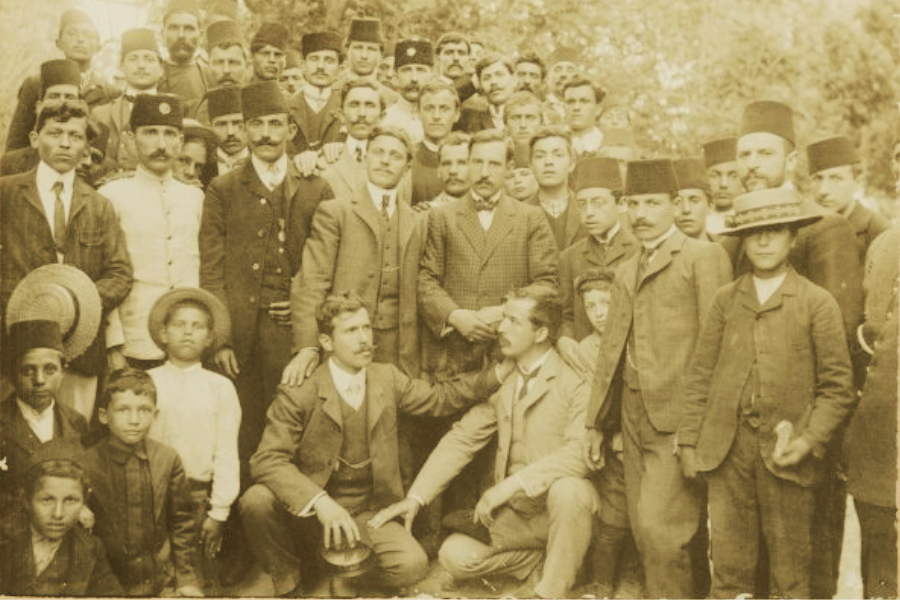
The united front, relationships with the broad peasantry, what constitutes a workers’ government, parliamentarism, and other issues are discussed in an article written before the coup on the Bulgarian C.P.’s orientation in a complicated and fluid situation. Khristo Kabakchiev was on the central leadership of Bulgarian Social Democracy since 1905. A member of Bulgarian parliament between 1914-23, he was also a founder of the Balkan Socialist Federation, and in 1919 of the Bulgarian Communist party which he represented at the Second and Fourth Comintern congresses. Arrested before the planned September, 1923 uprising, he was jailed for several years before his release in 1925. Eventually settling in Moscow, Kabakchiev lost his positions in the 1928 power-shift in the Comintern. Working at the Marx-Engels-Lenin Institute writing histories of the Bulgarian workers movement, though arrested during the Purges, he was later released. Dying in Moscow in 1940.
‘Before the Bulgarian Coup d’Etat’ by Khristo Kabakchiev from Communist International. Vol. 1 No. 26-27. September-October, 1923.
Editor’s Note. This article by Com. Kabakchieff was written before the Coup d’Etat. It explains the point of view which led the Bulgarian Party to adopt its present attitude. In the next number we shall print an article of Com. Kabakchieff written since the Coup d’Etat, and a reply thereto.
A regular session of the Party Council of the Communist Party of Bulgaria—such as is held every three months—was held from January 19-22, 1923. This session of the Party Council concerned itself with the internal situation of the country, with the decisions of the Fourth Congress of the Communist International, as well as with those of the Fifth Conference of the Communist Balkan Federation. As far as the domestic situation is concerned, the Party Council, after ascertaining the new gains of the party at the district elections held on January 14 of the same year, points to the necessity of a numerical growth of the party and Trade Union organisation in the cities and their organizational consolidation; an increase of the preparation for struggle both of the party and of its followers among the working masses of the cities and villages; and greater penetration and extension of the influence of the party among the workers and small landowners. The Party Council also dealt with the necessity of increasing preparations for warding off the attacks of the bourgeois coalition, which is organising its forces and preparing, in spite of its defeat in the elections, to seize power by a coup d’etat; to outlaw the Communist Party, to burden the workers and small landowners with the enormous war debts and reparations, and to bolster up its weakened class-rule by an undisguised dictatorship with the support of the Entente Governments, and even with the assistance of Entente troops.
The Party Council accepted the decisions of the Fifth Conference of the Communist Balkan Federation in their entirety and issued a manifesto against the war. Moreover, the Party Council went into an exhaustive consideration of the decisions of the Fourth World Congress, which it had accepted in entirety, and in connection therewith, passed a very important resolution with reference to the question of the Workers’ and Peasants’ Government. The purpose of this article is to explain the spirit and the meaning of this resolution, which we quote in full at the end of this article.
The tactic of the Workers’ Government in the West-European and Middle-European countries, and the Workers’ and Peasants’ Government in Czecho-Slovakia and the Balkans, which was recommended by the Fourth World Congress of the Communist International, is a development and application of the tactic of the United Front. But the Communist Party of Bulgaria is forced to apply the tactic of the United Front and of the Workers’ and Peasants’ Government under conditions that differ greatly from those of the West-European and Middle-European countries. We must first of all go into a consideration of these conditions.
1. THE TACTIC OF THE UNITED FRONT IN BULGARIA.
In Bulgaria the Communist Party is the only workers’ party; at is the mass party of the workers and of the landless and small peasants; it is the strongest party in the cities, and in the villages stood second only to the Peasant Party, which has governed the country for three years. The party of the betrayers of Socialism, called “broad Socialists” in our country, which with three ministers participated in the bourgeois coalition Government after the war, has entirely lost even those workers who had formerly followed it. Out of the approximately 80,000 votes it polled in 1920, it received barely 40,000 votes in the last elections (January 14, 1923); but during the same period the Communist Party, which has 40,000 members and which made its entire programme the basis for the election fight, increased its votes particularly in those villages where a furious terror reigned. The 184,000 votes it had polled in 1920 grew to 230,000 on January 14, 1923, which means that it received a quarter of the entire number of votes cast, and more than the votes of the coalition of the four old bourgeois parties. The party of “broad Socialists” is the most unimportant party in the country, having absolutely no influence among the masses.1
The trade union movement of Bulgaria is also united into one organisation which is bound theoretically and organisationally by the closest ties with the Communist Party. It is called the General Federation of Trade Unions, and has 35,000 members. After the workers of several trade unions, which had followed the “broad Socialist” Party, joined the General Federation of Trade Unions in 1920, there remained no other trade union of industrial and professional workers. A few “neutral” professional organisations of Government officials, employees. teachers, and others exist, but these are under the influence of the bourgeois and petty-bourgeois parties and do not count more than 10,000 members together.
It is clear, therefore, that the conditions in our country for the application of the tactic of the United Front differ greatly from those of other countries. The parties of the betrayers of Socialism in Western and Central Europe still count hundreds of thousands of workers among their members; the trade unions led by these betrayers of Socialism have millions of organised workers: the influence and the power of these parties of the betrayers of Socialism are still very great; the Communist Parties of these countries, on the contrary, embrace but a very small minority of the politically organised workers, and have but a rather weak influence among the trade unions.
Under these different circumstances and conditions, the tactic of United Front with other workers’ parties and trade union organisations has not the same importance in our country as in other countries. But the Communist Party and the General Federation of Trade Unions of Bulgaria are taking up the tactic of the United Front, and are applying it in practice, in spite of these conditions. How are they doing this? The professional unions of State officials and teachers affiliated with the General Federation of Trade Unions are fighting for the realisation of a United Front with all State officials and teachers and with their organised “neutral” unions. In Parliament, in the communalities, in its political actions, in meetings and demonstrations, the Communist Party supports the professional and class interests of these officials and workers. Results of this tactic are already apparent, and a wide and general movement against the State for wage increases and for an improvement of the conditions of work started among the State officials. Only a small minority of these are organised, but they number 120,000 and work under very bad conditions (their wages are less than the average wage of the industrial workers). This movement is under the influence of our professional unions of State officials and that of the Communist Party. The party of the “broad Socialists” opposed the United Front of State officials and workers, and thereby lost the little influence it had among the “neutral” unions of these employees and workers. The “broad Socialist” Party itself, which is fast disintegrating and which counts only a very unimportant number of petty-bourgeois intelligentsia and small business men among its followers, is—at least at the present moment—without any importance and without any interest to us from the standpoint of the tactic of the United Front and of attracting the masses.
The Communist Party and the General Federation of Trade Unions of Bulgaria have a good deal more to accomplish among the organised workers, as far as the penetration of the masses and uniting them against the bourgeoisie for the struggle for the defence of their immediate and their class interests is concerned, than among the “neutral” and other professional unions or other party organisations. This is because no other workers’ party exists outside the Communist Party, and no other trade union organisations exist outside the General Federation of Trade Unions, whether industrial or professional.
The aims of the United Front tactic are: the union of the working masses in the struggle for the preservation of their immediate and class interests against the bourgeois offensive; the advancement of revolutionary knowledge; and the strengthening of the revolutionary struggle of the working masses. But we, in Bulgaria, can best accomplish this aim by attracting the unorganised workers, by establishing workers’ commissions in the factories and workshops (which are the beginnings of the factory committees and the factory councils), and committees of administrative employees; by organising the workers in the trade unions and in the party; and by uniting ever greater masses of unorganised workers in the struggle led by the Communist Party. The strengthening and the success of our party is due to its uninterrupted and untiring activity in attracting and uniting the unorganised working masses, and to the daily struggles for immediate interests, as well as the great politic struggle for the class interests and the revolutionary tasks of the proletariat.
II. THE PEASANT PARTY AND THE COMMUNIST PARTY.
The question of the Workers’ Government in general, and of the Workers’ and Peasants’ Government in particular, must also be considered in our country in relation to conditions which differ from those of West Europe and Middle Europe. In Bulgaria there is no workers’ party except the Communist Party, and therefore there is absolutely no possibility, to-day, of a Workers’ Government in the hands of any workers’ party except the Communist. But even though the Communist Party is the only workers’ party, and has no rivals among the working class, still, among the village populace, where its influence is considerable and continually increasing, it encounters the opposition of the Peasant Party, which trails the majority of the peasants behind it.
What is the relation of the Communist Party to the Peasant Party? In order to understand this relation, we must know first of all the social composition of the Peasant Party on the one hand, and the policy and action of the Peasant Government, which has ruled the land for nearly three years, on the other. The overwhelming majority of the members of the Peasant Party and its adherents are small and landless peasants. According to the report of the Party for 1921, 121,000 members were landless, 97,798 owned up to 50 dekat, 27,176 had from 50-100 dekat, and 3,839 members had over 100 dekat. The actual number of peasants who own an average or large amount of land is undoubtedly much greater and has especially increased since the Peasant Party gained control of the Government; but in spite of this, the small peasants are in the majority in the Peasant Party. According to these figures, it is apparent that the Peasant Party is a small-peasant party in its social composition. It was as a small-peasant party that it took the reins of government with a programme which made the peasant the following promises: reduction of taxes, division of land among the small and landless peasants, restriction of the exploitation of the usurer and commercial capitalist, extension of self-government for the communalities, and of political rights for the people in general, the maintenance of peace, etc. The Peasant Party began its rule with the ideology and policy of a small peasant party. Many of its “social” laws and “reforms” are half-way measures which serve to mislead the small peasants, but actually give them little or nothing. No bourgeois party and no Government had yet been able so skillfully to use demagogy and to draw the peasant masses after it as this petty-bourgeois party, raised in the bosom of the peasantry.
Once in power, however, substantial changes took place in the Peasant Party, not only in its social make-up, but also in its policy. The middle and large peasants in the party grew richer, and in spite of the fact that they formed the minority, they were able to play an increasingly important role. The Peasant Party was untrue to its promise to extend the right and freedom of the people from the first moment of its rule. The party obtained power because the old bourgeois parties who conducted the war had utterly compromised themselves. These very parties pushed the Peasant Party into the foreground, facilitated its seizure of power, and hurled it against the Communist Party. The historic role of the Peasant Party, like that of the Broad Socialist Party, which took power from the bourgeoisie after the war, was to divert the attention of the wide active masses, to suppress their dissatisfaction, and to bolster up the faltering mastery of the bourgeoisie. The first great act of the Peasant Government was the bloody suppression of the General Transport Workers’ strike, which affected 20,000 railwaymen, post and tele graph employees, and lasted fully two months (December 24, 1919, to February 25, 1920). During this strike the Peasant Government outlawed the Communist Party, arrested thousands of its members, court-martialed and sentenced thousands of strikers and Communists, and subjected them to bestial acts of violence and whippings, shot many of them, suspended the entire workers’ Press, and, in a word, tried to choke the entire Labour movement in blood with the general approval of the bourgeoisie and the old bourgeois parties. But the Communist Party proved itself to be more virile and powerful than the new agrarian rulers had expected. In the month of March, 1920, at the parliamentary election which took place under a reign of rabid terror, the party, at the price of considerable sacrifices and upon its entire revolutionary programme, won 60,000 more votes than in the elections of August, 1919; it united 184,000 voters—workers and peasants—under its banner. Since, and to this very day, for a period of three years, the Peasant Party has continued the brutal reaction and bloody policy toward the Communist Party and the active workers of the cities and villages who fight for it.
But in order to determine the actual role of the Peasant Party, it is more important to know its taxation, land, and “social” policy, through which the Peasant Party defends the predominant interests of the village bourgeoisie, than its genera] reactionary policy toward the Communist Party, through which it serves the entire bourgeoisie.
Peasant Party’s Taxation Policy.
By its Taxation Policy, the Peasant Party has raised the indirect taxes from 150 million to 2,000 million leva. The entire burden of these taxes falls not only upon the workers of the cities, but also upon the small and landless peasants, who obtain the greatest part of their needed grain from the market; the direct taxes of the bourgeoisie have been only insignificantly increased and the increase of the property tax on the middle and large landowners is still more negligible.
In order to throw dust in the eyes of the masses of small peasants, the Peasant Party, as part of its agrarian policy, took the land from several large landowners—followers of the old bourgeois parties; it accelerated the appropriation of the estates of the communalities on the part of the rich peasants, but it did not give these lands to those peasant masses who needed it.
Bulgaria is a land of small scale production. According to the statistics of 1910, there are 705,000 independent peasants, of whom 285,000 own only up to 30 dekat of land—that is, they are small landowners; 263,000 own from 30 to 100 dekats—they are also small landowners; 82,000 own from 100 to 300 dekats of land, and the rest are large landowners. Accordingly, the overwhelming majority of the peasants are small landowners, and of these the greatest number, because of the low standard of agriculture in our country, cannot even obtain from their own land the grain they need.
Taking into consideration the primitive methods of agriculture in Bulgaria to-day and the small area of cultivation, it will be impossible to hand over sufficient land to the small and landless peasants by means of any land reform. Only by nationalising the land and by using agricultural machinery can the needs of the peasant be satisfied and the agriculture of our country progress. But the Peasant Government did not give and does not wish to give the landless peasant the little it could give; it does not wish to touch the land of the middle and large peasants; it robs and divides up the hands of ten large landowners, who are its political opponents, out of sheer demagogy.
Peasant Party’s “Social” Policy.
In its “SOCIAL” POLICY, the Peasant Party resurrected a bloody assessment of the Middle Ages—obligatory labour—from which it allowed the city and village bourgeoisie to free themselves by buying off; it abolished the restrictions which had been imposed on the profiteers of the city and village during the war; it created a State Consortium and Syndicate for the export of agricultural products and allowed these institutions to play into the hands of the middle and large peasants of the Peasant Party; it granted the middle and large peasants of the Peasant Party millions of credit from the State Banks; it contrived to protect the village bourgeoisie which became enriched during and after the war, and which made use of the increase in prices of agricultural products and of the State and community power to heap up capital by plunder. This “social” policy, which fostered and strengthened the new village bourgeoisie, and which snatched the trade in agricultural products from the State bourgeoisie, sharpened the antagonism between the Peasant Party and the old bourgeois parties.
In a word, by using their power to increase their property and their capital, the middle and large peasants of the Peasant Party now constitute the new-rich village bourgeoisie, which plays a powerful and leading role in the Peasant Party and determines the policy of the Peasant Government. That part of the village bourgeoisie which formerly belonged to the old bourgeois parties and which went over to the Peasant Party in order to make full use of its power, forms the right wing in the party and leans toward a coalition with the old bourgeois parties. At the head of this wing stands Turlakoff, Minister of Finance. The new-rich village bourgeoisie, which arose from the middle peasantry and, with Stambulinski at the head, forms the “left” wing of the party, is more numerous and stronger in the Peasant Party. This village bourgeoisie wants to use all the advantage of power for itself alone; that is why it wants to rule independently, and for this purpose it endeavours to keep its influence over the wide masses of the small and landless peasants by petty-bourgeois half-way reforms and demagogy. To-day the Peasant Party and the Peasant Government defend the interests and the policy of the village bourgeoisie.
But the Peasant Party and the Peasant Government increase the dissatisfaction of the small and landless peasants on this very account. The peasants are already feeling the results of the double-dealing and dissembling of the agrarian leaders. They are beginning to realise that they have been led astray and deceived, and that the village bourgeois has grown richer and stronger at their cost; they are forced out of the villages to-day by a still greater exploitation by usurers and traders; they pay greater taxes; they are being forced into increasing misery. That is why the small and landless peasants, even those who are followers of the Peasant Party, are beginning to adopt the slogans of the Communist Party, viz., abolition of the taxes on the working masses of the cities and villages; taxation of the bourgeoisie; restriction of exploitation on the part of finance and trade capital; safeguarding of the livelihood of the small landowners and the landless; confiscation of a part of capital; disarming of the bourgeoisie; arming of the workers and peasants; preservation of peace; union with the Russian Soviet Republic; peace and union with the neighbouring Balkan peoples. The Communist Party is uninterruptedly increasing the number of its followers and strengthening its influence in the villages; it is uniting thousands of peasants under its banner and at the same time is throwing the small and landless peasant in the Peasant Party to the left; it is sharpening the conflict and the struggle between these peasants and the village bourgeoisie which rules in the Peasant Party; in short, it is preparing the conditions for the joint struggle of the active village masses of the Communist Party and of the Peasant Party.
The village bourgeoisie, which controls the Peasant Party, and its Government are using all means to curb the growing influence of the Communist Party in the villages, to alienate the peasant masses from the Communist Party, and to keep them under its own influence. With this in view, it is not only terrorising the villages, where acts of violence, arrests, and even murder are being used against hundreds of our comrades and sympathisers, but also resorting to demagogy, playing to the left, promising division of the land among the poor peasants, etc. But all the exertions of the agrarian rulers and possessors of power cannot still the dissatisfaction of the small and landless peasants, cannot stop the ever-growing influence of the Communist Party in the villages, nor can they thwart the realisation of the United Front of the proletariat of the city with the wide masses of those small or landless peasants outside the Peasant Party or even those organised within it.
III. THE WORKERS’ AND PEASANTS’ GOVERNMENT.
From the foregoing it will be clear why the question of the Workers’ and Peasants’ Government must be considered under different conditions in Bulgaria than those in West and Middle Europe. To the foregoing must be added that, while the West and Middle European countries are industrial lands with a numerous proletariat, which in some of these countries form the greater part of the population, Bulgaria counts only 971,000 town dwellers out of a total of 4,860,000—that is, only 20 per cent. of the population is a city population; the number of industrial and transport workers amounts to 242,000, and of agricultural workers to 150,000. But even this numerically small proletariat is not concentrated in large industrial and agricultural undertakings or in great city centres. If, in those countries where the proletariat is the majority of the population, in which there is a numerous agricultural working class, in which there are workers’ parties counting millions of workers in their memberships (even though they are led by the betrayers of Socialism), the working class can seize power and build up a Workers’ Government, basing it at first on the neutrality of the small peasants and then gradually gaining their support. Then the working class in the Balkan, South European, and East European countries—in which industry is only weakly developed and where there is a small proletariat—countries which are still primarily agricultural lands, in which the village population forms the majority (in Bulgaria it forms three-fourths of the total population) can seize power only in conjunction with the small and landless peasantry. In these countries there can be no thought of a Workers’ Government, but only of a Workers’ and Peasants’ Government; even the final victory of the proletarian revolution in these countries is possible only if the active peasant masses take part.
In Bulgaria, however, there is no party, or any other kind of organisation, of the small and landless peasants, with which the workers and peasants struggling under the banner of the Communist Party can form a United Front and a Workers’ and Peasants’ Party. The Peasant Party is no such party or organisation. In spite of the existence of a majority of small peasants with: a petty-bourgeois ideology in the Peasant Party, it also contains a whole class of newly-enriched middle peasants, proceeding from both the new as well as the old village bourgeoisie—a class which plays the leading role in the Peasant Party. Judging from the policy and acts of its three years rule, the Peasant Party has set itself entirely on the side of the village bourgeoisie, protecting its interests, and putting its policy into practice. The petty-bourgeois declarations and “reforms” of the Peasant Government are simply a means the village bourgeoisie employs to lead the small and landless peasants astray and gain their support, without which it cannot retain power in its hands.
No Possibility of United Front!
The tactic of the United Front and for the Workers’ Government in the West and Middle European countries, where other parties exist besides the Communist Party, means the formation of the United Front and of the Workers’ Government with certain definite existing workers’ parties. In Bulgaria, where there is no workers’ party except the Communist Party, not even a party or organisation of small and landless peasants, it is impossible to apply the tactic of the United Front and for the Workers’ and Peasants’ Government to-day by the formation of a united fighting front with other working or peasant parties, or by a coalition with one of such parties.
The idea, or possibility of a United Front or Coalition between the Communist Party and the Peasant Party is absolutely out of the question, because a United Front or Coalition between the Communist Party and the village bourgeoisie, which controls the Peasant Party and exercises its policy through the Peasant Government, is impossible.
It is true that the Peasant Party and the Communist Party struggle contemporaneously against the city bourgeoisie and its parties. But this temporary parallel action is not a United Front and does not make a coalition possible. The struggle of the Peasant Party and the Peasant Government against the bourgeois coalition is explained by the opposing interests of the city and village bourgeoisie which we have mentioned above.
The Peasant Party and the Peasant Government fight against the city bourgeoisie and its parties from entirely different reasons and for entirely different aims than those which actuate the struggle of the Communist Party against the bourgeoisie and its parties. We have already pointed out that the Peasant Government defends the interests primarily of the village bourgeoisie; that it sharpens the antagonisms, conflicts and struggles between the village and city bourgeoisie and between the Peasant Party and the old bourgeois parties, by establishing consortiums and syndicates for the export of grain by the village bourgeoisie; by using credits granted by the State Bank on behalf of the newly-rich owners of large estates; and by its general policy of protection of the village bourgeoisie.
The Peasant Government is skillfully using the hatred of the working masses of the villages for the old bourgeois parties in its violent campaign against the latter in the name of the “Power of the People” and “Democracy”; yet, this is essentially a struggle of a clique, a struggle which aims to hold power exclusively for the ruling village bourgeoisie. The Peasant Government jealously protects its power from the ambitions of the bourgeois coalition, but it did not tax the capital of the city bourgeoisie; it did not renounce the nationalistic and reactionary policy of the old bourgeois parties; and it did not do away with the latter’s leagues of officers and bands of Fascists. On the contrary, the Agrarian Government actually abolished the few laws protecting labour; increased the taxes on the workers and working masses; and finally, as soon as the growth of the Communist Party threatened the common class interests of the village and city bourgeoisie, it built up a united front with the old bourgeois parties against the Communist Party. The Peasant Government formed local coalitions with the old bourgeois parties and organised a wild, bloody terror against the Communist Party, in order to wrest the city districts from the hands of the Communist Party, that is, from the workers and working peasants (during the last few years our party has won tens of city districts and hundreds of village districts), and hand them over to the city bourgeoisie and the old bourgeois parties.
In the Peasant Party to-day no complete, enlightened and disciplined left exists with which the Communist Party could reach an understanding for common action. The existing “left” in the Peasant Party must be differentiated from the masses of small and landless peasants of the village whose dissatisfaction with the ruling bourgeoisie of the Peasant Party and with the policy of the Peasant Government strengthens from day to day. This dissatisfaction of the small and landless masses in the villages is a spontaneous and unconscious one. These masses are not yet united and organised along any special lines, with their own ideology, demands and policy: they do not yet form an actual left in the Peasant Party.
At the head of the existing “left” of the Peasant Party stands Stambulinski, for three years the leader of the Peasant Party and Prime Minister of the Peasant Government. In order to understand the role which this “left” plays, it is necessary to know that the village bourgeoisie of the Peasant Party originated from two sources: one section consists of those large estate holders and village usurers of the old bourgeois parties who went over to the Peasant Party in order to enjoy the advantages of its power; the other section of the village bourgeoisie, the one which is most numerous in the Peasant Party and which plays the leading réleconsists of the newly-rich middle peasantry and village usurers who utilised the increased value of agricultural products during and after the war and the power of the Peasant Government to develop trade and usury in agricultural products, to accumulate capital, to increase their property, and to enrich themselves. This second section is the so-called “left” which wants to rule independently in order to turn the entire power exclusively to its own account, and which is the greediest, most insolent, and most unscrupulous group in the plundering of the village masses and the heaping up of wealth. But to keep the power in its own hands, this “left” finds the support of the wide working masses of the villages necessary; and to attract these masses, it is forced to continue along the line of petty-bourgeois demagogy and the policy of halfway “reforms” in order to conciliate the small peasantry.
The struggle between the right and the “left” in the Peasant Party is a struggle between cliques for the division of the spoils resulting from power; it is a struggle between two wings of the village bourgeoisie. This struggle finally caused a crisis in the Peasant Party, and ended with the expulsion of the right wing, led by Turlakoff, from the Peasant Government. What sort of “left” this is in the Peasant Party and what its policy is, has been made still more clear since this “purging” of the party of its right wing, for the Government of Stambulinski has instituted a still fiercer campaign of terror against the Communist Party. During the last city district elections, which took place February 11, 1923, the Government organised nightly attacks by armed police on the homes of Communists in many cities, arrested hundreds of our comrades, and practised the most brutal violence on many of them. In Warschetz, for instance, several comrades were wounded by the police. The Peasant Party created a new election law, which in reality abolished the proportional voting system. in order to separate the proletariat of the cities from the working masses of the villages, and in order to decrease the mandates of the Communist Party and build up a majority in Parliament for itself.
But even though an actual, well-formed left is lacking in the Peasant Party, growing dissatisfaction of the small and landless peasants exists in the party against the acts and the policy of the ruling village bourgeoisie. These working masses of the village are more and more following the voice of the Communist Party, the party which stands second in strength only to the Peasant Party (half the membership of the Communist Party, and two-thirds of its voting adherents are small and landless peasants). These working masses of the villages in the Peasant Party, under the influence of the Communist Party, are already beginning to set themselves against the policy of the Peasant Government. Under their pressure, the latter was forced to turn those responsible for the war over to a State tribunal, and to make certain insignificant concessions to the small and landless peasants—though these were more or less empty promises. In practice, a united front of the working peasant masses of the Communist Party and those of the Peasant Party is being spontaneously formed against the village and city bourgeoisie; these masses are beginning to free themselves from the village bourgeoisie, and during demonstrations organised by the Peasant Party, they are raising banners with the slogans of the Communist Party.
Possibilities Before the Peasants.
In the villages, the Communist Party is directing its struggle along two lines: firstly, to tear greater village masses away from the Peasant Party and the bourgeois parties, to absorb these masses in its own organisations, and to strengthen its influence in the villages; secondly, to force to the left the small and landless masses, which remain in the Peasant Party (those which belong to the organisation and those which vote for it) and which still constitute a large mass; to prepare and expedite the formation of a real left in the Peasant Party.
The Communist Party, by going to the working masses of the villages with its full programme, the maximum and the minimum, which contains a list of demands supporting the interests of the small and landless peasants, is rallying an ever-increasing number of these masses to its banner, is uniting the city proletariat and the working peasants for a common struggle against the city and village bourgeoisies, is forcing the working peasant masses of the Peasant Party to the left, and, in the process of the struggle itself, is accelerating the formation of the united front between the Communist Party and the left, or the future organisation of these masses. This policy of the Communist Party in the villages accomplished glorious results; the number of followers and the power of the Communist Party are substantially increasing—the dissatisfaction of the masses in the Peasant Party is growing.
It is impossible to prophesy to-day as to when the growing dissatisfaction of the village masses in the Peasant Party will develop into a left which will openly oppose the policy of the Peasant Government, will decisively break its connection with the village bourgeoisie, and form a new organisation of dissatisfied peasant masses, or how this internal struggle in the Peasant Party will develop. Three culminating points of this struggle are possible: firstly, the Peasant Party maintains itself unhurt, expels from its ranks only its leaders and the heads of the village bourgeoisie, and, as a petty-bourgeois peasant party, seeks the support of the Communist Party against the general danger of a return of the old bourgeois parties and bourgeois reaction to power; secondly, the Peasant Party splits, resulting in the formation of a new small peasant party or organisation with a clearly formulated radical programme, led by the majority of the small and landless peasants united in a left, which will continue the common struggle together with the peasant masses following the Communist Party; thirdly, large and ever-increasing groups of small and landless masses of the villages in the Peasant Party go over to the Communist Party, and the Peasant Party itself gradually transforms itself into a party of the village bourgeoisie tending more and more to the right and finally forming a coalition with the city bourgeoisie. Of these three possibilities, the first is the most improbable, because of the great corruption and the growing disintegration of the Peasant Party. The second will take place with the normal development of the sharpening of the antagonisms between the village bourgeoisie and the working masses of the villages in the Peasant Party. The third could take place during a great revolutionary crisis, when the village bourgeoisie and the leaders of the Peasant Party submissively and entirely go over to the camp of the bourgeois counterrevolution, and the overwhelming mass of the small and landless peasants of the party join the ranks of the Communist Party on the side of the revolution.
We consider the second and especially the third as the more probable, when we take into consideration the sharp class antagonisms, and struggles in our country, the intensifying internal crisis, the increasingly brutal reactionary policy of the village bourgeoisie, and the growing influence of the Communist Party among the working peasant masses—an influence that it wins upon its entire programme, by its slogans for immediate interests as well as the revolutionary slogans for the conquest of power through the workers’ and peasants’ councils. But whichever possibility is realised, the Communist Party can expedite the conquest of the working peasant masses for the cause and the success of the proletarian revolution only by penetrating ever deeper into these masses, by increasing the bonds with them, by forming and enlarging a united front of the struggling working masses of the cities and villages, and by attracting ever greater groups of the small and landless peasants who follow the Peasant Party.
When a United Front Can be Made.
Now it is clear why the resolution of the Party Council, which we quote in full at the end of this article, speaks of a common struggle and a united front at the present moment not with a left wing in the Peasant Party, but with the small and landless peasant masses who follow the Peasant Party. Not until a left has been created and consolidated in the Peasant Party can we talk of a common struggle and a united front. But it is also clear, on the other hand, that the common struggle and the united front between the Communist Party and such a left will accelerate the split in the Peasant Party and make it inevitable. And the question of the establishment of a Workers’ and Peasants’ Government can be practically considered as soon as the working masses of the villages in the Peasant Party break their ties with the village bourgeoisie for a struggle against the latter and against the Peasant Party, force their leaders who remain in the Peasant Party to unite with the working masses of the Communist Party in city and village, or shut them out of the party and cause a split therein.
What Sort of Workers’ and Peasants’ Government?
The following question will be asked and must be answered fully and clearly: What sort of Workers’ and Peasants’ Government is meant by the Communist Party slogan—a Parliamentary Government based on the foundations of bourgeois democracy, or Soviet Government? The resolution of the Fourth Congress of the Communist International contemplates several possibilities: firstly, a Liberal “Labour” Government, such as exists in Australia and can be formed in England; secondly, a Social-Democratic “Labour” Government, such as exists in Germany; thirdly, a Workers’ and Peasants’ Government, the possibility of which exists in the Balkans, Czecho-Slovakia, and others; fourthly, a Workers’ Government in which Communists take part; fifthly, a real Workers’ Government, which can be realised in its true form only through the Communist Party.
The first two possibilities are absolutely out of the question in our country, for the simple reason that there exist neither the trade unions nor labour party as in Australia and England, nor the social-democratic party and trade unions as in Germany. These “labour” governments are tools in the hands of the bourgeoisie, and the Communist Party can neither support them nor take part in them. The fifth possibility is that of a Soviet Government, which establishes the dictatorship of the proletariat. The resolution of the Communist International says: “”The two other types of Workers’ Government (three and four), in which the Communists can take part, do not mean the dictatorship of the proletariat; they are not even a historical, inevitable transition to the dictatorship; still, where they have been established, they can serve as a starting point for the realisation of this dictatorship.”
The Workers’ and Peasants’ Government of the Communist Party slogan is not a Government of Workers’ and Peasants’ Councils, is not a Soviet Government. Any Soviet Government in Bulgaria and in the Balkans will be unavoidably a Workers’ and Peasants’ Government, but that does not necessarily mean that every Workers’ and Peasants’ Government in these countries will be a Soviet Government. We are here discussing the possibility of the struggle for power of the working masses of the city and the small peasant masses of the villages resulting in a Workers’ and Peasants’ Government built on the foundations of bourgeois democracy—a struggle which will break the ties between these masses and the city and village bourgeoisie, and unite these masses on the basis of certain vital immediate interests. We shall see later under what conditions the Communist Party could support and take part in such a Workers’ and Peasants’ Government. But here we must emphasise that this is not the only possibility, and that in Bulgaria a Workers’ and Peasants’ Government resting on the foundations of bourgeois democracy is not a historically impossible step to a government of the Workers’ and Peasants’ Councils— just as in the industrial countries a labour government is not an impossible step to a government of the Workers’ Councils, to the dictatorship of the proletariat.
When a Workers’ and Peasants’ Government Can be Formed.
It is possible that, in a great and acute revolutionary crisis such as we mentioned above, the process of disintegration within the Peasant Party will be accelerated, that there will be no time or opportunity for either the formation of a left or the organisation of a new radical peasant party, and that the small and landless peasants of the Peasant Party and of the bourgeois parties will come over to the Communist Party en masse. Then the revolutionary proletariat and the working peasant masses who follow it can conquer political power and set up the Workers’ and Peasants’ Soviet Government directly. Such a crisis could occur, for example, if the bourgeoisie attempted to draw the Bulgarian people into a new war, particularly a war with Russia; such a crisis could also occur in consequence of a coup d’etat attempted by the bourgeois coalition of the old parties in the process of which civil war would be kindled in the country. If, in such a crisis, the village bourgeoisie of the Peasant Party goes over to the side of the Chauvinist and reactionary city bourgeoisie (which we take for granted), then the working peasants will leave the party en masse and go over to the camp of the workers and peasants struggling under the banner of the Communist Party.
But the total bankruptcy of the bourgeois parties and the swift disintegration of the Peasant Party necessitate the immediate advancing of the slogan of a Workers’ and Peasants’ Government.
The Workers’ and Peasants’ Government can be created only by the revolutionary struggle of the masses; that is, by an independent struggle of the city proletariat and the small and landless peasants, in which they defend not only their immediate interests, but also their class interests, and which is directed toward destroy the dependence of the masses on the bourgeoisie, toward breaking every bond with the bourgeois parties, and toward the building up of an independent power of the workers and peasants. The Workers’ and Peasants’ Government must take over power upon a definite programme, which unites the workers and the working peasants, separates them from the bourgeois parties, and opposes them to the bourgeoisie; only by putting this programme into practice will the Workers’ and Peasants’ Government be built on the one firm foundation on which it can maintain itself. The main points of this programme are: the arming of the workers and small peasants; the development of the organisation of workers and small peasants; their increasing participation in the control and management of production, as well as in the application of power. The chief lines of this programme are contained in the demands put forth by the Party Council (see the Resolution on the Workers’ and Peasants’ Government); this programme can be restricted or expanded according to the situation of the moment, the sharpness of the crisis, and the power of the Communist Party. On the sharpness of the revolutionary crisis and on the power of the Communist Party will depend what concessions the working masses of town and village, struggling under the banner of the Communist Party, will be forced to make to the still unconscious masses in the bourgeois democracy, to the constitutional and Parliamentary regime; and whether the Workers’ and Peasants’ Government will be satisfied with universal suffrage and the proportional election stem by granting woman’s suffrage, lowering the voting age, denying the vote to the large capitalists, usurers, bankers, and large estate owners, legalising the Factory Councils, allowing the organisation of Workers’ and Peasants’ Councils and their increasing participation in the application of power, etc. It would be an empty discussion to determine to-day what sort of democratic or parliamentary character the Workers’ and Peasants’ Government will have. One thing can be said with certainty: through the Workers’ and Peasants’ Government, the masses will entirely free themselves from the illusions of bourgeois democracy.
The Defence of the Workers’ and Peasants’ Government.
It is necessary to-day to emphasise that the Workers’ and Peasants’ Government can be established and upheld only through the revolutionary struggle of the masses; that it can lean on the support of only the organisation and the strength of the working masses of the towns and villages; and that it will inevitably inaugurate an epoch of still sharper class and revolutionary struggle. The Workers’ and Peasants’ Government must lean on the support of the working masses of town and village and their economic and political organisations in order to realise its programme and to ward off the attacks of the city and village bourgeoisie. The bourgeoisie ill not voluntarily capitulate to the Workers’ and Peasants’ Government; on the contrary, such a Government can conquer only in a decisive battle with the bourgeoisie, which will try every possible means to overthrow it, and in this struggle for maintaining the Workers’ and Peasants’ Government and for the realisation of its programme, the workers and peasants will be forced to arm themselves and disarm the bourgeoisie, and civil war will be kindled. In a civil war the proletariat and the working masses of the villages will build up Workers’ and Peasants’ Councils as the only class organs for the building up of new revolutionary power. The Workers’ and Peasants’ Councils, which are indispensable to the proletariat of all lands for the seizure of power and the establishment of its dictatorship, are still more necessary to the Bulgarian proletariat. In the industrial countries the proletariat has enormous trade unions, organisations, factory committees, and other proletarian organs, to which it can look for support in its revolutionary struggle for the conquest of power, as can also the Workers’ Government. In Bulgaria and in the Balkans, as well as in all industrially backward countries and in all agricultural countries in general, in which these proletarian organisations are much weaker, the Workers’ and Peasants’ Councils, as the only means for the conquest of power by the workers and peasants, will be so much more necessary. The Workers’ and Peasants’ Government which does not do away with bourgeois democracy and bourgeois parliamentarianism, but which, as a further development of the latter, grants greater rights to the masses, will inevitably open an epoch of much greater and sharper revolutionary struggle, and will be a gigantic decisive step forward in the revolutionary struggle of the workers and peasants for the conquest of political power by the Workers’ and Peasants’ Councils.
The Workers’ and Peasants’ Government in Bulgaria, in the Balkans, and in general, in the agricultural countries where the Communist movement is strong and where the rule of the bourgeoisie is disorganised, will mean a step forward in the proletarian revolution; but only on the following three chief conditions will no danger be run of petty-bourgeois illusions and of the degeneration and defeat of the revolutionary movement: Firstly, the working peasants of to-day, or their party or organisation of to-morrow, in conjunction with which the Communist Party is ready to fight and even to seize power, must break its bonds with the village bourgeoisie. Secondly, the Communist Party and the peasant masses or their party (organisation) must unite in a common struggle and must seize power only on behalf of fixed demands expressing the actual economic and political material and class interests of the workers and small peasants. (A programme setting forth the most important of such demands is contained in the Resolution of the Party Council.) Thirdly, the Communist Party must not for one moment weaken its independent organisation as the class party of the proletariat, whether in its struggle for the united front or in the struggle for the building up and maintaining of a Workers’ and Peasants’ Government; on the contrary, it must steadily strengthen its organisation, must continue its independent revolutionary fight with growing energy, must further the struggle of the masses with all its strength, and guide them to their final] goal—the victory of the revolution, conquest of power through the Workers’ and Peasants’ Councils, and the establishment of the dictatorship of the proletariat.
The slogan of the Workers’ and Peasants’ Government is of enormous agitational significance. With this slogan, the Communist Party will gather still greater masses of workers and peasants under its banner, and, at the same time, will force the masses following the Peasant Party still farther to the left, and bring nearer the moment when these masses will mingle with the general stream of the revolutionary movement. The slogan for the Workers’ and Peasants’ Government is a wedge by means of which the Communist Party will split the peasant masses from the village bourgeoisie in the Peasant Party. This slogan is a whip with which to lash those leaders of the Peasant Party who broke their promises to the peasant masses, and who hold their influence over these masses to-day only by violence and demagogy. This slogan is a bacillus which will accelerate the process of disintegration in the Peasant Party—a process which began the very day on which the party seized power and which strengthens itself in proportion as the real policy of the Peasant Government reveals the growing class antagonisms between the interests of the village bourgeoisie who rule in the Peasant Party, and of the working masses of the village who are dragged in its trail.
At this moment, when, on the one hand, the bourgeois bloc is preparing to steal power by a coup d‘etat, and on the other, the Peasant Party is trying more firmly to establish and develop its independent government by shutting out the leaders of the so-called right in the party and by new elections for Parliament; when, in a word, the parties of the city and village bourgeoisies are struggling hard, one in order to maintain power, the other in order to seize it—at this moment, the Communist Party is turning to the city proletariat and the working masses of the villages and says to them: “Power must not be seized by the bankrupt city bourgeoisie and its branded cliques. Neither must power remain in the hands of the village bourgeoisie, which has deceived the small and landless peasants, and which may revive a united front with the reactionary city bourgeoisie any day. Power must be conquered by and must belong to the workers and peasants.”
In the Smouldering Struggle for Power.
In this approaching crisis, in this smouldering struggle for power between the bourgeois city and village cliques, the Communist Party valiantly raises high the slogan for the Workers’ and Peasants’ Government. And this slogan, this banner of the Communist Party in its struggle for power, will be received over the whole country with enthusiasm by the working masses of city and village. But in the ranks of our enemies, the slogan will be met with fear and distraction by the bourgeois parties and particularly by the village bourgeoisie and the leaders of the Peasant Party.
The prominent victorious “left” of the Peasant Party—that is, the ruling group of newly-rich village bourgeoisie with Stambulinski at the head, replied to the hoisting of the flag by the Communist Party for the Workers’ and Peasants’ Government, with a frantic reactionary advance against our party: it organised Fascisti attacks of police and gendarmes on the Communist Party all over the country, disarmed the working masses of the cities, and put through a reactionary election law which annuls the proportional voting system and universal suffrage, and aims at reducing the number of votes and mandates of the Communist Party in the elections for Parliament now being prepared by the Government. But the more the village bourgeoisie and its leaders strengthen the reaction from fear of the influence of the Communist Party among the working peasant masses of the Peasant Party, the more they go toward the right, and in this way draw nearer to the bourgeois bloc and clear the way to power for a coalition of city and village bourgeoisies, so much greater becomes the dissatisfaction of the small and landless peasants of the Peasant Party, so much greater grows the disintegration of the party and the formation of a real left, and so much more is the influence of the Communist Party strengthened among the working masses of the village within and without the Peasant Party.
The struggle for the Workers’ and Peasants’ Government will give a mighty impetus to the common struggle of the workers and small peasants for the conquest of State power and will bring nearer the victory of the proletarian revolution.
IV. RESOLUTION OF THE PARTY COUNCIL ON THE WORKERS’ AND PEASANTS’ GOVERNMENT.
(Adopted in its Session of January 22nd, 1923.)
I.
The Party Council approves and adopts the resolutions and decisions adopted by the Fourth Congress of the Communist International.
II.
In the application and extension of the tactic of the United Front in the struggles of the working class and the working, small landowning peasant masses, the Communist Party of Bulgaria emphatically demands that as a necessary preliminary condition for the realisation of the united front with other worker and peasant organisations, these organisations break their ties with the city and village bourgeoisie, and undertake a common struggle against it for the defence of the immediate ag well as the class interests of the workers and small peasants. The Communist Party adopts the slogan of a Workers’ and Peasants’ Government promulgated by the Fourth Congress of the Communist International.
The Communist Party of Bulgaria explains that the Workers’ and Peasants’ Government cannot be realised by a coalition of the Communist Party with the Peasant Party and the Peasant Government which springs from it.
The Peasant Party defends the interests and follows the policy of the village bourgeoisie, particularly that bourgeoisie arising from the newly-rich middle peasants, which plays the leading role in the Peasant Party and which trails after itself the great masses of landless and small peasants by means of demagogy and small conciliatory half-day measures, as well as by the power of the Government.
The Peasant Government, which has ruled the land for about three years, proved by its acts and by its general policy that it actually defends the interests of the newly-rich village bourgeoisie in spite of the demagogy and the half-way measures by means of which it conciliates the small peasant masses which follow it. It did nothing to check the exploitation to which the workers are subject by the city bourgeoisie; it became a support of monarchism and a blind tool of Entente imperialism; it was untrue to its promises and to its programme, for it increased the burdens of taxation and the exploitation and misery not only of the masses of city workers, but of those of the village; it subjected the workers and peasants, who are fighting under the banner of the Communist Party, to a mad and bloody terror; it did not disarm the bourgeoisie—on the contrary, day by day it forms still closer ties with it and is preparing a coalition with its parties which are aiming at a violent seizure of power in order totally to defeat the Communist Party and the fighting masses in the cities and the villages.
But while the Communist Party to-day spurns every coalition with the Peasant Party and the Peasant Government, and while it continues its independent fight for the uniting of the wide working and small peasant masses under its banner, it calls the working peasants, proletariat, and small landowning peasants who are organised in the village branches of the Peasant Party, who follow it, and who constitute its overwhelming majority, to a common struggle in the name of the following demands:
1. Abolition of the Neuilly Treaty, of reparations and of State debts.
2. Popular trial for those responsible for the war.
3. Abolition of the taxes which burden the workers and small landowning masses of city and village. Abolition of obligatory labour.
4. Transfer of entire burdens of taxation on to the city and village bourgeoisie, graduated taxes on incomes, capital, and property, and graduated taxes on large inheritances.
5. State confiscation of part of large industrial, commercial and financial capital, placing them under the control of workers’ organisations.
6. Restriction of exploitation by profiteer, trading, and speculative capital, by establishing cheap State credit for the small landowning peasants and small industries by developing and supporting the workers’ and peasants’ co-operatives, consumers’, credit, and producers’ co-operatives, and co-operatives engaged in exporting agricultural products—as well as by introducing a State monopoly of foreign trade.
7. Forcible seizure by the State of all primary necessaries of life found in the possession of the large capitalists, property owners, merchants, and bankers, and their distribution at reasonable fixed prices among the communalities under the control of the organisations of the workers and small peasants.
8. Satisfaction of the housing needs of the homeless and the working masses of the city by the forcible seizure of the superfluous housing accommodation of the large landlords; decreasing and fixing of housing rents; sanitary rebuilding of the workers’ districts; and erection of healthy and cheap homes.
9. Increase of the wages of workers and of the salaries of employees and officials of the State, provinces, and districts, in proportion to the rise in prices.
10. Legislation by workers; inspection by workers; and control of production by the factory councils and the professional workers’ organisations.
11. Abolition of the monarchy; extension and guarantee of the political rights of the working people; extension of suffrage to women; and unrestricted freedom of organisation, speech, press, and assembly.
12. Disarming of the bourgeoisie as well as of their Fascist and other bands; arming of the workers and small peasants for the defence of the people against internal coup d’etats and external attacks.
13. Peace with Turkey, and peace and alliance with Soviet Russia.
14. National independence of the oppressed people in Macedonia, Thrace, Dobruga, and all other Balkan countries; establishment of Soviet republics and their union into a Balkan Socialist Federal Soviet Republic.
By these demands the Communist Party will unite still greater sections of the working peasants of the Peasant Party with the workers and peasants struggling under the Communist banner; it will reveal the antagonisms that exist between the great masses of small peasants in the Peasant Party on the one hand, and the village bourgeoisie on the other—a bourgeoisie whose interests and policy are expressed in the Peasant Party and the Peasant Government; it will force the working peasant masses of the Peasant Party to the left and unite the proletariat of the city and the great working peasant masses in a struggle against the city and village bourgeoisie, in the name of their common, immediate, and political interests.
In order to accomplish the above-mentioned demands, the Communist Party is ready to seize power and establish a Workers’ and Peasants’ Government together with the landless and small peasants, now organised in the Peasant Party, as soon as these working peasant masses oppose themselves to the policy of the Peasant Government and break their ties with the village bourgeoisie. The Communist Party will work with all its strength for the acceleration of the coming of this moment.
In calling the landless and small peasants of the Peasant Party, as well as the entire working peasant masses to a common struggle for the realisation of these demands and to establish a Workers’ and Peasants’ Government for that purpose, the Communist Party openly declares to these workers and peasants, that without a revolutionary struggle against the bourgeoisie, a Workers’ and Peasants’ Government can neither be gained nor maintained; and that the full realisation of these demands, their maintenance and extension to a universal preservation of the class interests of the workers and peasants, and the final release of labour from the yoke of capital are possible only when the entire power passes into the hands of the Workers’ and Peasants’ Councils. And to that end the Communist Party will continue with the greatest energy its agitation and its revolutionary struggle for the Soviet power and for the establishment of the Workers’ and Peasants’ Soviet Republic.
III.
The Party Council, emphasising the great immediate practical significance of the resolutions of the Fourth World Congress of the Communist International on the Trade Union Movement, the Agrarian Programme, Communist education within the party, Communist propaganda among the women, and the Young Communist Movement, hereby charges the Central Committee to work out immediately concrete plans of action in the spirit of the abovementioned resolutions, and charges all Party Organisations, Groups, and individual Comrades, as well as the Women’s and Youth’s Section, to work with all their strength in accordance with these plans of action.
1. In the elections of January 14, 1923, the bourgeois coalition received 219,000 votes—that is, less than in the 1920 elections, when it received 252,000 votes; the Peasant Government was able to increase its votes by acts of violence and demagogy by about 100,000 and received 437,000 votes in all.
The ECCI published the magazine ‘Communist International’ edited by Zinoviev and Karl Radek from 1919 until 1926 irregularly in German, French, Russian, and English. Restarting in 1927 until 1934. Unlike, Inprecorr, CI contained long-form articles by the leading figures of the International as well as proceedings, statements, and notices of the Comintern. No complete run of Communist International is available in English. Both were largely published outside of Soviet territory, with Communist International printed in London, to facilitate distribution and both were major contributors to the Communist press in the U.S. Communist International and Inprecorr are an invaluable English-language source on the history of the Communist International and its sections.
PDF of full issue: https://www.marxists.org/history/international/comintern/ci/old_series/v01-n26-27-1923-CI-grn-orig-cov-riaz-r3.pdf
 Revolution's Newsstand