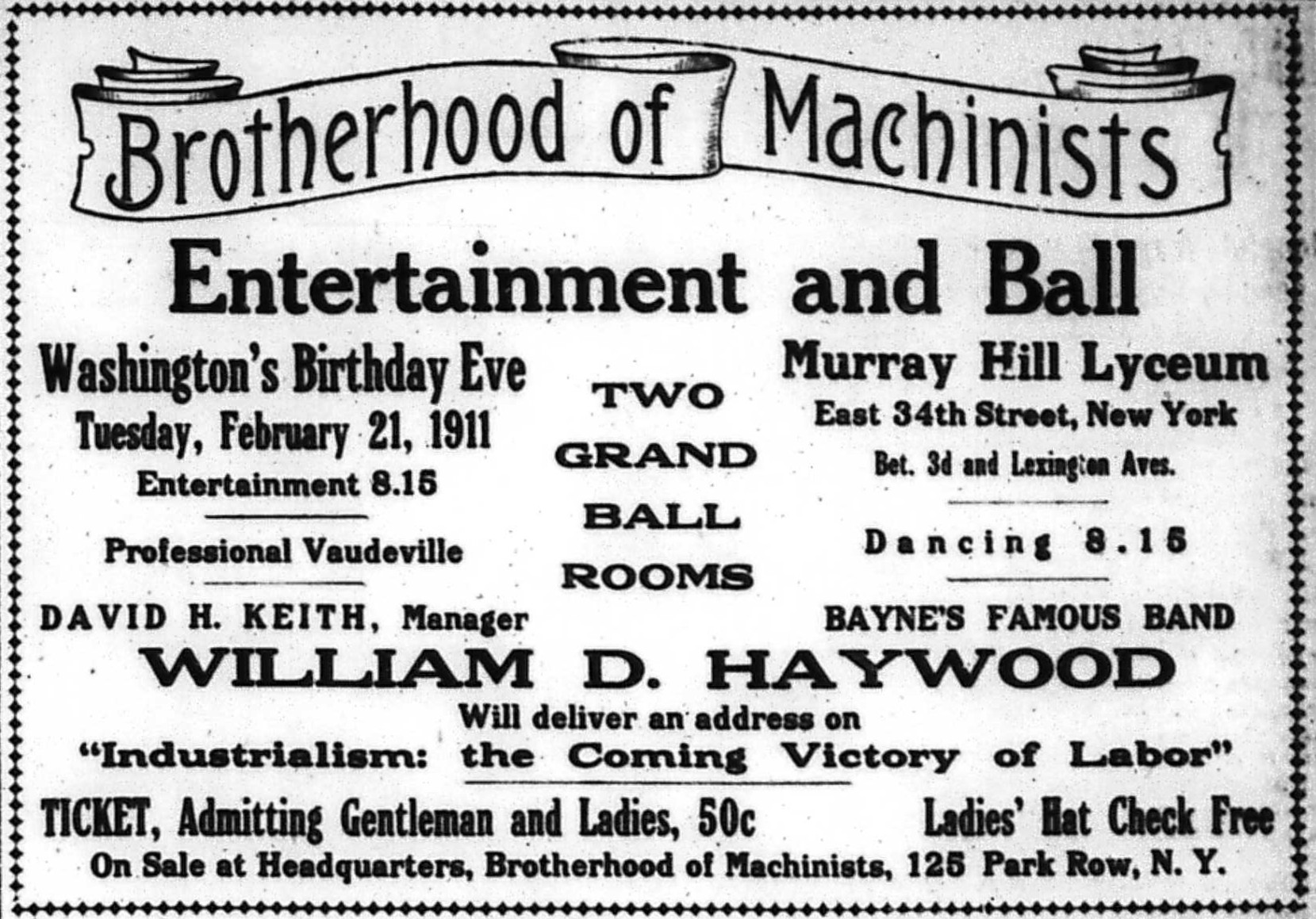
A comrade who needed no introduction and whose every word, weighted with experience and action, was listened to. Justus Ebert with a verbatim report of William D. Haywood’s speech to a New York City machinists ball, ‘Industrialism and the Coming Victory of Labor.’
‘Haywood Speaks’ by Justus Ebert from Solidarity. Vol. 2 No. 12. March 4, 1911.
New York, Feb. 22. Last night was a gala night for industrial unionism in “Little Old New York.” The occasion was the great ball of the Brotherhood of Machinists; the particular cause was “Bill” Haywood’s lecture on “Industrialism, the Coming Victory of Labor.” The Brotherhood of Machinists is a secession from the International Association of Machinists, with pronounced industrial union tendencies. “Bill” is known by almost everybody, so he needs almost no describing. Those who don’t know him will find some statements regarding him a little further on.
Chairman Lackey Explains B. of M.
“Bill” was introduced by Robert Lackey, the able general secretary of the Brotherhood, near the close of an enjoyable entertainment. Despite the break in the round of applause, he was intensely listened to for over one hour. Lackey, in his introduction, said:
“Many organizations would be proud of the size and character of the gathering assembled here this evening. It is larger than that of our last affair. We shall make each succeeding assembly still bigger. Our organization is an organization with ideals as well as principles. It stands for the brotherhood of man as well as the Brotherhood of Machinists. Its purpose is educational as well as ameliorative and emancipatory. It upholds and grants the floor to all men engaged in educating the working class to a sense of its own interests. To-night it represents one who is too well known to need introduction; one who occupies a place in modern labor history; and who will be remembered long after whatever we may say or do here this evening has been forgotten; a man who is great because he stands and strives for an idea; the solidarity and emancipation of the working class; a man who gives me great pleasure to introduce, William D. Haywood.”
After the generous and long continued applause had subsided, “Bill,” who had just come from Detroit, threw himself into his subject, showing the folly of craft unionism and the necessity and inevitableness of industrial unionism. Said Bill, in part and substantially:
Prefers Rebels to So-called Leaders.
“I have come a long way to be with you this evening. No doubt had I chosen another course and so preferred, I would have been at another machinists’ affair (referring to the rival ball of the I.A.M., also held last night) I would have been honored by the A.F. of L. and mentioned in the press with praise, as a member of the executive board of the Civic Federation. I prefer, however, to be with you machinists, the Brotherhood of Machinists, because you are rebels. You have dared to revolt even against the tyranny of labor leaders, who stand in the way of progress. [Long applause.] It is my fate to be ever with the radicals, the rebels, and the undesirable citizens generally; so I prefer to be with you than with others. [Laughter and applause.]
Causes and Evils of Labor Divisions.
Continuing “Bill” said:
“I regret division in the ranks of labor. But I think that it is often justified and will be vindicated by the victories of the future. The strike of machinists on the Santa Fe railroad was lost because of division in the ranks of labor. The various railroad brotherhoods interceded in behalf of the machinists’ organization. They were asked if each of them did not have a contract with the road, and if it were not being carried out according to schedule. When compelled to answer in the affirmative, the management then told the brotherhoods: “Live up to your contracts; we’ll attend to the machinists.” And it did, so effectually that there is not a union of machinists on the Santa Fe system to-day; it is run on the open shop plan. It was the same in the strike on the Rio Grande.” That, also has been “attended to.”
Bill then proceeded to develop his argument more closely.
“The evils of division,” said he, “were seen and appreciated by members of the International Machinists, who instituted a series of referendums for the purpose of obliterating them as much as possible. One was to extend the scope of the organization, so as to include helpers; the second favored the principles of Socialism; the third directed the delegate to the A.F. of L. convention to vote against Gompers for president. But were those constitutional amendments and referendums put into effect by those elected for the purpose? Had those measures been enforced as amended there would have been no division in the ranks of labor. Helpers were not admitted, as desired. Socialism has been covered up and blotted out. Gompers was not only voted for by the I.A.M. delegation at the A.F. of L. convention, but put in nomination, as well. Division under such circumstances is born of revolt. It is justifiable, and will be vindicated. Though you are only 3,000 in number, you are stronger in fact that 30,000 who are submissive and divided in opinion. You are powerful; they powerless.” [Great applause.]
Industrialism Explained.
From the specific phase of unionism as represented in the Brotherhood’s organization, Haywood passed to a consideration of the general phase. He said:
“Now, I come to my subject for this evening: ‘Industrialism; the Coming Victory of Labor.” First, let me define industrialism. It is based on a recognition of the class struggle and its world-wide significance; on the world-wide organization of capital as compared with the impotency of present day labor organization, which must be abolished and a labor organization paralleling the organization of capital reared in its stead. In brief, industrialism is Socialism with its working clothes on.” [Long continued applause.]
The World-Wide Class Struggle.
“Bill” now took up the class struggle. “The class struggle,” said he, “arises from the conflicting interests of the capitalist class and the working class, which are diametrically opposed. The labor leader who believes the identity of interest fraud perpetrated by the Civic Federation is either a fool or a knave, or under the influence of the masters’ champagne. The capitalist class, who are they–and what do they own? They own the land, the waterways the farms, the mines, the docks, steamships, railroads, telegraphs, banks, factories, the mortgages, the machines; in brief, the means of production, distribution and communication, which the workers must have access to or starve. The working class, who are they and what do they own? The workers own nothing; not even their jobs. They must have jobs or starve. So that the capitalists, owning the means of existence, own also the workers’ lives. Can there be an identity of interest between owner and owned?”
Bili then showed the world-wide nature of the class struggle, from “Bloody Sunday” in St. Petersburg, Jan. 20, 1906, down to the Kotoku hangings in Japan in 1910.
“It is unnecessary,” said he, “to cross the water to find the class struggle. Evidences of it are everywhere here. The bull pens of Colorado and Idaho were built in the shadow of the class struggle. The free speech fight first at Spokane, Wash., and now at Fresno, Cal,, are evidences of the class struggle. The Chicago garment workers’ strike, the Brooklyn shoe workers’ revolt, they, too, are but evidences of the same irrepressible conflict of class interests.
“The attempted hanging of Moyer, Pettibone and myself,” continued Haywood, was an evidence of the class struggle. In that instance, the working class, for the first time in the history of the United States, stood together. They saved my life, so that to-day I may truly say that I am the living embodiment of industrial unity. I can also say to the working class, do for yourselves what you have done for me. Stand together, save yourselves from capitalism and abolish the class struggle.” [Great outburst of applause.]
Haywood then exposed the piratical nature of the capitalist class, saying it has no country, no flag, no humanity, no God, but gold; its password is graft. Nevertheless, despite their insincerity and brutality, they were well organized and pe forming a great work, The Morgans, Goulds, Harrimans, Rockefellers et al., have done much to develop the country. They are, in a measure, great benefactors, because they have demonstrated that industry can be socially organized and operated without them. The next step is to own it socially.” [Great applause.]
A.F. of L. and the Steel Trust.
Haywood now got nearer the kernel of his subject. He took the steel trust, with its one-quarter million of employes and its compact ownership and organization of everything from the sources of raw supplies to the finished products, and compared it to the loosely federated and impotent A.F. of L. In the A.F. of L., steel trust concentration was opposed by 40 different executive boards and craft interests. The result is the destruction of unionism by the steel trust; and pronounciomentos bombasto in retaliation by the great and invincible Gompers. [Laughter.]
“The A.F. of L.,” said Haywood, “has never won a strike in all its history. It claims to be the American labor movement, but it is really a voluntary political organization. It consists of an executive board of 11 members, 7 of whom are members of the Civic Federation, an organization that is attempting the impossible task of pooling the interests of capital and labor.
One hundred and seventeen international bodies represent the constituent bodies of the A.F of L. These are divided in 27,000 locals, with trade autonomy. They make 27,000 contracts, expiring at 27,000 different times, and they call this organized labor [Laughter]. Van Cleave, Parry, Post, Kirby and all the other outspoken foes of labor, could not devise any better method of dividing labor.” [Applause.]
“Every effort of the A.F. of L.,” said Haywood, “is to discourage organization.” Then “Bill” gave specific instances of the many measures adopted by the A.F. of L. to restrict membership. These included apprenticeship regulations, high initiation fees, closed membership books, refusal to organize the unskilled, etc. They also involved corrupt alliances with the employers, as in the case of Geo. Warren, an officer of the I.A.M. and the Erie R.R.; and the Tobin “union” stamp, as is evidenced in the scabbery of the Boot and Shoe Workers’ Union in the Brooklyn shoe workers’ strike.
A Genuine Labor Union. Then Haywood dwelt on the necessity for a genuine labor union. He said: “The working class, like the capitalist class, must organize into one solid body. For labor to win, it is necessary to have one big union; a union big enough to take in the entire working class, no matter of what color, race, creed or sex.” [Great applause].
“The human race,” concluded Haywood, “depends primarily on the products of land and water. We must organize a food producers’ department, then a mineral department, composed of coal and metaliferous miners and mine workers; a metal workers’ and machinists department; a construction department; a transportation’ department, and a public service department. With the working class organized on these lines, we can take and own the socially operated industries developed by capitalism, and run them for the interests of all instead of a small class. This is industrialism, the coming victory.” [Long continued applause].
Much credit is due the Brotherhood of Machinists for the success of Haywood’s lecture. Also for the fact that it gave 100 tickets at 50c each to the striking Brooklyn shoe workers, to be sold for their benefit.
Hurrah for industrial unionism!
J. E.
The most widely read of I.W.W. newspapers, Solidarity was published by the Industrial Workers of the World from 1909 until 1917. First produced in New Castle, Pennsylvania, and born during the McKees Rocks strike, Solidarity later moved to Cleveland, Ohio until 1917 then spent its last months in Chicago. With a circulation of around 12,000 and a readership many times that, Solidarity was instrumental in defining the Wobbly world-view at the height of their influence in the working class. It was edited over its life by A.M. Stirton, H.A. Goff, Ben H. Williams, Ralph Chaplin who also provided much of the paper’s color, and others. Like nearly all the left press it fell victim to federal repression in 1917.
PDF of full issue: https://www.marxists.org/history/usa/pubs/solidarity-iww/1911/v02n12-w064-mar-04-1911-Solidarity.pdf
 Revolution's Newsstand