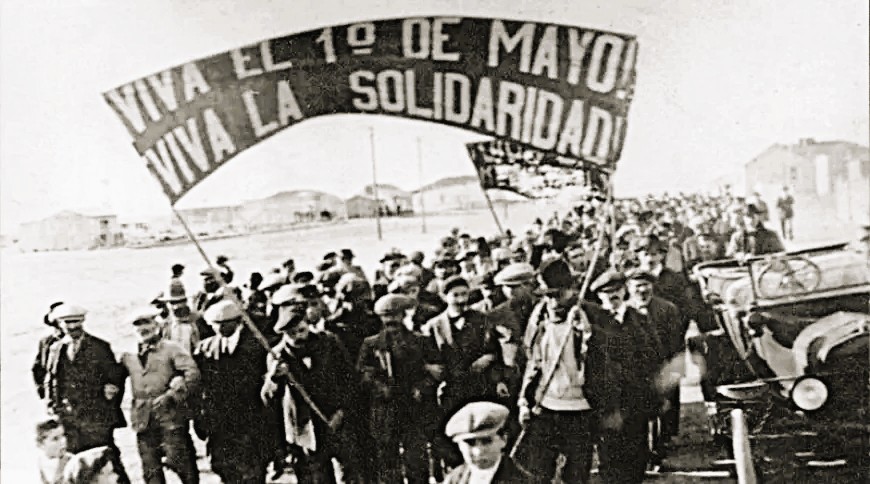
A polarizing Argentina in the 1920s saw growth of both the left and the far right under the regime of the Radical Civic Union’s Hipolito Yrigoyen. Below is a valuable report to the Comintern on the economic and political situation in the country, as well as the activities of the workers organizations and of the Argentine Communist Party’s then 2000 members.
‘Report of the Communist Party of Argentina’ from The Communist International Between the Fifth and the Sixth Congresses, 1924-28. Published by the Communist International, 1928.
THE ECONOMIC AND POLITICAL SITUATION.
WHILE it is true that during and since the World War the development of industry in the Argentine has shown marked progress, and that a continual increase can be observed in the number and extent of factories and equipment—in short, a continuation in the increase of the productive capacity of the industries—it is, however, also true that national economy in the Argentine has had to undergo, and is undergoing, serious difficulties, which will continue in the future. The fundamental causes of these recent, present, and future difficulties are of two natures: the peculiarities pertaining to the national economy of the Argentine on the one hand, and on the other the penetration of Yankee and British finance capital.
Agricultural production and stock raising, that is to say production of raw materials and articles of consumption, characterise the national economy of the Argentine. The progress realised in the development of light metal and textile industries, etc., has not modified the economic aspects of the country. The most far-reaching changes which have taken place and which are still taking place consist in a rapid development of refrigerating and similar industries, that is to say of the industries which handle the products of agriculture and of stock raising. Nevertheless this development, rapid and widespread as it has been during the past years, has naturally not been, and will not be able to do away with or alleviate the chronic agricultural crisis which still exists. Because, in spite of the progress in the utilisation of agricultural machinery and other modern agronomic and technical methods, the dominant method of agricultural production is still old-fashioned. The forms of landed property are also out of date; it is still the agricultural land-owners and stock raisers who control the greater part of national economy.
On the other hand, the penetration of foreign capital is continually spreading. British capital controls the railways. It is also behind the big landed proprietors. Yankee capital for its part controls the commercial trusts, the trusts of agricultural products and stock raising, and also patronises the development of the refrigerating industry. Consequently, the dominant classes in the Argentine are aligned as follows: (1) The big landed proprietors on the side of British imperialism. (2) The agricultural and industrial capitalists and part of the petty bourgeoise on the side of North American imperialism. Thus in addition to the conflicts of interests existing between the two dominant classes in the Argentine, there are also the antagonisms between North American and British imperialism. The immense majority of the rural population, the small farmers and tenants (approximately 1,400,000) live under material conditions which are absolutely wretched, and are in a perpetual state of discontent. The armed strike of tenant farmers in Tucuman involving 30,000 people in 1927, and other similar movements and insurrections are the striking demonstration of this discontent, and indicate its social character. On the other hand, in industry, counting approximately 61,000 enterprises, approximately 1,100,000 workers are employed, these being scattered and belonging to many varied races as a result of continual immigration. This circumstance enables the landed proprietor and industrial capitalists to carry the exploitation of these working masses to the very last degree.
This objective situation provides the basis, and creates the conditions for an ever-growing struggle against the landed proprietors and against the national bourgeoisie. At the same time this struggle has a direct effect upon the interests of North American and British imperialism, etc. This ts all the more true because of the fact that the latter are at every moment, directly, openly and cynically intervening into the life and political struggles of the Argentine.
Thus the class struggle of the proletariat and the great masses of workers in the Argentine against the big landed proprietors and against the agricultural and industrial capitalists takes the form of a struggle against North American and British imperialism. With the increase of penetration of foreign imperialism, which at the same time is intensifying its direct and indirect political pressure on political parties and on the Government, there is bound to be a growth in the anti-imperialist movement under the leadership of the proletariat of the Argentine, involving a large part of the petty bourgeoisie and rural working masses.
The State of the Bourgeois Political Parties.
With the industrialisation of the country there has come about not only a polarisation of forces between the proletariat and the bourgeoisie, but also within the bourgeoisie itself. The rising national bourgeoisie and petty bourgeoisie are represented by the Radical Civil Union Party, headed by the former President of the Republic, Hipolito lrigoyen. This party is bound up with United States imperialism, in so far as this imperialism contributes to the industrialisation of the country with its system of penetration, of investing its capital in industry for the sake of obtaining semifinished products. On the other hand, throughout the various provinces, there are several Conservative parties of various denominations which represent the interests of the land holders and the big stock raisers of the country. At a conference of Right elements, these various Conservative parties decided to support in the Presidential elections (held in the month of April of this year), a fraction which had broken off from the Radical C.U. known as the Anti-personal Radical Civil Union, led by the present President of the Republic, Alvear, who also represents the interests of big stock raisers and landholders. This fraction of the bourgeoisie is closely bound up with British imperialism, and its slogan is: “Buy from those who buy from us,” that is to say; buy industrial articles in England which was and still is one of the most important buyers of Argentine agricultural products and stock. This April the elections took place for the Presidency of the Republic, and according to the reports concerning the latest elections by the governors of the provinces, the largest success was obtained by the Radical Civil Union Party, led by the former President of the Republic Hipolito Irigoyen.
The Socialist Party of Argentine.
This party has approximately 7,000 members, recruited almost entirely among office employees, the aristocratic elements of the proletariat, and the petty bourgeoisie. Last year there was a split in the Socialist Party, led by a group of leaders who wanted the Party to adopt a policy of more open collaboration with the bourgeoisie. This fraction formed a new Party; the Independent Socialist Party of Tomasists, a national petty bourgeoisie party.
The old Socialist Party controls the strongest national trade union organisation in the country, the Confederacion Nacional Obrera, formed in 1926.
Situation in the Trade Unions.
The trade union movement in the Argentine has been up to the present almost entirely under the leadership of the anarchists and syndicalists, but thanks to their sectarianism and their lack of understanding of trade union problems—sectarianism, and lack of understanding which led to the mania for strikes and exaggeration of boycotts—the proletariat has become imbued with distrust of trade union organisation. If we add to this lack of understanding by the anarchists and syndicalists of general political problems and the problems of the immigrants who reach the country in very large numbers, almost always to play the part of strike-breakers because no propaganda is carried on among them, we can understand the confusion and division prevailing in the trade union movement of Argentine.
At the present time there are in Argentine three national trade union organisations: the Federacion Obrera Regicnal d’Argentina, the Unione Syndicale d’Argentina, and the Confederacion Obrera d’Argentina. There are also several autonomous trade unions.
F.O.R.A.—This organisation is controlled by the anarchists and affiliated to the Berlin International. It has two to three thousand members, mostly artisans. It is safe to say that this organisation has no influence on the proletariat.
U.S.A.—This organisation used to be under the control of the anarcho-syndicalists supported by the Amsterdam syndicalists but recently we can say that the leadership is exclusively in the hands of the latter. A united front of these two groups was formed to fight the Communists who formed the largest fraction within this organisation. The struggle of the “non-politicals” and the “anti-politicals” against the Communists led to the disruption of the U.S.A., the membership of which dropped from 45,000 dues-paying members which it had at the time of its formation in 1922, to 7,000 at the present time.
C.O.A.—This body was organised by the Socialists, and has at the present time 90,000 dues-paying members, approximately 75,000, of which are railwav workers. The Argentine proletariat is aligning itself little by little around this organisation, tired as it is of the “revolutionary gymnastics” of the anarchists.
Autonomous Trade Unions.
The autonomous trade unions throughout the country comprise approximately 7,000 dues-paying members. A number of these trade unions broke away from the F.O.R.A. and organised a committee of autonomous trade unions, which is without influence. In national movements, these isolated trade unions follow the policy of whichever national organisation is closest to them ideologically.
The Internal Situation in the Party.
The Party has recently undergone a split, led by one of its leaders, Jose F. Penelon. The causes which led to this split are as follows:
Trade Union Question.
In this sphere as in others, the C.C. was divided into two fractions. Both were agreed that, in view of the impossibility of continuing work within the U.S.A. because of the expulsion policy adopted by the leaders of this national organisation, who provoked disruption in the U.S.A., and in view also of the formation of the C.O.A., which had all the necessary conditions for becoming the national organisation of the Argentine proletariat, it was necessary to concentrate all our forces in the C.O.A. But differences arose concerning the tactical methods of taking this step. The majority was in favour of drawing together the trade unions under our influence, the red groups and the unity groups of the various industries, in a National Unity Committee. Once this work of concentration was carried out and explanations given to the proletariat regarding the causes of our step in relation to the C.O.A., we could have demanded favourable conditions for our reinstatement. On the other hand, the minority, led by Penelon, considered that it was not possible to wait long, and that it was necessary to take advantage of the danger that threatened the Socialists—the infiltration of elements from the bourgeois party, the Radical Civil Union, into the organisations of railway workers—to demand favourable conditions for the reinstatement of the trade unions which were led by Communists.
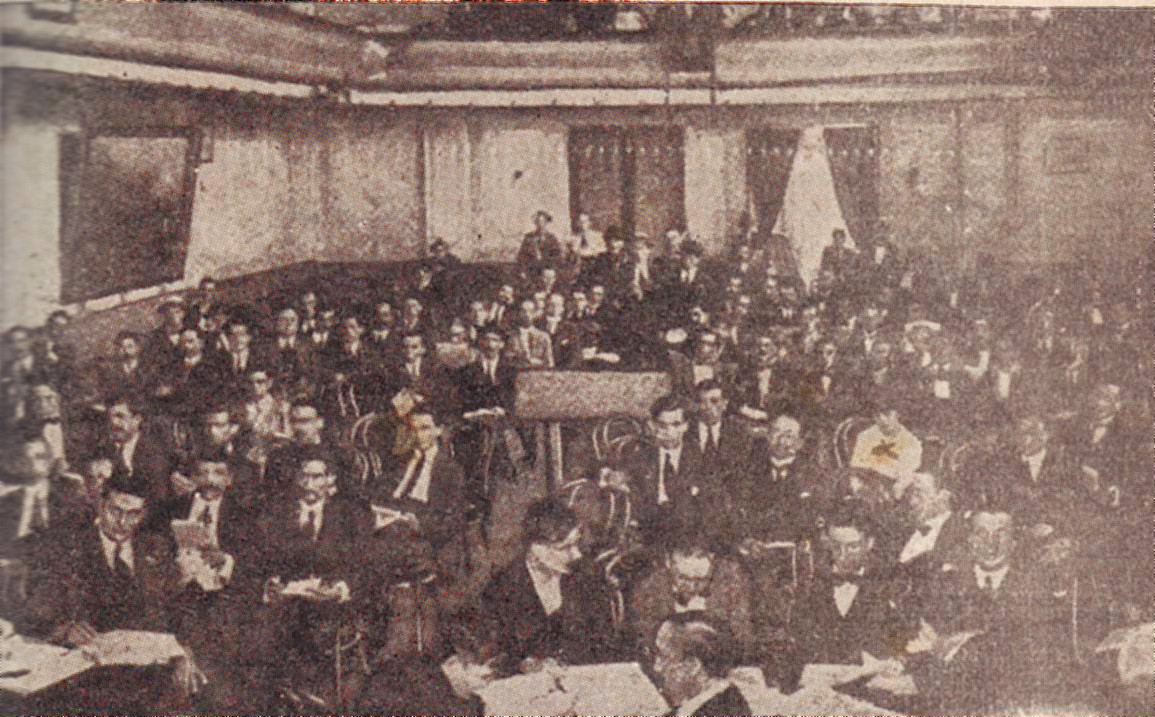
The majority position, which is fundamentally correct, was not sufficiently precise on the desirability of avoiding the formation of a fourth national trade union organisation—while the minority position declared itself clearly liquidational in connection with Communist influence in the trade union organisations.
Organisations of Foreign Language Propaganda Groups Among Immigrants and in the Party.
In view of the necessity of working among the great mass of immigrants who come to the country, the Party organised several propaganda groups, but there were differences regarding the forms of organisation of these groups and their proper functions. In the majority project the danger of the transformation of the Party into a federation of racial groups is not definitely avoided. On the other hand, the minority project, while coming closer to the scheme of organisation adopted by the C.I., did not take into sufficient consideration the special interests of the non-Spanish Argentine racial elements.
Parliamentary Question.
The work of the representative of the C.P. of Argentine, José F, Penelon, on the municipal council of the city of Buenos Aires, has led to a considerable discussion. The majority considered that it was one-sided, for it was limited to the defence of the poor districts, that is to say, to purely municipal work with the possibility of immediate achievement, and the majority considered that he should have devoted greater activity to the factories and also to political questions and general problems. The municipal councillor, also, did not submit his policy to the control of the Party. The minority fully defended his activity. The Comintern resolution criticises Penelon’s activity and the position of the majority in this matter.
Danger of War Against the Soviet Union.
The majority of the C.C. took this war danger seriously and issued the slogan: “Not a kilo of meat, mot a bag of grain for countries carrying on war against the Soviet Union and against revolutionary China.”
The minority, under-estimating the war danger and underestimating the role of the Argentine on the side of the imperialists, under-estimated also the possibility and necessity of organised action against the imperialists on the part of the proletariat and the broad working masses of the Argentine.
On the basis of these differences within the C.C. a fractional struggle began which led to the split in the Party. The minority fraction, led by Penelon, left the C.P. of Argentine and soon founded an organisation of its own. The Presidium of the Comintern has already dealt with this question, and has worked out in a political resolution the policy to be followed. On the basis of this resolution an effort will be made to reconstruct the unity of the Argentine Section of the C.I.
Trotskyist Question.
There is no need in our Party to speak of a Trotskyist opposition; the C.C. of the Party unanimously adopted a resolution condemning Trotskyism and supporting the C.C. of the Party of the U.S.S.R.
General Work of the Party.
With the reorganisation of the Party on the basis of nuclei, carried out after the last Party Congress, a new stimulus was given to the general work of the Party, and we can say that this marked the beginning of the penetration of the Party into the factories. The party has gained in influence with the proletariat. This is proved among other things by the success of recent campaigns, by the widespread support of activities organised by the Party, by the election of a municipal councillor in Buenos Aires and two municipal councillors in the province of Cordova, and by our consolidation in the leadership of the provincial Workers’ Union of Cordova. In spite of many defects in organisation, the trade union work is being carried on with definite success.
The propaganda work among the immigrants is being conducted with sufficient regularity, and has produced very good results for the Party: Our influence is strong among the proletariats of the two countries which supply the greatest quota of immigrants: Italy and Poland. Through language groups the Party controls approximately twenty cultural organisations; schools, relief committees, Jewish sections in the trade unions, etc.
To sum up: in relation to previous periods, our work has improved and our influence has increased.
Agitprop Work.
The agitprop work on a national scale has been inadequate. Although this work has been more regular in the city of Buenos Aires, it has not been as extensive as it should. Generally speaking, the agitprop work is based on agitation of current national and international questions and on propaganda in the factories. The internal education of the Party, which should be one of the fundamental tasks of agitprop, has been neglected, and the publication and distribution of Marxist literature in popular form has also been neglected. Propaganda is carried on by meetings, manifestoes, posters, and factory papers published by the groups. The Communist Press of the Country is as follows: “La Internacional,” the central organ of the Party, “Bandera Communista,” a fortnightly, published in Cordova, “Ordine Nuovo” the organ of the Italian groups, “Reiter Stern,” the organ of the Jewish groups, the two latter being weeklies, “Juventud Communista,” the organ of the Federation of Communist Youth, and a whole series of papers of other language groups and Communist centres in the provinces, as well as factory publications in the capital. The circulation of our press increases in proportion to the influence of the Party.
Factory Papers and Worker Correspondents.
In the capital and suburbs there are approximately thirty-one factory papers, but in view of the inexperience prevailing in this field they have many defects, which are being corrected little by little, as the make-up and editing improves. One of the most evident defects, which is, however, being combatted, is that these papers deal very little with the internal affairs of the enterprises for which they are published, and too much with questions of a general nature. In spite of everything, these papers are better received every day, and now they are published regularly, which was not the case in the beginning.
Worker correspondents are very few, and it is one of the shortcomings of our press that a section for ‘‘Letters from Workers and Peasants” is not published regularly.
Trade Union Work.
This work is being carried on through trade union fractions, and it must be said that mistakes have been made, chiefly because of the mechanisation of the work of the fraction, which limited the struggle against the reformist and anarchist leaders, atttemping to get control of the trade unions by the application of a sort of “trade union Parliamentarism,” for the struggle developed largely inside meetings without carrying on consistent work for winning over the working masses in industry. The trade union work, in the local as well as in the national field, has been concentrated in a few hands. Attention was drawn to this fact at the last regional conference in the capital.
Co-operatives.
There are a number of agricultural co-operatives under the control of the Argentine Agricultural Federation. We have not yet carried on any work in these bodies owing to lack of comrades. There are very few consumers’ co-operatives in the towns, and we have already begun work among them, and control one of them in Rosario.
Work Among the Peasants.
Owing to the character of agriculture, agitation work among the peasants is very difficult, because of the great size of the country and the special forms of labour. Agricultural workers get together in large numbers only during the sowing and harvest seasons—they are scattered throughout the country after this work is over. In regions where the forms of labour are different, as on the sugar plantations, we have begun work with a certain amount of success. Now a discussion has been launched in the Party press on agricultural questions in order to arouse the interest of our members, and this question is one of the most important points on the agenda of the coming Party Congress.
Voluntary Mass Organisations.
The Argentine Section of M.O.P.R. has been in existence since 1925. At the present time it has 4,500 members, and is gaining influence over the proletariat by the correctness of its activity in its own sphere, which has even enabled it to win the sympathy of many anarchists. The section of the Workers’ International Relief is going through a period of passivity. The Party is carrying on work also in the Workers’ Sports Federation, which has 3,000 members. The Party must still further intensify its work in this organisation. The attention of the Party is devoted, moreover, to an organisation which is becoming more important each day, namely, the anti-Imperialist League (Left group), and finally, the Party has its fractions in organisations of a different nature, such as the anti-Fascist alliance, and the committee to assist Jews to go to the U.S.S.R. to participate in agricultural work.
Work Among Women.
There is a growing concentration of women in the factories in Argentine, a fact which calls for closer attention of the Party to this field which has hitherto been neglected. There is a Women’s Department which has not been able to accomplish very much owing to the lack of suitable comrades, and also because of the limited assistance offered by the Party.
Party Organisation.
The organisation of the Party on the basis of groups began in the capital in 1925. In the beginning the following mistakes were made: (1) The organisation of groups was begun without adequate explanation to the comrades of the functions and nature of the new basis of organisation, which created confusion in the ranks of the Party. In this way the Party lost a number of members, although the total membership did not decrease because new members were gained, thanks to subsequent work. (2) Another defect was the organisation of mixed groups, that is to say, groups which were neither factory groups nor street groups. Each group was composed of comrades who worked at different factories, which interfered with the work and resulted in confusing the members still further. At the present time these defects have been largely corrected, and we have in Buenos Aires ninety-five groups—twenty-four factory groups, thirty-three mixed groups, and thirty-eight street groups. (3) As for factory papers, these were at first published in a mechanical fashion, and several of them were edited not by group members, but by the regional committee, with the result that they did not reflect the life of the factories. These defects have been to a large extent corrected, and groups are now being organised in the provinces on the basis of the experiences in the capital.
Party membership, 2,000. In Buenos Aires, 900.
Social composition (Buenos Aires):
Skilled workers 72.37%
Unskilled workers 4.24%
Artisans 3.07%
Office workers 13.47%
Miscellaneous 6.87%
As a general rule the work of the Communist fraction is very weak. To the number of other weaknesses in the organisational work of the C.P. of Argentine, we have to add the absence of collective spirit on the work of the controlling bodies and the lack of activity and initiative in the local organisations.
 Revolution's Newsstand