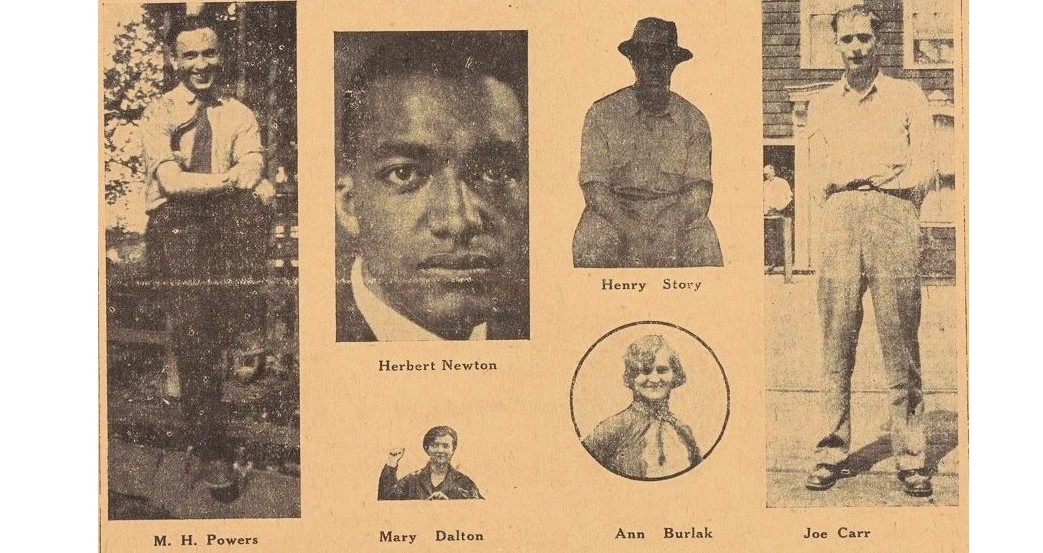
In police raids on Atlanta workers’ meetings, six Communists were arrested (two white women, two Black men, and two white), Anne Burlak, Mary Dalton, Herbert Newton, Henry Storey, M.H. Powers and Joe Carr. The ‘Atlanta Six’ were charged with inciting to insurrection and faced a potential death penalty. It took over eight years of continuous legal and mass struggle to finally have the charges dropped in 1939. Below are biographies of the six, and an original story of their arrest.
‘Who Are The Atlanta Six?’ from Labor Defender August, Vol. 5 No. 8. 1930.
HERBERT NEWTON is 26 years old and was born in Boston. His grandparents were slaves in Virginia. He has worked since the age of 11 in paper box, wagon and cordage factories and as a letter carrier. He worked his way through grammar and high schools. Newton joined the Communist Party in 1926, and in 1927 went to the Soviet Union. On the anniversary of the Paris Commune in 1929 he was sent on a tour by the MOPR. Later he returned to the U.S. and became national organizer of the American Negro Labor Congress and associate editor of the Liberator. He was arrested in Stamford, Connecticut, on a framed up charge of violating an unwritten Jim Crow law, but a large workers’ demonstration in court forced his release. Again on the same day he was arrested in Stamford for addressing a demonstration of the unemployed. He was convicted and his case is pending appeal. He was arrested in Trenton, N.J., on May Day, but released. He was active in Atlanta organizing for the American Negro Labor Congress when arrested on the insurrection charge.
MARY DALTON is 20 years old and has worked in an office since the age of 14, when she was forced to take a job to support a widowed mother and younger children. She joined the Young Communist League in 1927 and was active in anti-militarist work in New York City. In March, 1930, she went to the South as organizer of the National Textile Workers Union. She was arrested when she exposed the traitorous role of the A.F. of L. at a public meeting at which Green spoke. She was arrested again at a meeting of the American Negro Labor Congress and spent six weeks in Fulton Tower Prison in Atlanta charged with “inciting to insurrection.” On her release under bail she returned to her post in Atlanta to continue organizing Negro and white textile workers in the National Textile Workers’ Union.
M.H. POWERS comes from St. Paul, Minnesota. He is 23 years old, is married and has two children. Powers joined the Communist Party in October, 1923, and has been active in the Trade Union Unity League organizing the iron workers. He attended the National Training School of the Communist Party in New York in 1928, and later became organizer for the Party in the South. He was arrested several times in Minnesota and in the South for his militant activities. In March, 1930 he was jailed for distributing leaflets and arranging a mass meeting of the unemployed and was held on the “insurrection” charge which carries with it the death penalty.
JOE CARR is 19 and has worked in the coal mines of West Virginia since the age of 11. He is the eldest of a family of nine children. Carr’s father is also a miner and both are members of the National Miners’ Union. Carr joined the Young Communist League in September, 1928, and attended the League Training School in Cleveland in 1929. He was arrested twice in Wheeling. Later he was sent to the South as organizer of the Young Communist League. He was arrested in Atlanta, together with M.H. Powers, charged with “inciting to insurrection” and was held in the death house for many weeks, bail being denied. Following his release under bail, obtained by the I.L.D., he remained in the South continuing his work of organizing.
ANN BURLAK. I was born in the little town of Slatington, Pa., of working class parents. I had to quit school at 14 to go to work as a weaver for $9 a week and slaved for four years in the silk mills. All my wages went to feed the family because my father was not working steadily. At home, I saw the Daily Worker regularly because my parents were sympathetic to the labor movement. I joined the Young Communist League which had been organized in Bethlehem and became active in the mills. At a meeting called by the Communist Party on May 1, 1929, at which I spoke, 12 comrades were arrested. Later, detectives of the Bethlehem Steel Co., which controls the city, arrested me right at my looms. We were charged with sedition, and placed under $5,000 bail each with the perspective of a sentence of 5-20 years imprisonment if convicted. I became organizer of the National Textile Workers Union in the anthracite district. I was then transferred to the South and established headquarters in Greenville, South Carolina. Before the trial of Powers and Carr I was sent to Atlanta to take charge of the case and was arrested at a protest meeting called by the American Negro Labor Congress together with Storey, Newton and Dalton. Following my release on $4,000 bail I went on tour for the International Labor Defense to raise funds for the Atlanta case and I was again arrested at Camden, New Jersey, together with two other comrades and charged with sedition. One of the comrades has named me ‘Seditious Ann’.”
HENRY STOREY was born in Washington County, Georgia, on in September, January 27, 1896. His parents were farmers. Storey started work, picking cotton at the age of six. He received about four years of schooling and only at intervals at that. He worked as ploughman and in a sawmill at 50 cents a day until the age of 19, when he was drafted in the army during the World War. He served in France for 23 months. On his return he worked in lumber mills in Georgia, in steel mills in Youngstown and as a metal worker in Atlanta, Georgia. At the time of his arrest he was working in a print shop in Atlanta. Storey joined the Communist Party in 1929.
‘Workers Must Save 6 Organizers from Atlanta Chair Lynching’ by Jennie Cooper from Southern Worker. Vol. 1 No. 10. October 25, 1930.
Very shortly there will be held a trial in Atlanta, which will be one of the most important yet held in the entire country. This trial will bewatched carefully and with much interest by the working class of this country and of the entire world.
The Crime of Organizing
Six workers will appear in this trial, two women, two Negroes and two white men. They are organizers for the Trade Union Unity League, the American Negro Labor Congress, the Communist Party and the Young Communist League. The crime they will be charged with and to which crime all will plead guilty, will be that of organizing the workers both Negro and white, into the militant labor organizations. To fight together and for better conditions in the mills and shops, for shorter hours, and a decent living wage, to save the lives of their families from starvation, and pellagra, which is now prevalent in hundreds of worker’s homes due to lack of food–the bosses call that insurrection.
These men and women had the courage of their convictions. Altho they knew that the bosses, who have for many years managed to instill hatred in the minds of many white workers, by telling them that they are “better than the n***r, don’t have anything to do with the n***r,” etc., these union workers brought the message of solidarity to both Negro and white workers. They explained to them that as workers, no matter of what color, they are equally exploited by the white boss, and that the workers must organize together to fight their common enemy, the boss class.
Electric Chair Lynching
For the above named crime, the bosses of this city will demand that the six workers burn on the electric chair. Supporting them in their efforts, will be the bosses of the entire South whose aim it is to keep the workers divided, fighting each other, and easily kept in submission and un- organized so that the bosses may be able to reap more profits from them. Very active support will be given the bosses by the K.K.K., the A.F. of L., and the Black Shirts. The latter was organized during the time of the arrests of the six organizers, and their main aim is to serve the boss class in fighting organized labor, intimidating and fighting the Negro workers.
The trial of these six workers will be a challenge to the working class of Atlanta and the South as a whole. Should the capitalists succeed in convicting our comrades. It will mean the illegalization of workers organizations in the South.
We Demand
BUT THE WORKERS OF ATLANTA, AND THE SOUTH WILL NOT ALLOW THE BOSSES TO BURN THE SIX VALIANT FIGHTERS FOR THE WORKERS’ CAUSE. THE WORKERS WILL UNITE AS ONE AND FIGHT BACK AGAINST BOSSES’ TERROR.
The workers must demand the right to meet and discuss their problems as they confront them in the mill and shops from day to day. The workers must demand the right to organize themselves into labor organizations, negro and white together, be a challenge to the working class without being molested for it. The workers must demand the immediate and unconditional release of this six organizers. our comrades, it will mean a the six organizers.
Join the International Labor Defense, the organization that is defending these and all other workers that are daily facing jail terms for the same crime that the above workers are.
Labor Defender was published monthly from 1926 until 1937 by the International Labor Defense (ILD), a Workers Party of America, and later Communist Party-led, non-partisan defense organization founded by James Cannon and William Haywood while in Moscow, 1925 to support prisoners of the class war, victims of racism and imperialism, and the struggle against fascism. It included, poetry, letters from prisoners, and was heavily illustrated with photos, images, and cartoons. Labor Defender was the central organ of the Scottsboro and Sacco and Vanzetti defense campaigns. Editors included T. J. O’ Flaherty, Max Shactman, Karl Reeve, J. Louis Engdahl, William L. Patterson, Sasha Small, and Sender Garlin.
PDF of issue 1: https://www.marxists.org/history/usa/pubs/labordefender/1930/v05n08-aug-1930-LD.pdf
PDF of issue 2: https://www.marxists.org/history/usa/pubs/southernworker/v1n10-oct-25-1930-sw.pdf
 Revolution's Newsstand