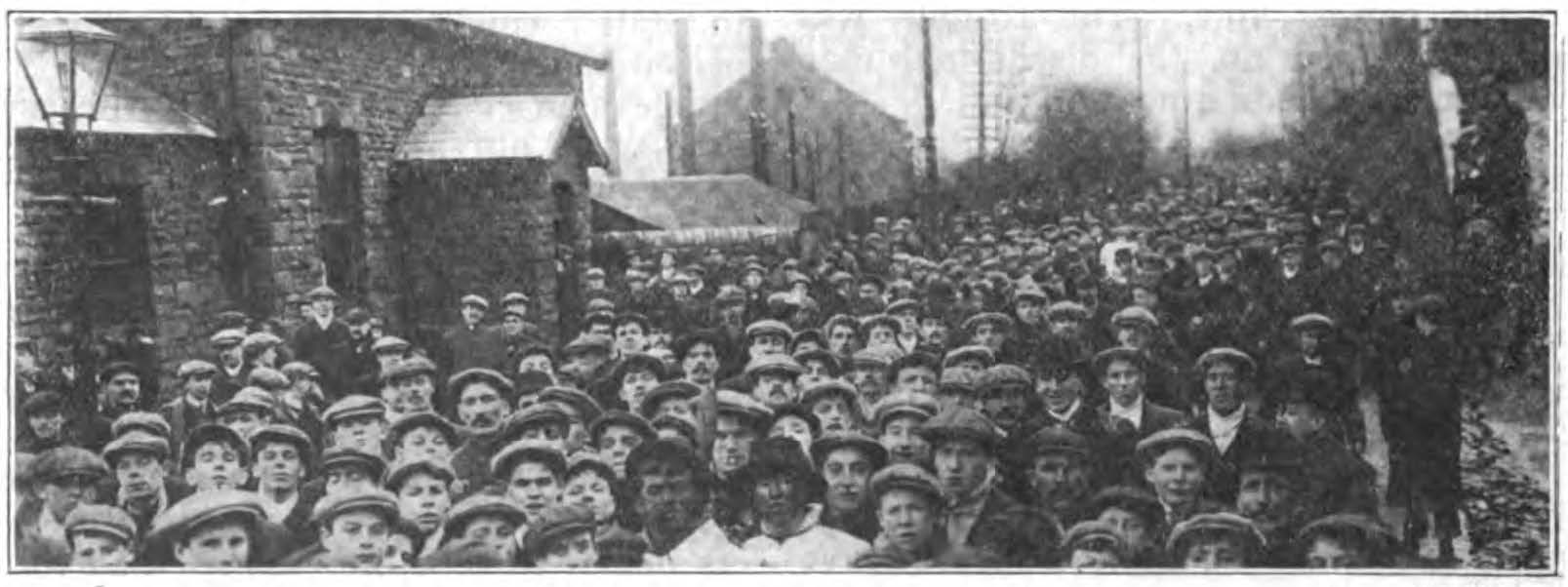
As part of his extended European tour in connection with 1910’s Socialist International Congress, William D. Haywood spent much time in Britain, which was entering a period of intense class struggle.
‘The Lockouts in Great Britain’ by William D. Haywood from the International Socialist Review. Vol. 11 No. 7. January, 1911.
THE lockout and blacklist, the old and blood stained weapons of the capitalist class, are certainly being used with a relentless hand by the employers of this tight little isle.
Cotton Workers’ Lockout.
A short time ago 120,000 cotton operators were locked out for more than two weeks because of a trivial dispute arising over the discharge of one man. The workers in a small mill immediately went on strike, demanding the reinstatement of their fellow worker; then the mill owners united to break the strike and give the cotton slaves a summary lesson, by adopting the brutal and cowardly method of throwing 120,000 men and women, boys and: girls into the street, depriving them of their meager wage and reducing them to the pauper line. The trouble was finally patched up, the discharged man securing a place in a near-by mill.
Peace now reigns in the textile industry and human life is again being spun and woven into cloth. In the dark and smoke-grimed streets of Lancashire towns, before daylight and after dark, one can hear the noisy click-clack of iron-shod wooden clogs as the patient fellow workers go to and from their toil.
Day after day the same monotonous life; there can be no change. They are working out the penal servitude of a five years’ agreement fastened upon them with the connivance of their leisureloving officials.
The real big things in this part of the labor world just now are the lockout of 46,000 boilermakers by the Ship Builders’ Employees’ Federation and the lockout and strike of 30,000 Welsh miners.
Locked Out Boilermakers.
If there is a law in England against conspiracy, it surely could be invoked against members of the Shipbuilding Employers’ Federation. In this instance there has been a coming together of minds, resulting in the misery and suffering of thousands of innocent human beings.
It seems that on March 9, 1909, a certain agreement was entered into between employers and employees, each agreeing to stated conditions to obtain for the period of five years.
The men claim the terms of the compact were not adhered to, many grievances arose, the adjustments were slow. In some instances the ships were away at sea while controversies over work done in the building of the vessels remained unsettled.
The burden of oppression kept growing until a small body of the men, unable to stand more, quit work and went on strike.
It was at this juncture that the employers began to conspire. There was to be adopted a program that would, for the term of the ship yard agreement, at least, put an end to any stoppage of work either by one or more individuals.
The first step in the procedure was to lock out the members of the Boilermakers’ Society, perhaps on the theory that poverty makes the worker gentle and pliable. After this medicine was given time to work, the doctors on the Board of Conciliation (?) drafted the following remarkable prescription to be taken with the original five-year dose, as an antidote for strikes. It is known as The York Agreement and here are a few gems:
“Both parties being in accord that any stoppage of work is against the best interests of all concerned, and that it is desirable to have further arrangements to secure the due observance of the Shipyard Agreement dated March 9, 1909, in federated shipbuilding yards and ship repairing yards, it is hereby agreed as follows:
“1. The society undertakes that any member who is a party to a stoppage of work in contravention of the Shipyard Agreement shall be fined for the first offence at the rate of 5s per day for each day’s absence from work. The society further undertakes to impose an increased penalty on members guilty of second or subsequent offences. A record of such fines and of their collection shall be certified each six months by a chartered accountant.
“2. The society within seven days of any stoppage shall pay the amount of any fines into bank on a special deposit account in the name of the society, to be used solely for the benefit of widows and orphans of the members of the Boilermakers’ Society. All intromissions connected with this fund shall be audited by a chartered accountant, and a certified copy of the account supplied each six months to the Federation.
“3. In the event of any member of the society failing to pay the above fine or failing to make satisfactory arrangements with the society to do so, he shall not be employed by any federated firm for a period of six months for the first offense or 12 months for the second and any subsequent offense. In such case the fine already paid by the society on behalf of such member shall, on the expiration of the periods named, be refunded to the society out of the special deposit account. Men who have paid their fine or made satisfactory arrangements with the society to do so shall not be penalized by being refused employment.”
As a document to which pure and simple trade unionists were a party, this stands a close second to the famous Roosevelt Commission in the anthracite strike of Pennsylvania.
In this case, however, it has been repudiated by a referendum vote. The officials seemed strangely bent on furthering the program of the employers. They made no effort to enlist support for the men who were locked out. So flagrant is the wrong, every principle of unionism being violated, that other trade unionists have expressed sympathy and a willingness to help. They have been rebuffed.
Mr. Hill and Mr. Bremner of the boilermakers have intimated that the men were not in their right minds on the first ballot. Accordingly they submitted another, being identically the same, with some added explanations.
These officials have received a stinging rebuke. The second proposal was rejected by a much larger vote than the first.
But the responsibility of the employers is not ended. Their attempt by means of the lockout to force the men to their knees is inhuman warfare. The men are not the chief sufferers. The first victims are the helpless wives and babies.
The International Socialist Review (ISR) was published monthly in Chicago from 1900 until 1918 by Charles H. Kerr and critically loyal to the Socialist Party of America. It is one of the essential publications in U.S. left history. During the editorship of A.M. Simons it was largely theoretical and moderate. In 1908, Charles H. Kerr took over as editor with strong influence from Mary E Marcy. The magazine became the foremost proponent of the SP’s left wing growing to tens of thousands of subscribers. It remained revolutionary in outlook and anti-militarist during World War One. It liberally used photographs and images, with news, theory, arts and organizing in its pages. It articles, reports and essays are an invaluable record of the U.S. class struggle and the development of Marxism in the decades before the Soviet experience. It was closed down in government repression in 1918.
PDF of full issue: https://www.marxists.org/history/usa/pubs/isr/v11n07-jan-1911-ISR-gog-Corn-OCR.pdf
 Revolution's Newsstand