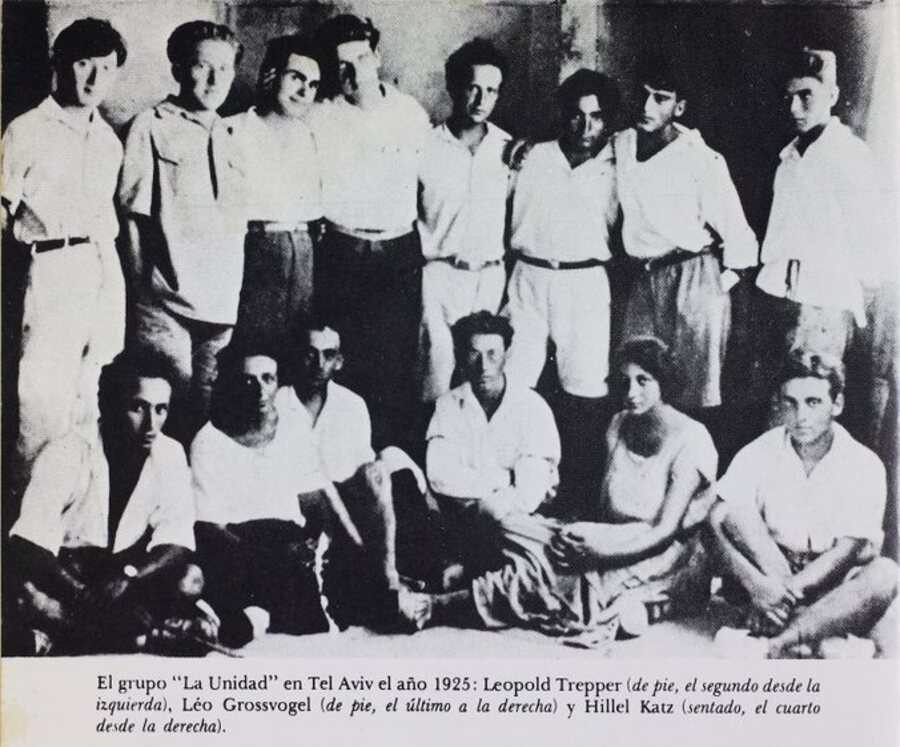
A look at the state of the Palestinian working class at the time of 1929’s ‘Arab Revolt.’
‘The Situation of the Workers in Palestine’ by Alini from International Press Correspondence. Vol. 9 No. 54. September 27, 1929.
Owing to the lack of statistical material, a circumstance which makes any exact determination of the numerical strength of the proletariat in Palestine extremely difficult, one is, as far as the Arab workers are concerned, compelled to rely upon calculations taking into consideration the economic situation of the country and the division of the population according to national characteristics. According to such calculations there are from 45,000 to 50,000 Arab wage-workers in Palestine. According to the figures of the “Histadrut” (Jewish Trade Union Federation) the number of Jewish wage-workers in Palestine in 1926 was 15,389, or including the unemployed approximately 20,000. The total figure is about 65,000 to 75,000 including a great percentage of women, youth and children engaged in the process of production.
According to the numerical strength of the workers employed, we receive the following picture of the importance of the various branches of industry etc.: agriculture and plantations (orange plantations and vineyards), building, transport (railways and harbours), manufacture (soap boiling works, cement works, textiles, tobacco works and match factories).
Since 1925 the economic life of Palestine has been dominated by a continual offensive on the part of the employers, who have been exploiting the three years of mass unemployment and the lack of a united organisation on a class basis of Arab and Jewish workers, in order to depress the conditions of the workers. Indeed, the employers have achieved their aim to a very considerable extent: wages have been greatly reduced and the working day has been lengthened.
The statistical material collected by the “Histadrut” for 1928 shows that the wages of Jewish workers in Palestine are lower than those prevailing in London and Berlin for similar work by 40 to 70% and 30 to 40% respectively, while at the same time the Jewish workers in Palestine worked a longer working day. It must be pointed out that the disparity between the wages of the Jewish and Arab workers has been constantly decreasing of recent years, whereby however, the former still earn considerably more than the latter. The average wages contained in the Histadrut figures are therefore not valid for Palestine, or in the best case they are valid only for the Jewish workers.
Despite the low wages, the cost of living is greater in Palestine than in Berlin. Taking the price level in Palestine in 1928 and comparing it with that of Berlin, we obtain the following figures:
Commodity—Berlin–Palestine
Rye-bread 2.2–2.7
Butter 21.0–44.9
Veal 11.0–15.6
Potatoes 0.6–1.5
Sugar 3.0–3.22
Cheese 7.5–12.5
Milk 1.5–3.75
Rents in Palestine are also very high. In 1928 the German worker paid on an average 18% of his wages for his home, whilst the worker in Palestine had to pay 21% of his wages for rent.
The above figures give some idea of the cost of living in Palestine. They also give some idea of the semi-starvation and misery of the working population when one considers also the permanent mass unemployment.
The laws in Palestine do not limit the working day for adult and young workers; only for child workers from 12 to 10 years of age is the working day limited officially to 8 hours. In fact, however, the children work just as long as the adults and something longer.
The Arab workers always worked more than eight hours a day, and the Jewish workers long ago lost the eight-hour day. The statistical material collected in the Palestine towns for 1928 by the Histadrut does not show the length of the working day.
Only the figures concerning the situation in Jerusalem (“Davar”. No. 831) deals with the working hours of child workers up to the age of 16: of 221 children 122 worked 10 hours a day and more; 58 children worked 12 hours a day and more; and 4 children worked from 14 to 15 hours a day. With regard to the proletariat in Palestine as a whole it must be said that the working day is generally from 9 to 12 hours.
There exist two labour protection laws in Palestine; one is the accident insurance law, and the other is the labour protection law for women and children. Both of these laws are more of a mockery of the workers than a protection of them.
The first law leaves out of account the majority of the proletariat (Landworkers, plantation workers, employees and brain workers, workers in factories without electrical power etc.). The second law is so formulated that under Palestine conditions it loses all significance. Woman and child labour is prohibited for instance in occupations dangerous to health, as understood in Europe, but such occupations hardly exist in Palestine. But women and child labour in the production of matches, tobacco, cement etc., which is deleterious for both women and children, is not prohibited. Night work for women is also prohibited, but night work is non-existent in Palestine. Important provisions for the protection of women are however not included, such as the prohibition of work for women immediately before and after confinement, etc.
It has already been pointed out that the working hours of young and of women workers are not fixed by law. The law has also nothing to say about paid holidays, minimum wages, apprentice protection etc.
The government has promulgated laws, but it has made no provision for controlling the carrying out of these laws, and the result is that the laws are practically ignored. Children of 8 and 9 years go to work and work as long hours as those from 12 to 16 years, 8 hours a day and over.
There exists no law in Palestine regulating the labour market, the employment and dismissal of workers. There is no health insurance, no unemployment insurance, and no old age pensions, and this in a country with a hot climate, widespread infectious sicknesses like malaria, and permanent unemployment.
The Histadrut has, it is true, a health insurance scheme, but it applies only to a section of the Jewish workers and is maintained exclusively by them. Recently this institution has got into financial difficulties and has been compelled to limit its payments.
The above is a short sketch of the economic situation of the workers in Palestine. Like the situation in all other colonial countries, it is characterised by hard conditions of life, boundless exploitation, and the complete lack of all effective labour protection laws. It was thus at the time of the conservative government, and it remains so under the MacDonald Labour government. To-day also the working day is ten, twelve and more hours, to-day also starvation wages are being paid, to-day also the unemployed are in great need because no provisions have been made to assist them. The MacDonald government is just as much a supporter of capitalism in Palestine as its predecessor. It assists in exactly the same fashion in the task of dragging the workers of Palestine down to the economic level of the Chinese coolie by brutal exploitation supported by equally brutal methods of repression.
International Press Correspondence, widely known as”Inprecorr” was published by the Executive Committee of the Communist International (ECCI) regularly in German and English, occasionally in many other languages, beginning in 1921 and lasting in English until 1938. Inprecorr’s role was to supply translated articles to the English-speaking press of the International from the Comintern’s different sections, as well as news and statements from the ECCI. Many ‘Daily Worker’ and ‘Communist’ articles originated in Inprecorr, and it also published articles by American comrades for use in other countries. It was published at least weekly, and often thrice weekly. Inprecorr is an invaluable English-language source on the history of the Communist International and its sections.
PDF of issue: https://hdl.handle.net/2027/uva.x002078458
 Revolution's Newsstand