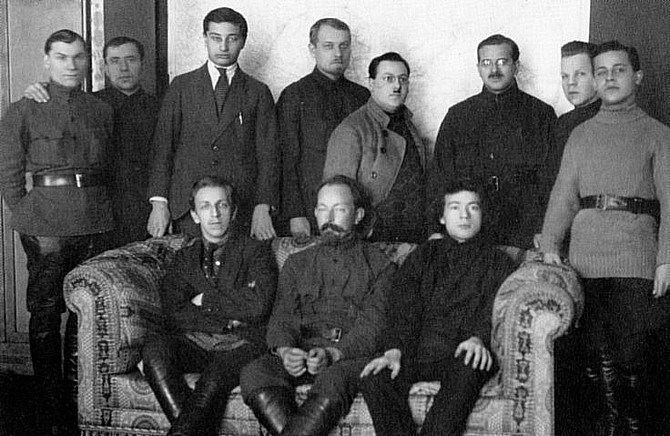
Just 15 when he joined the Bolshevik Party in May, 1917 Lazar Shatzkin, who would fight in the Civil War, was the leading force in the creation of the Komosol and Young Communist International, being the first Secretary of both. In the mid-1920s he would be a rising figure in the Party and a leading editor of Pravda, where he ran afoul of the new Stalinist leadership in the late 1920s. In the early 1930s he was a member of a short-lived opposition with, among others, Vissarion Lominadze. Both would lose their lives in the purges, Lominadze committing suicide in 1935 under threat of arrest, and Shatskin shot on January 10, 1937.
‘The International of Youth’ by Lazar Shatzkin from The Communist International. Vol. 1 No. 13. September-October, 1920.
THE majority of the Party comrades know only by hearsay of the organisations of youth and their international union. Meanwhile the international movement of the young people, which has been in existence about 30 years already, has played and is playing a tremendous role in the world Communist revolution.
The Unions of Socialist Youth began to form in West Europe in the eighties of last century and rapidly spread among all the countries of the capitalist world. They carried on the struggle against the exploitation of the labour of the young people and children which was sufficiently strongly developed in the larger industry, but particularly so in the smaller workshops, crippling physically and morally the apprentices and young assistant workers. They declared war against militarism, which made young men languish in barracks, which poisoned the minds of the wider masses of youth by its rabid jingoism, dull-headed patriotism, and loyalty to the imperialist ways of the bourgeois Government. They set the Socialist education of youth against the bourgeois nationalist ideology, conducted through the schools, the Press, the bourgeois unions of young people, and other organs of the ruling classes.
In 1907, under the chairmanship of Karl Liebknecht, the First International Congress of Organisations of Socialist Youth took place, and the International of Youth was formed. At that time the Leagues of Socialist Youth were very weak. The International of Youth numbered but a few tens of thousands of youthful proletarians. This movement of the young people, constantly developing, had attained enormous proportions by the beginning of the world war; (thus, for instance, the German “Working Youth numbered about 100,000 members). But during the process of their development, many of the organisations of youth modified their organisational form and their work. As a result of the struggle carried on by the opportunist Social Democratic Parties and Trade Unions against the revolutionary spirit of the young people and the independent movement of the proletarian youth, in Germany, Holland, and some of the other countries, a social-patriotic tutelage was instituted over the old organisations of youth (which formed its expression in the appointment of “Committees of Youth” by the Party and the Trade Unions); and in place of the anti-militarist struggle the chief attention was given to sport, amusements, and culture work.
The independent revolutionary unions of youth remained only in a few countries. When the world war broke out, the proletarian youth, carried away at first by the jingoist phrases, very soon got over its spell of intoxication, and was one of the first, with Karl Liebknecht at its head, to raise aloft the red banner of the proletarian revolution. revolution. The independent organisations of youth passed over wholly to the revolutionary position, moving on rapidly along the road leading from Zimmerwald to Moscow. A split took place in Germany, Austria, and some of the other countries, the result of which was the appearance of Communist organisations of youth alongside with the old social-patriotic or centrist leagues of youth. To the organisations of revolutionary youth of all countries belongs the merit of an inexhaustible struggle against the war and social patriotism, during the epoch of the most unqualified treachery on the part of the Socialist Parties.
The International of Youth recovered rapidly from the first blows of the imperialist squall. Already, in April, 1915, an international conference took place in Berne. At this conference the youth of all countries laid one of the first mines under the seemingly indestructible edifice of civil peace “between Labour and Capital. The International Secretariat of Youth, which had been publishing The International of Youth during the war, organising international anti-militaristic days for the young people, revolutionarily deciding all questions of the international struggle for Socialism and the movement of youth (which caused many of its members, and its printed organ, to suffer cruelly from the “democratic” Swiss authorities) proved to the whole world that for the young workers the union and the international solidarity of the proletarians of all countries are not an empty sound but a vital, sacred cause.
Therefore, when the October revolution was victorious in Russia, and the rising waves of the world revolution of the workers bore up the Communist International on their crests, the leagues of youth in all countries were the first to move out in defence of its mottoes for the dictatorship of the proletariat and the Soviet the Soviet system. And it was from their ranks that numerous cadres of members were recruited, and frequently leaders of new Communist parties. In some countries even (Spain, Belgium, Sweden, Denmark) the Communist parties were directly formed by the revolutionary organisations of youth.
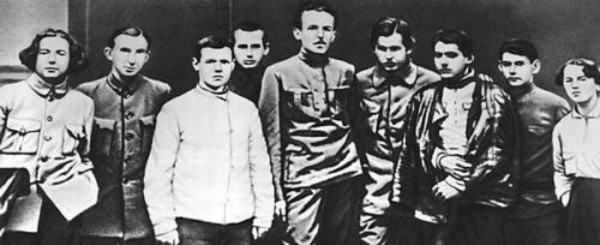
In November, 1919, an international Congress of the International of Youth was held in Berlin. This Congress decided unanimously that the Communist International of Youth should join the Third International. It accepted the new Communist program for the international movement of young people, which established the essential tasks of the Leagues of Communist Youth. The direct struggle for Soviet power in close contact with the Communist parties, a Communist rising of the young people, the struggle against the bourgeois army by means of its internal disorganisation and the organisation of a Red Guard, the struggle for a Socialist reorganisation of labour (possible only during the period of the dictatorship of the proletariat) and a Socialist education of the young–such are the watchwords given by the Berlin Congress to the young proletarians of all countries. Lastly, the Congress created a strong international centre of youth, which during the short period of existence, proved itself to be the real general staff of the International of Youth. In this way the Second Congress of the Communist International, in which the delegates of the Leagues of Youth took part, stood face to face with a powerful movement, both as to quantity and quality as the International of Youth includes at the present moment not less than 450,000 organised young men and girls. And naturally the question of the movement of youth was examined most seriously by the Congress, in its political, educational, and organisational aspects. The Third International has completely broken with the cowardly inimical attitude t wards the independent movement of the young people, which was maintained by the Second International, and against which Karl Liebknecht and other revolutionists struggled so fiercely; because the Third International has had the opportunity, from the very beginning of the process of its formation, of becoming convinced of the great importance of these Communist Leagues for the cause of the revolution.
The Revolutionary Council of the world proletariat passed a review of the Labour Army of Youth, drawn up in battle columns, in the International of Communist Youth. And we know that its decisions will double and treble the fighting capacity, the iron organisational discipline, and ardent enthusiasm, of these hundred thousand reserves of the whole world proletarian dictatorship.
PDF of full issue: https://www.marxists.org/history/international/comintern/ci/old_series/v01-n13-1920-CI-grn-goog-r1.pdf
 Revolution's Newsstand