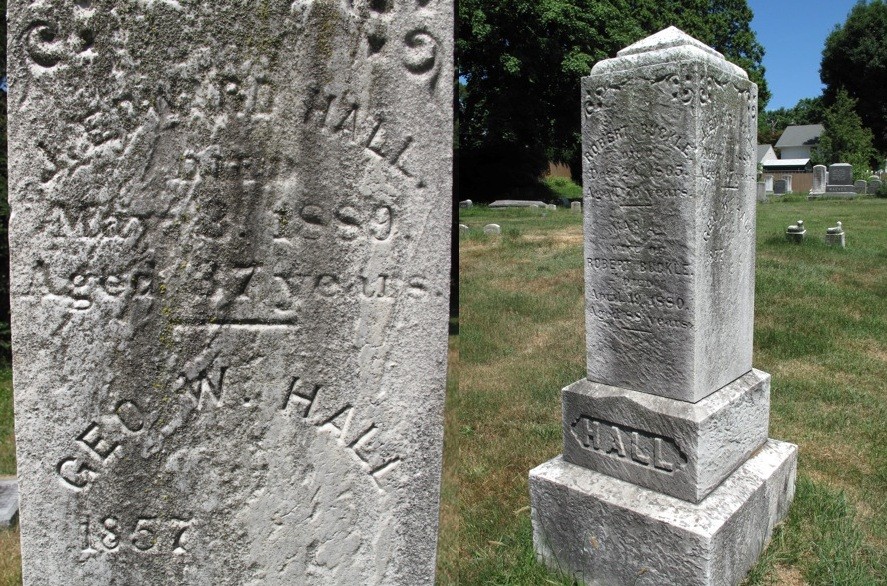
The life, death, and fitting burial of an early U.S. Socialist. James Edward Hall was a machinist born in 1851 from Glen Cove, New York. A leader of the Socialist Labor Party, and writer for its press he died in 1889 at 37 from the ‘proletarian’s terrible disease,’ tuberculosis.
‘Our Loss’ from Workmen’s Advocate (New Haven). Vol. 5 No. 19. May 11, 1889.
Death of J. Edward Hall–Hundreds Attend His Funeral.
The long illness of our comrade, J. Edward Hall, ended with his decease on May 3. The proletarians’ terrible disease, consumption, which he contracted, it is supposed, from inhaling brass filings, carried him off. He was born August 22, 1851, at Glen Cove, N.Y., and after receiving a common school education, learned the trade of a machinist. He was of a sympathetic temperament, with excellent reasoning powers, and soon became connected with organizations of advanced thinkers.
He was a member of the New York American Section of the Socialist Party, and was one of the organizers of the Central Labor Union. He helped to organize the National Trade District of the Machinery Constructors, of which organization he became the Secretary, his term of office ending about a year ago. In 1887 he was the Progressive Labor Party’s candidate for Secretary of State, and last fall he was nominated by the Socialist Labor Party for Governor. He contributed to the WORKMEN’S ADVOCATE since its establishment in New York, and one of the New York Labor Library’s pamphlets entitled “The Place of Individualism in the Socialist System” was from his pen. His last contributions to the WORKMEN’S ADVOCATE were printed in the issue of November 17, 1888, and were entitled “Standard Sophistries” and “The ‘Press’ Parrot.” These were written while he was confined to his bed.
Comrade Hall was held in high esteem by the members of his Sec-ion, and a visiting committee was in frequent communication with him during his long illness.
Upon hearing of his death the members of the American Section held a special meeting last Saturday evening and resolved to attend the funeral, which was arranged for the next day, in a body, wearing as insignia small red ribbon bows draped with crape. A wreath of dark red roses was also ordered to be woven to be placed upon the bier, and committees were elected to draw up suitable resolutions and to arrange a memorial mass meeting as soon as possible.
The funeral was attended by hundreds of people beside the American Section. The German Section had a large contingent present, as did the Jewish Branch, and there were delegations from various trade and labor unions. A delegation from the Socialist Sections of Kings County was present with their banner draped in mourning. A clergyman who was a friend of the deceased read a funeral service from a ritual, although our comrade was a pronounced agnostic. A wreath of red roses with a silken pendant of the same color was placed upon the coffin from the American Section, and other floral offerings were made by the Jewish Branch, the United Machinists of New York, and the Machinists’ Progressive Union. After a last parting look upon the face of the dead, the coffin was closed and borne to the hearse, while the delegations, numbering about 500, formed in line with the color bearers in front; then followed the hearse with four Socialists as guards and the carriages containing relatives. Arrived at the Astoria ferry the men formed in line on either side of the street while the hearse and carriages were driven between. The red banners were unfurled and heads were bared as a last salute while the cortege passed. The remains were then taken to the Crematory at Fresh Pond, Long Island, and consigned to the flames, in accordance with the express wish of the deceased. A number of the Brooklyn American Section were at the Crematory to pay their last respects, bringing with them another floral offering. Besides these many of Hall’s friends came to do his memory honor.
Thus ended the career of one of America’s pioneer Socialists. His works remain, and his name will ever be honored by his comrades.
The Workmen’s Advocate (not to be confused with Chicago’s Workingman’s Advocate) began in 1883 as the irregular voice of workers then on strike at the New Haven Daily Palladium in Connecticut. In October, 1885 the Workmen’s Advocate transformed into as a regular weekly paper covering the local labor movement, including the Knights of Labor and the Greenback Labor Party and was affiliated with the Workingmen’s Party. In 1886, as the Workingmen’s Party changed their name to the Socialistic Labor Party, as a consciously Marxist party making this paper among the first English-language papers of an avowedly Marxist group in the US. The paper covered European socialism and the tours of Wilhlelm Liebknecht, Edward Aveling, and Eleanor Marx. In 1889 the DeLeonist’s took control of the SLP and Lucien Sanial became editor. In March 1891, the SLP replaced the Workmen’s Advocate with The People based in New York.
Access to PDF of full issue: https://chroniclingamerica.loc.gov/lccn/sn90065027/1889-05-11/ed-1/seq-1/
 Revolution's Newsstand