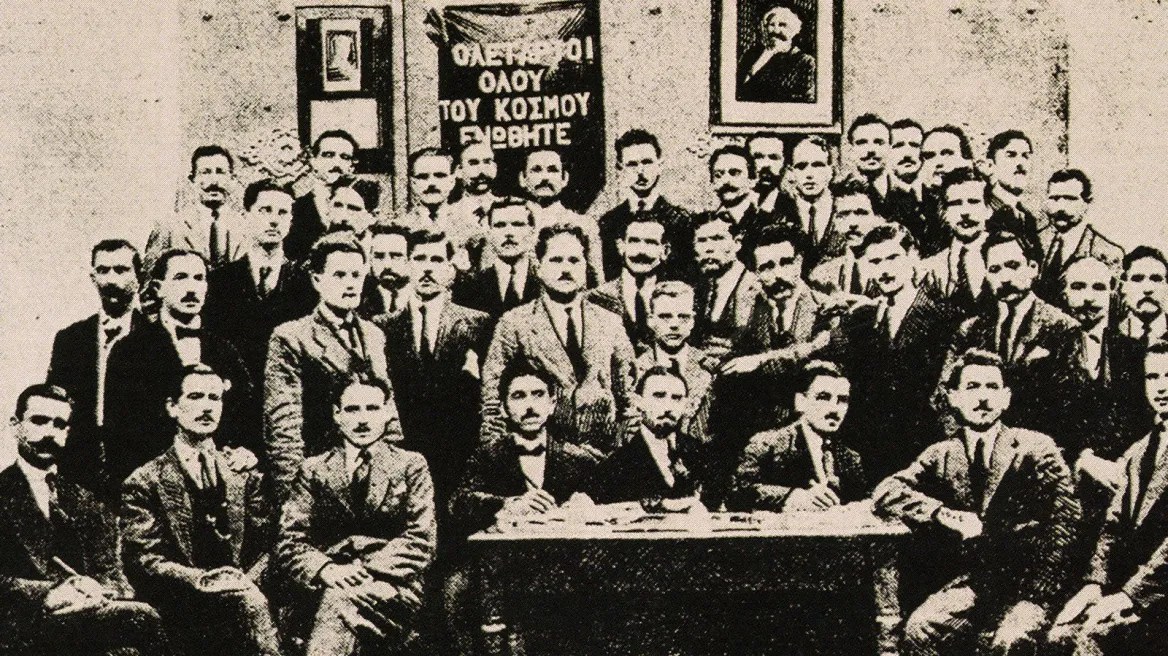
The official report of the Communist Party of Greece and the work of its then 1845 members to the Sixth Comintern Congress in 1928. Included the political and economic situation, trade unions and labor struggles, Party press, the internal fight with the Opposition, activity among peasants, women, and national minorities.
‘Report of Greece’ from The Communist International Between the Fifth and the Sixth Congresses, 1924-28. Published by the Communist International, 1928.
Economic and Political Situation.
FOR almost ten years Greece has been in the throes of an economic crisis. The trade balance sheet has a standing deficit of at least 50 per cent. (in 1926 a deficit of £15,000,000 on imports amounting to £27,800,000). The national budget of 1922 of nine billion drachma had a deficit of three billion (7 drachma = 1 dol.). Seventy-four per cent. of the budget was raised by indirect taxation. The chief items of expenditure are: 26 per cent. to meet the national debt, 20.5 per cent. for the army and navy, 13.86 per cent. for the Government machine, and only 4.4 per cent. for the 1,400,000 refugees who are living in misery.
The refugees constitute 22 per cent. of the population, and almost half of them (650,000) are engaged in agriculture, but for lack of machinery and cheap credit they cannot cultivate the land, with the result that the agricultural output is not yet up to pre-war standards.
Taxes have been greatly increased. From 48.40 pre-war drachmas per capita in 1914 they have increased to 100 drachmas in 1927. The cost of living rises continuously: 17.97 at the end of 1926 to 19.38 at the end of 1927. Wages remain stationary or are reduced, whilst the working day is prolonged.
In the attempt to overcome this crisis loans are sought, economic concessions are granted to foreign capitalists (chiefly British), and the League of Nations has become the real master in Greece. A short time ago there was a quarrel in the International Refugees Commission, because the enormous sum of £10,000,000 was spent without even providing adequate housing and means of living for more than a quarter of the refugees.
The Greek bourgeoisie has used the system of the Coalition Cabinet for the past two years. Immediately after the fall of Pangalos (August, 1926) all parties from the “Left” republicans to the Right monarchists united. The present Government is composed only of representatives of finance and industrial capital and big business.
In matters of foreign policy during the past two years all Greek Governments have favoured Great Britain, despite all the attempts France has made to gain a footing there. Beginning with 1926, a certain rapprochement with Italy was noticeable. The Guarantee Treaty between Greece and Roumania concluded in 1928 is aimed at the isolation of Yugoslavia and of France. Recently relations with the Soviet Union have become more strained. Under the pressure of Great Britain and in connection with the increased activity of the workers, the bourgeoisie started a violent campaign against the Soviet embassy, accusing it of interference in the internal affairs of Greece.
The Situation in the Trade Unions.
About 100,000 of the 400,000 Greek workers are organised in Trade Unions. Until March, 1926, “The General Federation of Labour” was in the hands of the Lefts, but in consequence of the fierce terror employed by General Pangalos, and with his direct support, the reformists regained control at the Third Congress of the Federation in March, 1926. In reality, however, the majority of the organised workers, about 60,000, continue to support the Left as hitherto.
Powerful unions belong to the Left wing, such as the tobacco workers (30,000 members), the workers in the food industry (8,000 members), the electricians (5,000 members), the building workers (8,000 members), and the workers in the book printing trade, metal industries, leather industry, etc. The reformists control the following unions: the railway workers (5,000 members)—though in this union there is a strong revolutionary minority—the dock workers (7,500 members), the seamen, clerks, etc.
Since the terror has been increased against the revolutionary Trade Unions the reformists have begun preparations for the Fourth Congress. The tobacco workers, who are the most important amongst the revolutionary unions, have been expelled from the Federation and also some other unions, so as to ensure a reformist majority at the Congress.—In this manner the reformists are working hand in hand with the terror against the Trade Unions, and preparing a split in the Greek Trade Union movement.
The Mass of the Workers Become Radical.
Radical tendencies have increased amongst the workers as a result of increased exploitation. This was first expressed in the opposition of the workers to the bourgeois attempts at stabilisation and in their struggle for an improvement in their position. The greatest number of political manifestoes was issued in 1927. The militant slogans of the Communist Party awakened a lively response among the workers. In May and June, 1927, the big lock-out of the tobacco workers took place, and also a number of lesser strikes. At the close of 1927 and the beginning of 1928 great unrest began to be manifested amongst the Civil Servants. The big increase in taxation also had its effect in stirring up other categories of workers. In March, 1927, a general strike of artisans occurred, which ended in a bloody encounter in Athens, and in Crete armed peasant risings took place which lasted for several weeks.
Activity and Development of the Communist Party.
During the past two years the Party has had considerable successes and become strengthened both ideologically and organisationally. It was forced into illegality by the Pangalos dictatorship, but after his overthrow it regained liberty of action, and utilised this chance to entrench itself in the masses. Now since the anti-Communist law is being discussed in Parliament there is every possibility of the Party being forced underground again.
The most important event of inner political significance was the Third Party Congress, which took place in Athens in March/ April, 1927. With the assistance of the E.C.C.I. the way was prepared for further work. The Congress condemned the political errors made during the Kondilis putsch and the other mistakes which threatened to turn the Party into a sect. The Opposition question played an important role at the Congress; it had developed into a Menshevist-Trotsky opposition, and attempted to split the Party. This opposition gave the Government and the entire bourgeoisie weapons against the Party and the Communist International, carried on a fractional struggle, infringed Party discipline and refused to do any sort of practical work. The Party was greatly hampered in its activity by this fractional struggle, but it succeeded in isolating this opposition of petty bourgeois elements from the masses, and in so doing greatly enhanced the ideological level of the Party. The liquidatory Trotsky opposition issued its own pamphlets and papers, and also attempted to gain supporters amongst the youth.
The Party parliamentary group consisting of ten has not been of much use to the Party. One section turned out to be opportunists, and others were of the Opposition and refused to follow Party instructions. Now the immunity of all members of Parliament, with the exception of Maximos, has been cancelled, some have been arrested and others continue their work illegally. The Party took a prominent part in an all-important political and economic struggle and issued the slogan “A Committee of Action in every Village” as a counter-attack to the bourgeois offensive.
The peasant rising in Crete was supported by press campaigns and meetings, and the slogan was “Establish the workers’ and peasants’ bloc—joint rising of the Greek workers and peasants.” The other campaigns were against the coalition government, against the cancellation of the immunity of Communist members of Parliament, in support of a workers’ delegation to the Soviet Union, against the lock-out of the tobacco workers in Macedonia. Street demonstrations were organised, and these often ended in bloodshed since the police and military intervened and arrested the active elements.
During the discussion in Parliament on the outlawry of the Communist Party (April, 1928), the Party called on the masses to demonstrate and issued the following slogans: “Hands off the Party of the workers, hands off the Trade Unions, down with the government of foreign imperialists, long live the workers’ and peasants’ government!” These slogans were circulated throughout the whole country, special manifestoes being issued for this purpose.
The Agit-Prop work of the Party suffers from want of Party cadre. The intellectual group continually sabotaged the work, and the Party Executive was forced to get on as best it could with workers less trained and qualified. The only campaigns that were really well carried out were the dispatch of a delegation to the Soviet Union, and that in connection with the tenth anniversary of the Proletarian State. Otherwise the work is weak. At present the Agit-Prop department is issuing a bulletin) with instructions on every-day work. The executive formed special groups to discuss the opposition question in order to conduct the struggle against the opposition more effectively. A pamphlet was published on the Russian Opposition, and also one on the opposition in the Greek Party.
Party Press.
The Party Press consists of “Risopestis,” the central organ, which is a daily and has a circulation of 4,500–5,000; the: “Avanti,” published in Jewish-Spanish, and “Foni tu Ergato” are published weekly in Salonika. The following papers are under the influence of the Party: “Syndicalists,” for work in the Trade Unions, and “Agrotiki Enosi,” for work amongst the peasants. This latter is a weekly with a circulation of 4,500, mainly amongst peasants. These papers are improving, and more concrete questions are brought under discussion. There is also an increase in the number of worker correspondents.
The Party publishing house is poor, though in a better position than it was two or three years ago. Several books are being published dealing with fundamental and propaganda questions. There exist translations of Marx and Engels, so that for the elementary theoretical basis the workers are provided with books.
Trade Union Work.
Little progress has been made in the Trade Union work of the Party. The transfer of the leadership of the C.G.T. to the reformists was brought about by the terror and the joint work of the reformists with the Government and the employers, but also because the Communist Party understood little about Trade Union work until about two years ago.
There is a permanent Trade Union commission in connection with the Party central executive and local Trade Union sections exist. The work, however, is so badly organised that there is no connection between the Trade Union commission and the Trade Union sections. There are few fractions; the Communist fraction in the C.G.T. was reorganised recently and is now active, and there are also fractions in the executives of two unions. Generally speaking, the fractions in the reformist Trade Unions and in the revolutionary Trade Unions are of little importance.
The government is now launching out on a systematic offensive which is inspired by the reformists; entire local executives are arrested, active revolutionaries are banished and Trade Unions are dissolved under the pretext that they have deviated from their main purpose.
Other Activities.
No Party work is being carried on in the Co-operatives; this movement has a membership of 250,000, composed of peasants who belong to the credit co-operatives.
Work amongst the peasants has pained in importance. The special peasant newspaper rallies large numbers of peasants, and the peasant membership of the Party has increased from 22.7 per cent. in July, 1927, to 32.2 per cent. in December, 1927. The Party policy is closely connected with the daily questions which face the peasantry. All the peasant movements and risings receive the energetic support of the Party and the urban workers. The main Party slogans issued are: abolition of the land tax; a single income tax; cheap long term credits; co-operative banks; trade monopoly of agricultural products for the cooperatives, etc., etc.
The only other non-Party mass organisation where the Communist Party is active is the Red Aid; this organisation works well, and its membership runs into thousands.
The Communist Party is not specially active in connection with the question of nationalities. The Government announced that it would take measures against the “autonomists” in respect to the Macedonian question by way of justifying its terror. The Communist deputy, Maximos, spoke on this question in Parliament and fresh Right deviations were made in this connection. The Party central committee had to declare that the slogan “self-determination even to separation” still continued to be the Party slogan.
Practical work is being carried on amongst the Jews, Turks and Bulgarians, though not on a very large scale.
Work amongst women is carried on by means of a special newspaper, “Ergatria” and women’s groups. This newspaper appears weekly and has a circulation of 1,000. “Risospastis” has now a permanent Women’s Section.
Party work amongst the youth has recently greatly improved. The contact between the Communist Party and the Y.C.L. is now better, there are mutual representatives and the Party executive helps to organise youth sections in the Trade Unions, and concentrates much more on work amongst the youth than was hitherto the case. This explains why the opposition did not succeed in gaining more than from twenty to twenty-five supporters in the Y.C.L. In December, 1927, 170 members of the Y.C.L., mainly workers, joined the Communist Party of Greece.
Organisation in the Greek Communist Party.—The organisation of the Party has greatly improved. There are street nuclei, factory nuclei and also groups. The membership of the Party at the end of December,1927, compared with that of July of the same year was:–Workers: 1,189 (July, 1,040), peasants 418 (July, 292), others 238 (July, 260). December total, 1,845, and July, 1,592.
During the past two years the E.C.C.I. helped the Communist Party of Greece on several occasions, and this help has greatly facilitated the development of the Party.
The Communist International Between the Fifth and the Sixth Congresses, 1924-28. Published by the Communist International, 1928.
PDF of full book: https://archive.org/download/comintern_between_fifth_and_sixth_congress_ao2/comintern_between_fifth_and_sixth_congress_ao2.pdf
 Revolution's Newsstand