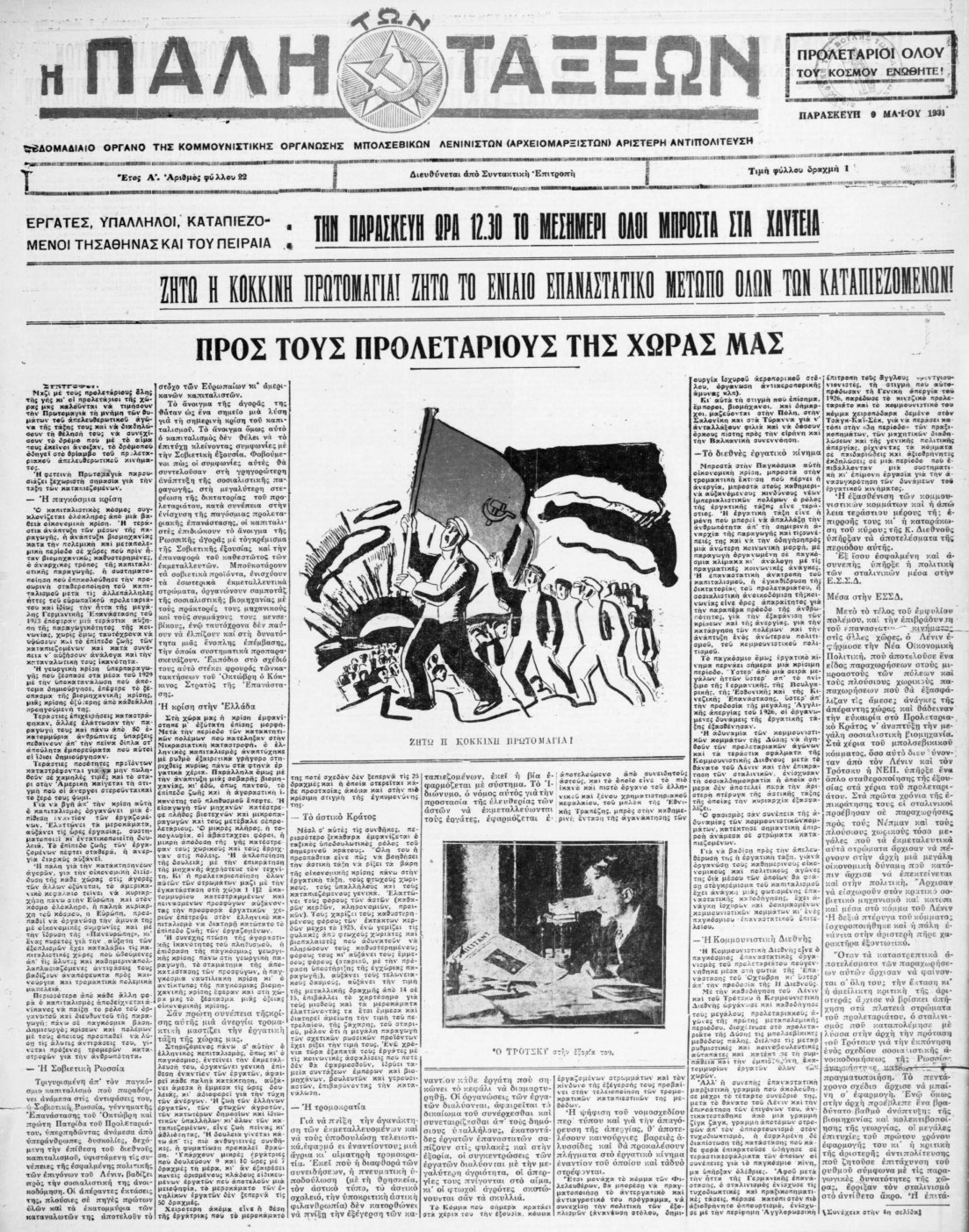
For a number of years in the late 1920s and early 1930s Greece’s Archio-Marxists were among the largest organizations of the International Left Opposition and one of the few to be, at least for a while, larger than the official Party. A 1931 report on their work.
‘The Work of the Greek Opposition’ by A. S—in. from The Militant. Vol. 4 No. 34. December 5, 1931.
The Archio-Marxists Lead the Workers in the Class Struggle
On behalf of the International Secretariat I visited the Greek comrades, with whom I stayed four days. I became convinced that the Left Opposition in Greece has become a leading revolutionary force in the young working class movement there. I must emphasize the fact that the whole revolutionary movement, both Party and Opposition, is being frightfully terrorized, that anti-Communist laws and special courts are prevalent, that severe penalties (lately five and six years of prison) are being imposed for mere membership in a communist group, and finally, that the Party and the Opposition work under strictly illegal conditions.
In spite of all this, the Opposition is strong in numbers; counting all Greece, it has today about 1,400 members. Its strongest centers are Athens, Piraeus, and Saloniki, which are among the most important centers of the labor movement in Greece. We must however remember that these 1,400 members without exception are firmly established in all mass organizations.
All work is strictly divided among the members, the activity of each is under exacting supervision, as all comrades must give an accurate report twice a month on their activity, and a true collective cooperation rules in the organization. I had the opportunity of talking to a group of comrades from Saloniki, who were in Athens for a conference. They were almost without exception workers. They are among the best-trained cadres in the labor movement, very active in daily work, fully penetrated with the conviction of the correctness of the ideas of the Left Opposition, and they carry on an untiring fight for clarification among the workers.
The Opposition in Greece, called the “Archio-Marxists”, far outnumber the Party, not only in membership, but also in the number of readers of their press, not to speak of its quality. Even if the Party received more votes than the Left Opposition in the past, it must be remembered that the Party carries the authority of the U.S.S.R. and of the C.I. on its banner. In all activities outside the elections, as an organized force, it is clearly proven that not the Party, but the Opposition, enjoys the confidence of the Greek working class. Let us let the facts speak for themselves.
The Press
Our comrades began with a magazine which appeared twice a month. Now it appears twice a week with an issue of 6 to 7,000 copies. Our comrades are now issuing, or causing to issue under their influence, the following papers:
1. A theoretical magazine, appearing monthly, with an issue of 4,000 copies.
2. The trade unions which are under our influence issue a number of papers which are edited completely along the lines of the Left Opposition. To name only the most important, (a) A bakery workers’ monthly, (b) а shoemakers’ monthly, (c) a monthly paper for war invalids, “The Voice of the Sacrificed”, (d) a monthly paper for students. Each of these has a circulation of 6 to 7,000 and is distributed throughout the entire country. All this work is controlled and directed by the strictly-organized fractions of the Left Opposition in the Left trade unions.
3. The Union of Employees of Banks and Corporations issue a monthly publication. This union has 1,200 members and fully approves the political lines of the Left Opposition. All the comrades who issue this magazine are among the old Party comrades.
Next week they will also begin the publication of a new monthly in Jewish, The Proletariat, in Saloniki.
Political Activities
These at first consisted of the offer to the Party of a united front in the struggle against terror and reaction. The Party made no answer. They realized it in spite of the refusal. It took place at the well-known trial of the two soldiers, Party members, who were condemned to death. A demonstration was organized in front of Athens University, at which the majority consisted of oppositionist comrades; a severe collision with the police took place, some of the comrades were wounded and some arrested, but one comrade was able to deliver a speech. Then followed demonstrations in the court-room. In the course of the trial, of the two soldiers one of the Oppositionist comrades were sentenced to four years in jail, only for shouting out to the judges and the audience, “The workers produce and have to starve, while you gentlemen do nothing and live on the fat of the land!” For this insult to the judges our comrade was sentenced to four years in jail. This action however showed good results for the future development of the united front with the Party. The membership began to see that the Archio-Marxists are no “Archio-fascists”, but together with the Party are struggling against the hated system.
Unemployment
Since February 1930 the work of organizing the unemployed has been begun, accompanied by frequent collisions with the police. In Athens, Piraeus, there is a committee of 50 unemployed, in Saloniki of 30 members, who direct these organizations. Lately general mass meetings have been organized. In Athens there were 1,000 participants, in Piraeus 1.500 and in Saloniki about 2,000. An unemployment meeting in Saloniki charged by cavalry, and some were wounded. As a result of our activity so far, the unemployed already receive free soup. Our Opposition was the first to take up the struggle for the demands of the unemployed, only afterwards did the Party take it up. One thing should be pointed out–the class enemy, and its savage armed forces, makes no distinction between the Opposition and the Party.
The demonstrations of war orphans should also be mentioned here. We carried through a demonstration in front of the political office of Venizelos, in which some 1,000 took part. In an encounter with the police a great many were wounded.
Elections
At the elections the Party received many more votes than our Opposition, but this is explained on two grounds: 1. The members and sympathizers of the Opposition in Saloniki are partly grouped around young worker elements, who have not yet reached the legal voting age, 2. Although the Party is constantly losing influence and now has little influence among organized trade union workers, and although these same workers follow our Opposition in the daily struggle and in all extra-parliamentary activity, still at the elections they continue to regard the Party as the only representative of the U.S.S.R. and of the C.I. At the later elections our comrades understood this mistake, formed a united front with the Party and called on all workers to vote for the Party. This action was greeted with enthusiasm by the Party comrades and the pressure became so strong that recently the Party leadership was compelled to take the Opposition back into the Red Relief. In all the prisons, too, the Opposition have been received into the collective organizations of the prisoners. This was accomplished only by a correct united front tactic toward the party.
Trade Unions
The work of the Opposition in the trade unions is concentrated under the slogan, “For Trade Union Unity–Against the Splitters!” Everywhere in the workers’ centers, among the workers of the Party and those who are under reformist influence, this slogan finds ready acceptance. For instance, as a result of the untiring work of the Opposition, reunion has been achieved in the bakery and shoe trade between our unions and the reformists. Now, after this reunion, the leadership is in the hands of the Opposition. The same results were achieved with the food industry workers. We forced the Stalinists to accept the reunion of both organizations and to take the bakers’ union into the general federation of food industry workers. The Opposition hopes to win over the whole federation in a short time. The same tactics are being applied in the leather and building construction trades. The unions which are led by the Opposition are the most active and the best organized.
Organization
The participation of the Opposition in the general class struggles in Greece forced a small number of its adherents to leave its ranks. These are the so-called “Fractionists”, who reunited with elements which had already previously been expelled from the Opposition. At first this took on a purely personal character, through mudslinging and slander of various comrades. Later, however, they took the viewpoint that the Opposition must give up all political as well as trade union struggles, and thus idealized the beginning stage of the Opposition, which had been based on work in narrow circles.
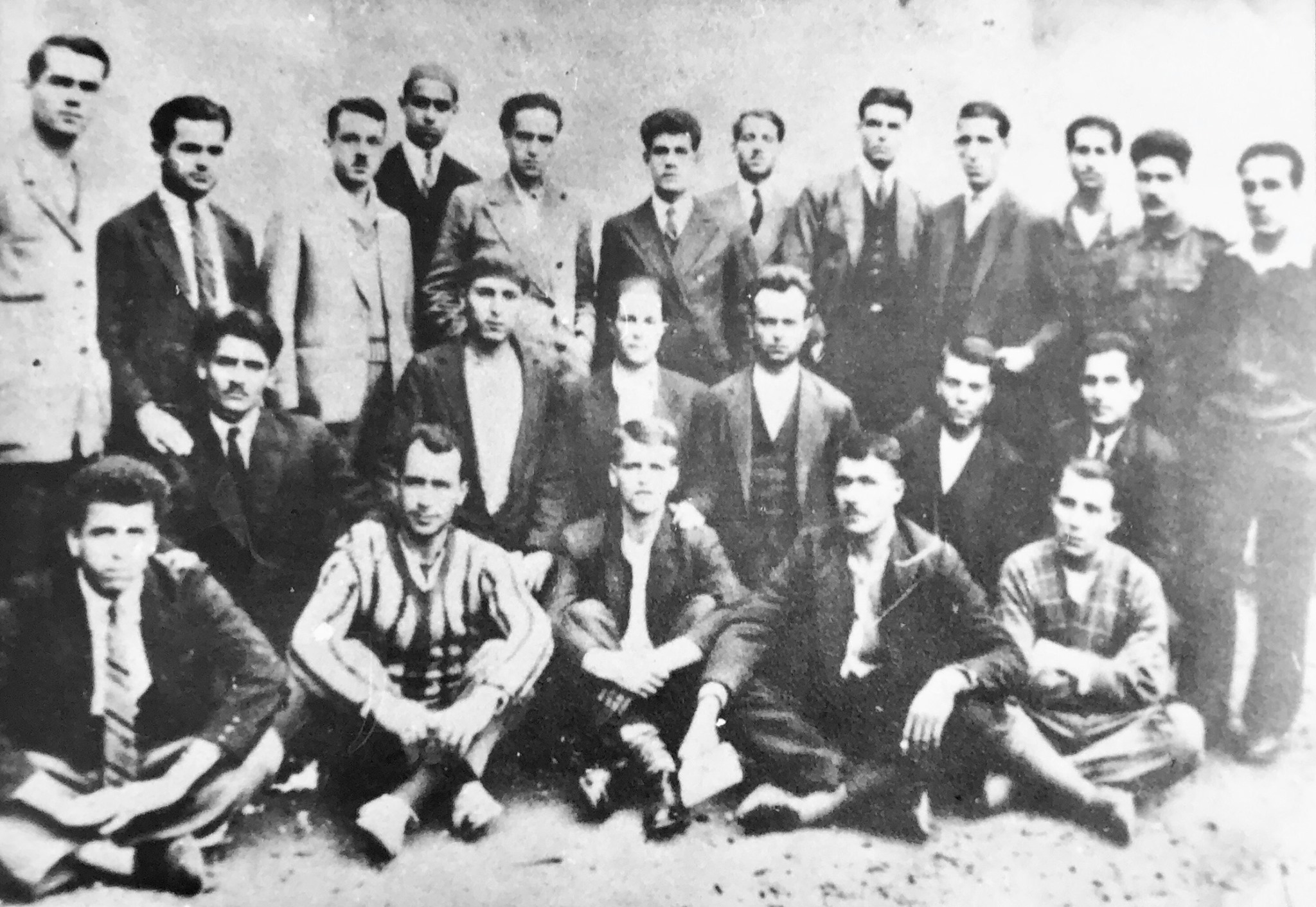
Under this slogan they acquired a group of elements who have no understanding of mass struggle. The struggle of the Opposition against this slogan forced the “Fractionsts” to drop it, but later they took up the slogan of democratic centralism, which they understood as meaning that the majority must submit to the minority. The theses of “Fractionists” appeared in the “Pali” (the theoretical monthly of the Greek Opposition).
At the moment this group is in course of disintegration; the honest elements are returning; the rest, consisting of corrupt elements, has formed a block with the Spartacus group, and both of them support the Stalinists in their dirty struggle against the Opposition; in fact, their slanders are more bitter and savage than those of the Stalinists. On the most important questions, such as the evaluation of Fascism, trade union unity, the immediate threat of war against the U.S.S.R., they take the same position as the Stalinists. They have all formed a Holy Alliance with the purpose of breaking down the oppositionist organization.
This has still further hardened the Opposition, and in spite of the machinations, it has been successful recently in its influence, strengthening particularly among the party cadres. Its influence in all the cities, large and small, is growing. Entire new groups have been formed in Macedonia among the tobacco workers, as well as in Larissa, Lamia, Thassos. They are holding a great number of sport meetings, and meetings of refugees. In addition, they have two well-developed artistic groups, who carried on propagandist performances with great success, especially in Athens and Saloniki, and among the sympathizers in rural districts. At present these performances have been forbidden by the police.
Formation of Cadres
The entire work of training which was carried on in the past, has shown good results. Today they have a large number of trained workers who know how to apply Marxist principles, in political questions as well as in those of strategy and tactics. Although the work was begun by a group of intellectuals, about 85 to 90% of it now consists of workers, who are engaged in the productive process. They have Marxist schools, which are attended by adherents. This whole work is reflected in the theses for the organization of their first congress.
The basis of the local organization is the cell. Through the press, in fly-sheets, in strikes and through active participation in all daily struggles of the workers, the Opposition shows its real face.
An organ for functionaries is published whose first issue appeared after Aug. 1, and whose second issue came out the beginning of September.
Spartakos
As to this sterile and petty-bourgeois group, they have already frequently given their views. Still, they tested them again from a political standpoint through publication of an open letter, calling upon them for work in common, for discussion of various questions of tactics, etc. This, as they pointed out, would then lead to a fusion in the future. No answer. On the contrary, the petty struggles of this group became even sharper, and dirtier. Our Greek comrades think it is the duty of the International Opposition to express its opinion of the Spartakos group and to condemn it as a group with which we have nothing in common.
The Slogans of Our Organization
The Congress of the Opposition will be held in about two months. Against the Party they put up the slogan of the reunion of the two political organizations. They have already published a series of articles on it in their organ, “Davlos”: 1. For trade union unity–against the splitters! 2. A group of democratic slogans, (a) Freedom for trade unions, (b) Freedom of the press, (c) Freedom of Assembly, (d) Freedom for political organizations, (e) Abolition of the Anti-Communist Law, (f) Abolition of the Press Law, (g) Amnesty (3) Struggle for the unemployed, struggle for decent social insurance, support of the unemployed.
Differences with the Party on Concrete Political Questions
(a) Evaluation of Fascism. (b) The immediate threat of war against the U.S.S.R., (c) Trade union questions, (d) Against the theory of socialism in one country, (e) Against “social-fascism”. It should be mentioned here, that on all these questions the Spartakos group and the “Fractionists” drift along at the tail of the Party.
We must develop and make closer our contact with our Greek section so as to exchange our experiences internationally. It is therefore of great importance to report more often in our press on their activities and to give them at the same time for their press authentic reports on the situation in the various European countries. A. S-in.
October 1931.
The Militant was a weekly newspaper begun by supporters of the International Left Opposition recently expelled from the Communist Party in 1928 and published in New York City. Led by James P Cannon, Max Schacthman, Martin Abern, and others, the new organization called itself the Communist League of America (Opposition) and saw itself as an outside faction of both the Communist Party and the Comintern. After 1933, the group dropped ‘Opposition’ and advocated a new party and International. When the CLA fused with AJ Muste’s American Workers Party in late 1934, the paper became the New Militant as the organ of the newly formed Workers Party of the United States.
PDF of full issue: https://www.marxists.org/history/etol/newspape/themilitant/1931/v4n34-dec-05-1931.pdf
 Revolution's Newsstand