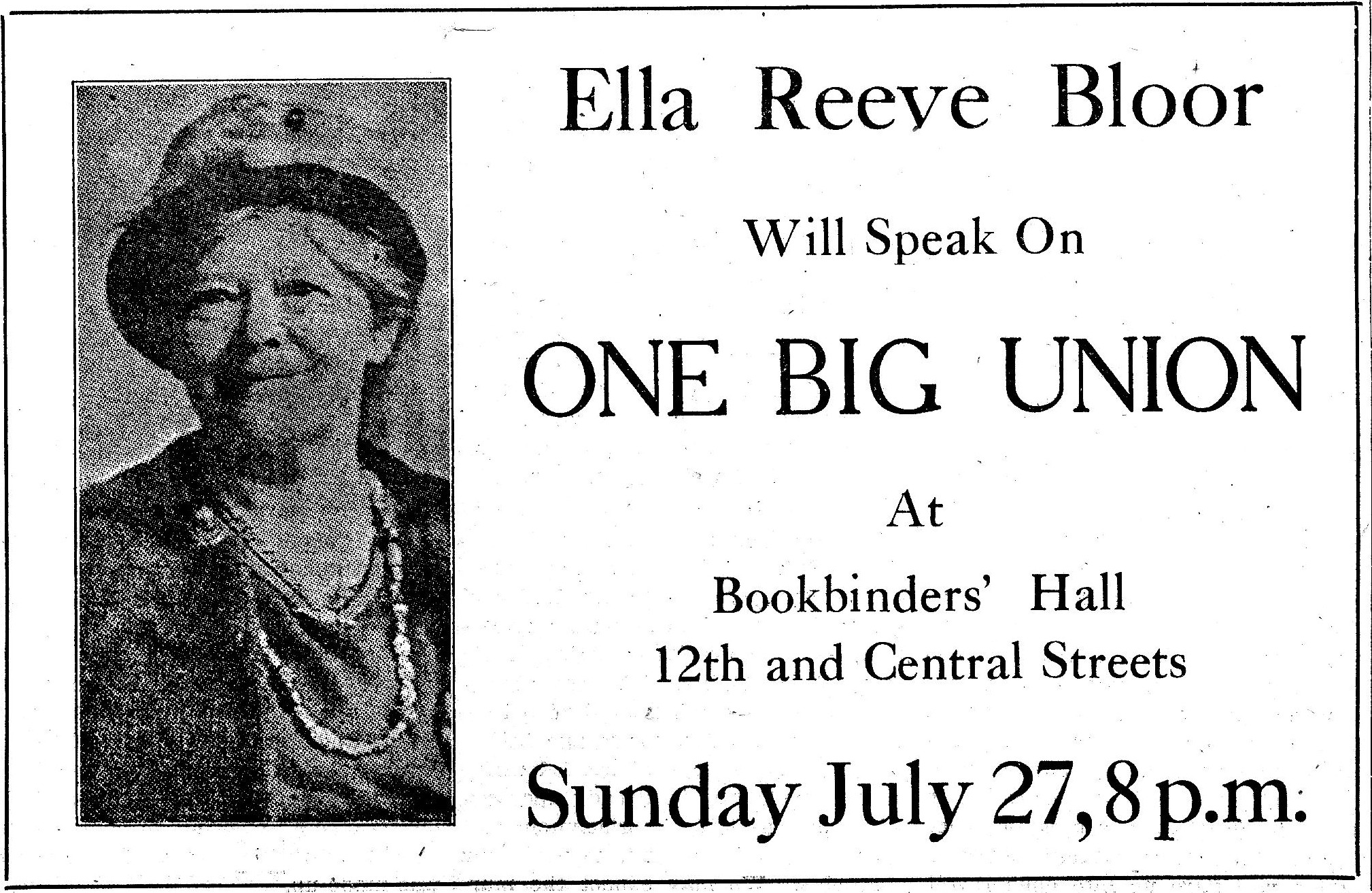
Step deep into the Great Plains with Ella Reeve Bloor as she stumps for the Left Wing through Iowa and Nebraska in the summer of 1919. Three reports below.
‘Mother Bloor at Omaha’ by Mildred E. Kern from Workers World (Kansas City). Vol. 1 No. 19. August 8, 1919.
Large and Enthusiastic Crowds Hear the Message of One Big Union
The social revolution in Nebraska has surely been brought closer by the recent visit and public talks of Comrade Ella Reeve Bloor. The first talk in Swedish auditorium handicapped in a measure, by the usual tactics of the prostituted press, nevertheless was I quite successful as six hundred turned out. This was an audience of good quality because of the responsiveness and not all of them were party members either; most of them being lately made rebels and those who were beginning to be dissatisfied with things as they are. Those sure standbys, the “wobs,” turned out In goodly number and helped, as they always do, to make the meeting a financial success.
Local Omaha is fortunate in having an influx of new blood just now and particularly so in that much of that new influx is of the younger generation. Two of these with the state secretary practically assured the attendance at the meeting by their tireless service.
Comrade Bloor’s subject was advertised as “Shall We Avoid Revolution?” and was in essence a boost for the One Big Union. She outlined the one big union that is so well organized and so well entrenched and which contains the real I Won’t Works who ride in limousines and winter at Palm Beach and then proceeded to show why the workers should form a One Big Union of those who produce the wealth for the parasites.
Encouraged by the success of this meeting and as an expression of her usual tireless energy and enthusiasm, Comrade Bloor next morning bearded the mayor in his den and asked permission to speak in a downtown park for that evening. The ignorance and prejudice displayed by this official were amusing until one realized how far behind the times most of our elected servants are, But it is the opinion of the writer, based on actual contact with hundreds of people every day, that there is a fine crop of rebels sown by such organizations as the various county councils of defense and the home guards during the war, and we really need not reckon very seriously with such moss backs as Mayor Smith who is already up for recall on account of his reactionary attitude toward labor. Nevertheless, he granted the permit as Comrade Bloor handled him very tactfully and also, we think because a Mooney defense advance agent had already had a somewhat serious seance with him when he obtained, few days before, a permit to use the park in behalf of Mooney and Billings.
This park meeting was a very wonderful success. As many as could possibly gather within reach of Comrade Bloor’s great booming voice squatted on the lawns or stood far out into the road and cheered and clapped and contributed and bought literature and eagerly inquired for more than we had on hand and asked questions and lingered until far into the night ready for more. The pulse of this meeting was indicative of a splendid state of health on the part of the proletariat and all that is needed is an organizer to garner that which is waiting.
Nebraska seriously needs an organizer as party, members who tour the state on business find many real red rebels just waiting for something to start. During the war a quietus: was put upon affairs Socialistic but, following the law of the spiral, through which all earthly motion goes, the greatest drop just precedes the rise. It is the hope of Local Omaha that Comrade Bloor can be induced to take up this work. At any rate we think that Kansas City has had her long enough to be willing to share her with Nebraska. How about it, Kansas City? Can’t you be persuaded to show Comrade Bloor this way again for awhile? We feel that she is just THE one we need.
The writer would like to add that it is the opinion of all, as freely expressed, that Comrade Bloor is not only one of the most charming personalities but a most capable and efficient organizer and public speaker.
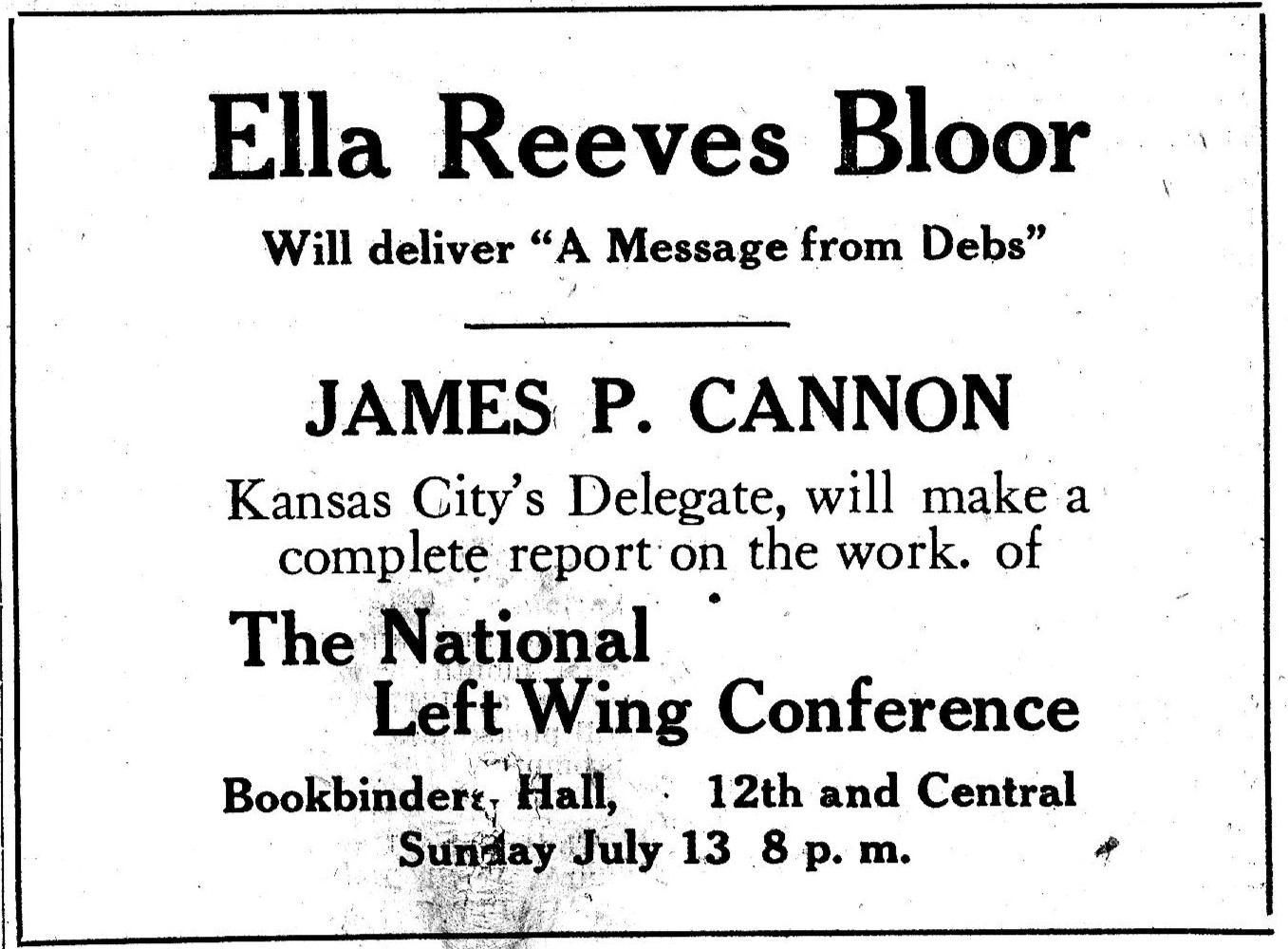
‘Sioux City Meetings’ by Ella Reeve Bloor.
A welcome had been assured me by the mayor, Wallace M. Short. In a letter he had said: “I think, in a general way, that you will find the masses of the people are interested in the matter of general amnesty for political prisoners. I shall hope to meet you and to hear you speak when you come to Sioux City.”
Accordingly I called on this staunch friend of free speech, who had the nerve to defy the Beef Trust and Real Estate magnates by allowing the I.W.W. to hold their convention in Sioux City and by making the address of welcome to them. They instituted an election to recall him, but he received a large vote than at his first election.
These same interests tried to get the police to arrest me at my tremendously enthusiastic street meetings. I refused to be arrested as the mayor had told me I could speak anywhere in the town. Three times the police came to “take me,” but each time the crowd of union men cheered me so lustily that they finally left me to hold the largest street meetings ever held in that city. Liberal contributions were received as well as subscriptions for the paper.
On Sunday evening the street was full of people waiting for the second meeting. At this meeting $25 was received in the collection and nine subscriptions were taken for the Workers’ World. In the midst of the address, a young fellow-worker handed me a beautiful basket of flowers which I set down by me on the big dry goods box I was talking from. It was a real inspiration.
These meetings in Sioux City and the wonderful response in Omaha show that the workers are aroused at last to their class interests. Verily, the harvest is ripe and the workers are few!
NEBRASKA NOTES.
Ella Reeve Bloor stirred up the people in Omaha., In two great meetings, one at the Swedish Auditorium, July 31, and the other in Jefferson Park the following evening, she reached scores who are not in the habit of being reached by the Socialist message. Every evening for a, week a few of the comrades had worked at Socialist Headquarters, sorting literature, planning for publicity and practicing and making copies of revolutionary songs on a duplicator. It was well. It resulted in meetings which, while not so well attended as some had hoped, were cause for congratulation in view of the many difficulties encountered.

The crowd that came to the Swedish Auditorium listened attentively. ap plauded frequently, and few left the hall until the meeting was over. There was no disturbance except that created by an ex-soldier, who interrupted the speaker, demanding to know if the war had not been justified. Comrade Bloor spoke pityingly to the poor young man, urged the others to ignore him and to pay strict attention to the message she had come from Kansas City to give.
Comrade Bloor gave the message in an uncompromising manner. No policemen were visible, and if Federal agents were present, they were disguised as respectable citizens, but Comrade Bloor gave no thought to that; she even declared that Federal agents were turning to Socialism through hearing the principles of Socialism expounded so often.
The meeting at Jefferson Park was remarkable for the fact that Mayor Ed P. Smith permitted it. (Comrade Bloor expressed her intention of framing the permit).The Mayor strictly enjoined against violence and incitements to violence, but he kindly condescended to let the Socialists enjoy their constitutional rights.
Comrade Bloor made good use of the opportunity, and, to judge from the actions of the crowd, her efforts were not wasted.
At both meetings liberal collections were taken, much literature was sold and every scrap of available free literature was disposed of.
An announcement of interest to Socialists all over Nebraska is that Comrade Bloor will return soon to tour the state. It behooves all live “reds” to get ready for her.
The Workers World, published weekly in Kansas City, Missouri during much of 1919 was a mix of regional and national working class news, international socialist events, and the growing fights within the Socialist Party. It was one of many left-wing Socialist Party journals inspired by the Russian Revolution to emerge. Edited alternatively by future Communist Party leaders James P Cannon and Earl Browder, The Workers World ceased publication in November, 1919 as writers and readers moved on to build the Communist movement and its early parties.
PDF of full issue: https://www.marxists.org/history/usa/pubs/workersworld/WW19.pdf
 Revolution's Newsstand