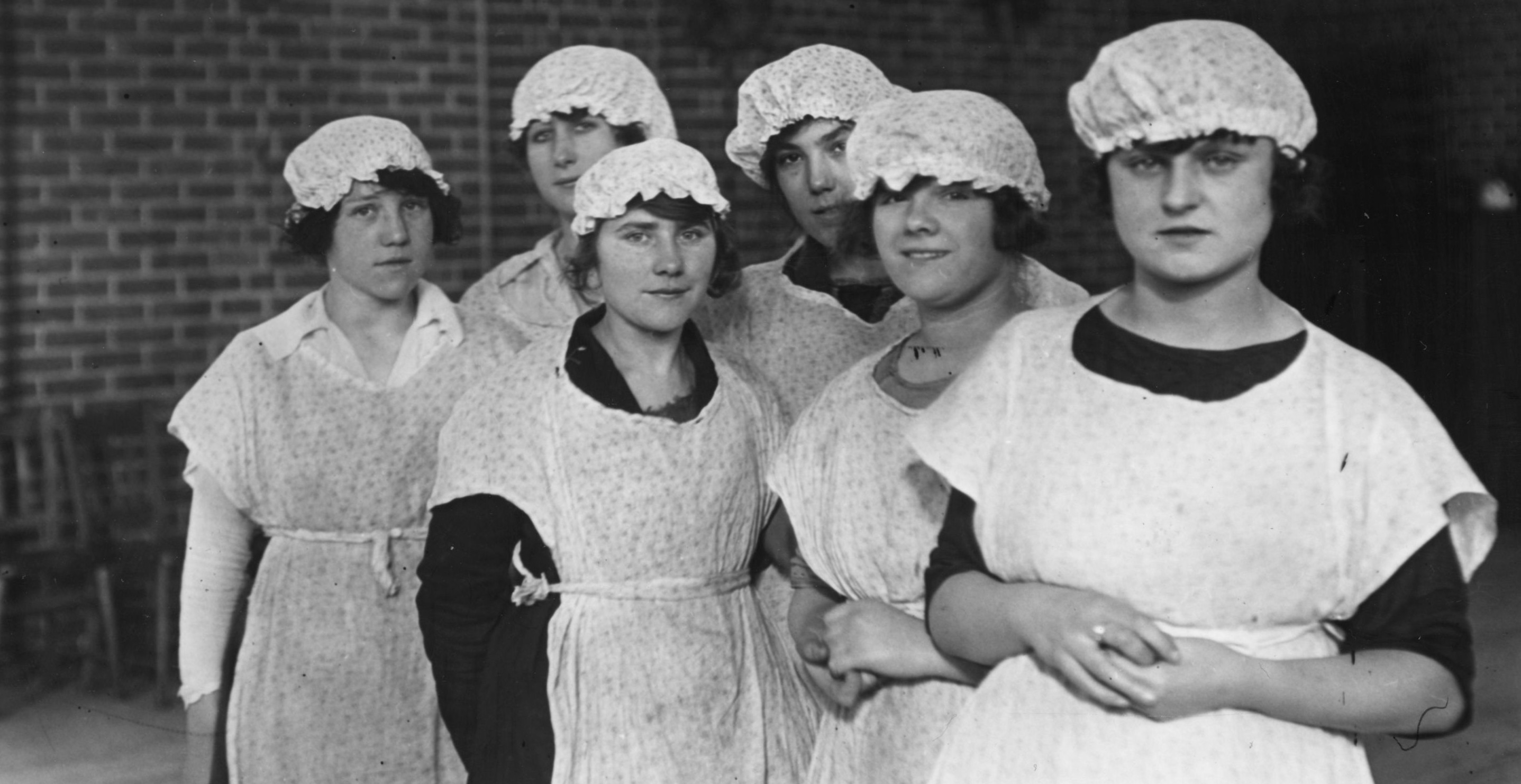
Charles Ashleigh with a look downstairs in this essay on the lives of British domestic workers and the beginnings of organization, the Domestic and Hotel Workers’ Union.
‘Slaves of the Kitchen’ by Charles Ashleigh from The Daily Worker Magazine. Vol. 4 No. 44. March 5, 1927.
If you leave the great teeming slums of the proletarian East End, of London, and make your way west, you must eventually arrive in the favored quarter of Belgravia. This is a quarter of large quiet squares, filled with shady streets and carpeted with well-kept grass. They are not public squares, however; only the occupants of the stately houses surrounding these small parks have keys to enter the gate in the iron fence surrounding them.
Belgravia–so-called from Belgrave Square, in its centre–is in the southwestern part of London, near Buckingham Palace, that great ugly pile of brick and stone where resides the royal family. It is the most “select” part of the metropolis.
A discreet quietude pervades these leafy squares, with their great houses of grey stone or drab stucco. Not many pedestrians are to be seen on the streets. The inhabitants always ride in their automobiles. Here may be a solitary policeman, majestically marching. Or a brightly painted motor-wagon stops to deliver goods from some famous store.
When the front door to one of these mansions is opened, you have a glimpse of a tall, clean-shaven man-servant, or of a white-capped, white-aproned, black-skirted maid-servant. If you pass early in the morning, you will note the servant-girls in their working overalls, cleaning windows, washing the white stone door-steps.
In these great houses, as many as eight to a dozen domestic workers are often employed. These comprise, cook, parlor-maids, kitchen-maids, butler, footmen, chauffeurs and page-boy. The houses were built about one hundred and fifty years ago, and, although solid enough in construction, they are most difficult to work in, from the point of view of domestic workers. They were built in the days when domestic labor was unaided by labor-saving devices, nor simplified by the good sense of the architect, in planning his house.
The servants’ part of the house is in the basement. Here are the kitchen and scullery, and, in the larger establishments, the “servants’ hall.” This latter is a room, in the basement–a part of the house which enjoys practically no daylight, and where artificial light is used all day during winter. This room is elegantly furnished with all the broken or rejected furniture from the upper portion of the house. Here the servants enjoy their “social life.” They sleep, either in the basement, or in small rooms at the top of the house, in the attics. And lucky is the domestic worker who has a room to herself!
The household slaves are permitted to have one evening free per week. On these free evenings, however, they must return home before a certain hour–usually eleven o’clock–or be locked out for the night, as they are not allowed a door-key. And, unless a very satisfactory excuse is forthcoming, to be locked out is generally punished by dismissal.
Pious servants, desiring to attend church, are usually given Sunday mornings or evenings free, on alternate Sundays. But it is understood that they really must go to church, and not deceive their employers by just taking a walk in the fresh air!
The hours of labor, among these domestic serfs, are about 14 per day. They rise at six in the morning and are on duty until eleven or later at night. And when their employers are giving a ball or other social functions, they may be kept up until two or three in the morning, and, in the bargain, they have the job of clearing up the remains of the party, on the following day.
In the large country houses of the rich, similar conditions prevail. The average small country estate has about twelve domestic servants. Their hours are about 15 per day. Often their sleeping quarters are of a most primitive nature, especially when a large number of guests are entertained, and room must be made for them and for the personal servants they bring with them.
On some of the larger estates, over fifty servants are employed, including many men, who work as chauffeurs, butlers, footmen, valets and gardeners. These slaves are the witnesses of the most gorgeous entertainments, where the women of the rich wear, in one evening, jewels which would maintain several working class families for a year. They see all the arrogant snobbery and insolence of the wealthy. Surely this should breed in these workers the passion of class hatred, and the understanding of the class war?
But it is not only in the houses of the very rich that the exploitation of the domestic workers is met. In another part of London, you will see houses which were once the residences of the rich–the comfortable streets of the rich British merchants of a hundred or more years ago. But these streets have degenerated; they now have an air of respectable squalor. These houses have become cheap boardinghouses, or rooming-houses. In these houses, in the small rooms, into which the former spacious salons have been sub-divided, live the under-paid clerks, the thousands of “white-collar slaves,” who work in the myriad offices of the city. In such houses, one or two women servants may be employed. Theirs is veritably a life of hell. Their work is not even organized as is the domestic work of a wealthy household, where many servants are employed. These miserable slaves of the kitchen are at the call of their mistress, the landlady, or of the guests of the house, every minute of the day. In the underground kitchens, amid dirt and darkness, they start, in the early morning, preparing breakfasts. Each lodger in the house has his or her time for getting up and eating breakfast; and, laden with trays, the servant must climb the high narrow stairs twenty times. While this is being done, there are rings and calls from other rooms: one requires hot water, brought in a can, for shaving–in the average English rooming-house there is no running water in any room except the kitchen. Another requires his laundry; another this and another that. The landlady is nervous and hysterical–the inevitable result of such an existence. She visits her own fretfulness on the poor little slave of the kitchen. Abused and over-worked, from early morning until late at night, for a shamefully low wage; living amidst dirt and discomfort; without privacy or leisure; such is the life of the domestic worker in the cheap boardinghouse.
In the cheap boardinghouses, also, one often meets foreign boys who work as waiters at tables. They are French, Swiss, German or Czech lads usually. They work only for their bed and food receiving no money wage, or perhaps just a shilling a week pocket-money. These boys have been secured for the boardinghouse proprietors by unscrupulous employment agents who advertise in Swiss or other newspapers for boys who wish to learn languages and British hotel methods. Wishing their son to become a waiter–later–in a first-class hotel, the parents often save just enough for the boy’s third-class fare to London. Once in London, penniless and friendless, not knowing the language, the boy is compelled to take any job the employment agent offers, however vile the conditions.
No better than the lot of the private domestic workers is that of those who labor in the hotels and expensive clubs of London. Recently, for instance, the British labor press gave details of cases which had come to the knowledge of the newly-formed Domestic and Hotel Workers’ Union. A girl of 17, for instance, employed as kitchenmaid at a well-known conservative club in London, works 90 hours a week for eight shillings! She also complains that her life is made miserable by the continual nagging and bullying to which she is subjected. This is no unusual instance, but is typical of the cases of thousands of young girls, in scores of hotels or residential clubs in the fashionable parts of London. The infamous exploitation of young girls, in domestic service–many of whom are from country villages, and have no friends or advisers in the city–has led to many of them, in desperation, adopting the career of prostitution, in preference to the miserable life of a kitchen slave. Another section of domestic workers consists of those who live at home, but work, either by the hour or the day, for a family, or for several families. These are usually married women–often widows, with children to support, or the wives of unemployed workers. One typical case was revealed recently in a letter from one of these domestic workers to the “Sunday Worker,” the well-known militant left-wing newspaper. The writer says:”
At my last job I was promised fifteen shillings a week, and my first pay day I received only twelve shillings after an awful argument. Cash was left lying all over the house, probably to see if I would steal it! Food there was in plenty, but being paid by the hour, all that I was allowed was a cup of tea. The children of the house had lots of toys and playthings. What chance has my kid at home of toys, on my miserable pay?”
The above affecting document is merely typical of the cases of thousands of others. These domestic workers, like their brothers and sisters who live on the job, working in the houses of the rich, or in affluent hotels, are nearly all unorganized. It is one of the worst examples of negligence that the British Trade Union movement has ignored these exploited workers. Time and time again, delegates to various labor bodies–especially women delegates–have emphasized the need for the organization and class-conscious education of domestic and hotel workers, but the bureaucracy of the British trade union movement, with its usual sloth and lack of initiative, has failed to respond.
Quite recently, however, a beginning has been made. Not through the efforts of trade union leaders, however, but by the initiative of rank-and-file workers and left-wing militants. Within the last eight months, the Domestic and Hotel Workers’ Union has been formed, and has already set on foot an energetic campaign.
A series of articles, by Comrade Leonard Mason, the London organizer of the union, in the “Sunday Worker,” elicited a number of responses from domestic workers. The first few months of the union’s existence has shown that, even among domestic workers, there is a desire for organization, and that a more militant spirit–reflected, possibly, from the industrial workers–is taking the place of the old habit of servility.
Domestic workers in Britain were especially interested to read in the “Sunday Worker,” of the very different conditions of domestic workers in the U.S.S.R. The example of their Russian brothers and sisters will inspire them to real efforts towards a new standard of work and living. It is hoped that the new union will grow stronger and stronger, and that, when the next general strike occurs in Britain, the rich people will have to sweep their own floors, wash their own dishes, and cook their own food–if they get any!
The Daily Worker began in 1924 and was published in New York City by the Communist Party US and its predecessor organizations. Among the most long-lasting and important left publications in US history, it had a circulation of 35,000 at its peak. The Daily Worker came from The Ohio Socialist, published by the Left Wing-dominated Socialist Party of Ohio in Cleveland from 1917 to November 1919, when it became became The Toiler, paper of the Communist Labor Party. In December 1921 the above-ground Workers Party of America merged the Toiler with the paper Workers Council to found The Worker, which became The Daily Worker beginning January 13, 1924.
PDF of full issue: https://www.marxists.org/history/usa/pubs/dailyworker/1927/1927-ny/v04-n044-new-magazine-mar-05-1927-DW-LOC.pdf
 Revolution's Newsstand