
Organizing lumber workers, I.W.W. activist J.A. MacDonald describes how the folks live who provide the timber for building the country’s homes.
‘Homes for Yourself or Your Boss?’ by J.A. MacDonald from the International Socialist Review. Vol. 16 No. 8 February, 1916.
THIS is the story of denial, of foodless, shelterless, outraged lives, dark and hopeless as is the texture of the looted lives it aims to portray, but ending in promise.
Only a Dante, accenting the stygian portions of his Inferno, his pen dipped in the heart blood of toiling millions of earth’s prostituted, could draw the full present picture. Ours can be but a suggestive outline, to which the reader must add out of his own experiences—all too common—the hunger pang. deeper than the hunger for bread. Human longings and desires die hard, how hard only those who have themselves hungered in the wider sense can conceive. I will deal not with Hells, future or metaphysical, but with the hells of the here and now!
My story is that of the lumberjack as he exists—life in its higher and sweeter meanings is now impossible—in the cities of the Timber Empires of Northern Minnesota, Wisconsin and Michigan; in the camps where he toils that others may live; to where in the bread lines, no longer a Lumberjack, a producer, the curtain goes down over the derelict remnants of a sunless, hopeless, loveless, looted and murdered life.
Needless to say ours will not be the Lumberjack of the Maiden Writer Lady of Back Bay, Boston, building word halos over the cesspools of legal piracy, but the real lumberjack, strong in his vices and virtues, passionate and primitive—a man not a myth living in a world of illusion.
The Lumberjack is the pioneer of Empires for others. He is the miracle worker, the giant of the North. Moccasin-clad, Macinaw-shirted he goes into forests peopled by the animal dwellers of the wilderness only. To the thump of his axe and the whine of his saw cities are built, but never for the Lumberjack! These cities are for his bosses, his self-appointed masters, loved not wisely but too well. By his toil he feeds them foods that are to him a dream, he clothes their children, he buys costly textures for their women. Himself is mostly childless, shelterless, womanless, homeless. To him fatherhood is denied.
Through windows of homes made possible only through his sweat and agony, a pariah, an outcast, he looks at happy wives and laughing children in the rosy glow of open fireplaces and the brighter lights of comradeship and home. To him home is a heaven distant and unattainable. Not knowing the gigantic murderous forces of which he is the victim he is despairing; or knowing, he curses an industrial system which makes the dollar standard and symbol of home, life and manhood. Inarticulate, mute, but dynamic of future action he wonders why idleness should be rewarded with smiles and luxury, and productive toil be cursed with agony, outrage and tears! The lack of dollars does not stifle his desires, longings and aspirations: these are deeper than any veneer code of morals or laws man made and man cursing. Strong, virile, red-blooded, is it to be wondered that his nature sometimes scorns unnatural laws the result of unnatural social and industrial conditions.
SOCIETY THE CRIMINAL.
Man can be studied only in the light of his environment. He without whose labor all homes were impossible, asks for home. This society denies him and drives him to the brothel, and having driven, blames!
The lumberjack is a social being. He longs for companionships. An industrial system founded on Dollaranity instead of Christianity, except as they can divert and destroy the latter to minister to the Dollar, drives him to the cheap companionships of the cheap lodging house and the saloon—and having driven, blames!
UNDERFED—OVERWORKED.
The lumberjack’s life is a sordid, dreary, nightmare of underfeeding and overwork. There is no pen too vitriolic to outline the conditions under which the overlords of the Northern woods have sapped the lives of their workers. Horses are better cared for, considered more valuable. To them there is nothing cheaper than human flesh and blood. Men are fed like hogs. The Cochoran Outfit at Bena brags because it gives its men sugar once a day. Milk is never seen by the men in many camps. The hogs that are brought in camp are all belly, with buttons instead of union labels, and no backbone, and the conditions under which the food is cooked often such as to preclude cleanliness. Dinner—or rather the lunch they call dinner—is generally served in the woods, with the men often knee-deep in snow and the temperature often 20 degrees below zero. A picnic with the knives and forks sticking to their lips!
THE LUMBERJACK’s “Home.”
They are worked as the Southern Railway contractors used to work their mules, before the mules got too valuable. Some of the camps are as far as seven miles from the front and the men have to be on the job before daylight. Walking the distance from the camp to the job is not considered work—just exercise. After working till dark they walk back “home,” some of them call it. It is their only substitute. Home does not, however, convey what the camps really are except in the sharpness of its every contrast. The principal difference between the “Lumberjack’s home” and the orthodox hell is that instead of being filled with sulphur fumes, sorely needed, the lumberjack’s hell is filled with vermin.
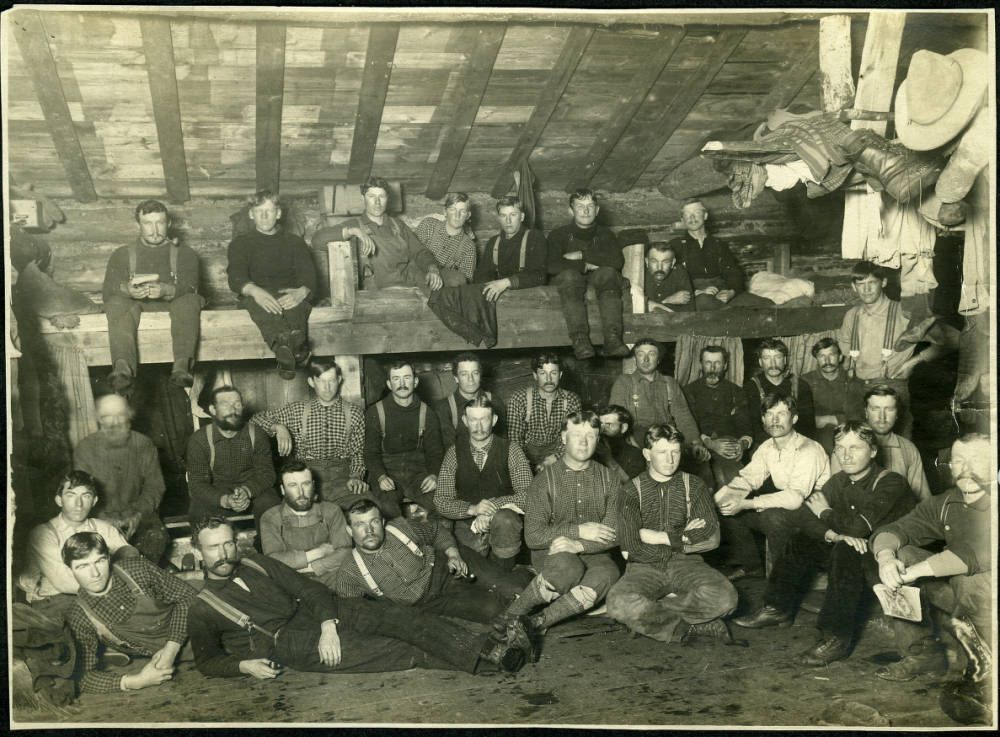
The bedding unchanged for a period often dependent on the number of years the camp has been in commission, is alive. After his first night in camp the lumberjack gets nearer than any inventor’s model to being a perpetual motion machine. He is perpetually working all day and perpetually scratching all night. Staying awake all night to be awake early in the morning is no joke where they use lice instead of alarm clocks.
Otherwise the bunk houses are not all right: they are atrocious, damnable. Men are packed in them like sardines sleeping in the stench of drying garments, if they are armor-plated enough to sleep. There are often two men in a bunk: A healthy man may be sleeping with a consumptive or syphilitic. The bunks are two and sometimes three tiers high. The average camp bunk house is a breeding place, with all conditions right, for all disease germs that like filth. The air is disease-laden, murderous.
The wage for this work—and torture—is so low as to be almost unbelievable. Last season men were hired in Minneapolis and Duluth as low as five and eight dollars a month. Out of this the worker had to pay a dollar, or more, for employment fees, his railway fare to the job, and had to buy clothing in the camp at prices that would open the eyes of a Captain Kidd to new methods of piracy, more effective and less dangerous than the old.
THE RAPE OF JUSTICE.
All laws of humanity, legislature and court have been trampled in the dust by the timber barons. The writer is open to conviction that there is in northern Minnesota, one camp which has conformed to the provisions of the law. For the boss law wears a smile. Law has a loaded club for the lumberjack. For him the beautiful mask is torn from the face of Justice and he finds her a repellent raped murderous hireling of his masters. Justice is a thing of loot and murder to the lumberjack and Liberty a myth.
As if to put salt on the wounds of the lumberjack and show the lumberworker their utter contempt for them the bosses in their kept press—many of them of the street-walker type—print a story of the lumberjack having gone on strike because the boss wanted to put bath tubs in the camps. That the boss is a wonderful fictionist is no new discovery for the lumberworker. The boss lies to him as to wages; he lies to him as to the camp conditions; he lies to him as regard the bunk house and anything or everything in connection with the job. The boss is often the kind of a liar who will not soil his hands with the truth even where a lie is unnecessary.
Yes, smug respectable timber baron robber, yours is a system of robbery compared with which highway robbery is respectable! Your luxury and idleness are foundationed on the degradation of the lumberworker. His labor is the foundation of your stolen empire; For you he carves the forest into homes. Himself has none! You scorn him and call him “Timber-beast.” You have used all the forces of your laws to brutalize him. You have with the whip of hunger lashed him into your camps to be sucked of ambition, health, hope and life. After an industrial system fitted to be the nightmare of an idiot, has stolen all hope and initiative that made him man, you drive him out of your empire–really his—into the bread lines–a vagrant, hobo, bum to live as he can, to die as he must. This is the product of your vaunted industrial system, in its disregard for the life of the toiler, more barbarous than any savagery.
This is the full death flower of your civilization more ruthlessly savage than any barbarism.
Your strength has been the weakness of the worker, his lack of knowledge of his power and his lack of organization. A new era for the lumberjack is being born where his consciousness of power and his strength through organization will be your weakness.
Your czardom of outrage and abuse is doomed. The hands of your workers— strong hands and mighty to make or doom, now the hands of those who are beginning to think, are reaching for the power that is theirs!
The lumberworker—your past slave—is no longer unprotected from your rapacity.
The Agricultural and Timberworker’s Organization of the Industrial Workers of the World is in the field with its motto: “An injury to one worker is an injury to all.” With the boss there will be no compromise, from the boss there will be no retreat. The boss knows it as through putting the fighting force of this great organization of fighters behind the lumberjack, wages have already been raised ten dollars a month. The lumberjack knows it as he is, as the result, having a closer acquaintance with the lady on the American dollar than usual. He is now getting the kind of results he can eat and is hungry for more and organizing to get it.

Naturally and inevitably the boss is sorer than ever before at the I.W.W. His enmity—may we always be worthy of it!—is our title to the respect of the lumberjack. A union the boss would like merits only hatred from the worker! Our fight in the timber belt of northern Minnesota, Wisconsin and Michigan is the fight of the lumberjack. Our union is the lumberjack’s union and no one knows it better than the lumberworker. That is the reason that he is behind us with all the strength of his manhood. The better fighter he is the quicker he is joining and the greater his efforts. The lumberjack will, through his organization on the job, dictate and demand where in the past unorganized, he begged, and met the fate of the beggar.
Forces so powerful, that even we who are on the firing line cannot fully understand their potential energy, are being marshalled in a struggle for higher wages, better camps and human conditions.
Students of contemporary labor history should keen their eye on the timber territories as where the worker has been most abused, he will become most powerful. Consciousness of his power is for the worker the beginning of wisdom and who can set limits to the possibilities of an awakened working class?
The International Socialist Review (ISR) was published monthly in Chicago from 1900 until 1918 by Charles H. Kerr and critically loyal to the Socialist Party of America. It is one of the essential publications in U.S. left history. During the editorship of A.M. Simons it was largely theoretical and moderate. In 1908, Charles H. Kerr took over as editor with strong influence from Mary E Marcy. The magazine became the foremost proponent of the SP’s left wing growing to tens of thousands of subscribers. It remained revolutionary in outlook and anti-militarist during World War One. It liberally used photographs and images, with news, theory, arts and organizing in its pages. It articles, reports and essays are an invaluable record of the U.S. class struggle and the development of Marxism in the decades before the Soviet experience. It was closed down in government repression in 1918.
PDF of full issue: https://www.marxists.org/history/usa/pubs/isr/v16n08-feb-1916-ISR-riaz-Holt-ocr.pdf
 Revolution's Newsstand