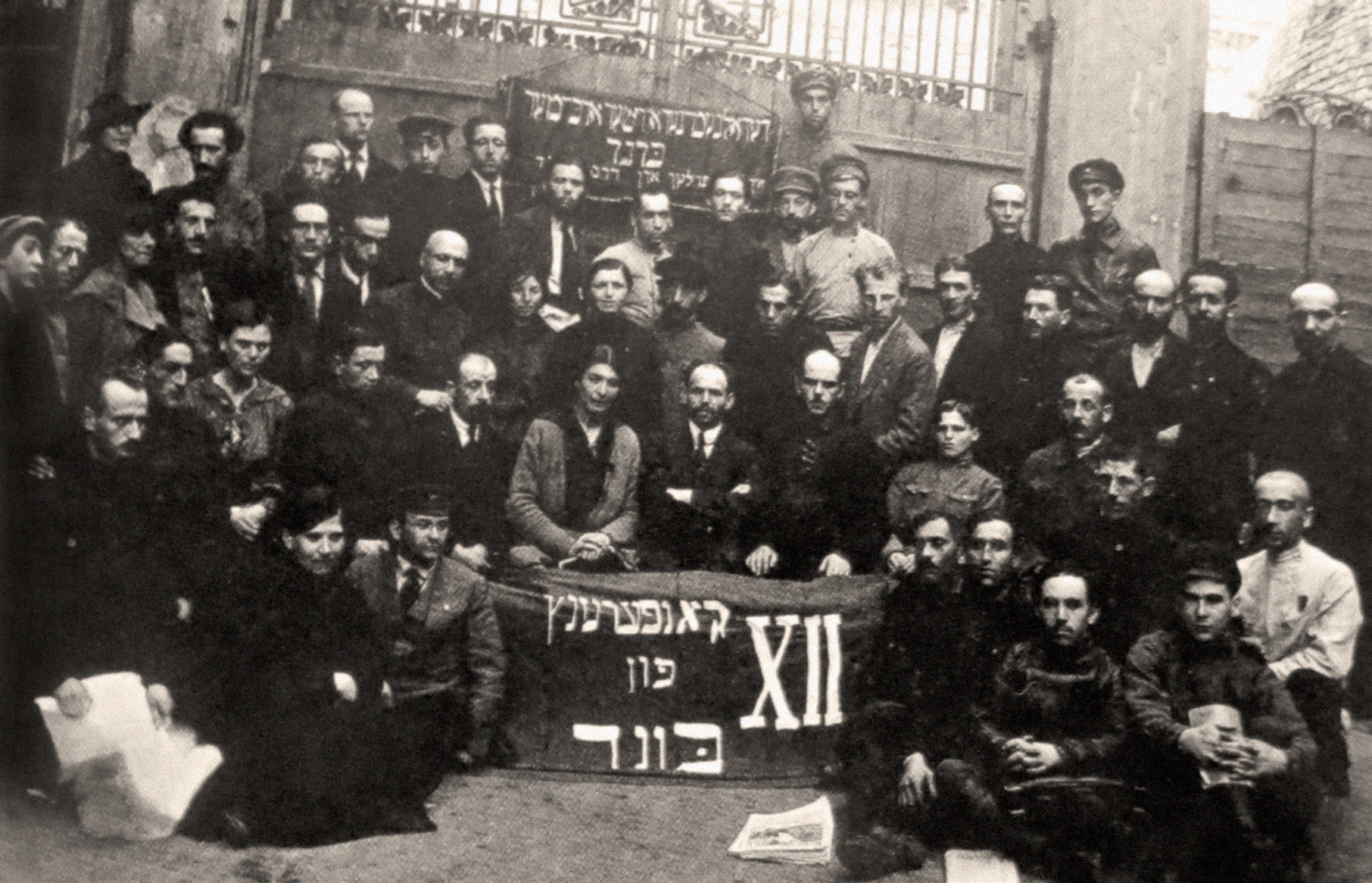
With the document below, in April, 1920 the 12th Congress of the Bund voted in its majority to join the Communist Party and International. The Jewish Workers Bund was among the largest constituents to found the Russian Social Democratic Labor Party in 1898, to which it joined with autonomous structures. The Bund demanded a new ‘federated’ relationship at the R.S.D.L.P.’s 1903 Congress. At that congress, federation was rejected by both Menshevik and Bolshevik delegates. In response, the Bund withdrew from the R.S.D.L.P., and with its 30-40,000 members became the largest single Marxist party in the Russia Empire at the time. However, events would change positions and under the influence of the 1905 Revolution, and the mass pogroms that accompanied it, the Bund would rejoin the R.S.D.L.P. in 1906 and where it would remain. In 1912’s formal split of the R.S.D.L.P., the Bund allied with the Mensheviks, who had come to support federation. History, however, would again intervene to change positions, with the 1917 Revolution, Civil War, and (again) mass pogroms leading a majority of the Bund’s 1920 12th Congress voting to dissolve into the new Communist Party.
‘The Bund on Soviet Power and the Third International’ from Communist International. Vol. 1 No. 11-12. June-July, 1920.
The general Jewish Workers’ Union (Bund), at its Twelfth Conference, adopted a resolution concerning the current moment and the objects of the Party. We quote here some points in the resolution, dealing with the relations of the Bund to the Soviet authority and the Communist International.
1) The Eleventh Conference of the Bund stood on the platform of Social Revolution and official recognition of the Soviet authority. The experience of the past year has entirely confirmed this position…
7) The Russian Socialist Soviet Republic is becoming a powerful organising centre of the World Revolution. The Soviet system is acquiring a wide recognition among the proletariat. The slogans of the Russian Revolution are how the slogans of the world proletariat. The victory of Soviet Russia is a matter concerning all the workmen of the world. The demand of the workers not to interfere in the affairs of Soviet Russia, to lift the blockade, to enter into commercial relations—has grown more insistent during the whole year in all countries. It becomes the motto of all the electoral campaigns—the demand in economic strikes. This movement compels the governments to relinquish all military plans in regard to Russia—it is one of the most powerful factors which has brought about the lifting of the blockade.
The twelfth conference recognises the fact ‘hat the forces of the Social Revolution are organising themselves for the advance on capital under the mottos of the October revolution.
8) For Soviet Russia the last phase of the bloody and stubborn two-years struggle with internal and foreign counter-revolution, in order to strengthen the dictatorship of the proletariat has been brought to a victorious conclusion.
9) The victory at the fronts, the complete extermination of the forces of Denikin, Koltchak and Judenitch, give at last to the Russian proletariat an opportunity to turn to creative socialist labour, without laying down its arms.

New and complicated aims now rise before the Russian proletariat to strengthen national economy, to lift to a higher lever the industrial forces of the country, and consolidate the foundation of the Social Revolution—the economic dictatorship of the proletariat. The first business is to inaugurate a general conscription of all the working masses for a struggle on the new fronts—the fronts against disorganisation of industry and transportation, famine, epidemics, ignorance, which taken all together form the great bloodless front of labour. The gradual carrying out of general labour conscription, the introduction of an iron labour discipline, the education of the working masses in a spirit of collective combined creation, are the daily business of the time, and the revolutionary Marxist organisation of the Jewish proletariat, the “Bund“, finds its great and responsible work in spreading those principles among the broad circles of Jewish workmen, and the still broader circle of yesterday’s petty bourgeoisie, which must join the others in productive labour.
10) The conference of the “Bund” acknowledges that during the first year the Soviet power has unflinchingly followed the firm and decided policy, which alone can assure the victory of the revolution. This is the policy of actual agreement with the peasantry, when in stead of requisition there will be the system of compulsory tax on grain, the establishment of regular commercial exchange with the peasantry, the organisation of technical and material aid for the peasants, careful accounting in organisations of Soviet economic and agricultural communes, instalment of rural Soviets and the placing of authority in the country in the hands of the middle and the poor peasants. Is it the policy of systematic grouping of the wide masses for the process of the Soviet creation, transformation of the Soviets into virile organs of Soviet activity, supplying of Soviet institutions with workers and establishing actual labour control, awakening of initiative in the wide masses. With all its power the “Bund” must come to the aid of the Soviet authority in this line of conduct, which has already been characterized by the eleventh Conference as the only efficient one.
11) The “Bund” must support with all possible energy the inclination of the authorities to do away with the system of Terror.
12) The “Bund” must fight together with the Soviet Power against bureaucratism, administrative license, which are so often found in the provinces, owing to a lack of the right people, and the necessity to making use of bourgeois specialists and the passiveness of the wider circles.
13) The “Bund” supports the food policy of the government, and categorically condemns all open and secret attempts to strengthen and sanction free trade.
14) Summing up the experiences of the past year, the Twelfth Conference of the “Bund” states:
a) That the Eleventh Conference of the Bund placed it in principle on the platform of Communism.
b) That the program of the Communist Party, which is at the same time the program of the Soviet power, coincides with the position in principle of the Bund.
c) That “united Socialist front” with the enemies in principle of the Soviet authority, who oppose its power to the proletariat—cannot be recognized.
d) That the moment has come when the Bund can withdraw its official attitude of opposition, and share the responsibility of the policy of the Soviet power.
The Twelfth Conference of the Bund opposes itself to every attempt to create another Third International.
Providing:
a) that the Third International must admit not only Communist Parties, but all proletarian parties who have actually broken with the Second International, and at the same time have placed themselves on the platform of Social Revolution, revolutionary class struggle and dictatorship of the proletariat;
b) that tactical dissensions and even disagreements of programme between separate Communist and Socialist Parties which stand in general lines on the platform of the Third International—dissensions, which can justify the existence of these parties—cannot be allowed to interfere with the unity of these parties in the Third International;
c) seeing that the Third International, during the period of its existence, has shown that it is building a new world policy, taking into consideration the objective surroundings in every country, grasping the value of actual possibilities, fighting energetically Anarcho-Blanquist tendencies in the working masses, and applying the principles of revolutionary Marxism;
d) that the Third International has officially announced its complete readiness to enter in negotiations with every party which confirms its actual rupture with the Second International, and has also expressed its readiness “to take account of the experience of the proletarian movement in all countries, to alter and complete the platform of the Third International on the basis of the Marxist theory and the experience of revolutionary struggle in all the world”;
stating further that for the Bund, standing in principle on the Communist platform, there can be no such doubts and hesitations which are in other parties the result of their disagreement with Communism,
the Twelfth Conference of the Bund proclaims that the Bund of Soviet Russia joins the Third Communist International, and calls all the branches of the Bund separated from it by the imperialist and civil wars, to follow the example of the Bund of Soviet Russia.
The ECCI published the magazine ‘Communist International’ edited by Zinoviev and Karl Radek from 1919 until 1926 irregularly in German, French, Russian, and English. Restarting in 1927 until 1934. Unlike, Inprecorr, CI contained long-form articles by the leading figures of the International as well as proceedings, statements, and notices of the Comintern. No complete run of Communist International is available in English. Both were largely published outside of Soviet territory, with Communist International printed in London, to facilitate distribution and both were major contributors to the Communist press in the U.S. Communist International and Inprecorr are an invaluable English-language source on the history of the Communist International and its sections.
PDF of full issue: https://www.marxists.org/history/international/comintern/ci/old_series/v01-n11-n12-1920-CI-grn-goog-r3.pdf
 Revolution's Newsstand