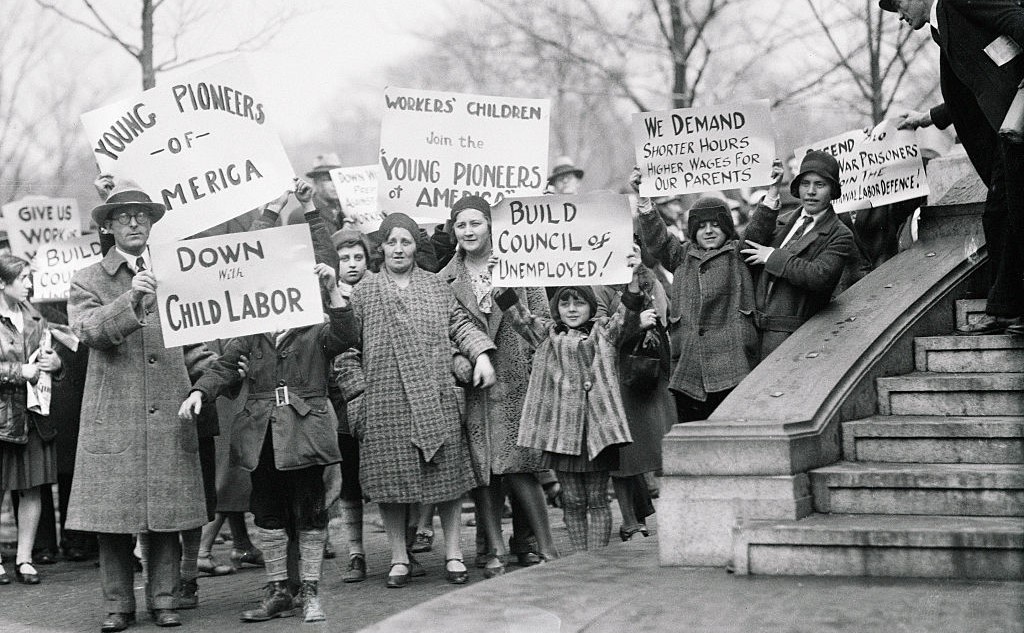
Anna Damon on the central role of women in the first national hunger march.
‘Women Hunger March Delegates Show Splendid Spirit; Maintain Negro and White Solidarity’ by Anna Damon from Working Woman. Vol. 3 No. 1. January, 1932.
Denounce Boss Press Lies Against Negro Women, Hunger March Delegates
The refusal of President Hoover and Congress to see the delegation of the National Hunger March on December 7 and to hear the demands for Unemployment Insurance by the delegates proved to all the workers that the Hoover government is not interested in the twelve million jobless workers and their families.
What do these gentlemen care if the workers live or die, if their children are starving, without food, clothing or roofs over their heads? We can be sure that their own immediate family and their own social circles don’t have these problems. Their wages are not being cut, instead their dividends are still being clipped. While millions are starving they are living in great luxury.
They would have the workers believe that they represent them and their interests in Congress. The action of Congress and the fact that not one single Congressman or Congresswoman fought on the floor to permit the delegation to present the demands of 12 million starving workers, shows that no matter what fine promises these “esteemed gentlemen” make at election time, they are the representatives and servants of the big bankers and manufacturers, and as such are the enemies of the workers. We must mention that the bourgeois women in Congress are of the same stripe, made no move to admit the National Hunger March delegation which would present the demands for the jobless workers and special women’s demands.
Boss Press in Vicious Lies
The capitalist newspapers carried screaming headlines that the government was feeding and housing the unemployed delegation in Washington. Those of us who had the “good fortune” to be housed and fed at the expense of the government cannot help but wonder at the organized publicity which was distributed. Let us be assured that were this a delegation of bankers and rich manufacturers coming to Washington to make demands for a greater chance to rob and burden the working class the reception they would receive would be quite different. They too would be fed and lodged by the government but where and how is the question. The workers should know and the delegation will tell just how they were herded together, 500 in barracks and 1000 at the Salvation Army, the women in the unheated barracks, given slops unfit to eat and served in a stinking stable. How throughout the night the National Guard and the fire department and the police had their men walk back and forth, not permitting an hour’s sleep to the worn out women hunger marchers.
The delegation learned that the Hoover government had the backing and was working hand in glove with the American Federation of Labor officials in refusing to grant a hearing to the unemployed workers and were opposed to any kind of unemployment insurance for the jobless workers.
In the National Hunger March there were a great many women. Of the 1,670 delegates, 158 were women, 60 of which were Negro women, in face of the many difficulties and hardships the marchers had to undergo this must be considered an achievement.
The women were a most active section of the Hunger March and took part in all activities and through the entire march not one fell out of the ranks though some were worn out by lack of sleep and food. The spirit was splendid not in one single instance were the politicians in the various cities along the line of march able to break the spirit of solidarity and comradeship that existed among the Negro and white hunger marchers. Boss elements tried to bribe the white workers especially the women in the so-called chivalrous states of the South to jim crow the Negro women and offered better sleeping accommodations to the white women. The white women hunger marchers in the true spirit of class solidarity refused the “generous” offers. They refused to accept anything that the Negro workers, their comrades in the Hunger March and their fellow workers in the class struggle would not get. So in Cumberland, Md., the city authorities having failed to create dissension by setting up the artificial white superiority were forced by the splendid spirit of the marchers to house the Negro and white men and women in the same barracks.
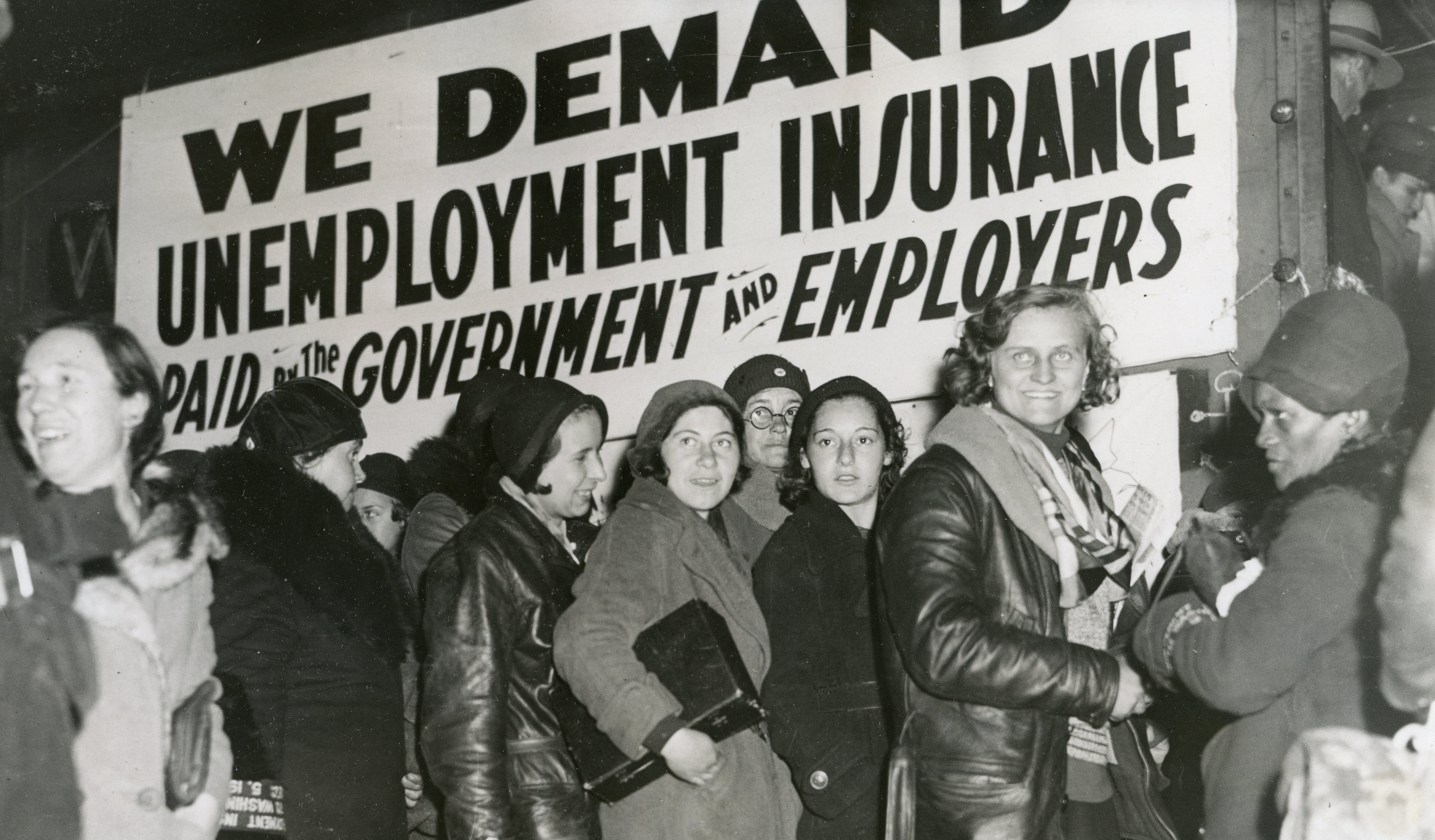
It seems that the bourgeoisie was hell bent on dividing the Negro and white workers. The Hoover government, the capitalist papers, all came out with lying statements that the Negro women were paid to take part in the Hunger March, and that they were just picked up “rabble.”
Condemn Boss Lies.
At the women’s meeting which was held on December 7 preceding the march to the Capitol the Negro women introduced a motion. that was unanimously adopted by the entire women’s delegation branding the statements as vicious lies. All the women delegates both Negro and white were regularly elected delegates representing tens of thousands of unemployed workers. The women delegates were chosen through their activities and militancy in the local struggles for Unemployed Insurance, against evictions and for having a record as fighters in the interest of the working class.
The splendid speeches of the Ne gro and white women at the conferences in Washington showed that the women of the country are well aware that the struggle for Unemployment Insurance can only be won through mass action of the entire working class men and women, Negro and white. That the fight for immediate winter relief must become a daily job of the women factory workers as well as the women at home, employed and unemployed. They brought out in their speeches that the only country that fully protects its workers. in time of sickness, unemployment and old age is the Soviet Union. They pledged themselves to arouse the women of the working class to fight the bosses and their hirelings who are preparing for imperialist war, and to defend the Soviet Union.
Four Women on Nat’l Committee
The experiences in Washington gave the women Hunger Marchers greater determination to continue the struggle for Unemployment Insurance and for immediate winter relief from local administrations. The National Committee that was elected has four women who will bring forward in all fields of activities the special needs and problems of the unemployed working girls and women and wives of unemployed workers.
The experiences in Washington gave the women Hunger Marchers greater determination to continue the struggle for Unemployment Insurance and for immediate winter relief from local administrations. The National Committee that was elected has four women who will bring forward in all fields of activities the special needs and problems of the unemployed working girls and women and wives of unemployed workers.
The tasks that confront the unemployed workers, and especially the women in connection with the Hunger March are many. On February 4, the day designated as the National Unemployment Day, great demonstrations will take place all over the country. From now on the women must redouble their efforts in all phases of activities among the unemployed.
To date very little has been done among the women in the factories and among the women in the employment agencies. All of these women are vitally concerned with the problem of social insurance. With the problems of wage cuts and part time work. The leading women in the struggles that have taken place must become the organizers and agitators especially among the women and arouse them to join in the fight for Unemployment insurance, against wage cuts, against imperialist war and for the defense of the Soviet Union.
The comrades active in the Unemployed Councils must see to it that women’s committees are organized, that the women delegates who took part in the, Hunger March report at the general meetings and that special women’s meetings be arranged through the branches of the Unemployed Councils and in the various unions and women’s organizations and in neighborhoods.”
Women’s conferences and delegate meetings around the issues of unemployment and struggle against imperialist war should be held around the 20th of January, 1932.
The collection of signatures for the Unemployment Insurance bill, the passing of resolutions condemning the action of Hoover and Congress in refusing to see the delegation with the demand for federal unemployment insurance now becomes the task of every working woman in all organizations.
We must build a powerful unemployed movement. Unemployed women and wives of unemployed workers must unite their strength and fighting spirit in this great struggle. Join the Unemployed Councils.
The Working Woman, ‘A Paper for Working Women, Farm Women, and Working-Class Housewives,’ was first published monthly by the Communist Party USA Central Committee Women’s Department from 1929 to 1935, continuing until 1937. It was the first official English-language paper of a Socialist or Communist Party specifically for women (there had been many independent such papers). At first a newspaper and very much an exponent of ‘Third Period’ politics, it played particular attention to Black women, long invisible in the left press. In addition, the magazine covered home-life, women’s health and women’s history, trade union and unemployment struggles, Party activities, as well poems and short stories. The newspaper became a magazine in 1933, and in late 1935 it was folded into The Woman Today which sought to compete with bourgeois women’s magazines in the Popular Front era. The Woman today published until 1937. During its run editors included Isobel Walker Soule, Elinor Curtis, and Margaret Cowl among others.
PDF of full issue: https://www.marxists.org/history/usa/pubs/wt/v3n01-jan-1932-WW-R7524-R2.pdf
 Revolution's Newsstand