The incredibly dangerous work of building the Share Croppers Union in Alabama’s Tallapoosa County during the early 1930s.
‘Camp Hill–Slavery That is Legal’ by Melvin P. Levy from Labor Defender. Vol. 8 No. 1. January, 1932.
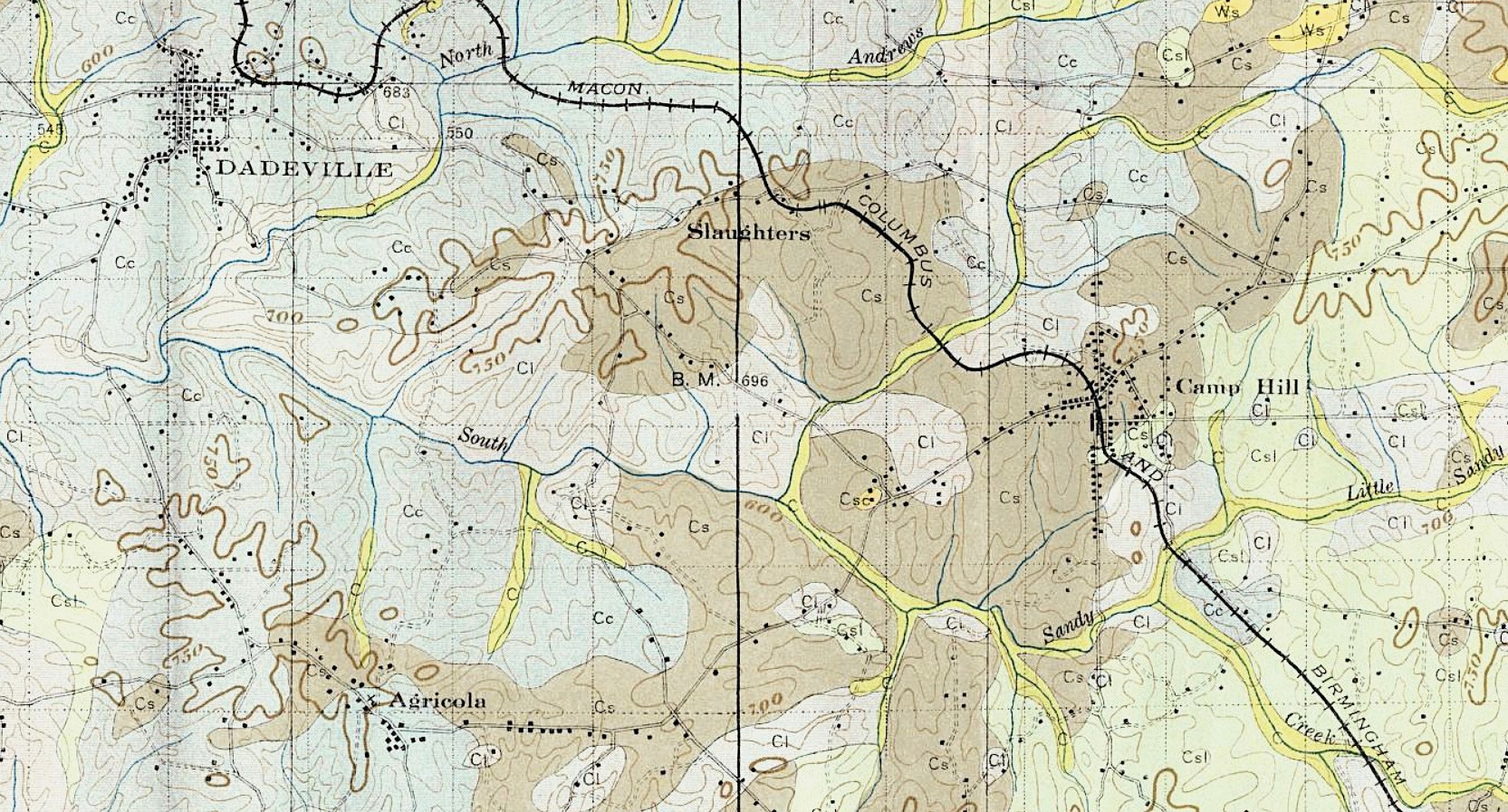
THE rich center of that belt of wonderful red soil which extends from the Carolinas to the Gulf of Mexico, is Camp Hill, Alabama and the plantation area, a hundred miles in diameter which surrounds it and has become famous under its name. The land here is rich, so rich that it need be hardly more than planted to yield abundant crops of corn, peanuts, yams, peas, and cotton–much cotton: food and clothing spring alike from this soil. In the midst of this plenty, however, there is starvation and nakedness.
The men, women and children—Negro and white alike who raise the cotton and the corn have neither shirts, underwear, nor sufficient food. They have begun, however, a powerful mass movement, the Share Croppers Union, led by the Trade Union Unity League. It has already enabled them to wrest from the landlords who are their bosses certain concessions and has given to them hope, the vigorous power of an arising working class moving toward the ultimate victory which it can already see ahead.
In the town of Dadeville, fifteen miles north of Camp Hill town, a storekeeper told me that he had increased his landholdings from 280 acres to more than 14,000 acres, all through foreclosures. Two banks in this community “failed.” The president of one of them came out of the “failure” with some 20,000 acres of rich land which cost him not one cent.
As the crisis grew more intense these two signs which mark the road to fascism became plainer and more abundant. On the one hand was growing up a small ruling group in whose hands all land was centralized. On the other was the mass of tenant farmers, constantly swelled poor by additions from the ranks of the small owners. As their numbers increased their condition grew worse. They had always been treated as slaves. Those of them who are Negroes have been constantly assured by the white rulers that they never had been freed. Chattel slavery may be “illegal”; but the Negro cropper knew that if he wished to move from the land of one owner to that of another he must be bought off by the second man. He knew that he might not leave his employer without permission (escape is the word used) on pain of being hunted, brought back, beaten and, perhaps, killed.
Now, however, to actual hunger was added oppression. The cropper was never allowed to have, for his own use, a garden on the land he tilled. When cotton brought a good price he had been able to purchase from the foodstuffs he raised “for” the landlord enough corn, beans and fatback to keep himself, his wife and his children–also forced to become workers from the time they were eight years of age–from starving. With “bad times” this was no longer true. The landlord could no longer “afford” to supply his tenants such luxuries as food. However, they need not starve so long as a good providence provided grass which could be boiled and eaten.
In April of last year there were distributed through the Camp Hill district leaflets telling of the attempted legal murder of nine Negro boys at Scottsboro, Alabama, and of the part of the International Labor Defense in organizing the workers, Negro and white alike, to save these lives and to expose the infamous conspiracy by which they were to be sacrificed on the altar of class oppression. The Negro farmers recognized the leadership of the great working-class movement of which the I.L.D. is a part. As one of them later told me: “When the movement speaks we can hear our own voices talking.”
There were meetings. More and more croppers began to hear their “own voice.” The Share Croppers Union expressed their needs and showed the path by which they might be attained. The Workers International Relief gave the promise of physical support from other workers and poor farmers in time of need during the impending struggle. The I.L.D. taught defense against the landlords’ counter offensive, sure to follow any move of workers to improve their conditions.
The counter offensive was not slow incoming. The homes of Negro croppers known to belong to the union, or suspected of membership, were raided. Men, women and children were beaten and thrown into jail. “N***r hunts” (the middle class white of this district speaks of “N***r hunts” and “rabbit hunts” in one breath) were organized. We know that Ralph Gray, a leader of the union, was murdered. We do not know how many more of our comrades died at this time, nor how many were flogged.
We know, too, that the struggle in Camp Hill led to victory. As a result of it the food allowance, formerly discontinued for tenants on July first (after that there was always grass and leaves) was continued until the early winter. The croppers have forced from the landlords the right to raise their own gardens; and have thus been relieved of a terrible burden–the purchase of their own labor at an enormous cost. The Negro in the Camp Hill district is treated better today than ever before (but still horribly), because the landlords recognize his growing power, the power of mass action.
Labor Defender was published monthly from 1926 until 1937 by the International Labor Defense (ILD), a Workers Party of America, and later Communist Party-led, non-partisan defense organization founded by James Cannon and William Haywood while in Moscow, 1925 to support prisoners of the class war, victims of racism and imperialism, and the struggle against fascism. It included, poetry, letters from prisoners, and was heavily illustrated with photos, images, and cartoons. Labor Defender was the central organ of the Scottsboro and Sacco and Vanzetti defense campaigns. Editors included T. J. O’ Flaherty, Max Shactman, Karl Reeve, J. Louis Engdahl, William L. Patterson, Sasha Small, and Sender Garlin.
PDF of issue: https://www.marxists.org/history/usa/pubs/labordefender/1932/v08n01-jan-1932-LD.pdf
 Revolution's Newsstand