Karl Lore on young workers and the Pioneer Youth of the C.P.L.A.
‘Kids on the March’ by Karl Lore from Labor Age. Vol. 19. No. 8 August, 1930.
AS we enter the door, the face under the big straw brim lifts and a pair of black, snapping eyes flash us a welcome. “I’m fixin’ to make me a house,” he explains, and turns back with all the seriousness of his fourteen years to his work bench and his hammer and nails. On the other side of the table, two girls are very busily engaged in the manufacture of what is obviously to be toy furniture. Back in the far corner is a smaller carpenter, whacking with great delight and concentration on something, which as yet possesses no identifying characteristics at all.
In the next room some others are playing with water colors and modelling clay. Pictures of tree and flowers run riot over the walls, and clay houses and boats clutter up the shelves. The third and last room is the real art gallery, the children having selected it as their reception room. The windows are framed by curtains that they have cut and sewed and the prize pictures adorn the walls. In these three rooms the kids work away without interruption from anyone making what they want when they want to. The teacher withdraws very much into the background. On the whole, a very modern educational institution.
The house is not in Philadelphia or New York, nor are the youngsters what one might expect to find in this kind of place. They are the children of textile workers, and the house itself lies on the outskirts of East Marion, North Carolina, the mill village of the Marion Manufacturing Company.
There was a strike here last winter and the textile workers marched with cheering, singing, picket lines. These boys and girls marched with them. It was not just for the excitement, or for the opportunity it gave to let off steam, either. They all know that at fourteen, or even thirteen and twelve if they looked old enough to fool the inspector when he came around, they would also work their twelve hours in the mill for a pay of $11 per week, that is, unless the union could help.
That strike is lost, and the picket lines have stopped. But because of it, these future mill workers find themselves, for the first time in their lives perhaps, the objects of an organized attempt to give them a good time.
It is not the boss that’s to be thanked for it either. Mr. Baldwin, president of the Marion Company, has not been as clever as some of his fellow manufacturers who have followed strikes with the introduction of welfare work in their mill communities. The lumber and the paints and the modelling clay come from a labor organization, the Pioneer Youth of America.
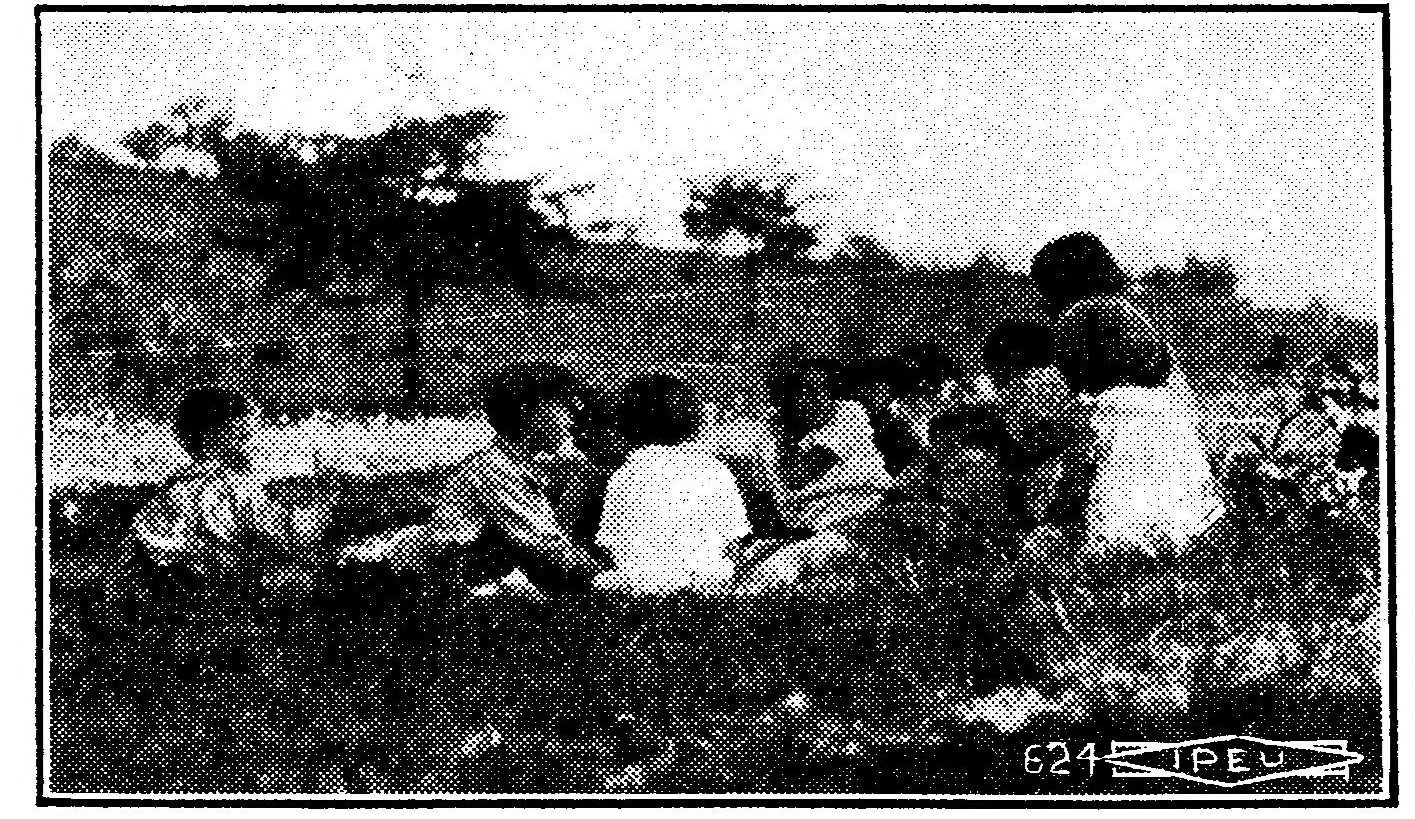
The fact that that organization is functioning there, has done more than just give the kids a lot of fun, though. For some time now the union has only had a local representative in the village to liquidate the strike. Now Pioneer Youth is in Marion, and the strikers and the mill people know that the outside world has not forgotten them, that people still remember their fight. It keeps up their faith in the union and in the Labor Movement when they see their children play ball with the teacher from New York or sit down in a field for an earnest discussion of some subject which had been very carefully kept from them in school.
I have discussed Pioneer Youth in Marion at some length because it shows how valuable organized youth can be to the Labor Movement. And how the Labor Movement needs its kids. There have been too many scabs who did not know what it was all about; too many products of our educational system who have been willing to take things for granted; too few who have been given a chance to know and learn Labor’s ideas and ideals.
Millions of Young Workers
The census of 1920 reported 2,774,000 children from ten to seventeen years of age gainfully employed in the United States. Of these, 1,061,000 were under sixteen years of age. In addition, there were 20,000,000 out of industry between the ages of five and fourteen, all, according to circumstances, potential wage earners, strike breakers, or unionists. It would be interesting to know what did happen to them. How many of them heard the call of the movement and responded? How many were made to realize their destiny and that of mankind and joined in the fight for a better scheme of things? It is impossible, of course, to give an answer. But a look at the unions today, ten years after that census, should give some indications. There are few young delegates in labor bodies. In some trades employing many young people, very few of them are in the union. It may not be the fault of the unions entirely, of course. Most of these children have been inculcated with an anti-union and anti-labor spirit all their lives. In school and in church, economic facts and problems have been soft pedaled or perverted. The idea that “my Jimmie isn’t going to work in a factory,” has certainly played its part. The average trade unionist, especially if he is in one of the highly paid craft organizations, wants his son to enter a profession, to be a dentist, doctor or lawyer. In that case, of course, all his contacts and friendships must be formed in a different group from that in which the son of a steel worker can move.
The unions simply have not recognized it as their job to organize the youth on a labor basis. Many of them see organizations like the Boy Scouts as the logical interest of their children. How it is possible for the Boy Scouts, subsidized as they are by the great financial, union breaking interests of the country to give its members the training, and the point of view that is necessary for them to function in the Labor Movement, has not yet been satisfactorily explained.
Proper use of spare time is the final lesson that the Labor Movement should teach the child within its ranks. Leisure in itself is not the end of all problems. Leisure with only the movies, the Nick Carter thriller or the True Story Magazine to turn to, does not take a young fellow far along the road that the Movement needs so very much to have traveled. They have got to be taken out into the woods away from the cities and taught what the outdoors holds. The riches of the world of books must be displayed for them. They have a right to be allowed to use their own spare hours in creating things with or without sense or utility as it gives them a creative joy. None of this will our ordinary municipal education factory give them. They must get it from somewhere if they are to be part of Labor’s ranks.
Have we uncovered a problem in the preceding paragraphs? Or isn’t there really any? Are we at 12 or 14, children with no interest and no responsibility in the world we live in? And do we, with the eighteen candles in the birthday cake, automatically become serious minded citizens fully prepared to decide all such ethical points as trade unionism versus open shop or scabbery? There are some who doubt that this works out in such beautiful simplicity. They have set up organizations and proceeded to educate kids for work in the labor movement.
Pioneer Youth was started in 1924 as the result of a series of conferences of labor men and educators. “We propose,” they say, “to take the children, not least those of the masses of industrial workers, out into the open; to cultivate alert, critical minds; active and generous sympathies; respect for all honest toil; the passion for justice and brotherhood.” They have extended their class work over four cities. At their summer camp in Rifton, New York there is room for 150 workers’ children to spend a summer of sport, discussion and creative effort.
A similar camp has been maintained for the past five years by the Modern Sunday Schools at Lincoln Park, New Jersey. There at camp, in the play and in the work, the children carry on the work of the classes held during the winter months where they discuss their world as they see it.
One experimental group that has grown with vigor in the three years of its life is the Young Circle League, the Young people’s section of the Workmen’s Circle, Jewish fraternal order. There are at present over 100 sections of the League in existence, the forty New York groups alone boasting a membership of 1,000. Anyone from 12 to 25 is eligible for membership and may participate in the social, educational, athletic, and dramatic activities of the League. It is not a mere social club however, for in addition they “train their members in the lofty ideals of the Workmen’s Circle and prepare them for their future duties as adult members of the organization.
The immigrant worker has, of course, brought many of his youth organizations with him. German youth especially has found the American outdoors worthy of attention. The Naturfreunde, an organization with over 1,200 branches throughout the world have ten groups spread from coast to coast through this country and for over twenty years now, have propagandized on the need for a worker’s world.
The labor political parties have always seen the organization of the youth as a part of their problem and today both the Socialist and Communist parties have their young peoples branches.
These are some of the attempts that have been made to solve the problem of the youngsters. Their sponsors have done praiseworthy and excellent work. Yet even the wildest enthusiast will not claim that they are on the way to a solution of the problem of the youngsters. Their million kids entering the field of industry certainly cannot be dispelled by the individual efforts of enlightened but comparatively insignificant groups. The powerful youth movement of Germany arose only after the German workers formed a strong political arm to aid in their organization. The kids are on the march to somewhere. We can’t laugh off 800,000 American Boy Scouts. It is up to the movement to decide which way they shall go.
Labor Age was a left-labor monthly magazine with origins in Socialist Review, journal of the Intercollegiate Socialist Society. Published by the Labor Publication Society from 1921-1933 aligned with the League for Industrial Democracy of left-wing trade unionists across industries. During 1929-33 the magazine was affiliated with the Conference for Progressive Labor Action (CPLA) led by A. J. Muste. James Maurer, Harry W. Laidler, and Louis Budenz were also writers. The orientation of the magazine was industrial unionism, planning, nationalization, and was illustrated with photos and cartoons. With its stress on worker education, social unionism and rank and file activism, it is one of the essential journals of the radical US labor socialist movement of its time.
PDF of full issue: https://www.marxists.org/history/usa/pubs/laborage/v19n08-Aug-1930-Labor-Age.pdf
 Revolution's Newsstand