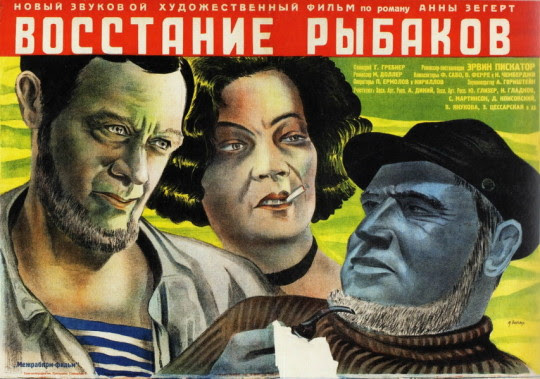
Béla Balázs reviews Erwin Piscator’s first film,The Revolt of the Fisherman, linked below. Balázs was a poet, screenplay writer, and hugely influential formalist film and arts critic. A Hungarian Jew born in 1884, he was part of Budapest’s Sonntagskreis (Sunday Circle) of intellectuals that included Karl Mannheim, Arnold Hauser and György Lukács. After the fall of the Hungarian Soviets in 1919, Balázs moved to Vienna, then Berlin where he immersed himself in the Weimar-era radical arts scene. After Hitler took power, he moved to Moscow and helped direct the Film Workers Union. Returning to Hungary after the Second World War he died in 1949 just after finishing his Theory of the Film, which was published posthumously.
‘Piscator’s First Film’ by Béla Balázs from New Theatre. Vol. 1 No. 11. December, 1934.
[Both the author, Bela Balasz, and the subject of this article, Erwin Piscator, refugees from Nazi Germany, are working in the Soviet Film industry. Piscator’s first film, The Revolt of the Fisherman, will soon be released in this country by Amkino.]
ERWIN PISCATOR does not introduce himself to the world with Revolt of the Fishermen. As an artist, director, as a political personality, he is widely known even outside of Germany. His importance cannot be measured by this, his first film.
Piscator is known throughout the world as the 100 per cent political theatreman. To him art is primarily a weapon of the revolutionary offensive. The political, the Marxist point of view, determines the style, the artistic formula of Piscator’s theatre. The desire to create a social entity, to fuse social matter with economics and to penetrate to everyday realities, has always prompted him. He constructed huge designs with revolutionary aims. Piscator is no painter of miniatures, no engraver and no aesthete. His productions have the significance, the meaning of political mass demonstrations. This is his great and commanding strength. This has been the source of his inventions and phantasies, but also the source of his weakness. He could never find a corresponding play for the tremendous scale of design he is able to project in his theatre. He has stretched small and thin materials on a giant stage, or superimposed the vastness with too obvious solutions. The very greatness of his genius has often been the cause of his faults.
We are able to trace most of the faults of Piscator’s first film to this basic source. The subject of Segher’s novel The Revolt of the Fishermen at St. Barbara is too thin, too pale to serve Piscator’s aim: the creation of a monumental social picture. He was forced to magnify it in order to give it a political entity. The film begins with unorganized dry political titles; in spots we find rough and schemed shots. The claim that this picture is purely agitational is sheer nonsense, for it is full of tender lyricism, of psychologically shaded figures, and possesses an artistic quality altogether new in the film. It suffers in the beginning from an abundance of imposed agitational material, especially where the political tendency within this narrow subject cannot be stated internally. This is its only artistic imperfection.
Piscator’s first film is not a masterpiece. He shows himself even here the great master, the great director, and indeed, a great film director. We can easily detect many of his weaknesses, at the same time we are forced to admit his tremendous strength. There is no need to deal lengthily with the faults of this film, for even a third rate motion picture reviewer could easily detect them. These errors are expected of one who makes his debut in the field of the cinema, especially when he is unable to use the experience of others as his own. The shortcomings of the film are partly due to the scenario, partly to the magnification of the theme itself.
IT IS more important to discover, within the frame of this work, the great director. One can recognize his greatness in the differentiation of his figures, in the richness, in the coloring and shading of individual characters such as we have not yet seen in any film. This, of course, does not condemn all other pictures. The simplicity, the single color of characterization was the needed and natural style of the silent film, for the director worked without dialogue. We believed that the talkies would present a discriminating, psychological, deeper, a three-dimensional characterization. Until now the talkies have not fulfilled this expectation. Piscator, however, with his first still imperfect film already shows a path in this direction.
His richer individuation is exemplified in the varied forms of the political character. From the class-conscious sailor of St. Sebastian to the cynical strike-breaker, Piscator shows all sorts of political types among the fishermen: the hero of this picture, an anarchistic revolutionist, who stabs his friend in the back for becoming a scab; the strike-breaker who discovers solidarity with his class in a decisive moment; the naive young fisherman who “knows what is to be done” and blows the ship up.
To Piscator a class does not mean psychological uniform. Every face which he portrays is individual, alive, and expresses an unusual political consciousness.
The most outstanding artistic and original expression of this film is not this differentiation of varied political characters, but the inner perception and the psychological coloring of a few of the principle performers. Piscator creates two characters which have not as yet existed in the art of the cinema–the two female characters of this film, masterpieces of cinema characterization. One of these characters is the sailor’s whore, portrayed with inexorable realism. Not for a moment is she romantically idealized. She is no “La Dame aux Camellias,” but an ordinary prostitute in a harbor town. She is much used, but never martyred. He portrays her as a lumpen-proletarian, very ordinary, tough and businesslike. She remains declassed though she shows warmth and solidarity towards the working class. This contradiction is organic in the character–through this contradiction the portrayal becomes three-dimensional.
In order to show her human qualities Piscator does not find it necessary to give her a perfumed soul. He creates the many sided picture of this woman. At first we see her in the window of a waterfront brothel. She is not even exceptional. She is but one of the many, a very ordinary type. Next we see her on the boat, sailing to Barbara, sitting among the rich bourgeois and among the sailors. She does not concentrate on the bourgeois alone. She is displaying her body here. We notice next an adolescent. Then her first meeting with the youngster.
“I would like to come to you. Maybe I could come tomorrow?”
“Tomorrow? Impossible.”
“Why?”
“Today!”
THE amiable charmer, the declaration of love of an ordinary prostitute, is created here with unsentimental realism. In the scene with the sailors we see a great deal more. Social feeling has awakened in the girl. She converses with the sailors in a very businesslike manner. “Maybe you haven’t got money She understands his sadness. She is sorry.
But at no time is she allowed to become soft. She throws herself on the sailor’s neck, though she knows that he has no money. Here she becomes different from what she appeared to be in the beginning of the picture. At first she was selling her body; now she would like to lay her head on his breast. Being inexperienced in such behaviour she fails to convince the sailor. The sailor pushes her away. She is not surprised, she knows that she has failed. She is not idealized even later when she goes to the marketplace with a young fisherman. Someone offers her money. She is reluctant to accept it in the young man’s presence, but exclaims in a friendly rational voice: “You must not disturb my business dealings.” The youngster spits at her. She creates no scene, she shrugs her shoulders, but later, when left alone, breaks down weeping.
In spite of her being a whore we are persuaded to believe her deeper feelings, that she is capable of calling the youngster a traitor and a scoundrel when she thinks that he is scabbing. Janukowa, who plays the prostitute, is an excellent actress. From gestures and voice the director built a complicated architectural design of a living being that has many sides, but one character. This organic many-sidedness is new in the movies.
More meaningful, deeper and picturesque is the other female figure, a figure of gloomy strength, of somber stature. There is antiquity in the dignity of her tragedy. This character is created with silence. She speaks no words. Silence used as a dramatic emphasis is the most specific and strongest possibility of the talking pictures. In the silent pictures this was impossible. Where everything is silent, muteness can not be used for accentuation. Even on the stage silence can not have such meaning because the production itself is unable to convey the tempest brewing under the stillness. The actress Gliser and Piscator were able to create and translate this mute, restrained inner storm.
In the first scene, after her husband has been shot dead, she goes from one child to another, her eyes tearless, she herself suppressed, mute and hard, a housewife who must keep order even though the earth shakes. At the burial where everyone cries she does not shed a tear. She is sorrowful, silent, aloof like a storm-cloud. Only once her muteness is broken by a wild shriek–then silence again. She seems absent-minded and when everyone runs to meet the soldiers she is left alone with the coffin. She stands up slowly. As if in a dream, her sight clouded, she walks straight ahead towards the soldiers. She seems unconscious and possessed by a fixed idea. She is frenzied with hate. She runs after the soldiers, without seeing, without thinking, through the middle of the firing line. Her eyes search for the soldier she wants to find. She chases him as stubbornly as a werewolf. She is beating him now like a maniac. Under her hand the soldier must have died a hundred deaths.
This is truly a tragic figure of the gloomy stature of Electra. Gliser is a great actress and Piscator has given her style. It is too bad that this greatness of silence is disturbed, even though only for a moment, with a spoken word. Piscator through this break wanted to give to the character a particular political meaning. He weakened the character and gained little instead and perhaps these very scenes will receive Many will praise the scenes of warfare the most popular acclaim. Such scenes have already been done with greater perfection by the Russian masters. However, Piscator’s female characterizations show a new and important path.
Translated by NICHOLAS WIRTH.
The New Theatre continued Workers Theater. Workers Theater began in New York City in 1931 as the publication of The Workers Laboratory Theater collective, an agitprop group associated with Workers International Relief, becoming the League of Workers Theaters, section of the International Union of Revolutionary Theater of the Comintern. The rough production values of the first years were replaced by a color magazine as it became primarily associated with the New Theater. It contains a wealth of left cultural history and ideas. Published roughly monthly were Workers Theater from April 1931-July/Aug 1933, New Theater from Sept/Oct 1933-November 1937, New Theater and Film from April and March of 1937, (only two issues).
PDF of full issue: https://www.marxists.org/history/usa/pubs/workers-theatre/v1n11-[p9-10-mfilm]-dec-1934-New-Theatre.pdf
 Revolution's Newsstand