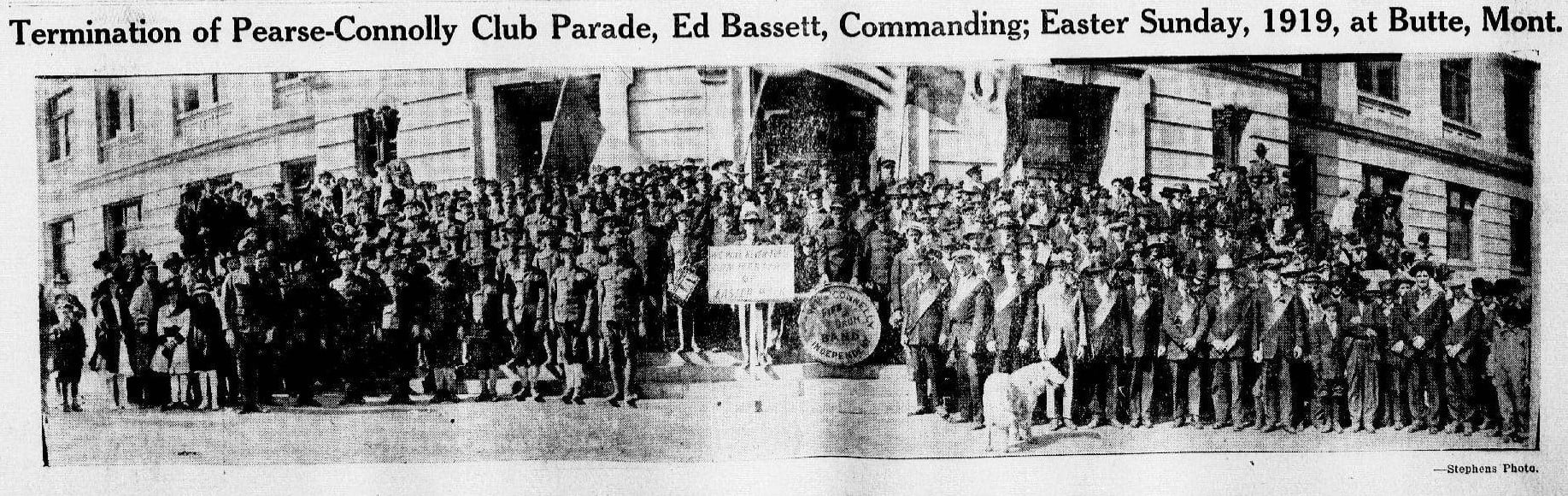
‘The Butte Pearse-Connolly Club’ from the Butte Daily Bulletin, 1919.
The Irish Workers Republic in the Montana mountains. The radical Irish working class of of Butte, Montana created a Pearse-Connolly Club to organize activities in 1919, the first year of the Irish War of Independence. Named after two leading martyrs of the 1916 Rebellion, Connolly himself a well-known figure among the U.S. left, the Club hosted meetings, held memorials, lectures, parades, acted as escort for De Valera on his visit to Butte, refused to march with Hibernians, provided music for May Day, buried their comrades, and much more. Here are a selection of their activities in 1919 from the Butte Daily Bulletin, edited by Irish-American radical William F. Dunne.
January 21, 1919. Youthful Fighter Meets With Fatal Accident.
James W. Ferriter, 24 years old, was killed by a fall of rock at the 2200 level of the St. Lawrence mine at l0 o’clock last night.
THIS Brief announcement brings not only keen sorrow to the many friends of the deceased, but leaves a deep feeling of irreparable loss to the thousands of militant workers in this community, as James Ferriter was known to all of them as a fearless and indefatigable worker in all movements which had for their purpose the bettering of the working conditions and general welfare of the toilers.
Mr. Ferriter was a member of the Pearse-Connolly club, the Metal Mine Workers’ union and the I.W.W., and in all of then he was an active and tireless leader in the efforts of those organizations to enforce emancipation and, as a result of Mr. Ferriter’s efforts in behalf of his fellowmen, he attained his highest honors when he was placed on the A.C.M. blacklist.
Besides a brother, Michael, living in Butte, Mr. Ferriter leaves a father, three brothers and one sister, living in Ireland. A brother, Morris, died recently in Butte from influenza. James Ferriter was a native of Bally Ferriter, County Kerry, Ireland. He emigrated to Springfield, Mass., and then to Butte in 1912.
Tonight a wake will be held for the deceased at 341 East Broadway. The funeral will be at 341 East Broadway Thursday morning at 9:30, proceeding to Sacred Heart church and from there to Holy Cross cemetery. The coffin will be carried on the shoulders of friends. The remains are at Daly-Shea undertaking parlors.
January 22, 1919. GAELIC SCHOLAR BREATHES HIS LAST.
They buried him in the mountains, far from his native fountains,
Far from the roaring billows that strike upon that shore;
Far from his weeping parents that dwell in far off Erin,
Where the stranger’s voice shall hover o’er his body ever more.
Maurice Ferriter, a native of Ballyferriter, west of Dingle, county Kerry, killed by a fall of rock recently, was a splendid type of the old race, possessing all the characteristics of his forefathers that made that part of Ireland famous with story and song. His parents were evicted in the early ’80’s through the democracy of England, and thrown to the mercy of the wild winds that blow on that romantic shore.
But that only inflamed the Gaelic breast of young Ferriter in after years. And ever since he was a boy he worked unceasingly for his native land. He never spoke the English tongue unless he had to, and where- ever he went through this country he sang the glorious songs of his famous kinsman, Pierce Ferriter, an illustrious bard of the time of Elizabeth, who was beheaded by the great civilizer because he composed songs in his native tongue.
Patrick Ferriter of New York, who for years has been writing in Irish to the Gaelic American, is an uncle of the deceased.
He leaves, besides the bereaved family in Ireland, two brothers in Butte, James and Michael, who are connected with the Pierce-Connolly club.
May the kind snows of the Rockies light lightly on his last home, where the seagulls of Ferriter’s Cove will never flutter their wings over the truthful Gael.
‘AN SPAILPEEN FANACH.”
January 23, 1919. FUNERAL OF THE LATE JAMES M. FERRITER.
Workers to the Number of a Thousand Honor Memory of One Who Always Fought for Them.
The remains of James M. Ferriter were laid at rest in Holy Cross cemetery this morning, after services had been held in Sacred Heart church.

The funeral procession started from the late residence of the deceased, 341 East Broadway. The coffin was carried on the shoulders of friends, and the turnout is said to have been the largest that has attended a funeral in the history of Butte. The funeral arrangements were in charge of the Pearse-Connolly club, of which the deceased was a member. He was also a member of the Metal Mine Workers’ union and the I.W.W., and the fact that the members of all these organizations turned out in their hundreds testified to the esteem the workers of Butte had for their departed brother. The coffin was decorated with floral offerings from the Pearse-Connolly club, the Metal Mine Workers’ union and the I.W.W.
A noticeable feature of the procession was the wearing of sashes by the members of the Pearse-Connolly club, the colors being green, white and orange, these being the colors of the new Irish republic, the white between the green and orange signifying harmony between the two factions.
February 3, 1919. PEARSE CONNOLLY CLUB PARADES MARCH 17.
Leading Butte Irish Will Stage Parade and Invite Returned Soldiers and Sailors to Join Them.
The Pearse-Connolly club will parade on March 17 in honor of Ireland’s patron saint and in memory of those martyrs to the cause of Irish freedom, Pearse and Connolly, who were killed in 1916 by English autocracy.
The parade will start from North Wyoming and Copper streets and the line of March will be: West on Copper, south on Main, west on Broadway, south on Washington, east on Silver, north on Idaho, east on Park, north on Atlantic, west on Broadway, north on Main to Quartz and disband. A special invitation to all returned soldiers and sailors and all lovers of liberty to join in the parade is extended by the club.
February 10, 1919. RESOLUTIONS OF CONDOLENCE.
To the parents and relatives of Brother James Ferriter:
Whereas, The grim reaper Death has removed from our midst our friend and brother, James Ferriter, he having been killed in the St. Lawrence mine, Jan. 13, 1919;
We, the members of the Pearse-Connolly Irish Independence club of Butte, Mont., in meeting assembled on this ninth day of February, 1919, wish to place ourselves on record as placing the responsibility for the death of our friend and brother, James Ferriter, upon the brow of copper capitalist greed for profits.
Be it resolved herewith, That we, the members of the Pearse-Connelly club of Butte, Mont., extend to the parents and relatives of our late friend and brother, James Ferriter, our profound sympathy in their hour of sorrow and grief; and
Be it further resolved, That we herewith acknowledge the great service to mankind rendered by our deceased friend and brother, in his efforts during life in assisting by thought, word and deed to uplift mankind; and
Be it further resolved, That a copy of these resolutions be forwarded to the parents and relatives of James Ferriter.
Dead but not forgotten.
(Signed) Executive board of Pearse-Connolly Irish Independence club. D. HARRINGTON, JOE KENNEDY, FRANK NESDEL, BRYAN CONWAY, JOHN J. LEMON.
February 25, 1919. AITTENTION IRISHMEN
The Pearse-Connolly club, the leading Irish society of Butte, had a large attendance at the regular meeting last Sunday, the 23rd. All arrangements were made for their parade on St. Patrick’s day. The band is in readiness and its members are practicing every night and are making marked success for the big turn-out. The club will hold its meetings every Sunday at their hall at 318 N. Wyoming street. Initiation of new members will take place at each meeting. All Irishmen who believe in self determination for Ireland and who believe in Sein Finnism for their native land. are urged to join the Pearse-Connolly club.
March 13, 1919. PEARSE-CONNOLLY CLUB ISSUES STATEMENT.
The Pearse-Connolly club wishes to make it known that it will not parade on the 17th of March, as it could not get a permit from the mayor unless they join the Hibernians, and this they absolutely refuse to do.

The Hibernians heretofore have been adverse to the stand the Pearse-Connolly club has taken in demanding equality and justice for all liberty-loving people.
No later than last year they approached the mayor and influenced him to prevent the Pearse-Connolly men from parading on that day.
We don’t want it understood that we are opposed to the organization, or the rank and file of its members; we are at variance only with some of its figureheads. The natal day in Ireland’s history, as every Irishman knows, is St. Patrick’s day. On each succeeding year that day is observed by the Irish all over the world.
The Irishmen of Butte know that there is an Irish fife and drum band in the town, and that is the Pearse-Connolly band, and we are sure any true Irishman would feel indignant to parade after any other band and have its own silenced or compelled to take a back place in the parade. As far as the Pearse-Connolly men are concerned, they would think it more honorable not to take any part at all. because they are too proud. when vanquished, to assist by their presence in gracing the triumph of the victor.
The Pearse-Connolly club wishes also to thank the various organizations who had signified their willingness to parade with them.
We wish to extend an invitation to all to attend our dance at Finlander hall on the evening of March 17th. Admission 50 cents. Ladies free. Doors open at 8 o’clock.
April 14, 1919. PEARSE-CONNOLLY CLUB TO PARADE.
On Easter Sunday in Memory of Patrick Pearse and William Connolly and Other Martyrs.
The Pearse-Connolly club, the representative of Sinn Feinn in the United States, is arranging for a mammoth celebration on Easter Sunday in commemoration of the Irish revolution and as a tribute to the immortal deeds and unselfish lives of Patrick Pearse, William Connolly and other martyrs in the Irish cause.
At 2 p.m. sharp, Easter Sunday, the parade will form at Copper and Wyoming streets.
First in line will be the officers of the Pearse-Connolly club. Then the club fife and drum corps, the Army and Navy league, the club membership. In addition to the above will be all organizations and individuals who believe in freedom for Ireland and all oppressed people.
The Pearse-Connolly club has ex- tended an invitation to all lovers of freedom to participate in the parade.
In the evening a mass meeting will be held at the high school auditorium.
Among the speakers will be Jack Carney of Duluth, Minn., who was in Dublin during the Easter rebellion; W. F. Dunn and James H. Fisher.
Michael M. Ferriter, president of the Pearse-Connolly club, will act as marshal of the day and will also preside at the memorial meeting.
On Monday evening the club will give a dance at Pallmont hall.
April 19, 1919. CELEBRATE EASTER WEEK.
Pearse-Connolly Club Arranges Good Program. Big Parade, Two Dances and a Mass Meeting.
The Pearse-Connolly club have all their plans completed for their Easter week celebration. The committee on arrangements finished up their work last night and are looking forward to one of the largest and most representative turnouts ever stage! in Butte.
It will be a tribute to the gallant men of Dublin who lost their lives Easter week, 1916. The parade, which will be the first observance of the day, will form at the corner of Copper and Wyoming streets at 2 p.m. sharp, and will traverse all the prominent streets of the city.
Jack Carney Will Speak.

At a mass meeting to be held in the high school auditorium Sunday evening at 8 o’clock, Jack Carney will be the principal speaker and no doubt give some interesting facts as he was in Dublin Easter week, 1916. Other speakers for the evening will be William F. Dunn and James H. Fisher, both of whom are well known to the people of Butte.
Two Dances Monday Night.
On Monday night, April 21, there will be two dances given, one at Pallmont hall on South Montana street and the other at Finlander hall, North Wyoming street. Tickets will be good for either dance.
Weather permitting, this should be one of the best celebrations held in Butte, and the Pearse-Connolly club feels very optimistic as regards the entire program. Self-determination for Ireland is in the air and every liberty loving man and woman is invited to join in the parade and make it the greatest day for Ireland in the history of Butte.
April 21, 1919. OVER 3,000 IN EASTER PARADE.
Mass Meeting in Evening Well Attended. Many Were Unable to Obtain Seats.
Beginning with a monster parade headed by the Pearse-Connolly fife and drum band in uniform of the Irish Volunteers, followed by a delegation from the Army and Navy association in uniform, and 3,000 workingmen–lovers of freedom, the memorial ceremonies commemorating the sacrifices of Padriac Pearse and James Connolly and the other martyrs of Easter week in Dublin, 1916, were concluded by a mass-meeting in the High school auditorium. So large was the attendance that dozens were unable to find seats and dozens were unable to get into the hall, in spite of the fact that the doors, for some unexplainable reason, were not opened until after eight o’clock.
The Pearse-Connolly fife and drum band occupied seats on the stage and enlivened the proceedings with renditions of stirring martial airs played as only an Irish fife and drum band can play them under the influence of an inspiring occasion. And the occasion and the setting as well, was inspiring, with the enthusiasm of the gigantic gathering tempered by sorrow for the brave spirits who had fought and died for Irish freedom and the freedom of the human race.
Michael Feniter, brother of the lately deceased James Feniter–loved and mourned by all who knew his sterling qualities–presided over the meeting, introducing the speakers in a few well-chosen words.
Seated with the band on the stage were James Coffey of the Pearse-Connolly club, James H. Fisher, Jack Carney and W.F. Dunn.
After a selection by the band, Chairman Feniter introduced James Coffey who, in an earnest, eloquent speech, in a clear and concise manner, outlined the principles of the Pearse-Connolly club, its attribute toward the Irish question and the purposes of the meeting.
He paid tribute to James Fisher, eulogized his efforts in behalf of the workers, and scathingly rebuked the daily press and those who had attempted to create the impression that Fisher was an enemy of Ireland. Outlining the history of the “Irish question,” the efforts of the Irish people to free themselves from the domination of an alien race and stating that the issue was no longer national but economic, W.F. Dunn spoke far over an hour and quarter. Denouncing the attitude of men of Irish blood, who, while intensely in favor of Irish freedom, have bent their every effort to depriving both Irish and Americans of their liberties, Dunn stated to the cheering audience that “the aims of the English government against the Irish people are as scarlet, but compared with the aims of a certain class of Irishmen against Ireland, they are as white as snow.” Concluding, he predicted that Ireland would gain her freedom when the English workers gained their industrial freedom and that Ireland would gain independence as America did, “by wresting it by force of arms from an unwilling monarchy.”
When James Fisher rose to speak he was given an ovation. He spoke of the similarity of the method of oppression of the English and the Irish workers, stating that they were victims of the same class and of the same system.
He spoke of the terrible conditions of the English workers who have the political independence that the Irish have not and expressed the opinion that not until all workers were free would the Irish be free.

Speaking of the apparent alliance between the imperials of England and America–mentioned by W.F. Dunn–he expressed the hope and the belief that the rising tide of working class consciousness would render such an alliance harmless and said that before the year 1920 rolled around the industrial autocrats of all countries would be overthrown.
He pleaded for the political prisoners in America and asked how the Irish people could be freed by the efforts of the Irish-Americans while 2,000 workingmen and women were incarcerated in this country for activities in behalf of their class.
He concluded with a masterful oratory, asking the audience to pledge themselves to unity as workers, that freedom might come to Ireland and all the world.
Frail and delicate-appearing, but with the spirit of a crusader in his breast, Jack Carney, editor of the Duluth Truth, and an eye-witness and a participant in the Easter Revolution, held the audience spellbound for an hour and a half.
He denied that the revolution of Easter week was unsuccessful; he stated that the Irish republic dates from that day, and that only black treason on the part of Irishmen high in the councils of the Irish citizen army prevented Ireland from throwing off once and for all, the falling fetters of English rule.
He also stated that the Irish question was an economic question; he asked how Irish men, women and children could be free while they were held in industrial bondage by Irish employers; he brought tears to the eyes of many in the audience when he described how Irish girls work ten and twelve hours per day for sixty-five cents per week. How Irish laborers toil ten hours per day for $3.50 per week; his hearers scarcely breathed as he told in burning words of how men and women were shot and clubbed in the streets of Dublin at the behest of Irish employers.
Eloquently he told how, after the massacre of men, women and children by English soldiery, Premier Asquith had come to Dublin and asked for volunteers to fight for “the rights of small nations,” and amid tremendous applause, he stated that “the Irish workers were the only ones who had prevented the rulers from driving them to the slaughter.”
He paid a glowing tribute to Pearse and Connolly, the Irish martyrs, and to Jim Larkin, head of the Irish Transport Workers’ union, “the greatest Irishman of them all.”

Carney asked Irishmen what they were doing for freedom in America. When you come back to Ireland, as you will want to, when she is free, we are going to ask you what side you were on in America, whether you belonged to a union of your class or not,” he said.
“Ireland and Irishmen are going to have freedom,” he cried, “both economic and political freedom, because they are organizing on the industrial and political field.
“We are joining hands with the English workers and we will win or fall together,” was his closing sentence and it brought a storm of applause that shook the building. Hung on the curtain were two enormous flags of the Irish Republic; they were raised and lowered as the audience filed out to the strains of a march by, the fife and drum band.
The largest and most enthusiastic Irish celebration held in Butte for years, putting in the shade the St. Patrick’s day demonstration, will be concluded by two big dances given tonight under the auspices of the Pearse-Connolly club at Pallment hall, South Montana street, and the Finnish Workers’ hall on North Wyoming street.
June 13, 1919. Well-Known Lovers of Justice to Visit Native Land.
Both Leave Over Milwaukee Railroad.
Two well-known patriots of the Irish race have left Butte this week for the old sod. Both departed over the Milwaukee. Both have been active workers in the cause of Irish independence. Both, it is said, were at one time members of the Pearse-Connolly club of Butte. Father Michael Hannan of St. Mary’s church has talked from many a rostrum for Ireland’s cause. Joseph Kennedy, secretary of the Industrial Workers of the World, No. 800, has been for years a fearless, persistent worker in the cause of justice for the men of every race and creed. Both Father Hannan and Joseph Kennedy have gone back to the old land in which they were born. They left this week over the Milwaukee.
July 23, 1919. PEARSE-CONNOLLY CLUB MEMBERS TAKE NOTICE.
The Pearse-Connolly club will meet at their hall, 318 North Wyoming street, at 8 o’clock, Friday morning, sharp, for the purpose of escorting President De Valera of the Irish republic up town. All members of the band take notice and report to Con Bonuoe, treasurer, and all members please bring their sashes.
July 25, 1919. Butte Prepared to Outdo Itself in Honoring First President of Irish Republic.
President De Valera, Provisional President of the Irish Republic will arrive in Butte this afternoon at 5:25 o’clock over the Oregon Short Line from Salt Lake City where yesterday he was the guest of the citizens of that city and the state officials of Utah.
Elaborate preparations for the reception of this distinguished Irish revolutionist in Butte and from all indications the welcome to be accorded him will far exceed that accorded any other notable character who has ever visited Butte. From the Oregon Short Line depot, where Mr. De Valera and the members of his party will be met by a special reception committee of 300. the party will proceed to the courthouse where a public reception at which school children are invited to meet Mr. De Valera. Thousands of marchers are expected to be in line, including a large detachment of returned soldiers, sailors and marines in uniform, delegations from various Irish societies, prominent among which will be the Pearse-Connolly club with its drum corps, and delegates from various fraternal, labor and industrial organizations. Mayor Stodden and the entire membership of the city council will be among those who will welcome the revolutionist at the depot and participate in the parade. Judge Jeremiah J. Lynch, chairman of the committee on arrangements, left this afternoon for Melrose for the purpose of boarding the Irish president’s special car there to formally welcome him to Butte. After the reception at the courthouse President De Valera and party will be guests of local Irishmen at dinner and at 7 o’clock a procession will be formed to escort De Valera from the Finlen hotel to Hebgen ball park on East Second avenue where the city’s distinguished guest will deliver an address on the Irish question. Tomorrow morning at 10:30 o’clock Mr. De Valera and party will be honor guests at a breakfast at the Silver Bow club. From then on during the remainder of his stay in the city the arrangements will be made to conform to the wishes of De Valera himself.
July 26, 1919. GREAT OVATION IS EXTENDED DE VALERA.
Mayor W.T. Stodden and Lieutenant Governor McDowell Extend Welcome on Behalf City and State.
Butte yesterday went wild in its efforts to pay honor to President Eamonn De Valera of the republic of Ireland and to the nation and the cause he represents. With cheers, the music of bands and demonstrations of interest and affection, some 20,000 people, comprising residents of Butte and from outside p points participated in the various features of the city’s welcome to the De Valera party yesterday afternoon and last night.
The presidential party arrived in Butte at 5:25 o’clock from Salt Lake, Utah, where the Irish president was given a royal reception by the citizens of Utah. Upon their arrival at the depot here, the fact that Butte was heart and soul with the Irish in their struggle for freedom was evidenced by the warmth of the greeting.
Plays Irish Airs.
While the A.C.M. band into the strains of Irish airs while the crowd of hundreds burst and that thronged the platform burst into cheers and applause, President De Valera and the members of his party stepped from their sleeper.
Progress of the party along the platform was temporarily impeded by the rush of those present to shake Mr. De Valera by the hand and to extend personal greetings. Miss Mary Cosgrove, in a pretty speech, presented Mr. De Valera with a handsome bouquet of flowers in behalf of the women of the state.
Lieutenant Governor McDowell extended a welcome on behalf of the state and Mayor W.T. Stodden welcomed the distinguished Irishman on behalf of the city. Hundreds of other welcomes of an informal character were extended Mr. De Valera as he slowly progressed from his car to Front street, where he was seated in a gaily decorated car, and as he walked through the crowd he was kept busy taking the hands offered him and replying to the greetings.
Cheering Bursts Forth.
As the presidential party reached the street, a burst of cheering from the crowd rent the air and every automobile in the neighborhood added to the din with continued shrieking of sirens and tooting of horns.

The presidential car drove to its position in the parade and was surrounded by an escort of returned soldiers in their service uniforms. A delegation of members of the Pearse-Connolly club, clad in uniforms and sashes added a picturesque touch to the parade as they formed in line as an escort immediately behind the car. A long line of delegations from various Irish societies and local organizations followed and then came the autos.
The Parade.
The procession progressed along Arizona and Utah streets to Park, thence west to Montana, north to Granite and east to the courthouse, where several hundred children greeted the Irish leader with Irish airs. The parade was stopped, while President De Valera made public expression of his thanks at his reception and paid a compliment to the children.
The stop, however, was brief and the procession soon resumed the march to the Finien hotel, where headquarters had been established. While the band played Outside, the crowds which thronged the hotel lobby to greet De Valera staged an informal reception. Mr. De Valera was rescued from his friends and finally was escorted to his rooms to rest before dinner, at which the De Valera party was the guest of the local reception committee.
Outdoor Meeting.
Shortly before 8 o’clock the Irish president was escorted to Hebgen park, where he addressed an out- door meeting at which more than 10.000 people heard him.
This morning at 10:30 o’clock President De Valera and his party were guests at breakfast at the Silver Bow club. This afternoon the party was taken on an automobile tour of the city and environs and were shown through one of the local mines.
Tomorrow President De Valera will attend mass at one of the local Catholic churches and will spend the day at his hotel resting. At 6 o’clock tomorrow evening he will be escorted to Anaconda where he will address an open-air meeting there at 7:30 o’clock.
The Irish president and his party will remain in Butte possibly until Wednesday morning, when, it is expected he will go to Helena to appear before a joint session of the state legislature, which will convene on Tuesday.
The Butte Daily Bulletin began in 1917 in reaction to the labor wars in Montana, the Speculator Mine fire killing 168 miners; IWW organizing, and the murder of IWW organizer Frank Little in Butte. Future Communist leader and IWW organizer William F. Dunne and R. Bruce Smith, president of the Butte Typographical Union published the paper as an outgrowth of a strike bulletin with the masthead reading, “We Preach the Class Struggle in the Interests of the Workers as a Class.” It became daily in August 1918 and in September 1818 officers raided their offices and arrested Dunne and Smith on sedition charges. An extremely combative revolutionary paper, while unaligned, it supported the struggles of the Left Wing in the SP, reflecting the large radical Irish working class of Butte also supported Ireland’s and the Bolshevik revolution, as well as the continued campaigns of the IWW locally and national as well as the issues in Butte. It ran until May 31, 1921.
 Revolution's Newsstand