Cannon as head of International Labor Defense on one of the era’s great solidarity campaigns.
‘The International Campaign for Sacco and Vanzetti’ by James P. Cannon from International Labor Defense. Vol. 2 No. 2. February, 1927.
How the Workers of the World Responded to the Call for Solidarity
RARELY has the vital importance of international solidarity of the working class been so decisively shown as in the world campaign for Sacco and Vanzetti. Had there not from the very beginning been demonstrated that unbreakable determination of the workers everywhere to make the fight of the two Italian agitators their fight; had there not been that splendid series of labor demonstrations in the capitals of the world, the incessant flow of resolutions and protests against this hideous conspiracy to murder two innocent workers, then the judicial vultures of Massachusetts might long ago have seized and demolished their prey.
Realizing this essential fact, as soon as the verdict against a new trial was rendered by the Massachusetts court, International Labor Defense appealed to labor defense organizations throughout the world to renew their agitation for Sacco and Vanzetti. The need was desperate, for very few but knew that the Massachusetts bourbons had—as they still have—every intention to apply as swiftly as possible the electrodes of death to their long-suffering victims.
Those who have observed even superficially the development of the case from that time on know that it was this new campaign of protest and demonstration of solidarity that halted the hand of the executioner. The workers of this country, and of Latin-America and Europe, by their tireless solidarity, placed an unbroken wall between Sacco and Vanzetti and the death chair that is being held vacant for them and gained for them a new respite.
The campaign that was conducted in the United States is well known to all workers. At the request of the I.L.D., Congressman Victor Berger introduced his resolution in congress calling for an investigation of the case. Hundreds of labor organizations and men and women prominent in the labor and progressive movements reiterated their belief in the innocence of Sacco and Vanzetti and pledged themselves to a renewed drive for their final vindication and release. Mass meetings were held in every large city, and in New York City alone some 18,000 workers came to the Madison Square Garden to protest against the proposed legal assassination. Resolutions poured into the office of Governor Alvam T. Fuller of Massachusetts. Hundreds of thousands of leaflets, an appeal by International Labor Defense, and a stirring call to action by Eugene V. Debs, were distributed everywhere. Posters, buttons, articles for the press, the Labor Defender, every means of publicity and agitation was utilized in the campaign. The Sacco-Vanzetti Conferences, into which hundreds of thousands of workers were organized, made the names of the two Italian workers the symbol of solidarity and united efforts.
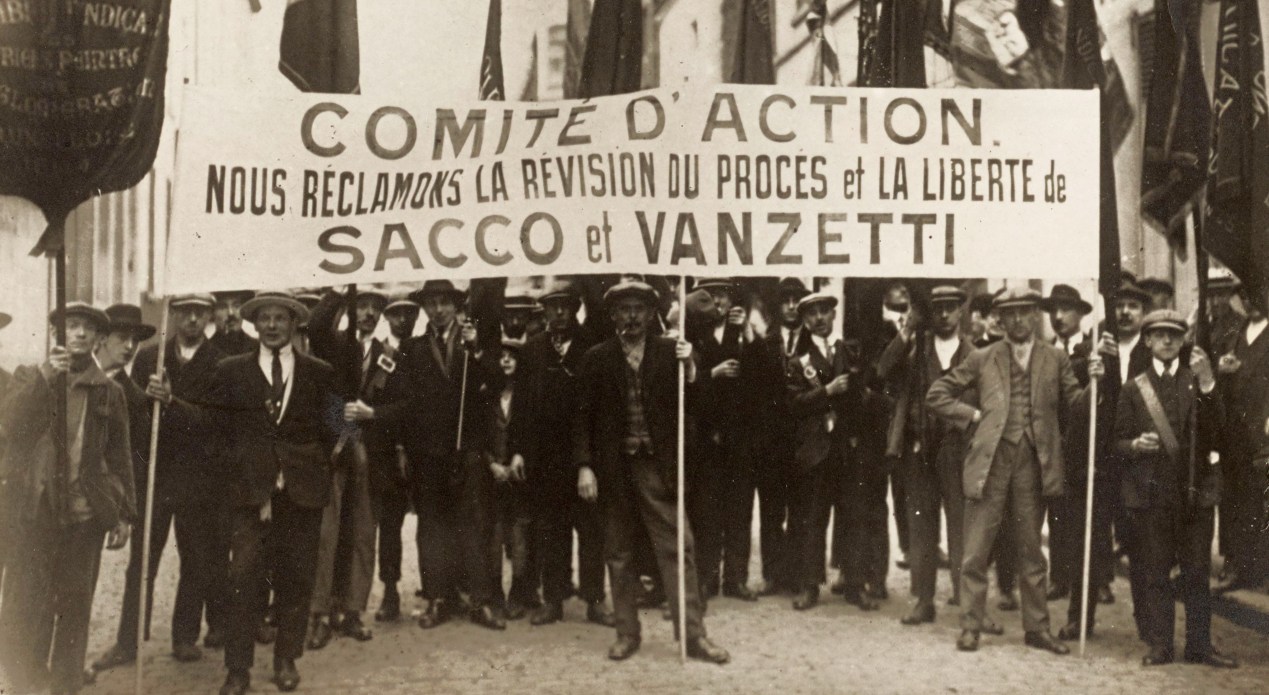
In Europe the campaign received its greatest support from Germany, Italy and England. In the German Reichstag, a large group of members of various parties combined to send a telegram of protest to Governor Fuller. The president of the Reichstag, Paul Loebe, also cabled his protest. Dozens of the prominent leaders of the German trade unions aligned themselves with the movement. Leading publicists, scientists, artists and public officials, including the former ambassador to the United States, Von Bernstorff, Maximilian Harden, Rudolf Breitschied, Professor Liebermann, General Music Director Kreisler, Georg Bran des, added their voices. Deputations from labor bodies were sent to protest to the American ambassador in Berlin. Scores of meetings were held in every German center, and to list the organizations which adopted resolutions of protest would require an issue of the Labor Defender.
From England came the protests of the Trade Union Congress, from the British Labor Party, the Independent Labor Party, the Communist Party and the “Minority Movement.” A telegram signed by members of parliament which included George Lansbury, Ellen Wilkinson, Robert Smillie, Sullivan and many others was sent to the now deluged governor of Massachusetts. The International Class War Prisoners’ Aid (the British counterpart of the I.L.D.) did some remarkable work in agitating for Sacco and Vanzetti, and literally hundreds of local labor organizations throughout England were listed by the I.C.W.P.A. as having adapted protest resolutions.
In Italy, despite the incredibly difficult situation, meetings were held wherever possible to protest against the conviction of Sacco and Vanzetti. The labor representatives in the Chamber of Deputies demanded the interference of the Italian government in the case. Constant interpellations to the government were made by the radicals in the chamber.
Since the May decision of the court, demonstrations were held in front of the American embassies at Paris, Sofia, Lisbon, Buenos Aires, Berlin, Montevideo and Mexico. Everywhere the demand of the workers was for the immediate cessation of this hounding of two innocent labor fighters.
Governor Fuller, who fled from America to France, was pursued there by the international solidarity of the workers. The Secours Internationale Rouge (International Red Aid) of France announced its intention of interviewing him by means of a workers’ demonstration, and Fuller was forced into hiding in France. To escape the demonstration he even saw to it that his name was omitted from the list of American arrivals which is regularly given in the Paris edition of the Chicago Tribune.
In the Union of Socialist Soviet Republics, literally millions of workers and peasants have recorded their opposition to the planned execution of the two American radicals.
The same story can be told of the work in a dozen other countries, and a (great debt is owed by us to the International Red Aid, to which the I.L.D. appealed at the crucial moment, and which organized and centralized the protest movement in many countries.
It was this campaign of international solidarity that has so far saved Sacco and Vanzetti from the death chair, and not the reliance solely upon the good intentions and judicial honesty of the Massachusetts courts. So long as Sacco and Vanzetti remain in the shadow of danger the workers of the world will stand guard. They will continue to make the cause of the two Italian radicals their cause until their liberation has brought a successful end to the Sacco-Vanzetti case.
Labor Defender was published monthly from 1926 until 1937 by the International Labor Defense (ILD), a Workers Party of America, and later Communist Party-led, non-partisan defense organization founded by James Cannon and William Haywood while in Moscow, 1925 to support prisoners of the class war, victims of racism and imperialism, and the struggle against fascism. It included, poetry, letters from prisoners, and was heavily illustrated with photos, images, and cartoons. Labor Defender was the central organ of the Scottsboro and Sacco and Vanzetti defense campaigns. Editors included T. J. O’ Flaherty, Max Shactman, Karl Reeve, J. Louis Engdahl, William L. Patterson, Sasha Small, and Sender Garlin.
PDF of issue: https://www.marxists.org/history/usa/pubs/labordefender/1927/v02n02-feb-1927-ORIG-LD.pdf
 Revolution's Newsstand