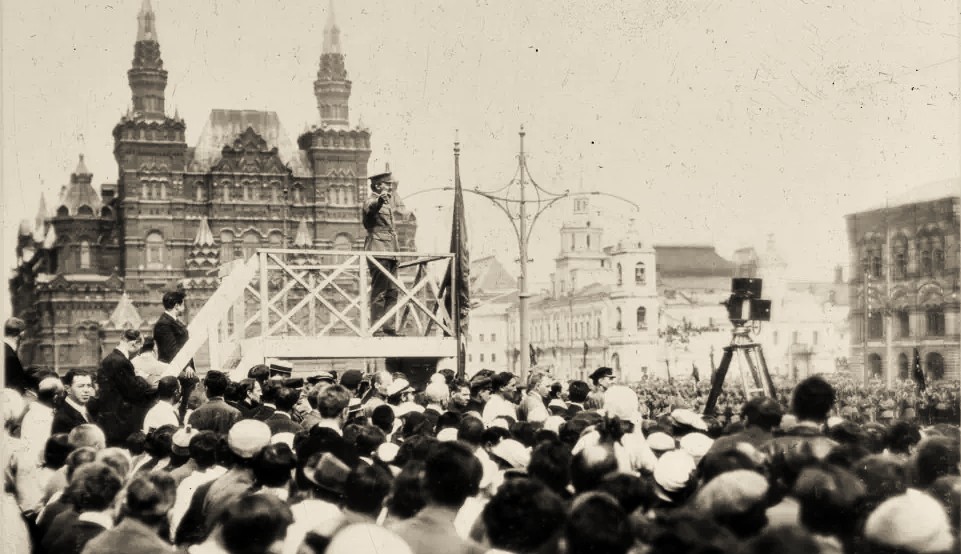
Foster is overwhelmed at the sight of the victorious Red Army marching through Red Square in ceremonies opening the Third World Congress of the Communist International.
‘The Soul of the Revolution’ by William Z. Foster from Truth (Duluth). Vol. 4 No. 34. August 26, 1921.
Moscow. Once in a while one has an experience that can never be forgotten so long as life lasts. That was my lot today (June 17, 1921). I witnessed a great Russian mass demonstration. It seemed as though I saw the soul of the revolution.
The demonstration, held in honor of the congress of the Third Communist International, which begins in a day or two, took place in the super-historic Red Square of Moscow. No more fitting place for a revolutionary gathering can be imagined. The Red Square is a large cobble-paved plaza, probably 200 yards wide by 400 yards long. Along one side of it runs the famous Kremlin wall, above which, in the interior, rise buildings literally bullet riddled from the terrible fighting during the October revolution. At the foot of the wall lie buried, in a mass grave, the hundreds of workers who gave up their lives in the revolutionary battles in Moscow. Along the other side of the Red Square stretches a great arcade, likewise torn with bullets. Once it was the scene of intense capitalistic activity, but now its many shops and offices are closed tightly and the painted names of their former occupants look down lugubriously upon a scornful world. At one end of the Square there is a magnificent revolutionary museum and at the other end the celebrated church of St. Basel, the most beautiful building in all Russia if not in the whole world. In front of this church stands the “executioner’s block” where hundreds of victims of Ivan the Terrible and other czars were beheaded. Merely to look about this famous place is to get a thrill such as the new world cannot produce. But when one sees the Red Square filled with surging revolutionary proletariat, as it was today, one’s feelings are indescribable.
The day started with a review of the Red Army, some 20,000 soldiers of which, members of the Moscow garrison, marched in and banked themselves in the Red Square. All branches of the military service were represented, including infantry, cavalry, lancers, artillery, signal corps, officers’ schools, etc. Aloft, over St. Basel’s church, hung a great “sausage” observation balloon; a score of aeroplanes skimmed in and about the heavy clouds overhead. Promptly at the scheduled time, exactly upon the stroke of 12 by the great Kremlin clock, the ceremony began. The massed bands struck up The Internationale and People’s Commissar for War Leon Trotzky, came out of the Kremlin gate to inspect the troops.
Trotzky is a man in the prime of life. He is well built and vigorous looking. He was afoot and dressed in civilian khaki without any decorations whatever. With him there came half a dozen officers, uniformed, as usual, like privates, save for small ranking marks on their lower sleeves. All walked up to the reviewing stand, where they were joined by a number of congress delegates from various countries. Together the enlarged party made the tour of the square in front of the troops. The soldier stood at “attention” (I am told that “present arms” is not in the manual of the Red Army) and each regiment chorused the greeting. “We serve the people,” as the reviewers reached it. Meanwhile the great combination band poured forth the stirring strains of The Internationale. It was a memorable scene.
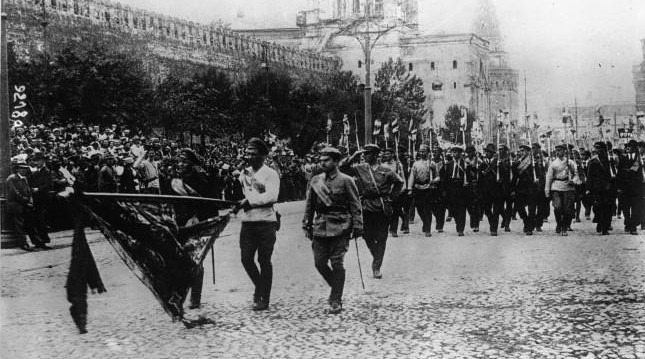
As I looked at this simple yet most impressive picture I could not help but compare it with the gorgeous reviews of imperialistic armies that I have seen in other European cities. How different the meaning of the two kinds: this one typifying the struggles for liberty, justice and humanity; the others, tyranny, slavery and brutal slaughter.
At imperialistic army reviews one usually finds officers from foreign lands who have been invited to inspect the troops. An analogy occurred at this demonstration, but instead of foreign capitalistic officers called in to observe and to learn it was working class delegates. As these went through the review with Trotsky no doubt many of them were looking forward to the day when they will be organizing similar Red Armies in their own countries now trembling on the brink of revolution.
I was particularly Interested in noticing the makeup of the army. Its morale was a marvel to the delegates, many of whom had fought in the great war. The soldiers had all the appearance of being well fed, highly trained and thoroughly equipped. For the most part they were dressed in plain khaki, although one special branch wore red trousers and another black ones. Several others had red cloth straps across their breasts. Their uniforms consisted of a sort of cloth helmet, Russian blouse with heavy leather belt, ordinary military trousers and high leather boots. Altogether they cut a smart appearance. I could not learn what make of rifles they had, but was told that most of them were French, captured from Wrangel. The soldiers had a very business-like appearance, which was especially increased by their almost in variable custom of carrying their rifles with bayonets fixed.
The officers were unique. They were conspicuous by their lack of the usual military swagger and bluster. They were quiet, efficient and human. They were the very antithesis of the old czarist army officers. Most of the Red Army officers are quite young, although they are experienced veterans. Here and there an ex-czarist officer could be seen, some of them holding high rank. Most of them could be picked out at a glance. There is something about them–a remnant of their old military training that the new working class officers do not posses. I was particularly interested in two who stood close by where I sat. One wore a sabre, evidently from the old army, for it had on it the imperialist emblems. The other officer, noticing it, pointed to the czar’s coat of arms and both smiled broadly. I wondered what thoughts were passing through their minds at this incident. The czarist officers seemed to fit in fairly well with things, although it seemed to me as I watched them narrowly that they did not come to “attention” as readily and as freely when The Internationale was played as did the new officers, who are practically all Communists.
After the review Trotsky made a speech to the troops, touching on the needs and duties of the present situation. He has a splendid ringing voice. I doubt if there was one in the vast Red Square outside the range of it. I read in one issue of the New York Times recently that he is afflicted with a cancer and in another issue that he is dying with tuberculosis. But he is the healthiest looking invalid I have seen for some time. It was a physical achievement to make one-self so distinctly heard in that great open air gathering. Representatives of several countries also made speeches. Trotsky seemed affected by the occasion, more than once he led in the cheering.
Following the speechmaking came a great parade. There must have been fully 60,000 in line. It was a combined military, naval and civil affair. In other countries the military rarely or never condescend to march with civilians. This is because they are a thing apart from the life of the people. But in Russia it is different. The Red Army is distinctly a people’s army. It is a real working class institution, as much so as the trade unions are in other countries. The people are proud of it and it is proud of them. Hence in this demonstration it was sandwiched in between a big group of civilian organizations at the head of the parade and another bunch at the rear. It fell into the middle of the parade from its inspection position in the Red Square,
The procession was kaleidoscopic in its variety. Soldiers, sailors, student officers, school children, university students, civil guards (local police). factory groups, trade unions, etc., etc. It was a veritable outpouring of the proletariat.

To me the most interesting feature of the parade was the Communist party groups from the various sections. Many of these consisted of war prisoners who have been converted to Communism. There were German, Austrian, Polish and other national divisions. Even America was represented by a body of Russians who had been in the United States. The Communist party is the brain and backbone of the Russian revolution, not to speak of its soul. Wherever there is duty or danger, there the Communists are to be found in force. In every crisis, no matter of what kind, they are called upon to bear the brunt of the struggle. For the most part their groups in the parade looked simple enough. They consisted of plain working men, without uniforms, but each one carrying a bayoneted rifle. Confirmed revolutionists and idealists to the last man, they are the shock troops of the revolution. No capitalist country possesses armed forces which, man for man, could meet them successfully in battle. The ordinary “crack” troops would melt before them. It was significant that they were given the position of honor at the head of the parade, coming before even the Red Army. In Russia the Communists are first in war and everything else. I watched them march by there were many thousands of them with more interest than I have ever bestowed on any other body of human beings in my life.
So deeply impressed was I with this great proletarian demonstration that I went home feeling that if I had done no more than witness it alone my long trip from Chicago to Moscow was well repaid.
Truth emerged from the The Duluth Labor Leader, a weekly English language publication of the Scandinavian local of the Socialist Party in Duluth, Minnesota and began on May Day, 1917 as a Left Wing alternative to the Duluth Labor World. The paper was aligned to both the SP and the IWW leading to the paper being closed down in the first big anti-IWW raids in September, 1917. The paper was reborn as Truth, with the Duluth Scandinavian Socialists joining the Communist Labor Party of America in 1919. Shortly after the editor, Jack Carney, was arrested and convicted of espionage in 1920. Truth continued to publish with a new editor JO Bentall until 1923 as an unofficial paper of the CP.
PDF of full issue: https://www.mnhs.org/newspapers/lccn/sn89081142/1921-08-26/ed-1/seq-1
 Revolution's Newsstand