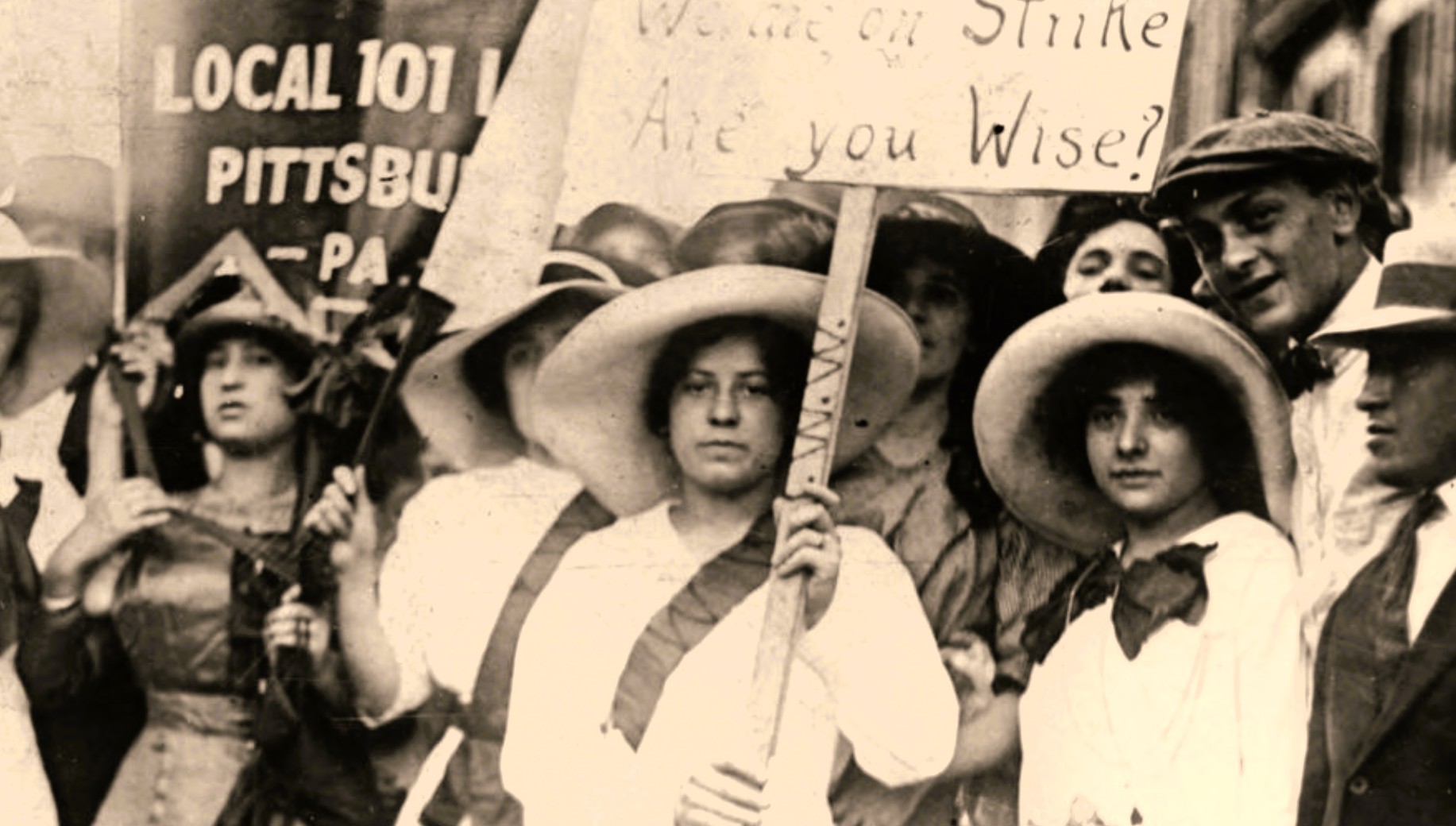
Long-time local wobbly H.A. Goff on what made Pittsburgh such an icon of exploitation and of resistance in the early 1900s.
‘Proletarian Pittsburgh’ by H.A. Goff from Solidarity. Vol. 4 No. 2. January 4, 1913.
Professor Huxley gave us the finest and most concise definition of the word “proletariat,” that is in the books He defined it thus, “The plant is the ideal proletarian–the worker who produces.”
I am writing as a proletarian, and for the proletarian only. The proletarian has no occasion to concern himself about any other component in society except his own type–“the worker who produces,” the bona fide working class. Any other divisions in society, who “sympathize” with the proletarian, and who perform their various and amazing capers upon the political and industrial fields, need not be taken at all seriously by the proletariat. In the last analysis, this breed of phrase mongers and limber-lipped blatherskites will do anything for the proletarian except get off his back.
In fact, as a matter of history, every parasite and idler in society professes an immense interest in the welfare of the worker because they all aspire to live at the expense of the worker. And, so far, In the pursuit of this noble aspirations, the idlers have been uniformly successful.
The history and experience of the proletariat shows conclusively that they cannot afford to enter into any organization or alliance with any other class or division in society. And, as history further shows, when the proletariat enter into any organization with others, they are invariably exploited for political purposes just as they are exploited for profits at the point of production.
It appears, that while the proletariat is fairly well on its guard against the great capitalist exploiter, yet it is still easily hoodwinked by the middle class. Hence it follows that the middle class has always been quick to ally itself with the proletariat. And by the sympathy dodge, the middle class has been able to impose upon the credulity of the proletariat, and thus serve the political and profit-mongering interests of the petty bourgeoisie. From almost the nascent stages of capitalism to the present, both the great capitalist exploiter and the petty bourgeois have always used the proletariat a buffer in their political and industrial battles with each other. At the same time, these political and industrial battles had their causation in the common desire of both the great capitalist and the middle class to skin the working class.
While the petty bourgeois is the economic descendant of the ancient “freedman,” yet in his modern type he is essentially the product of capitalism.
As a class these gentry have always occupied an untenable position even until this time. Not only is their position untenable, but it is even ridiculous. Their mission is to buy by the peek and bell by the pint, using short weights and measures as a necessity.
Yes! The petty bourgeoise are many of them socialists: coming in several varieties, as described in Part III of the Communist Manifesto.” But they are bourgeois socialists, who are only reactionary from the proletarian standpoint. When the proletariat finds itself within an organization that consists in part of workers, in part of petty bourgeoise, with a sprinkling of millionaires, that organization is going to exploit the proletariat.
The proletarian psychology can never dominate an organization that is not strictly proletarian. This, also, is economic determinism.
THE I.W.W.
For the first time in the history of the workers, we have in the Industrial Workers of the World an organization that is at once class conscious, revolutionary and industrial. To be sure, the I.W.W. was three years in the borning. This was because the politicians insisted on officiating as midwives.
But now that the I.W.W. has finally “arrived,” not by reason of the heroic efforts of the midwives, but rather in spite of them, the lusty infant is able to stand upon its feet, and the Egyptian destruction of Hebrew children is only equaled by the vindictive capitalist campaign against this lusty young organization that alone measures efficiently with the latest developments of capitalism.
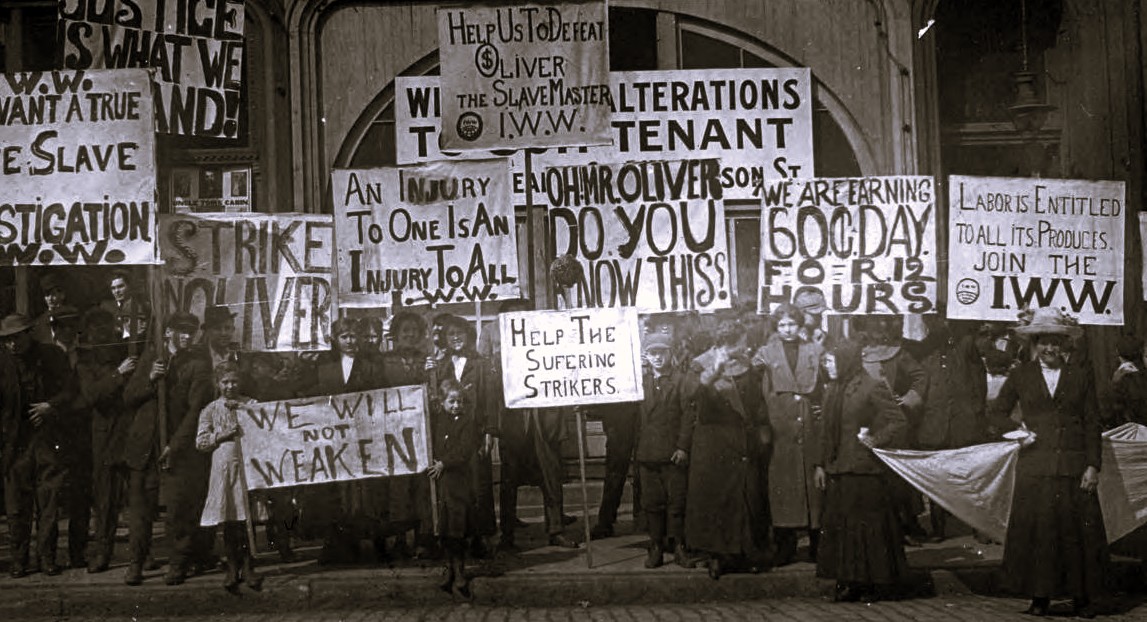
Never before has the working class openly declared an organized purpose to take over shop control. Because the I.W.W. recognizes that the socialism of the proletariat finds its birthplace at the point of production.
On the other hand, the capitalist class are well aware that if they lose shop control they lose all else with it. And with the war for shop control now well under way, it is not hard to understand that vindictive hatred of the capitalists toward the I.W.W, than which there could be no finer tribute to the character of the I.W.W.
The proposed new organization of society will either be an industrial society or the another political state. And at this point proletarian must ask himself which of these two social structures he wants and most have. To the proletarian this is a life and death question, because, as the class struggle now presents itself, the fate of the small middle class is now written, and as between the capitalist class and the proletariat, it is simply a question of self preservation. Therefore, the proletariat must choose a future form of society wherein they can exist to the best advantage.
Again history comes to our aid and reveals the fact that no political state has ever undertaken and carried out an industrial enterprise but what it has developed into state capitalism with its inevitable concomitant of state slavery. When we consider the building of Solomon’s temple; the excavating of the catacombs of ancient Rome; the pyramids of Egypt; the building of the great Chinese wall; and at present, the construction of the Panama canal, the existence of these great works can be accounted for upon no other hypothesis then the practice of state capitalism and state slavery.
Here, then, is something for the proletariat to consider very carefully, and decide whether we shall struggle for a political state or make our battle for shop control, thereby establishing an industrial society that will bring with it its own political reflex.
In the light of this history, it is clear that the I.W.W. has wisely chosen the proletarian method, and, as Joseph Dietzgen has said: “The battle must be fought out upon the economic field.”
THE I.W.W. IN PITTSBURG
The community in and about Pittsburg is one of the most conservative in the United States. But for that same reason, when the people of this community take a stand on any proposition, it is all the more significant as several historical occasions have demonstrated.
The workers of Pittsburg are very much of the same conservative temper. For a century they were the most skillful, biggest paid and most independent body of workers in the world. As a rule, the Pittsburg workers have always been union men, and nearly all of the greater craft unions have maintained their headquarters here for many years.
Pittsburg lies between immense hills of solid granite and is cut into sections by three rivers. It is crowded, dirty, has crooked streets running up hill and down. Has 750,000 of the most productive wage slaves the world has ever known. Has more multi-millionaires than any other city of its size in the world. Is much given to Pecksniflian piety. Commands the finest natural gas and soft coal fuel supply in the world. Has the only bank that never suspended specie payments during the war of 1861-5. It is the only city that ever during a strike licked the militia in a fair stand up fight. Its annual tonnage exceeds the combined tonnage of New York, Chicago and Philadelphia. It gets the smallpox oftener than any other city in the U.S. It is the home and stronghold of the U.S. steel trust Its proletarians are living 45 per cent below the normal subsistence line. Its once powerful craft unions have blown up and gone to the devil. Its industrial spy system makes the Russian police look like amateurs, and the Pennsylvania cossacks are as efficient a bunch of trained murderers as ever capitalism can desire. It has the finest Carnegie Institute in the world, into which the proletariat never enters. This city is the classic type of capitalist exploitation.
One hundred and fifty years ago, the sturdy yeomen of Western Pennsylvania began to make some very excellent whiskey. At the same time they also assembled the rich native coal, iron ore and limestone. They set up their primitive blast furnaces; their little charcoal fires; their little water power driven trip hammers, and began to turn out some as good forging iron as was ever beaten on an anvil. And what with the whiskey and the iron, Vulcan and Bacchus cavorted through the tall timber hand in hand. But this proceeding so aroused the righteous wrath of the pot-bellied Britons that in 1772 the English House of Commons was moved to declare the blast furnaces of Pennsylvania a public nuisance.
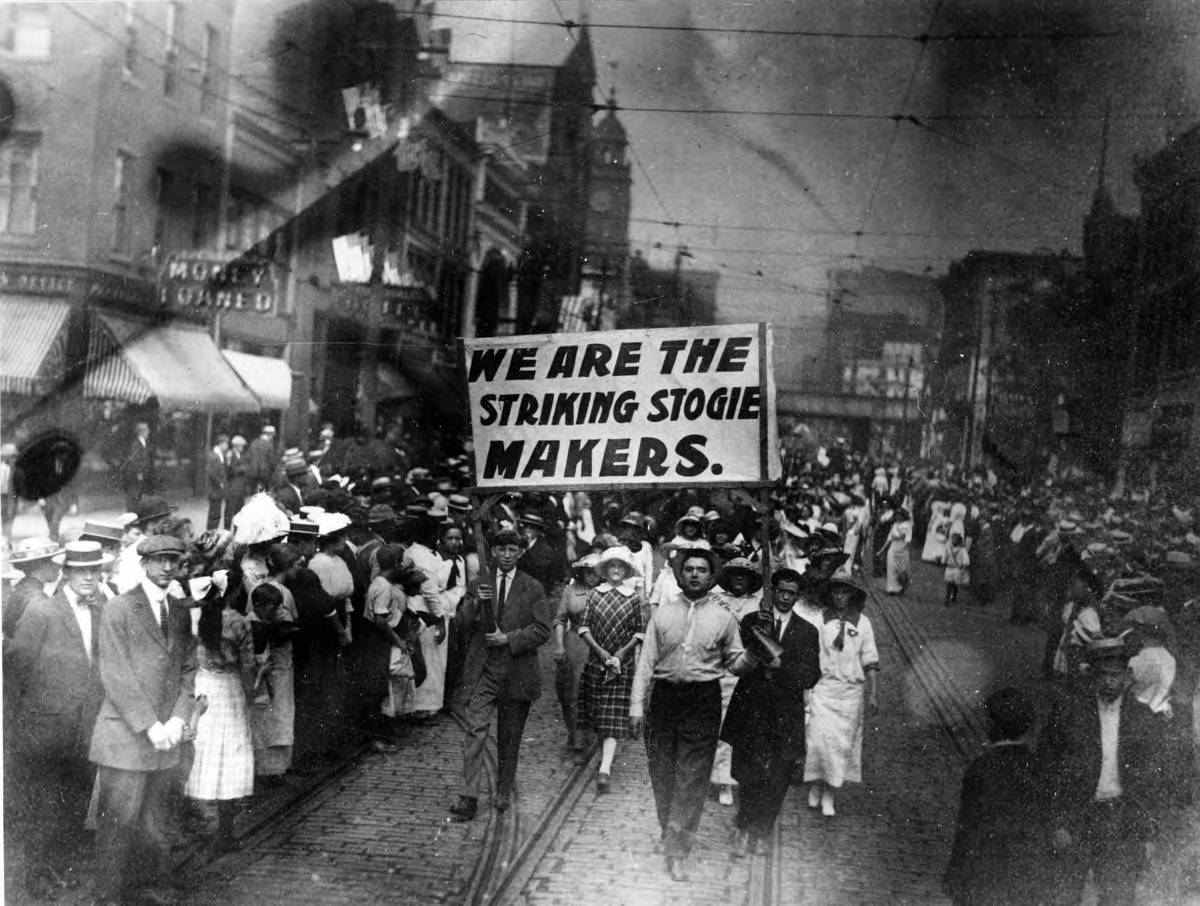
But the whiskey and the iron and steel are still being made. Now the whiskey is made by slaves and owned by the whiskey trust; and the iron and steel are made by slaves and owned by the steel trust. But the iron and steel are not nearly as good as they used to be. Neither is the whiskey. Now when we drink whiskey we get the delirium tremens; and when we work in the steel mills we die at 38 of overwork and underfeeding.
For the last 12 years the proletariat of Pittsburg has been very indifferent toward the matter of organization. As for the I.W.W., it had no standing except with some of the “foreigners.” But, in this year, the seething discontent, more or less irrational in its manifestations, has hardened into a cool determination to organize industrially. The crust of conservatism is breaking up. Under the increasing economic pressure the English speaking proletariat in getting his petty prejudices squeezed out of him.
We are learning the value of shop control, we are learning that capitalist employment is but a necessary evil, to be gotten rid of as soon as possible. We are learning that as a means of living, capitalist employment is an exploded fallacy, and only serves to prolong the workers’ misery. And so long as we continue to work for the capitalist class we furnish that class with all they want political power included.
We are learning that it does not pay to work and starve at the same time. Capitalist employment has lost nearly all incentive; and we are learning that by destroying profits we thereby destroy capitalist incentive also. We are organizing industrially for revolution, to take and bold the means of production.
Conservative Pittsburg is waking up, and through industrial unionism her influence upon the emancipation of the proletariat will be immense.
The most widely read of I.W.W. newspapers, Solidarity was published by the Industrial Workers of the World from 1909 until 1917. First produced in New Castle, Pennsylvania, and born during the McKees Rocks strike, Solidarity later moved to Cleveland, Ohio until 1917 then spent its last months in Chicago. With a circulation of around 12,000 and a readership many times that, Solidarity was instrumental in defining the Wobbly world-view at the height of their influence in the working class. It was edited over its life by A.M. Stirton, H.A. Goff, Ben H. Williams, Ralph Chaplin who also provided much of the paper’s color, and others. Like nearly all the left press it fell victim to federal repression in 1917.
PDF of full issue: https://www.marxists.org/history/usa/pubs/solidarity-iww/1913/v04n02-w158-jan-04-1913-solidarity-2pgs-damaged.pdf
 Revolution's Newsstand