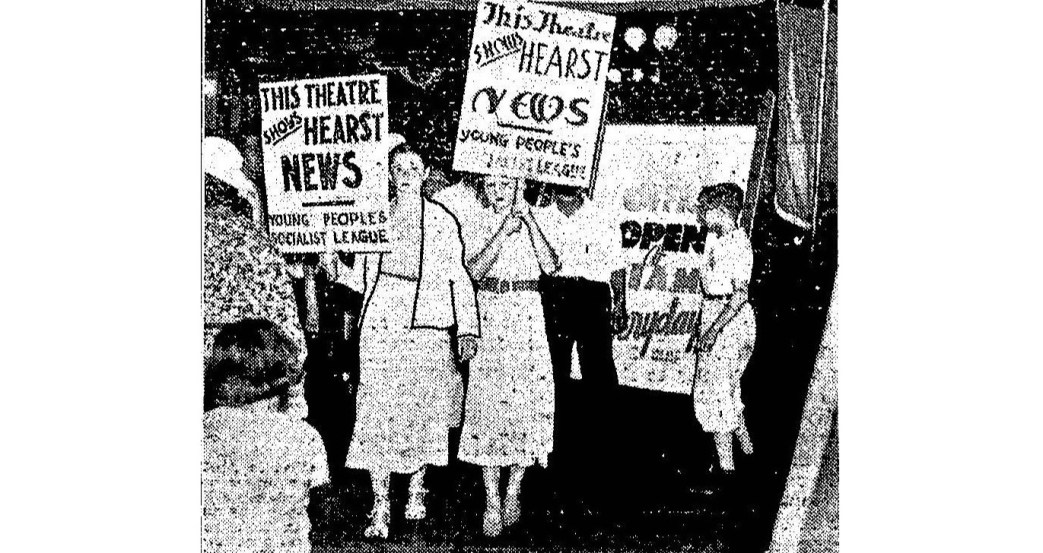
Reactionary oligarchs controlling media empires to peddle conspiracies and race-baiting is as American as apple pie.
‘Boycott Hearst Films’ by Louis Norden from New Theatre. Vol. 2 No. 7. July, 1935.
FROM his hundred-thousand acre estate at San Simeon, California, William Randolph Hearst dispatches hourly telegrams to all parts of his vast feudal domain. And, in the last few months, those telegrams have become so violent in their effects upon the working masses of America that it becomes desperately important that more words be added to the many already written, this time to tell of a new phase of Mr. Hearst’s lordly activities–his control of the motion pictures.
Hearst realizes what is happening throughout the world. He sees the growth of the dread menace of militant action by American workers. And, during the past few years, he has also seen the growth of two new media for the dissemination of propaganda to stop this growing militancy. The first of these, the motion pictures, has already shown its effectiveness during the First World War when it was in its infancy. The other, the radio, had not been born at that time. Into these two fields of “entertainment,” Hearst has just purchased his way, and the odor of his subversive propaganda is already beginning to flood America.
His radio chain already comprises six stations in carefully selected locations. They are WINS in New York, WSIN in Milwaukee, WBAL in Baltimore, WCAE in Pittsburgh, KYA in San Francisco and KELM in Los Angeles. Hearst is also purchasing time on WOR in New York and on a dozen other stations as well.
Hearst’s interest in motion pictures is not new. He has been producing under the name of Cosmopolitan Productions for years, releasing through Metro-Goldwyn-Mayer, to satisfy the demands of Marion Davies. Hearst’s Metrotone Newsreel is also released by that company through the Loew’s chain of theatres which control it.
If you believe the recent rumor that Hearst broke away from Metro because Marion Davies wanted to play the lead in The Barretts of Wimpole Street, a role which Norma Shearer also wanted–and got because she was the wife of Metro’s production chief, Irving Thalberg, you’re a great deal more gullible than I believe you to be.
The break between Hearst and Metro undoubtedly came when the chiefs of that company objected to their colleague’s blatant propaganda methods in the films. This corporation, a great deal more subtle than the raucous Willie, was forced, however, to keep Hearst’s name on the Metrotone Newsreel because of a contract, because they had just spent thousands of dollars advertising the Hearst tie-up on their new product schedule, and it was too late and too costly to change.
No longer because of Marion Davies, but because Hearst himself realizes that the motion pictures are the most important propaganda medium of modern times, he began scouting around for another company. Fox was in the hands of Chase National; Radio Pictures was owned by Rockefeller; Paramount was the object of a three-cornered fight between Kuhn, Loeb & Company, Lazard Freres, and the Atlas Investment Trust backed by the Fortington group of London. Hearst picked on Warner Brothers, who have been losing more money, year after year, than all of the other majors put together. He was their saviour; they were easy pickings for him.
Another telegram hit all of the city desks in the Hearst chain of newspapers. “Give Warners 65% of all motion picture publicity space,” it said in substance, “all other companies 35%.” The other companies are raising hell, and not getting any place. Warners get three times the blurb space of their nearest competitor; their salesmen boast of the Hearst tie-up to exhibitors, and the other companies are demanding action from their publicity counsels. Metro, Radio, Fox, Paramount, United Artists. and Columbia will probably spend fortunes in extra advertising in all Hearst publications to get back some of their precious publicity space.
THIS deal with Warners is only months old. When the papers were signed, Marion Davies’ bungalow was moved from the Metro lot to the Warner Brothers studio. Its decorative scheme necessitated the redecoration of all other bungalows on the Warner lot.
The first picture from the combination was Devil Dogs of the Air, already in production when Cosmopolitan arrived at the Warner Brothers’ studio, but Hearst took over its completion. Then came Flirtation Walk with Dick Powell, another screen recruiting poster; Dinky, with Jackie Cooper, which tried to build up the flag-waving spirit in the young; the viciously anti-labor Black Fury; G-Men, and this month, two more specials hit the screen, Oil for the Lamps of China with Pat O’Brien and Josephine Hutchinson and Stranded with Kay Francis and George Brent.
I had fully expected Oil for the Lamps of China to be a gross distortion of the novel. Just prior to its release, two Hollywood trade papers had carried stories revealing Hearst’s insistence that Warner Brothers add scenes to take the sting out of the story’s condemnation of American corporation methods. But who might have suspected that the title Stranded concealed the most violent anti-labor picture of the year, one that makes Black Fury sympathetic by comparison. Again stressing Hearst’s contention that all labor troubles are caused by “outside agitators,” Stranded further recommends that workers use violence against their militant fellows.
The boss, in the picture, very clearly enunciates what amounts to Hearst’s wish-fulfillment, when appearing at a strike meeting, collaring the militants.
“I will not turn them over to the police,” he says. “I turn them over to you as a reception committee. You know what to do with them.”
And, like a herd of wild animals, the workers rush forward to beat hell out of the trouble-makers. If this isn’t inciting to riot, I don’t know what is. To come back for the moment to Oil for the Lamps of China, the first picture on our list. The book dealt with a young man’s disillusionment with the great oil corporation for which he worked, showed him finally beaten, thrown out of his job after years of loyal slavery. The picture twists this story until we get a happy ending, the corporation fulfilling its promise to “take care of its own,” giving Stephen Crane the big job to which his work has entitled him. Hearst had it changed to prove that corporations are human after all, that profits are subordinate to “dispelling the darkness of centuries with the light of a new era,” that any man who gives his boss a full day’s work will never want for a job.
The picture portrays the Chinese people as jabbering idiots, comedy foils for the superior white race, shows the Communists ruthlessly shooting down gentle, old Chinese. It falls to pieces finally in its efforts to find a happy ending for a story that might have been one of the most important of the year.
Stranded is more evidence of Mr. Hearst’s betrayal of everything American. It tells the story of Lynn Palmer (Kay Francis), a “social worker” with the Traveler’s Aid Society who has no conception of the economic factors that created the problems of those she helps with her “sweetness and light” treatment. In love with her is Mack Hale (George Brent), boss of construction on the Golden Gate bridge. To Hale, the unemployed are bums, misfits, flawed human material which should be discarded.
The picture shows how racketeers plant these “outside agitators” on the job in order to foment trouble among the men, thus forcing the boss to pay them monthly protection money. The thugs get the workers drunk; then fired by Hale, their grievances are nursed by the sympathetic “agitators” who seize the opportunity to issue a strike call. The racketeer, Sharkey, is shown at immigration headquarters paying the bonds for several wicked-looking aliens. Hale, a good American, sees the danger in these aliens, but Lynn, only a woman, doesn’t know that aliens are agitators, believes that Sharkey is being a friend to some of his countrymen.
When Hale sees an old employee of his in a bread-line, he upbraids him for falling to such depths. After giving him money and a job, he says:
“What are you, a steel man, doing with If I ever see these no-good cast-offs? you hanging around with these bums again, I’ll thrash you within an inch of your life.”
When the men walk out on Hale, their wives come to Lynn Palmer, begging her to appeal to Hale to stop the strike. Afraid of the terrors of strike starvation, she begs for aid, briefly reviews, for middle class audiences, what Mr. Hearst hopes will prove a deterrent.
The walk-out meeting is an amazing conglomeration of lies. The agitators have been planted in the hall to get the men drunk so that they will vote to strike. The women are outside the hall praying that their husbands will not “walk out on Hale.” Brave little Lynn Palmer, bless her Hearstian soul, bravely pushes her way through the brawling, drunken workers, mounts the rostrum, delivers a speech in which she tries to tell the “truth.” The workers are ready to tear her limb from limb when Hale appears, trussed-up Sharkey in tow, and gives the workers the evidence against the “agitators.” Then Hale urges the workers to take the matter into their own hands, and the workers proceed with the righteous American thumping which Mr. Hearst is so anxious that his workers give to all of their militant leaders.
Hale and Lynn Palmer leave the hall, pass between the ranks of thankful workers’ wives and see a police patrol dash up to the curb loaded with cops whose only job will doubtless be to see that the workers don’t mete out too drastic a punishment.
PICTURE after picture, released through Warner Brothers-First National, each playing a new and more vicious role in building up the Nazi national philosophy which Hearst is attempting to force down the throats of American workers under the guise of Americanism! Picture after picture building up propaganda for a new imperialist war…libelous indictments of the laboring class to stop the wave of strike action that is our class’ only economic and political protection. Picture after picture to split our ranks, traducing the aliens who have given their lives to build America, slandering the Jews, libeling the Negroes.
This must be stopped. Hearst’s Metrotone News, distributor of subversive propaganda under the guise of fact, has already been withdrawn from Loew’s in several places in America through militant working-class action. In Amherst and Williams Colleges, students have forced its withdrawal from the screen. Action has been started at Princeton and elsewhere.
The month of July is the most effective month of the year in which to start an action to ban and boycott Warner Brothers’ pictures. It is the month when the contracts between exhibitors and producers expire, when new contracts are signed. All workers, through factory and mass organizations, can hit Warners and Hearst by immediately petitioning managers of local theatres to withdraw the Warner Brothers product, to refuse to renew their contracts. Every theatre showing one of their pictures should be continuously picketed. Leaflets should be distributed everywhere to build mass action.
Hearst, today, is the representative of the workers’ enemies. He has taken upon himself, through newspapers, magazines, radio and motion pictures, the task of the fascisization of America. He can be stopped from achieving his ends by the very militant action which he most fears. Boycott Hearst and Warner Brothers now–before it is too late.
The New Theatre continued Workers Theater. Workers Theater began in New York City in 1931 as the publication of The Workers Laboratory Theater collective, an agitprop group associated with Workers International Relief, becoming the League of Workers Theaters, section of the International Union of Revolutionary Theater of the Comintern. The rough production values of the first years were replaced by a color magazine as it became primarily associated with the New Theater. It contains a wealth of left cultural history and ideas. Published roughly monthly were Workers Theater from April 1931-July/Aug 1933, New Theater from Sept/Oct 1933-November 1937, New Theater and Film from April and March of 1937, (only two issues).
PDF of full issue: https://www.marxists.org/history/usa/pubs/workers-theatre/v2n07-jul-1935-New-Theatre.pdf
 Revolution's Newsstand