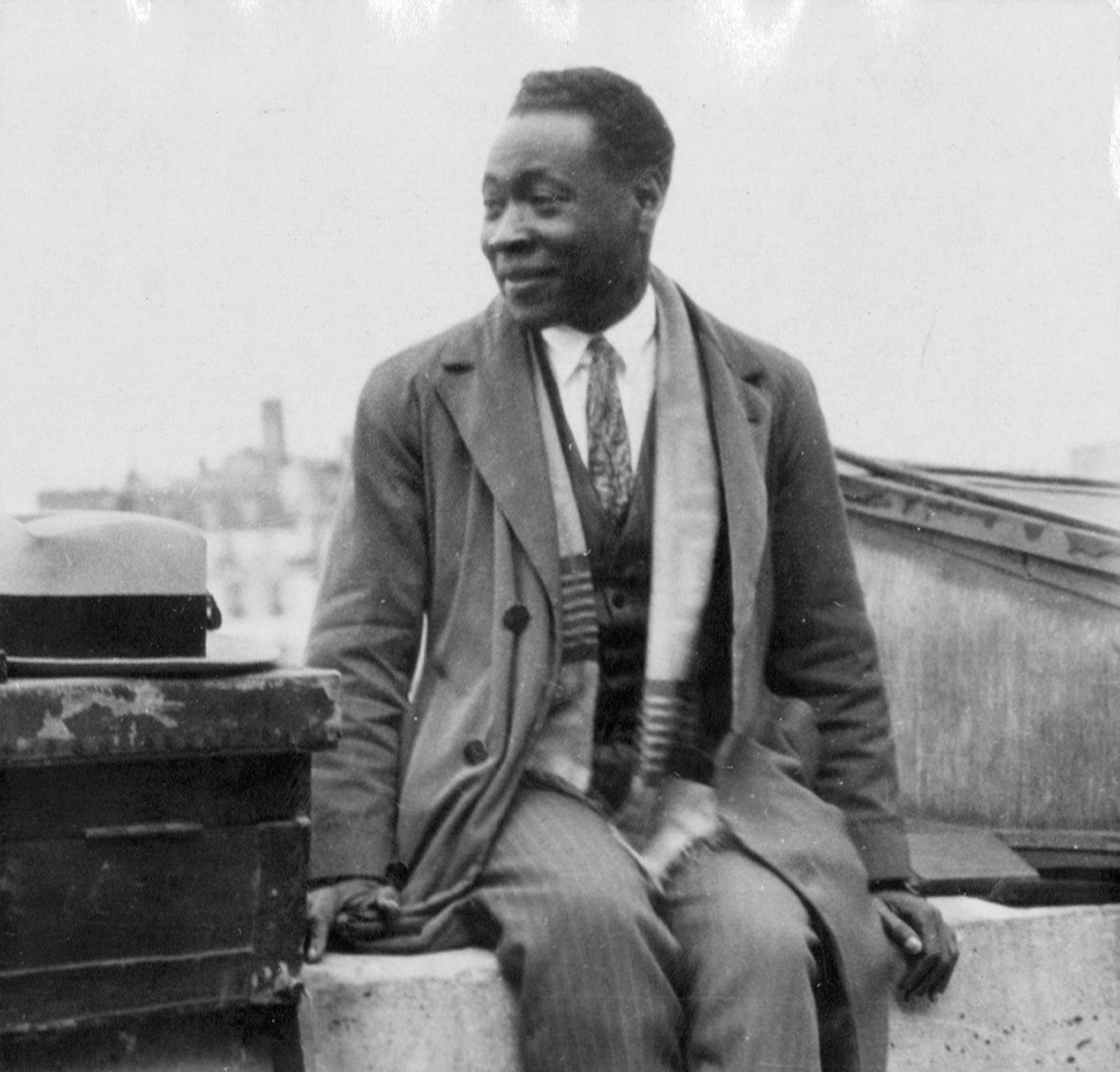
The full collection of Claude McKay’s poems published in The Liberation between 1919 and 1923, including The Negro Dancers, The Barrier, After the Winters, A Capitalist at Dinner, The Little Peoples, The Roman Holiday, If We Must Die, Spring in New Hampshire, The Tired Worker, In Bondage, A Memory of June, Subway Wind, Flirtation, Africa, To One Coming North, Jasmines, Morning Joy, America, Thirst, Through Agony, Negro Spiritual, The White House, To the Intrenched Classes, The Night Fire, and Petrograd: May Day, 1923. Introduced by Max Eastman.
The Complete Liberator Poems, 1919-1923 by Claude McKay.
Claude McKay by Max Eastman. July, 1919.
WE HAVE the good fortune to publish this month a page of sonnets and songs by a negro poet practically unknown to the public, who seems to have a greater and more simple and strong gift of poetry than any other of his race has had. Claude McKay is a native of Jamaica, who came to this country seven years ago to study scientific agriculture. He graduated from an agricultural college in the west, but for reasons that I suppose are personal did not return, as he had planned, to his own lazy island. He stayed in America, living the active life of the northern negroes, only with a more wandering will and more song on his lips.
At the time when these poems were written he was a waiter in a dining-car–a position from which he was able to see a great many things and understand them with a bold and unhesitating mind. His attitude toward life is like Shelley’s, free and yet strenuously idealistic. I think his conscience is a little more austere in matters of social conduct than in matters of art. I wish he would write more poems as mettle- some and perfectly chiselled throughout, as some of his stanzas are. And I think he will, for he is young and he has arrived at the degree of power and skill revealed in these poems practically without encouragement or critical help. To me they show a fine clear flame of life burning and not to be forgotten.
Sonnets and Songs. July, 1919.
THE NEGRO DANCERS.
I.
IT with cheap colored lights a basement den,
With rows of chairs and tables on each side,
And, all about, young, dark-skinned women and men
Drinking and smoking, merry, vacant-eyed.
A Negro band, that scarcely seems awake,
Drones out half-heartedly a lazy tune,
While quick and willing boys their orders take
And hurry to and from the near saloon.
Then suddenly a happy, lilting note
Is struck, the walk and hop and trot begin,
Under the smoke upon foul air afloat;
Around the room the laughing puppets spin
To sound of fiddle, drum and clarinet,
Dancing, their world of shadows to forget.
II.
‘Tis best to sit and gaze; my heart then dances
To the lithe bodies gliding slowly by,
The amorous and inimitable glances
That subtly pass from roguish eye to eye,
The laughter gay like sounding silver ringing,
That fills the whole wide room from floor to ceiling,–
A rush of rapture to my tried soul bringing–
The deathless spirit of a race revealing.
Not one false step, no note that rings not true!
Unconscious even of the higher worth
Of their great art, they serpent-wise glide through
The syncopated waltz. Dead to the earth
And her unkindly ways of toil and strife,
For them the dance is the true joy of life.
III.
And yet they are the outcasts of the earth,
A race oppressed and scorned by ruling man;
How can they thus consent to joy and mirth
Who live beneath a world-eternal ban?
No faith is theirs, no shining ray of hope,
Except the martyr’s faith, the hope that death
Some day will free them from their narrow scope
And once more merge them with the infinite breath.
But, oh! they dance with poetry in their eyes
Whose dreamy loveliness no sorrow dims,
And parted lips and eager, gleeful cries,
And perfect rhythm in their nimble limbs.
The gifts divine are theirs, music and laughter;
All other things, however great, come after.
THE BARRIER.
I MUST not gaze at them although
Your eyes are dawning day;
I must not watch you as you go
Your sun-illumined way;
I hear but I must never heed
The fascinating note,
Which, fluting like a river-reed,
Comes from your trembling throat;
I must not see upon your face
Love’s softly glowing spark;
For there’s the barrier of race,
You’re fair and I am dark.
AFTER THE WINTERS.
SOME day, when trees have shed their leaves,
And against the morning’s white
The shivering birds beneath the eaves
Have sheltered for the night,
We’ll turn our faces southward, love,
Toward the summer isle
Where bamboos spire the shafted grove
And wide-mouthed orchids smile.
And we will seek the quiet hill
Where towers the cotton tree,
And leaps the laughing crystal rill,
And works the droning bee.
And we will build a lonely nest
Beside an open glade,
And there forever will we rest,
O love-O nut-brown maid!
A CAPITALIST AT DINNER.
AN ugly figure, heavy, overfed,
Settles uneasily into a chair;
Nervously he mops his pimply pink bald head,
Frowns at the fawning waiter standing near.
The entire service tries, its best to please
This overpampered piece of broken-health,
Who sits there thoughtless, querulous, obese,
Wrapped in his sordid visions of vast wealth.
Great God! if creatures like this money-fool,
Who hold the service of mankind so cheap,
Over the people must forever rule,
Driving them at their will like helpless sheep–
Then let proud mothers cease from giving birth;
Let human beings perish from the earth.
THE LITTLE PEOPLES
THE little peoples of the troubled earth,
The little nations that are weak and white;–
For them the glory of another birth,
For them the lifting of the veil of night.
The big men of the world in concert met,
Have sent forth in their power a new decree:
Upon the old harsh wrongs the sun must set,
Henceforth the little peoples must be free!
But we, the blacks, less than the trampled dust,
Who walk the new ways with the old dim eyes,–
We to the ancient gods of greed and lust
Must still be offered up as sacrifice:
Oh, we who deign to live but will not dare,
The white world’s burden must forever bear!
A ROMAN HOLIDAY
‘TIS but a modern Roman holiday;
Each state invokes its soul of basest passion,
Each vies with each to find the ugliest way
To torture Negroes in the fiercest fashion.
Black Southern men, like hogs await your doom!
White wretches hunt and haul you from your huts,
They squeeze the babies out your women’s womb,
They cut your members off, rip out your guts!
It is a Roman holiday, and worse:
It is the mad beast risen from his lair,
The dead accusing years’ eternal curse,
Reeking of vengeance, in fulfilment here.
Bravo Democracy! Hail greatest Power
That saved sick Europe in her darkest hour!
IF WE MUST DIE
IF we must die-let it not be like hogs
Hunted and penned in an inglorious spot,
While round us bark the mad and hungry dogs,
Making their mock at our accursed lot.
If we must die–oh, let us nobly die,
So that our precious blood may not be shed
In vain; then even the monsters we defy
Shall be constrained to honor us though dead!
Oh, kinsmen! We must meet the common foe;
Though far outnumbered, let us still be brave,
And for their thousand blows deal one death-blow!
What though before us lies the open grave?
Like men we’ll face the murderous, cowardly pack,
Pressed to the wall, dying, but–fighting back!
Negro Poems. August, 1919.
SPRING IN NEW HAMPSHIRE
Too green the springing April grass,
Too blue the silver-speckled sky,
For me to linger here, alas,
While happy winds go laughing by,
Wasting the golden hours indoors,
Washing windows and scrubbing floors.
Too wonderful the April night,
Too faintly sweet the first May flowers,
The stars too gloriously bright,
For me to spend the evening hours,
When fields are fresh and streams are leaping,
Wearied, exhausted, dully sleeping.
THE TIRED WORKER
O WHISPER, O my soul!–the afternoon
Is waning into evening–whisper soft!
Peace, O my rebel heart! for soon the moon
From out its misty veil will swing aloft!
Be patient, weary body, soon the night
Will wrap thee gently in her sable sheet,
And with a leaden sigh thou wilt invite
To rest thy tired hands and aching feet…
The wretched day was theirs, the night is mine;
Come, tender sleep, and fold me to thy breast…
But what steals out the gray clouds red like wine?
O dawn! O dreaded dawn! O let me rest!
Weary my veins, my brain, my life,–have pity!
No! Once again the hard, the ugly city.
Poems. August, 1921.
IN BONDAGE
I would be wandering in distant fields
Where man, and bird, and beast, lives leisurely,
And the old earth is kind, and ever yields
Her goodly gifts to all her children free;
Where life is fairer, lighter, less demanding,
And boys and girls have time and space for play
Before they come to years of understanding–
Somewhere I would be singing, far away.
For life is greater than the thousand wars
Men wage for it in their insatiate lust,
And will remain like the eternal stars
When all that is to-day is ashes and dust.
But I am bound with you in your mean graves,
Oh black men, simple slaves of ruthless slaves.
A MEMORY OF JUNE
WHEN June comes dancing o’er the death of May,
With scarlet roses tinting her green breast,
And mating thrushes ushering in her day,
And Earth on tiptoe for her golden guest,
I always see the evening when we met–
The first of June baptised in tender rain–
And walked home through the wide streets, gleaming wet,
Arms locked, our warm flesh pulsing with love’s pain.
I always see the cheerful little room,
And in the corner, fresh and white, the bed,
Sweet scented with a delicate perfume,
Wherein for one night only we were wed;
Where in the starlit stillness we lay mute,
And heard the whispering showers all night long,
And your brown burning body was a lute
Whereon my passion played his fevered song.
When June comes dancing o’er the death of May,
With scarlet roses staining her fair feet,
My soul takes leave of me to sing all day
A love so fugitive and so complete.
SUBWAY WIND
FAR down, down through the city’s great, gaunt gut
The grey train rushing bears the weary wind;
In the packed cars the fans the crowd’s breath cut,
Leaving the sick and heavy air behind.
And pale-cheeked children seek the upper door
To give their summer jackets to the breeze;
Their laugh is swallowed in the deafening roar
Of captive wind that moans for fields and seas;
Seas cooling warm where native schooners drift
Through sleepy waters where gulls wheel and sweep,
Waiting for windy waves their keels to lift
Lightly among the islands of the deep;
Islands of lofty palm trees blooming white
That lend their perfume to the tropic sea,
Where fields lie idle in the dew-drenched night,
And the Trades float above them fresh and free.
FLIRTATION
UPON thy purple mat thy body bare
Is fine and limber like a tender tree.
The motion of thy supple form is rare,
Like a lithe panther lolling languidly,
Toying and turning slowly in her lair.
Oh, I would never ask for more of thee,
Thou art so clean in passion and so fair.
Enough! if thou wilt ask no more of me!
AFRICA
THE sun sought thy dim bed and brought forth light,
The sciences were sucklings at thy breast;
When all the world was young in pregnant night
Thy slaves toiled at thy monumental best;
Thou ancient treasure-land, thou modern prize,
New peoples marvel at thy pyramids;
The years roll on, thy sphinx of riddle eyes
Watches the mad world with immobile lids;
The Hebrews humbled them at Pharaoh’s name;
Cradle of Power! Yet all things were in vain!
Honour and Glory, Arrogance and Fame!
They went. The darkness swallowed thee again.
Thou art the harlot, now thy time is done,
Of all the mighty nations of the sun.
TO ONE COMING NORTH
AT first you’ll joy to see the playful snow,
Like white moths trembling on the tropic air,
Or waters of the hills that softly flow
Gracefully falling down a shining stair.
And when the fields and streets are covered white
And the wind-worried void is chilly, raw,
Or underneath a spell of heat and light
The cheerless frozen spots begin to thaw,
Like me you’ll long for home, where birds’ glad song
Means flower-filled lanes and leas and spaces dry,
And tender thoughts and feelings fine and strong,
Beneath a vivid silver-flecked blue sky.
But oh! more than the changeless Southern isles,
When Spring has shed upon the earth her charm,
You’ll love the Northland wreathed in golden smiles
By the miraculous sun turned glad and warm.
JASMINES
YOUR scent is in the room.
Swiftly it overwhelms and conquers me!
Jasmines, night jasmines, perfect of perfume,
Heavy with dew before the dawn of day!
Your face was in the mirror. I could see
You smile and vanish suddenly away,
Leaving behind the vestige of a tear.
Sad suffering face, from parting grown so dear!
Night jasmines cannot bloom in this cold place;
Without the street is wet and weird with snow;
The cold nude trees are tossing to and fro;
Too stormy is the night for your fond face,
For your low voice too loud the wind’s mad roar.
But Oh, your scent–jasmines, jasmines that grow
Luxuriant, clustered round your cottage door!
MORNING JOY
AT night the wide and level stretch of wold,
Which at high noon had basked in quiet gold,
Far as the eye could see was ghostly white;
Dark was the night save for the snow’s weird light.
I drew the shades far down, crept into bed;
Hearing the cold wind moaning overhead
Through the sad pines, my soul, catching its pain,
Went sorrowing with it across the plain.
At dawn, behold! the pall of night was gone,
Save where a few shrubs melancholy, lone,
Detained a fragile shadow. Golden-lipped
The laughing grasses heaven’s sweet wine sipped.
The sun rose smiling o’er the river’s breast,
And my soul, by his happy spirit blest,
Soared like a bird to greet him in the sky,
And drew out of his heart Eternity.
Four Sonnets. December, 1921.
AMERICA
ALTHOUGH she feeds me bread of bitterness,
And sinks into my throat her tiger’s tooth,
Stealing my breath of life, I will confess
I love this cultured hell that tests my youth!
Her vigor flows like tides into my blood,
Giving me strength erect against her hate.
Her bigness sweeps my being like a flood.
Yet as a rebel fronts a king in state,
I stand within her walls with not a shred
Of terror, malice nor even a word of jeer.
Darkly I gaze into the days ahead
To see her might and granite wonders there,
Beneath the touch of Time’s unerring hand,
Like ancient treasures buried in the sand.
THIRST
MY spirit wails for water, water now!
My tongue is aching dry, my throat is hot
For water; fresh rains shaken from a bough,
Or dawn dews heavy in some leafy spot.
My hungry body’s burning for a swim
In sunlit water where the air is cool,
As in Trout Valley where upon a limb
The golden finch sings softly to the pool.
Oh, water, water, when the night is done,
When day steals grey-white through the window-pane,
Clear silver water when I wake, alone,
All impotent and stupefied of brain;
Pure water from some forest fountain first,
To wash me, cleanse me, and to quench my thirst!
THROUGH AGONY
ALL night, through the eternity of night,
Pain was my portion, though I could not feel.
Deep in my humbled heart you ground your heel,
Till I was reft’ of even my inner light,
Till reason from my mind had taken flight,
And all my world went whirling in a reel,
And all my swarthy strength turned cold like steel,
A passive mass beneath your puny might.
Last night I gave you triumph over me,
So I should be myself as once before
I marveled at your shallow mystery,
And haunted hungrily your temple door.
I gave you sum and substance to be free,
Oh, you shall never triumph any more!
II
I am not afraid to face the fact and say,
How darkly dull my living hours have grown,
My wounded heart sinks heavier than stone
Because I loved you longer than a day!
I am not ashamed to turn myself away
From beckoning flowers beautifully blown,
To mourn your vivid memory alone
In mountain fastnesses austerely gray.
The mists will shroud me on the utter height,
The salty, brimming waters of my breast
Will mingle with the fresh dews of the night
To bathe my spirit hankering to rest.
But after sleep I’ll wake with greater might,
Once more to venture on the eternal quest.
Spring Sonnets. May, 1922.
NEGRO SPIRITUAL
THEY’VE taken thee out of the simple soil,
Where the warm sun made mellowy thy tones
And voices plaintive from eternal toil,
Thy music spoke in liquid lyric moans;
They’ve stolen thee out of the brooding wood,
Where scenting bloodhounds caught thy whispered note,
And birds and flowers only understood
The sorrow sobbing from a choking throat;
And set thee in this garish marble hall
Of faces hard with conscience-worried pride,
Like convicts witnessing a carnival,
For whom an alien vandal mind has tried
To fashion thee for virtuoso wonders,
Drowning thy beauty in orchestral thunders.
THE WHITE HOUSE
YOUR door is shut against my tightened face,
And I am sharp as steel with discontent;
But I possess the courage and the grace
To bear my anger proudly and unbent.
The pavement slabs burn loose beneath my feet,
And passion rends my vitals as I pass,
A chafing savage, down the decent street,
Where boldly shines your shuttered door of glass.
Oh I must search for wisdom every hour,
Deep in my wrathful bosom sore and raw,
And find in it the superhuman power
To hold me to the letter of your law!
Oh I must keep my heart inviolate,
Against the poison of your deadly hate!
TO THE INTRENCHED CLASSES
YOUR power is legion, but it cannot crush,
Because my soul’s foundation is cast-steel,
And myriads of unseen bodies rush
From hidden bowers and shrines my wounds to heal.
Your petty irritants are tiny spears
That cannot pierce through my protecting mail
To mortal hurt, and all your Bourbon fears,
Quite warrantable, never will avail.
Mine is the future grinding down today,
Like a great landslip moving to the sea,
Bearing its freight of debris far away,
Where the green hungry waters restlessly
Heave mammoth pyramids and break and roar
Their eerie challenge to the crumbling shore.
THE NIGHT FIRE
NO engines shrieking rescue storm the night,
And hose and hydrant cannot here avail,
The flames laugh high and fling their challenging light,
And clouds turn gray and black from silver-pale.
The fire leaps out and licks the ancient walls,
And the big building bends and twists and groans.
A bar drops from its place; a rafter falls
Burning the flowers. The wind in frenzy moans.
The watchers gaze held wondering by the fire,
The dwellers cry their sorrow to the crowd,
The flames beyond themselves rise higher, higher,
To lose their glory in the frowning cloud,
Yielding at length the last reluctant breath;
And where life lay asleep broods darkly death.
Petrograd: May Day, 1923. August, 1923.
THE Neva moves majestically on,
The sun-rays playing on her breast at seven,
From her blue breast all winter’s snow-slabs gone.
Now ripples curl where yesterday lay riven
Great silver oblongs chiselled by the hand
Of Spring that bellies through earth’s happy womb,
To glad and flower the long, long pregnant land.
Where yesterday a veil of winter gloom
Shrouded the city’s splendid face,–today
All life rejoices for the first of May!
The Nevsky glows ablaze with regal red,
Symbolic of the triumph and the rule
Of the new Power lifting high its head
Above the place where once a sceptered fool
Was mounted by the plunderers of men
To awe the plundered while they schemed and robbed.
The marchers shout again, again, again!
The stones where once the hearts of martyrs sobbed
Their blood are sweet unto their feet today
In celebration of the First of May.
Cities are symbols of man’s forward reach,
Man drawing near to man in close commune.
And mighty cities mighty lessons teach
Of man’s decay or progress, late or soon.
And many an iron-towered Babylon,
Beneath the quiet golden breath of Time,
Has vanished like the snow under the sun,
Leaving no single mark in stone or rhyme
To flame the lifted heart of man today
As Petrograd upon the First of May.
Oh many a thoughtful romance-seeking boy,
Slow-fingering the leaves of ancient glory,
Is stirred to rapture by the tales of Troy,
And each invigorate, vein-tingling story
Of Egypt and of Athens and of Rome,
Where slaves long toiled for knights and kings to reap.
But in the years, the wondrous years to come,
The heart of Youth in every clime will leap
For Russia that first made national the day
The world-wide workers’ day–the First of May.
Jerusalem is fading from men’s mind,
And Christmas from its universal thrall
Shall free the changing spirit of mankind:
The First of May the holy day for all!
And Petrograd, the proud, triumphant, city,
The gateway to the new awakening East–
Where warrior-workers wrestled without pity–
Against the powers of magnate, monarch, priest!
World Fort of Struggle! each day’s a First of May
To learn of thee to strive for Labor’s Day.
The Liberator was published monthly from 1918, first established by Max Eastman and his sister Crystal Eastman continuing The Masses, was shut down by the US Government during World War One. Like The Masses, The Liberator contained some of the best radical journalism of its, or any, day. It combined political coverage with the arts, culture, and a commitment to revolutionary politics. Increasingly, The Liberator oriented to the Communist movement and by late 1922 was a de facto publication of the Party. In 1924, The Liberator merged with Labor Herald and Soviet Russia Pictorial into Workers Monthly. An essential magazine of the US left.
 Revolution's Newsstand