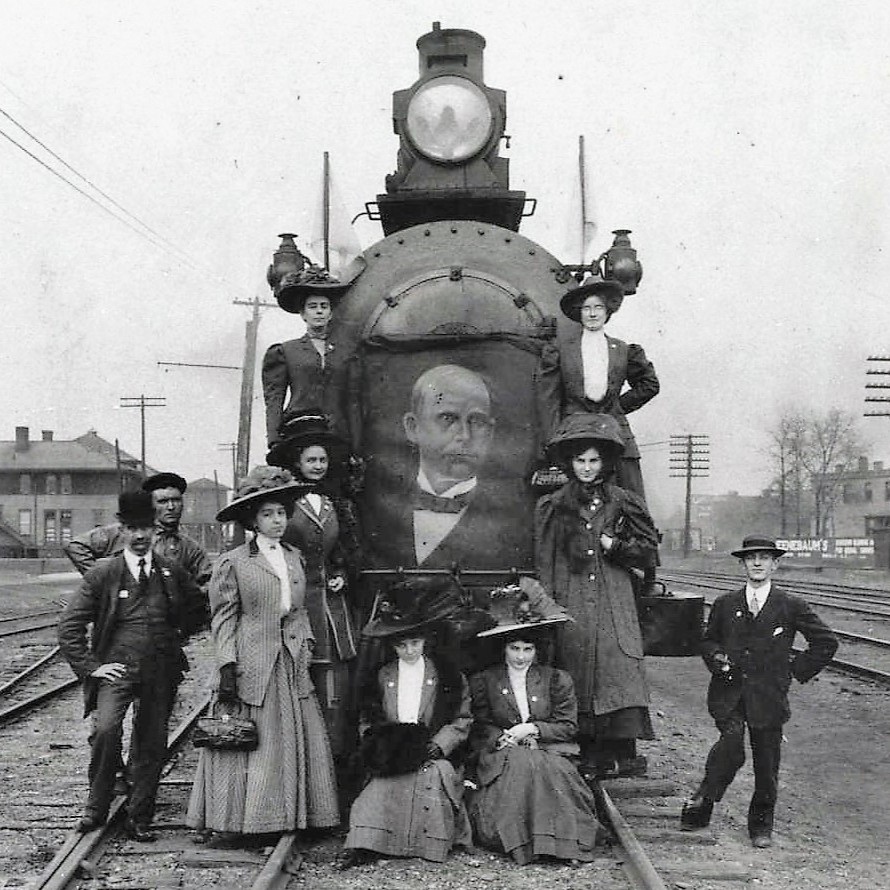
Heading back East from its Western leg, the 1908 campaign tour of the Red Special gave out multiple daily updates of its journey.
‘The Red Special in the Land of Wheat’ from The Chicago Daily Socialist. Vol. 2 No. 280. September 24, 1908.
WORKERS GIVE DEBS A BANQUET
Hancock Event Marks End of First 9,000 Miles of “Red Special” Trip
Hancock, Mich., Sept. 23. The Socialist “Red Special” closed a busy day with a big meeting and a banquet tonight. The banquet was given to Eugene V. Debs, the presidential candidate, and the “Red Special” party, by the Socialists of Hancock.
At Houghton, not far from Hancock, earlier in the evening, a small hall was packed to the doors. At Hancock Debs was welcomed with a big demonstration.
In Forest Fire District
Today the “Red Special” is in the midst of the forest fire section of Michigan. No delays, however, are anticipated.
The train yesterday completed 9,000 miles. Up to date it is announced that 50,000 coins have been received in contributions to help send the train eastward.
Debs has his eye on the eastern trip and says he expects the tour to be a series of the greatest labor demonstrations in political history.
Reaches Chicago Friday
The “Red Special” will arrive in Chicago at 6 o’clock Friday morning, but will stay only a short while, departing on its eastern schedule at 10 o’clock.
THROUGH THE LAND OF WHEAT BY OTTO McFEELY
Earnest Socialist Workers Found by Crew of Red Special”
New Ulm. Minn., Sept. 20. In some respects yesterday was one of the weakest days of the twenty the “Red Special” has been on the road, and yet, as it is reviewed, the events appear to indicate that Debs will poll a great vote in November.
Saturday was spent in the newly opened country of South Dakota. Two years ago there was no railroad, the line over which we run having been put into commission less than a year ago. At all the small prairie towns there were crowds, and scores of men told us they had driven all the way from a hundred miles down to see the “Red Special”, hear Debs and get some Socialist literature.
Crowds at All Points
Among the stops yesterday were Lead, Deadwood, Sturgis, Rapid City, Owanka, Wasta, Philip and Pierre. At every other village there were crowds and as the train went flying past shouts came into the windows. If the “Red Special” were to run a year it could not stop at all the places where active Socialists had gathered crowds on the mere hope of a few moments of connection with the great international movement.
Two thousand miners and middle class folk stood on the mountain side at Lead and heard Debs. Freeman Knowles, well known in the Socialist movement, opened the meeting. The meeting was held between 11 and 12 o’clock. Electric cars took the band and the speakers from the special just outside of Deadwood and up the mountain to Lead, a larger and more active center.
Has Socialist Daily
The Daily Register, published in Lead by W.C. Benter, is a Socialist publication. The party has two men in the city council and expects to elect number of county officers in the fall. Benter has had a hard run, but is at last winning out, and his paper is supreme in the local field. C.F. Saurbrum, a loan cartoonist, is one of the best in the business and his admirers predict a great future for him.
Wayne Pratt of Lead, a contracting gravel roofer, and R.C. Bickert, a section hand of Rapid City, were passengers on the train. Bickert laid off two weeks to arrange the meeting at Rapid City, Pratt is tireless in spreading the propaganda and will start a movement to have a number of good meetings next winter. He wants Arthur Morrow Lewis to come to Lead again.
Five Young Planters
At Philip, a little prairie town that has grown up in a year, five young planters came aboard. They live 35 miles in the country. Away out on the plains, where there is not a group of houses within 30 miles, they have a strong Socialist local. They were LeRoy Hixon, Oscar Helgeson, Wayne C. Hixon, Ulysses Anderson and Elza G. Anderson. They are all candidates for office in their county, which is larger than the state of Massachusetts. They own quarter sections adjoining and farm co-operatively. They have formed a center that promises to make all the new country Socialistic within a few years.
These young men, the flower of the west, are with the Socialist party with their money, their lives and their sacred honor. They are types of thousands scattered over the country traversed by the Red Special. What this means for human welfare can be plainly seen from the train–it means that there soon is to be a new deal and the worker will hold the winning hand.
Huron Crowd at 4 A.M.
At New Ulm and Mankato meetings of from 1,500 to 2,000 were held. At 4 o’clock this morning the entire party was awakened by the hundred men who had waited at Huron. They demanded a speech, but all hands, exhausted by night and day work for three weeks, refused to move. Human machines even in the Socialist movement run down, and last night after the big meeting at Pierre, which ended after midnight, every one from Debs to the porter was exhausted.
Beecher Moore, Socialist candidate for governor, joined the train at Sleepy Eye. He spoke there last night on the street for an hour and a half and on the platform of the railway station this morning, holding the crowd of a thousand. The train stopped but a moment, however, and men who had driven twenty-five miles were disappointed.
Six Six-Foot Brothers
Moore says the party will carry Ros Beau county, Minn. Six brothers in that county, the Rassmussens, are the center of a great rural movement. The Rasmussen boys are each over six feet in height and some are six-feet four inches. They own a thousand acres of land and farm it together. They are famous for their crops and are men who stand up in the community figuratively as they do in fact.
W.W. Swan of Frankfort, B.D., and his five-year-old son, William Garrison Swan, a fine boy, came aboard at New Swan in a manly way that promises much, walked into Debs little den and handed him $5 for the “Red Special.” The boy is the pet of the train crowd today. He will go with his father to St. Paul. William and his father are farmers.
William F. Anderson of Mankato is aboard. He was one of the active workers in organizing the meeting this morning.
Old Veterans Are Busy
At New Ulm Socialist literature was being given away by fine looking man whose gray hair and beard showed him to be full of years. He wore the garb of the G.A.R. and the decoration. At almost every stop we see these veterans who fought against chattel slavery and the rule of the slave owners working for the abolition of wage slavery.
It is said “blood will tell,” and it seems to tell among the men who as boys offered their lives in the successful effort to make America free. Since that day the form of slavery has changed, but the old soldiers are still on the firing line with Socialist bombs in the shape of books and papers.
HOW CROWD WAITED FOR DEBS BY LEWIS J. DUNCAN
Montana Man Writes of Delayed Meetings at Missoula and Butte
Butte, Mont., Sept. 23. Delayed, by a wrecked freight in Idaho and running on slow orders the “Red Special” arrived six hours late in Missoula Between 1 and 3 p.m. the people commenced gathering at the Missoula depot. At 3 p.m. I seized the opportunity to discuss the issues of the campaign and the proposals of the Socialist party with the crowd, which at that time numbered about 500 people. They gave good attention. After talking an hour I informed them of the delay and that the Special” was expected at 5 p.m. and urged them to come at that time and bring their neighbors. They did so. At 6 p.m. there were at least a thousand people waiting.
Crowd Waits Patiently
The bulletin announced that the Special would arrive at 7; then at 7:30, then at and still the people waited patiently and the size of the crowd grew steadily. When at last the 3:20 the train pulled into the depot, six hours behind time, there were at least 5,000 or 6,000 people to greet Debs. The stop at Missoula was lengthened by the railroad company to more than an hour. The speaking was interrupted and the crowd divided by the coming in and going out of passenger and freight trains, but Debs kept right on talking, and each time the way was made the eager people surged back across the tracks to hear his arraignment of the old parties and eloquent pleas for Socialism. Every rapier-like idiom was greeted with cheers. One plucky young woman pushed her way through the mass of people to the rear platform of the train to shake Debs hand. She got his hand and said “God bless you.” A little girl climbed on to platform to pat his back as he was talking and went away satisfied. As the train pulled out the crowd ran after, cheering and scores of workingmen reached up to seize the ready hand of their champion and to bid him godspeed.
A Stirring Scene
It was a stirring scene and a most remarkable one for conservative Missoula, where corporation influences are very strong and make the workers timid about open sympathy with Socialism. Even the most sanguine of Missoula Socialists were amazed by the enthusiasm and sympathy the coming of the Special unveiled. Meanwhile in Butte where the train was scheduled for 7:40 p.m., a great audience of more than 5,000 people had gathered in the Auditorium and nearly as many at the depot. Hoping against hope, the audience at the Auditorium lingered till nearly midnight, while local speakers discussed our principles. It was with heavy hearts that the people gave up all hope of a meeting. At the depot more than a thousand people waited till after 2 a.m., and when the Red Special rolled into Butte at 6 a.m. on the 18th there were still 200 of the comrades who had waited all night for sight and speech with the beloved leader.
The train had been run on slow orders all night. It was drawn by an old freight engine. And, to crown “sorrow’s cup of sorrow” when we final arrived at Silver Bow at 3:30 a.m. were held there more than two hour only six tiles from Butte, by a washout between the two places.
After a stop of nearly an hour, during which Debs met the waiting ones informally and in a short speech told of the successes which have attended his trip and urged them to fresh inspiration and zeal, the “Red Special” pulled out to the east.
Expects a Big Vote
I joined the train at Missoula, and at Garrison James D. Graham the state secretary joined, and we went as far as Butte. In every section of Montana that I have visited there is remarkable interest in Socialism, not only the among wage earners but among ranchers as well, and not a few small traders and professional people, who heretofore have voted old party tickets, are realizing the futility of the policies set forth in the platforms and the candidates of the Republican and Democratic parties, and are listening respectfully, intelligently and interestedly to those of the Socialist party We expect a large crease in the Socialist vote in this state next November.
The Chicago Socialist, sometimes daily sometimes weekly, was published from 1902 until 1912 as the paper of the Chicago Socialist Party. The roots of the paper lie with Workers Call, published from 1899 as a Socialist Labor Party publication, becoming a voice of the Springfield Social Democratic Party after splitting with De Leon in July, 1901. It became the Chicago Socialist Party paper with the SDP’s adherence and changed its name to the Chicago Socialist in March, 1902. In 1906 it became a daily and published until 1912 by Local Cook County of the Socialist Party and was edited by A.M. Simons if the International Socialist Review. A cornucopia of historical information on the Chicago workers movements lies within its pages.
PDF of full issue: https://www.marxists.org/history/usa/pubs/chicago-daily-socialist/1908/080924-chicagodailysocialist-v02n280.pdf
 Revolution's Newsstand