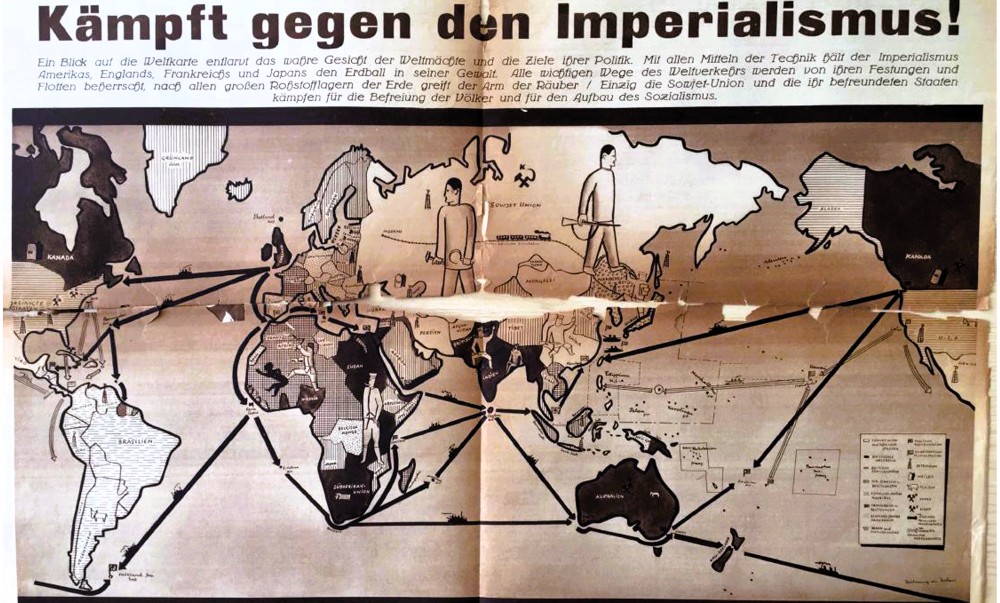
Patterson reports on the background and character of the Second international Congress of the League Against Imperialism held in Frankfurt during the summer of 1929. Between the two congresses the alliance with the Kuomintang had been drowned in blood, the growth of the Independent Labour Party in Britain, and the withdrawal of the Indian National Congress from active League participation. A significant change in leadership and policy the Soviet Union and Communist International occurred as the New Economic Policy gave way to the Third Period, and the ‘anti-imperialist united front’ orientation shifted to ‘class against class’.
‘The Second Congress of the Anti-Imperialist League’ by William Wilson (William L. Patterson) from The Communist. Vol. 9 No. 2. February, 1930.
A correct appraisal of the extent to which the Second World Congress of the Anti-Imperialist League fulfilled the tremendously important political and organizational tasks with which it was confronted is possible only on the basis of a brief analysis of the character of the world situation during the period between the 1927 Brussels Congress and the Frankfurt Congress of the League. This must include a survey of the most outstanding economic and political events featuring that period. These reveal all of the insoluble contradictions involved in imperialism. Only thus will it be possible to secure a comprehensive idea of the revolutionary perspectives presented to the Second Congress. But this alone is not sufficient. This presents us with a background; in the foreground must be shown the social forces with which the Frankfurt Congress worked. Only in the light of these perspectives and with full knowledge of the social composition of the delegates to it, is it possible to draw any definite conclusion regarding the achievements and shortcomings of this Congress.
In the examination of the picture presented by the Congress it should not be forgotten that at the Cologne Session of the League’s General Council (January, 1929) a turning point in the League’s program was determined. This called for a radical re-orientation of the League upon the worker and peasant movements in the colonies and dependencies. The General Council’s determination grew out of the established fact that world imperialism finds the colonies its chief theatre coupled with the fact that the national revolutionary movement developing ever-increasing intensity, offered irrefutable proof that the national bourgeoisie of the colonial countries had ceased as a whole to be a revolutionary factor in the anti-imperialist movement. This orientation therefore, became one of the basic tasks of the League. There remained as one of its fundamental tasks the establishment of an indissoluble alliance between the oppressed toiling masses of the colonial and semi-colonial countries, the revolutionary workers of the imperialist countries, and workers and peasants of the Soviet Union.
The period between the Brussels and the Frankfurt Congresses of the League witnessed in the capitalist countries an enormous intensification of labor under the process of rationalization. The disparity between the productivity of labor and the consumptive capacity of the home markets sharpened to an enormous degree the struggle of the imperialists for control of colonial and foreign markets, increasing the danger of imperialist war, which is inevitable, and forcing the imperialists to more intensive acts of provocation and aggression against the Soviet Union. Rationalization is the prelude to the war drama. Its characteristic feature is the deliberate worsening of the standard of living of the working class, the utmost exploitation of human labor power and the creation of a category of permanent unemployed.
The acute struggle of the imperialists for control of the colonies increase the exploitation and oppression of the colonial and semicolonial peoples, gave rise to an anti-imperialist nationalist revolutionary liberation movement which drew into its ranks and held there for a time nationalist revolutionary bourgeois and petty-bourgeois organizations together with the trade unions and peasant organizations. Under the driving force generated by these organizations, a new revolutionary wave was rising in China, in India, and anti-imperialist sentiment was growing more outspoken and expressing itself in a powerful strike movement; strikes were spreading in Corea; the toiling masses of Indonesia were again in revolt; counter-revolution in Mexico had encountered heroic resistance from the Mexican workers and peasants; the plantation slaves of Latin America had risen in rebellion against their inhuman exploitation and oppression. The tramp of the insurgents was still audible in Nicaragua, an armed uprising was going on in Brazil, the liberation of Outer Mongolia from foreign oppression was rapidly proceeding, the struggle of the heroic Riffs in Morocco and the Druses in Syria and of the thousands of the most thoroughly oppressed and exploited natives of equatorial Africa had taken place, in the Balkans and South Central European countries the national revolutionary movements were strengthened, particularly in Croatia, Macedonia, Bessarabia, Albania, Dobrudja and Translyvania, great strikes were developing in Indo-China and Persia, Egypt was threatening revolt. The colonial and semi-colonial world had anticipated the call to arms of the Anti-Imperialist League. Before its program reached them they were carrying into life a policy of revolutionary action.
Everywhere the national bourgeoisie and the national-reformist elements, alarmed at the magnitude of the revolutionary conflagration and the intense militancy of the toiling masses were desperately striving to retain control of the current, or were capitulating to imperialism. Fearful of their own future, they were waging a desperate struggle to maintain hegemony and leadership of the nationalist movement in all of the colonial centers. Workers’ and peasants’ organizations were growing in strength and taking over the leadership of these liberation struggles, ousting the weaklings and capitulators. Class contradictions were developing ever sharper forms. The Kuomintang betrayed the Chinese Revolution and had become a bloody counter-revolutionary force sitting with the heads of tens of thousands of the best fighters of the working class in its lap; the leaders of the Indian National Congress were proclaiming the virtues of Dominion Status and trying to make the masses forget that complete independence had ever been thought of. The national reformists moving rapidly away from the revolutionary zones were seeking to prove to the masses that violence would serve no useful purpose. A policy of peaceful petition to the “home” governments was their proposal. An appeal was made to avoid all violence and bloodshed, all hateful race and color prejudices. The road of evolution was offered as the only profitable course in place of the road of revolution.
This policy immediately received the endorsement of and was further elaborated upon by Social Democracy. In innumerable instances it came forward as the hangmen of the colonial revolution. In Europe it had numbered among its achievements in the interests of its bourgeoisie the ruthless suppression of the Vienna revolt and the bloody First of May in Berlin. Large sections of the petty-bourgeoisie had passed into, or were accepting the guidance of social fascism and fascism. The triple alliance between the government, the reformist labor bureaucracy and capital had been affected and was openly operating in many countries. The rivalries between the imperialist powers were more openly expressed. Bolivia and Paraguay, the pawns of English and American imperialism, facing each other fully mobilized, showed how the relations of these two keepers of “world peace” stood. The contradictions between the imperialists and the Soviet Union against whom they continued to express an implacable hatred, reached their sharpest point with the seizure of the Far Eastern Railway by the Chinese hirelings of imperialism. By this act of provocation the imperialists proclaimed their readiness to commence an onslaught against the workers’ and peasants’ republic and sought only a means to accomplish this end which would at the same time deceive the exploited masses of their own countries. This is a bird’s-eye view of the colonial and semicolonial world prior to the opening of the Frankfurt Congress.
And so the Frankfurt Congress of the League was faced with the perspective of giving organizational forms as the leading force in the anti-imperialist struggle to the new proletarian detachments which appeared on the colonial front. The League was faced with the perspective of linking together the oppressed workers of the imperialist countries and the toiling masses of the colonies. The direct relation between the worsening of the standard of living of the one and the ruthless exploitation of the other was becoming more clear and distinct. The common enemy could no longer be shielded by social democracy behind phrases glorifying “ultra-imperialism.”
But although the General Council of the League decreed an orientation upon the revolutionary workers’ and peasants’ organizations in the colonial and semi-colonial countries, although the desertion of the revolutionary struggle by the national bourgeoisie was an indisputable fact, although the process of differentiation in the camp of national reformism was clear and equally clear was the fact that the driving force of the colonial revolution was now the workers and peasants under the leadership of the working class which proved the correctness of the decision of the General Council, nevertheless this decision had not been followed to any appreciable degree. The preparatory steps taken before the Frankfurt Congress did not follow along this line. The composition of the League therefore could not reflect such an orientation. The League was not adequately prepared to cope with the revolutionary perspectives opened up before it, and this serious weakness of composition could only be partially overcome.
Of the 260 delegates which attended the Congress, only 84 were from colonial countries and of these only 15 were directly from the colonies. The trade union representation (20 delegates) was extremely small and the peasantry (three delegates) was almost without representation. The overwhelming majority of the delegates were from non-colonial countries. The Indian delegation contained not one member from Bombay or Calcutta where the revolutionary workers were locked in a life and death struggle with the imperialists. Heading this delegation was Gupta, a large landlord, a delegate from the Indian National Congress and a Ghandiite. The revolutionary movement of Africa, Indonesia, Corea, China and Japan had no direct representation. In respect to representation based on the decision of the General Council, the delegation from Latin America was unquestionably responsive. Eleven of its sixteen members were direct from the front, bringing their experiences and the lessons of the struggle. Of the delegates from the non-colonial countries, many represented social-reformists, nationalists and pacifist organizations in the imperialist countries. Many of these delegates were not only in deeds objectively, but even subjectively the tools and agents of imperialism. Such a situation was of course not unexpected. Such a situation at a Congress of the League, however, called for the utmost tactical precaution directed towards the complete exposure of the enemy within the ranks and a clear and concise description of his role.
These “foes” of imperialism, Kirkwood of the I.L.P.; Fimmen, the Dutch left social democrat; Gupter of the Indian National Congress; Pickens of the National Association for the Advancement of Colored People and the representative of the American Negro bourgeoisie, and Hatta of Indonesia, under the leadership of Maxton, Chairman of the British Independent Labor Party, and head of the League, formed a united front with which Baldwin, the American pacifist, associated himself. They were there to prevent by all possible means the Congress acting as an organizational-mobilizing factor in the developing colonial revolutionary movement. They were there to thwart as far as possible the League’s orientation upon the workers’ and peasants’ revolutionary organizations in the colonies and semi-colonies. They were there to prevent if possible the formation of any alliance between the toiling masses of the colonial and semi-colonial countries, the revolutionary workers of the imperialist countries, and the workers and peasants of the Soviet Union.
Let no mistake be made, however. Let no one suppose that all of these elements desired to desert the League or to destroy it. The League represented for most of them another basis from which they hoped and still hope to struggle against those who are truly fighting imperialism. It offered a cover behind which they hope to sally forth and to fool the masses now turning to the left. It offers organized contact among the nationalist movements of the
colonies. These elements wished only to clothe the resolution of the Anti-Imperialist League with the formulations of reformism. The composition of the Congress did not reflect the present position of the anti-imperialist struggle either in the imperialist or in the colonial countries. As a result, it fell into several serious errors.
The left social democrats, the most dangerous enemies of the colonial people, were given a testimonial of friendship and sympathy with the anti-imperialist struggles of the colonial masses. True, the political resolution and the manifesto of the Frankfurt Congress attacks the majority of the I.L.P. and to a degree exposes social reformism and national reformism, but the Maxton group was declared to be sympathetic towards the struggles of the toiling masses of the colonies. Maxton, under fire from all sides and forced to express his attitude towards the British Labor Party, the I.L.P. and the colonial revolutionary movement, made his “declaration,” seeking to put himself forward as the advocate of a ruthless anti-imperialist policy and to be as ambiguous as possible regarding the “Labor” party and to avoid at all cost wholesale condemnation of his friends and comrades within the I.L.P. This declaration was fiercely attacked from several sources but from sources least expected it received endorsement. The apparent strength of the friends of imperialism caused the enemies of imperialism to waver. Pickens, the representative of the Negro reformists, submitted a document opposing the Negro resolution and proclaiming the immediate evacuation of Africa by the forces of imperialism to be an act extremely undesirable and his statement was allowed to go unchallenged. India was not given a place on the Congress agenda nor in the discussion warranted by virtue of the revolutionary situation existing there. The rebellion in equatorial Africa arising out of the most inhuman conditions of exploitation and oppression was hardly mentioned. The new situation in the colonies was underestimated by the League. The League as a non-party fighting organization of the workers of the imperialist countries, together with the toiling masses of the colonies, gave inadequate attention to the workers’ and exploited masses’ defense organization. Time as well as the organizational defects militated against a full discussion of many problems confronting the Congress.
But the Frankfurt Congress registered its positive as well as its negative points. Notwithstanding the shortcomings noted, or rather in spite of them, the League developed an imposing demonstration against reformism, imperialism and the imperialist wars, social fascism and fascism, and for the defense of the Soviet Union. For this the League attracted widespread attention and called down upon its head columns of vituperation from the social-democratic press. Coming as it did at the commencement of the military provocations of the Nanking government against the Soviet Union, the Congress ruthlessly exposed these imperialist maneuvers. Meeting as it did before, on the eve of August First, the League gave inspiration and impetus to the anti-war demonstrations of that day. The importance of the Congress must not be underestimated. The oppressed masses of the colonies have shown that they have faith in the methods it advocates. If it has not brought to them full and complete consciousness of the source and nature of their exploitation, and appreciation of all the ramifications of imperialism, we must recognize that the League has only now made a beginning.
The Congress has recognized these as being the chief immediate tasks of the League:
(1) The League must immediately take the course for the mass revolutionary movement of the workers and peasants of the colonial countries.
(2) It is essential to take energetically in hand the establishment of national sections of the League in colonial and imperialist countries and resting on workers’ and peasants’ organizations and revolutionary national groups, taking care that the workers be given the leading role.
(3) Special efforts should be made for the organization of League sections in India and Africa. The League must, above all endeavor to attract revolutionary trade unions and peasant organizations. At the same time it is essential to start an energetic campaign for maintenance and consolidation of connection between the League and the Indian Trade Union Congress and the revolutionary trade unions of Africa. A relentless struggle should also be carried on in regard to exposing opportunist elements of the type of Gupter, Nehru and Joshi, who are endeavoring to sever the connection of the national congress and the Indian Trade Union Congress with the Anti-Imperialist League. Pickens and the Negro reformists should receive similar treatment.
(4) The absolute inadmissibility of connections between the League and the colonial countries solely through right nationalists—Gupter, Nehru, Hatta and others, must be emphasized. While carrying on the decisive struggle against the continuous treachery of these elements in regard to the national revolution in India, Indonesia, Africa, Arabia, etc., and undermining their influence in the mass movements of the colonial countries and in the League, it is essential to strive to free the League of these elements and to draw gradually into its ranks the workers’ and peasants’ organizations of India, Africa and of other colonial countries.
(5) It is essential to sharpen the struggle against Maxton, especially in Britain, in order to expose his new treacheries (I.L.P. approval of the new Anglo-Egyptian Agreement), reckoning with the inevitability of freeing the League of Maxton (now expelled). With this object in view, Maxton’s declaration at the Second Congress of the League should be used to the utmost. It is also essential to carry on a systematic exposure campaign against Fimmen and Pickens who swear fealty to the anti-imperialist struggle, but support in reality social democracy.
The League must and will take the necessary organizational steps to assure the accomplishments of these tasks, the while carrying out its fundamental tasks among which not the least important is:
To combat the policy of preparation of imperialist war upon the Soviet Union and to rally the exploited and oppressed masses of the world to fight resolutely in its defense. Long live the Anti-Imperialist League!
There are a number of journals with this name in the history of the movement. This The Communist was the main theoretical journal of the Communist Party from 1927 until 1944. Its origins lie with the folding of The Liberator, Soviet Russia Pictorial, and Labor Herald together into Workers Monthly as the new unified Communist Party’s official cultural and discussion magazine in November, 1924. Workers Monthly became The Communist in March, 1927 and was also published monthly. The Communist contains the most thorough archive of the Communist Party’s positions and thinking during its run. The New Masses became the main cultural vehicle for the CP and the Communist, though it began with with more vibrancy and discussion, became increasingly an organ of Comintern and CP program. Over its run the tagline went from “A Theoretical Magazine for the Discussion of Revolutionary Problems” to “A Magazine of the Theory and Practice of Marxism-Leninism” to “A Marxist Magazine Devoted to Advancement of Democratic Thought and Action.” The aesthetic of the journal also changed dramatically over its years. Editors included Earl Browder, Alex Bittelman, Max Bedacht, and Bertram D. Wolfe.
PDF of full issue: https://www.marxists.org/history/usa/pubs/communist/v09n02-feb-1930-communist.pdf
 Revolution's Newsstand