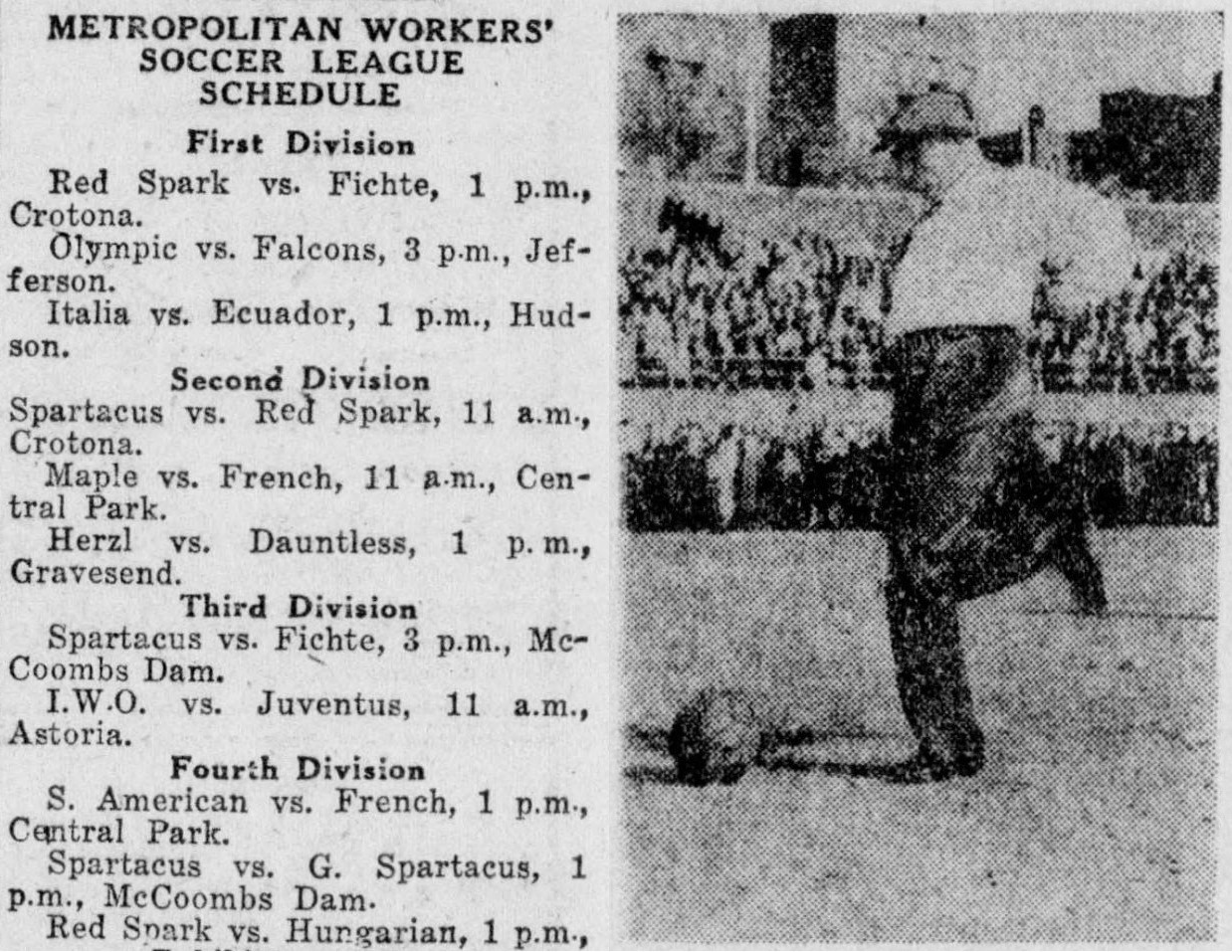
Running for mayor of New York, Robert Minor kicks off the opening game of the Metropolitan Workers’ Soccer League at Crotona Park in front of 6000 fans and distributes leaflets on the Communist program for municipal recreation.
‘Kick-Off by Minor’ by Edward Newhouse from The Daily Worker. Vol. 10. No. 255. October 24, 1933.
ONE of the preliminaries was still in progress when Bob Minor appeared under the Crotona Park stands. Towering above the crowd which came to see him kick off the first ball of the Metropolitan Workers’ Soccer League, New’ York’s Communist candidate for Mayor beamed and gesticulated happily as he moved into the jammed gallery. For the first time in the history of the Park 6000 fans rose as a man and cheered.
This was something really new. Crotona Park has a steady Sunday clientele which comes to see the Labor Sports Union teams, but it’s a soccer-sophisticated crowd which goes in for grandstand managing and peanut consumption rather than cheers. They had congregated hours before the usual time and thousands came who had never witnessed competition.
No, Bob didn’t want to utter a few appropriate sentiments. He had come to kick off and to see the game. There wasn’t much to watch in the prelim. The boys were young and none too skillful. Bob went down the dressing room and sat around in his shirt sleeves. If Pop, harassed patriarch of Crotona Park, ever writes that autobiography he’s reported to be contemplating the occasion will warrant more than a footnote. Even Pop, the groundkeeper, hoary with experience and dripping from tradition, was impressed.
Minor sat in the Red Sparks room, smiling his hearty, naive smile. The players joshed him respectfully, offering their soccer shoes, asking whether he’d ever played soccer before. A dozen kids’ faces shut out the light from the basement window. Somebody’s injury is painted up with mercurochrome.
ALL players, Red Sparks and Fichte, wear “Vote Communist” and “Minor for Mayor” bands across their chests. They line up in the dressing room and take the field together.
Wild cheering again when Minor emerges. Some of it organized, most of it spontaneous. The Crotona fans are interested and flattered in a sense. Obviously this is no campaign baby-kissing and cigar distributing. There’s no bunk about this impressive, shirt-sleeved man or about the red-jerseyed teams. Red Sparks and Fichte are combinations of proven ability and their endorsement carries a certain prestige in that corner. They’re well set-up boys but as they pose for the picture Bob still stands out prominently.
The camera clicks and thousands of leaflets fly from the grandstand’s higher points:
“We, the members of Red Sparks and Fichte Athletic Clubs, support the candidacy of Minor and the Communist Party ticket because this Party alone has demonstrated its interest in the workingman by putting forward a program for more recreational facilities.
“Minor has advanced the following demands:
“1. Every public school gymnasium to open five evenings per week as a recreation center free of charge; school playgrounds to be open after school and for the week-ends; school pools to be open after school hours to the public free of charge.
“2. City to build more playgrounds particularly in crowded sections.
“3. No fees for permits to public ball fields and tennis courts. More courts and fields to be built. These fields to be distributed without discrimination against labor, Negro or any independent teams.
“4. Dressing rooms to be built at all fields.
“5. All building to be done by union labor at union rates. All gyms and playgrounds to be supervised by trained instructors at regular rates of pay.
“Furthermore, Communists, by their constant struggles for relief, against evictions, against racial prejudice, against war, indicate that they alone are sincere in their platform. Any party can make statements, but we believe only those who act on these things throughout the year.”
BOB kicks off and retires into the stands. He sits in the crowd, asks questions, becomes absorbed in the play. The teams start off fast and it’s obviously Red Sparks all the way. They are the class of the league, while Fichte is spotty though effective in spurts. Two goals are scored in the first few minutes of play, both on passes from the left wing. The Fichte goalie is courageous enough, but not in Red Sparks’ class. A penalty goes past him and another goal. 4:0 at the end of the first half. Bob is scheduled for a meeting at Rockland Palace and leaves reluctantly. Somebody offers to take him in a car. “I have a car,” he says. “Went and borrowed a Ford to knock about in.” Cheering again as he stands.
The crowd stays on. The second half is more even and the score stands. Red Sparks is playing with two subs and though the game is looser, it’s just as enjoyable. Fichte fights hard and there are several brilliant individual plays but no combination.
The “Vote Communist” signs wore off gradually. The “Vote Communist” appeared to have stuck.
The Daily Worker began in 1924 and was published in New York City by the Communist Party US and its predecessor organizations. Among the most long-lasting and important left publications in US history, it had a circulation of 35,000 at its peak. The Daily Worker came from The Ohio Socialist, published by the Left Wing-dominated Socialist Party of Ohio in Cleveland from 1917 to November 1919, when it became became The Toiler, paper of the Communist Labor Party. In December 1921 the above-ground Workers Party of America merged the Toiler with the paper Workers Council to found The Worker, which became The Daily Worker beginning January 13, 1924.
PDF of full issue: https://www.marxists.org/history/usa/pubs/dailyworker/1933/v10-n255-oct-24-1933-DW-LOC.pdf
 Revolution's Newsstand