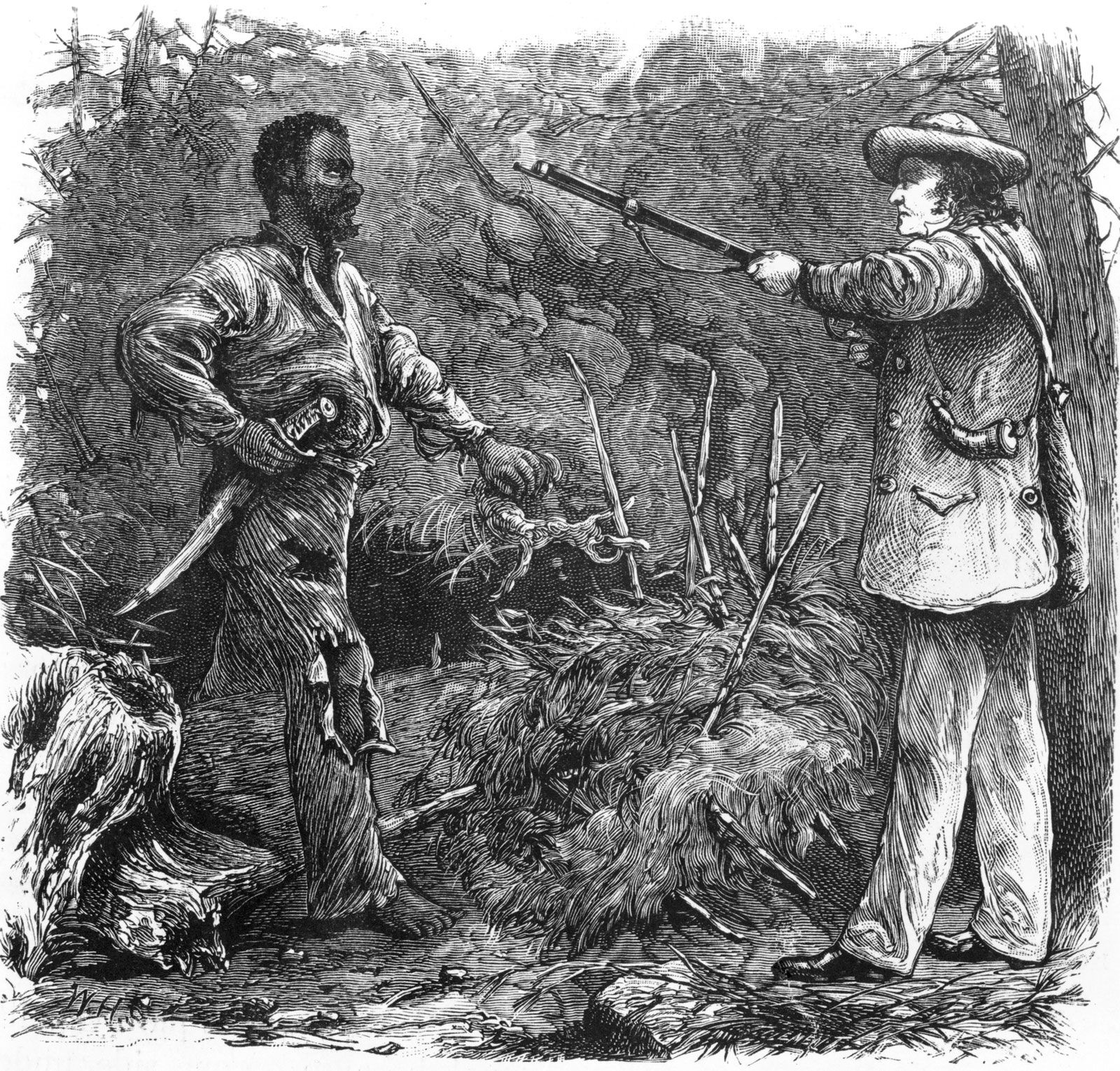
The section on Nat Turner’s 1831 rebellion in Virginia from Aptheker’s famous 1939 study.
‘Nat Turner’ by Herbert Aptheker from Negro Slave Revolts In The United States (1526-1860). International Publishers, New York, 1939.
The terror prevalent in the South due to this rebellious activity was soon transformed into hysteria as the result of the actions of a slave named Nat Turner. He had been born October 2, 1800, and lived all his life in Southampton county, Virginia. When, in August, 1831, he led a rebellion, he was officially described as follows:
“5 feet 6 or 8 inches high, weighs between 150 and 160 pounds, rather bright complexion, but not a mulatto, broad shoulders, large flat nose, large eyes, broad flat feet, rather knockkneed, walks brisk and active, hair on the top of the head very thin, no beard, except on the upper lip and the top of the chin, a scar on one of his temples, also one on the back of his neck, a large knot on one of the bones of his right arm, near the wrist, produced by a blow.”
Nat Turner was an intelligent and gifted man who could not reconcile himself to life as a slave. His religion offered him a rationalization for his rebellious feeling and, having taught himself how to read, he immersed himself in the stories of the Bible. His personality and keen mentality made him influential among his fellow-slaves and even with some neighboring poor whites.
In 1826 or 1827 he ran away, as his father had done successfully, and stayed away one month. Yet doubts overwhelmed him, and he felt that perhaps he “should return to the service of my earthly master.” He did, but the other slaves “found fault, and murmured against me, saying that if they had my sense they would not serve any master in the world.” In the spring of 1828 Turner, while working the fields, was finally convinced that he was to take up Christ’s struggle for the liberation of the oppressed, “for the time was fast approaching when the first should be last and the last should be first.”
The solar eclipse of February 12, 1831, was his sign. This fact has led chauvinistic historians to ridicule the “negro intelligence” (whatever that may mean) of Turner. The fact is that his (what would today be called) superstitious nature was common in his day among all people. Southerners still, generally, carried on agriculture according to the signs of the Zodiac. In 1833 under William Miller, a white citizen of New York, thousands of people were to be firmly convinced that the end of the world and the second coming of Christ were just around the corner. Indeed, that eclipse of 1831 itself led a white minister in New York City to prophesy that the whole city “South of Canal-Street would sink,” and some folks actually moved to the upper part of the city.
Following the eclipse, Turner told four slaves it was time to prepare for rebellion. Significantly they selected July 4 as the day on which to strike for freedom. But Turner was ill on that day and he waited for another sign. This came on August 13 in the peculiar greenish blue color of the sun. A meeting was called for Sunday, August 21.
Turner arrived last and noticed a newcomer.
I saluted them on coming up, and asked Will how came he there, he answered, his life was worth no more than others, and his liberty as dear to him. I asked him if he meant to obtain it? He said he would, or lose his life. This was enough to put him in full confidence.
Such were the “bandits,” as the slavocrats called them, that Nat Turner led.
In the evening of that Sunday this group of six slaves started on their crusade against slavery by killing Turner’s master, Joseph Travis, together with his family. Within twenty-four hours some seventy Negroes, several mounted, had covered an area of twenty miles and had killed every human being (with an important exception), about sixty in all, that they came upon. The exception was a family of non-slaveholding poor whites who, as the Governor of Virginia sarcastically but truthfully declared, were hardly any better off than the rebels.
When within three miles of the Southampton county seat, Jerusalem (now called Courtland), there was, against Turner’s advice, a fatal delay, and the Negroes—whose guns, according to the Richmond Compiler of August 29, were not “fit for use”—were overwhelmed by volunteer and state troops. Soon hundreds of soldiers, including cavalry and artillery units of the United States Army, swarmed over the county and, together with the inhabitants, slaughtered over one hundred slaves. Some, in the agony of death, “declared,” to quote an eyewitness, “that they was going happy fore that God had a hand in what they had been doing.” The killings and torturings ended when the commanding officer, General Eppes, threatened martial law.
Thirteen slaves and three free Negroes were immediately (and legally) hanged. According to Governor Floyd, “all died bravely indicating no reluctance to lose their lives in such a cause.” Turner, himself, though he never left the county, was not captured until October 30. By November 5, after pleading not guilty, for, as he said, he did not feel guilty, he was sentenced to “be hung by the neck until you are dead! dead! dead!” on the eleventh of November. And on that day Nat Turner went calmly to his death.
The South was panic-stricken. Disaffected or rebellious slaves were, in the winter of 1831, arrested, tortured or executed in other counties of Virginia, in Delaware, Maryland, North Carolina (where at least three slaveholders died from fear!), Tennessee, Kentucky, South Carolina, Georgia, Alabama, Mississippi and Louisiana. The terror in the latter state was increased when it was discovered, according to Major-General Alexander Macomb, commanding officer of the United States Army, writing October 12, 1831, that “the coloured people in the (West Indian) Islands, had a correspondence with the Blacks of Louisiana, tending to further their insurrectionary dispositions.”
There is evidence, too, that the unrest extended to poor whites as well as Negroes, at least in Virginia and North Carolina. A letter to Governor Stokes of North Carolina, from Union county, dated September 12, 1831, declared that the slave rebels there were “assisted by some rascally whites.” A militia colonel of Hyde county told the same Governor on September 25 that non-slaveholding whites were refusing to join in slave-suppression activity for they said “they have no slaves of their own and ought not to be interrupted about the slaves of others.” Finally, a Baltimore newspaper of October 15, 1831, stated that so far as North Carolina was concerned the “extensive and organized plan to bring about desolation and massacre…was not altogether confined to slaves.”
The Governor of Virginia, in his legislative message of December 6, 1831, darkly hinted that the unrest was “not confined to the slaves.” Indeed, there exists a letter from a white man, Williamson Mann, to a slave, Ben Lee, dated Chesterfield county, August 29, 1831, which confirms this. The letter makes it clear that several whites, among whom a Methodist by the name of Edmonds is especially mentioned, were plotting to aid the slaves. Mr. Mann hoped the anti-slavery efforts might succeed so that “we poor whites can get work as well as slaves.”
International Publishers was formed in 1923 for the purpose of translating and disseminating international Marxist texts and headed by Alexander Trachtenberg. It quickly outgrew that mission to be the main book publisher, while Workers Library continued to be the pamphlet publisher of the Communist Party.
PDF of original book: https://archive.org/download/dli.ernet.236315/236315-Negro%20Slave%20Revolts%20In%20The%20United%20States%20%281526-1860%29%20%281939%29_text.pdf
 Revolution's Newsstand