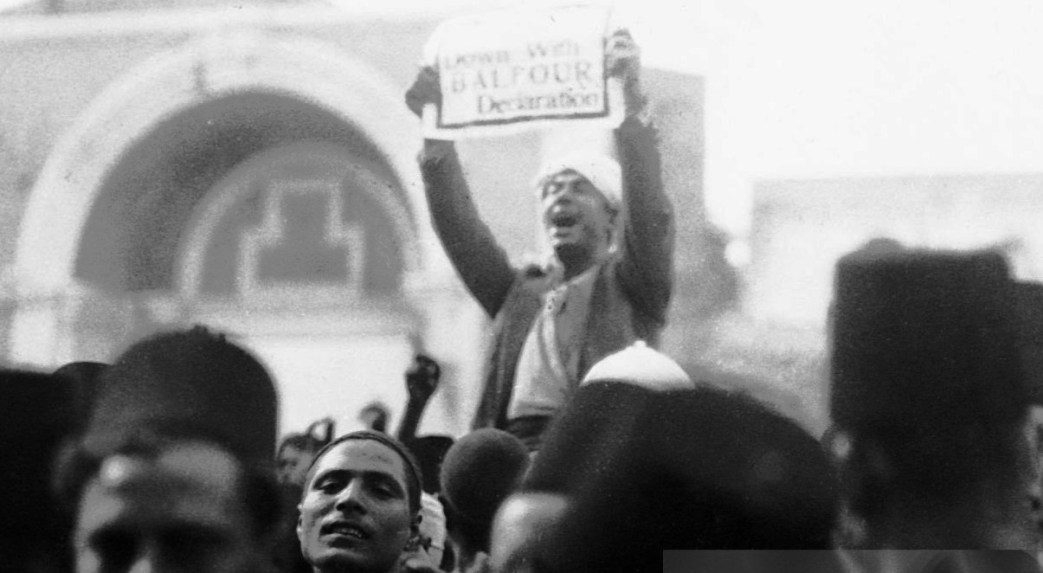
In the aftermath of August, 1929’s ‘Arab Revolt,’ three statements by the League Against Imperialism from that November on: the imprisonment of comrades Hamid el Husseini and Kemal el Daschani, the League’s attitude towards Zionism, and statement on the larger struggle of the Arab nation.
‘Against the Imperialist Terror in Palestine!’ Statements of the League Against Imperialism from International Press Correspondence. Vol. 9 Nos. 62, 63, & 64. November 1, 8, & 15, 1929.
Against the Imperialist Terror in Palestine! November 1, 1929.
Appeal of the League Against Imperialism and for National Independence.
Hamid el Husseini, member of the General Council of the League Against Imperialism and Kemal el Daschani, one of his followers, who have been kept in the prison of Jaffa since August 27th without being examined, have been on hunger strike since the first week of October.
Imperialist terror is raging in Palestine. Hundreds of revolutionaries are arrested. The Special Court in Haifa has condemned 45 peasants of Firah to a total of 185 years’ hard labour. The peasants are accused of having undertaken a march on Haifa, without however a collision having ensued. The courts have already imposed sentences amounting in all to over 1000 years’ imprisonment, although the great trials in Jerusalem, Hebron, Saffed etc. are still pending. The prisons are over-crowded and many of the arrested persons are transferred to internment camps where they are subjected to the most brutal treatment.
How could Hamid el Husseini be spared from this terror instigated by the MacDonald government! Hamid el Husseini, the leader of the Left wing of the Arab National Congress, had the temerity to attend an Executive Meeting of the League Against Imperialism at Cologne. On his return all the documents and even books he had brought with him were confiscated while he himself was placed under strict police super- vision.
It was Hamid el Husseini who proclaimed in his speeches and articles that the struggle against British imperialism can be conducted only if the toiling population, the workers and peasants, no matter whether Mohammedan, Jew or Christian. unite for the purpose of a ruthless struggle against imperialism and its confederates, the Zionists and the Arab big landowners.
On the 12th of August, 1929, the Arab Youth of Palestine met at a Congress. Hamid el Husseini’s statements were enthusiastically welcomed and the active anti-imperialist struggle was programmatically proclaimed. Since that time Hamid e! Husseini and his friends were placed under even more strict surveillance. Criminal police kept watch night and day in front of his house so that it was converted into a prison.
When on the 23rd of August the revolt broke out in Jerusalem, the two supports of imperialism, the Zionists and the feudal Arab elements, tried to make out that it was a “wailing wall affair”.
On the 24th of August, Hamid el Husseini came openly forward in Jaffa. He proclaimed that the time has now come when the working Jews and Mohammedans should unite. The struggle must be conducted against imperialism and the mandatory system. With the cancelling of the mandate the Balfour Declaration would also become null and void.
This furnished sufficient cause to arrest Hamid el Husseini. Not the revisionist-Zionist inciters and the reactionary feudalist elements who had attempted to make use of the justified indignation of the Arab masses for their special interests were arrested, but precisely he who had enlightened the Arab population as to the true character of the events. Hamid el Husseini was thrown into prison on the accusation of having incited the population to make a revolution against the government.
Hamid el Husseini has now been in prison for two months. The government has already for the fourth time prolonged the order of arrest against him. He is not treated like a political prisoner but like common criminal. The protest of the Arab organisations from all parts of the country against this unheard of brutality have remained without effect.
In such circumstances Hamid and Kemal el Daschani declared a hunger strike and made the following declaration:
“We have decided to enter on a hunger strike as the whole time we have been here we have not been examined, and in order to protest against the cruel treatment. This strike will last as long as the government intends to keep us in prison in this manner. The government, apparently, is equally indifferent whether we live or die. But we are firmly determined to continue the strike until we are released. If we die, then you must know that the mandatory power with its cruel system has killed us and not hunger.”
In the meantime, other political prisoners, who have for the greater part been arrested in connection with recent events. have put forward a number of demands such as the abolition of the humiliating prison regime, special privileges for political prisoners, abolition of hand cuffing, release of the administrative prisoners, amnesty for political prisoners etc. As these demands have not been fulfilled, 46 comrades have entered on a hunger strike.
In Palestine. India and Ireland the prisons are filled to overflowing with revolutionaries who fought for the independence of their countries and the emancipation of the toiling masses. In Lahore and in Meerut, in India. the prisoners have entered on a hunger strike in order to enforce from the Mac Donald government special treatment of the political prisoners. The young national revolutionary Jatindranath Das has already paid with his lite for espousing the cause of his suppressed brothers. The “Labour Government” of MacDonald has always been prepared to let revolutionaries perish in the prisons. The toiling masses of India, Palestine, Ireland and Great Britain and of the whole world have no interest in supporting the imperialist plans of a “Labour Government”. They must take up the struggle against the imperialist policy of the MacDonald government, which is supported by the English Labour Party and the English Independent Labour Party; for the immediate release of Hamid el Husseini and of all the revolutionaries who are pining in the prisons of British imperialism!

Statement of the Arab Secretariat of the League Against Imperialism. November 8, 1929.
In connection with the last Congress of the League at Frankfort and with its attitude during the last troubles in Palestine, many statements and remarks were published in the press which are not correct. We, therefore, have decided to publish the following statement:
1. The League Against Imperialism is not a “communist branch” or an “agency of the Communist International”. The truth is that the League Against Imperialism comprises anti-imperialist elements aiming at the national and social liberation of the nations, without distinction of party, be they socialists, communists, pacifists, syndicalists, national-revolutionaries or belong to no party at all.
2. The attitude of the League towards the Arab countries in general, and Palestine as part of them in particular, was clearly defined during the Frankfort-Congress of the League. This attitude rejects any national or religious chauvinism and insists upon safeguarding the rights of every national or religious community, and is, in consequence, strictly opposed to the excitation of national and religious hatred, condemning every kind of national or religious collision. The masses of workers, peasants and intellectuals of many nations represented in the League think, however, that the right to national independence being an elementary right of the inhabitants of Palestine and Transjordania cannot be denied to them as it cannot be refused to India, Egypt, Syria or China. Thus, the principal demand of the League is: establishment of an independent union of Arab republics composed of all countries where the majority of the population are Arabs, abolishment of all imperialist mandates or protectorates over those countries.
3. It is an error to assume that the League–or the extremist Arab national-revolutionaries participating in it–opposed to Zionism because it has introduced (as the Zionists argue) culture into the country, has built colonies, schools etc. The aims of the League are as far from any reactionary attitude, from any opposition to progress, as they are from any justification of feudal oppression or exploitation of the working class by a rich minority.
The cause of the League’s struggle against Zionism is the fact that Zionism is the instrument by which the justified demand of the Arab masses for independence is rejected, the Balfour Declaration being the base of the British Mandate which is contrary to the principle of “self-determination” of the country’s inhabitants. A further cause is, that Zionism, while adding to the wealth of a small section of the native population, i.e. the big landlords who are selling their plots to the Zionists for millions of pounds, destroys completely the economic position of the great majority of the native population, especially of the Fellahs who are driven from the soil which they owned for generations. Another cause is that Zionism created an abyss between the Jewish and the Arab workers, founding a national Jewish labour association (where no Arab worker is admitted as member with equal rights) which asks for “Jewish labour to 100%”; the cause is, finally, that through the activities of Zionism, which is closely connected with the British mandate, the economic, social and cultural progress of the country is hindered, while the national antagonism created by a declaration which promised the establishment of a national home for one nation in a country already occupied by another without consulting its inhabitants, but by application of an outside force, is fatal to the peace of the country and shakes the stability of its development.
The League therefore considers the struggle against imperialism as inseparable from the struggle against Zionism, and sees a possibility of an alliance between the Jewish and the Arab masses only on the base of this common struggle.
4. At the same time the League rejects the point of view according to which an abolishment of the Balfour Declaration is possible while the mandate and British imperialism remain. Only the full independence of the country within an independent union of Arab countries is the aim of the League. “Palestine for the Palestinians”, “The Arab countries for the Arabs” are the slogans.
5. Hamdi effendi Husseini, the League’s Secretary for the Arab countries, was arrested by the authorities on August 27, because of his courageous opposition to national and religious strife, when the national and religious excitation reached their culmination; he proclaimed the necessity to employ all power for the struggle for full independence of the country. This was emphasized also in the mass meetings of the League abroad and in its publications. Thus it was proved clearly that the League has nothing in common with any reactionary movement.
6. The League believes that every honest inhabitant of Palestine–Arab or Jew who is truly against imperialism and imperialist methods, and who wants peace and fraternity between the toiling masses of the two nations, who supports development and progress in this country must agree with the programme of the League and join its ranks.
Jaffa, October 15th 1929.

For the Struggle for Freedom of the Arab People. November 15, 1929.
From an Appeal of the League Against Imperialism.
The events in Palestine go to prove the fact that the Arab national question constitutes today one of the most import items of world politics. Also the Arabs have the right abolish the dismemberment of their countries and to form a united, strong, independent, perfectly free State, a great Arab national State, the form and fate of which are to be determined not by the exercise of force of imperialist foreigners but by the will and the interests of the toiling masses of the native Arab population, peasants, workers and bedouins.
The League Against Imperialism and for National Independence, impressed by the splendid demonstration strike on November 2nd in Palestine and in view of the powerful development of the national movement in all Arab countries, send cordial greetings to all fighters for Arab National emancipation. It considers it necessary in connection with the struggle for Arab national emancipation, to express two ideas which arise in the general experience of the international struggle against imperialism.
The Arab people must not believe in the hypocritical manoeuvres and the honeyed words which the British imperialists use every time their position is endangered, while at same time employing bombs and machine guns (the fraudulent Treaty with Egypt, the investigation commission in Palestine, the play with Iraq etc.). The Arabs must realise that the so-called “Labour Government” of MacDonald was purposely entrusted with government power in Great Britain in order to clamp down the growing revolutionary indignation of the masses of the suppressed countries by means of deceit; to corrupt the leaders of the nationalist movements by means of hypocritical promises, and in this way to consolidate and extend the bases imperialist exploitation.
The second experience of the international struggle against imperialism teaches that a people can conduct a successful struggle for national emancipation against the imperialist power only, if the leadership sets up a programme of social demands the great majority of the nation, of the toilers, fights for itself and places the organisation of the national struggle not in hands of a small group, a narrow circle of rich landowners religiously influential and privileged individual persons, but the hands of the broad masses of the toiling population. It is necessary that in every city, in every village, in every bedouin group there exist a fighting committee against imperialism and for national emancipation and unity. These committees which should to be composed of the most tried fellahin, workers and bedouins, shall make all decisions regarding the organisation the anti-imperialist struggle in their districts. They shall so elect in every separate country a Central Arab national-revolutionary Committee, and these committees shall in turn elect for the whole area an “All-Arab National Revolutionary Council”. Such an organisation, built from below, is capable of mobilising all the forces of the people in the struggle for the National Liberation. It is at the same time a guarantee that the struggle will not be ended before a real victory is achieved. Hence the creation of a broad, militant organisation is the command of the hour.
In the fight for this aim the Arab people can reckon upon the active support of the League Against Imperialism and for National Independence. The Arab national movement has reached, such a stage that it appears expedient to establish a close connection between it and the international organisation, the League Against Imperialism. Form therefore in every country section of the League Against Imperialism! Form in all important districts local branches of the League. Such local branches can also be formed in the big villages. Unite the sections of e various Arab countries in an “All-Arab Committee of the League Against Imperialism”.
Long live the liberation struggle of the Arab People! Down with the imperialists, down with the dismemberment the Arab countries, the mandatory system and the Balfour Declaration!
Long live the Federative, really free and independent great Arab State!
International Press Correspondence, widely known as”Inprecorr” was published by the Executive Committee of the Communist International (ECCI) regularly in German and English, occasionally in many other languages, beginning in 1921 and lasting in English until 1938. Inprecorr’s role was to supply translated articles to the English-speaking press of the International from the Comintern’s different sections, as well as news and statements from the ECCI. Many ‘Daily Worker’ and ‘Communist’ articles originated in Inprecorr, and it also published articles by American comrades for use in other countries. It was published at least weekly, and often thrice weekly. Inprecorr is an invaluable English-language source on the history of the Communist International and its sections.
PDF of issue: https://www.marxists.org/history/international/comintern/inprecor/1929/v09n62-nov-01-1929-inprecor.pdf
PDF of issue 2: https://www.marxists.org/history/international/comintern/inprecor/1929/v09n63-nov-08-1929-inprecor.pdf
PDF of issue 3: https://www.marxists.org/history/international/comintern/inprecor/1929/v09n64-nov-15-1929-inprecor.pdf
 Revolution's Newsstand