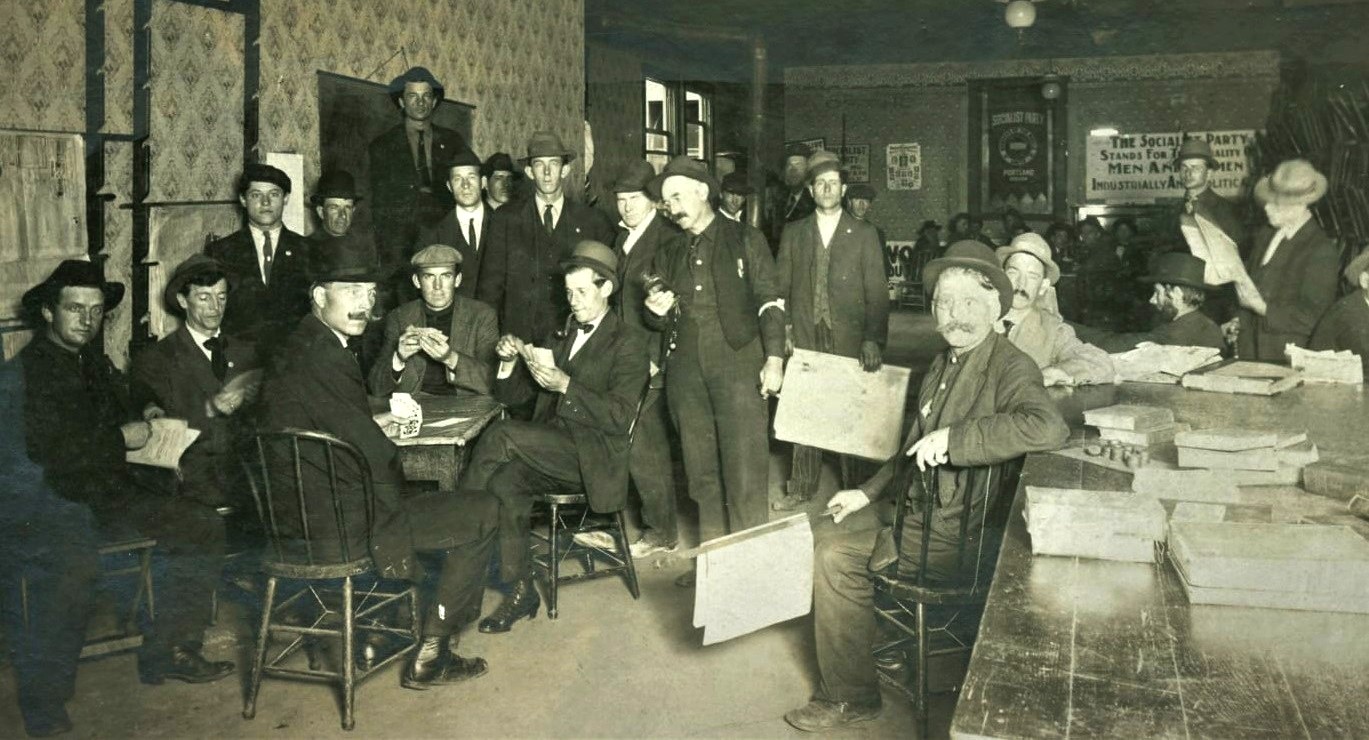
Left winger Thomas A. Sladden was leader of the Socialist Party in Portland, mentor to William Z. Foster, and Oregon State Secretary engaged in a fierce polemic with, among others, Marx translator Ernest Untermann, on the class make-up and outlook of the Socialist Party. Rejecting a ‘labor’ or ‘populist’ approach, Sladden says confusion on the question was a consequence of too many non-proletarian members.
‘Class Struggle in the Socialist Party’ by Tom Sladden from The Socialist. Vol. 10 No. 440. September 25, 1909.
In the opening paragraph of the Communist Manifesto is the sentence: “The history of all hitherto existing society is the history of class struggles.”
The fundamental requirement for admission into the Socialist Party is, or is supposed to be an acceptance of the fact that society is divided into two classes whose interests are diametrically opposed to each other. And yet muddle-heads, those who write about muddle-heads and those who do not, would tell us that to exclude the middle (capitalist) class would be foolish if practicable, but which is really impossible.
Let us take the word of Marx and Engels, you who are everlastingly posing as interpreters of Marxian Economics, and here is what Marx and Engels propose to do:
“The immediate aim of the Communists is the same as that of all other proletarian parties–formation of the proletariat into a class, overthrow of bourgeois supremacy, conquest of political power by the proletariat.”
What is the proletariat? Is it a farmer class, skilled mechanics, professional men? In the Manifesto a definition of the proletariat is given in this sentence: “The other classes decay and finally disappear in the face of modern industry; the proletariat is its special and essential product.”
Now what is it that modern industry called into play? It was hands, machine hands, men that were hired not because they had a head, or skill, but because they had a strong back, strong arms and a willingness to slave faithfully. But is the skilled tradesman, the professional or small farmer a product of modern industry? I guess not. He is a disappearing quantity in the face of modern or machine industry, and he was a product of the era of manufacture, not of the era of modern industry.
By taking this view many of the seeming inconsistencies of the present time are easily solved. Take the Associated Press dispatches of the 17th of September.
Here it was stated that “the American working men were going back to work marching behind the fixed bayonets of the militia and State constabulary with the American flag at their head; that they were all armed and woe be it to any Foreigner that offered insult to the flag.” But was it a division of races? Oh, no. It was a division of skilled and unskilled laborers. For years the skilled work had been done by American skilled mechanics, while for unskilled labor these Pennsylvania factory owners and mine owners had been importing their proletarians from Europe. The skilled trades were as a general thing satisfied with their wages and never did strike at McKee’s Rock, but they were scared out. But the unskilled laborers were actually forced to the stand they took by conditions. The skilled trades were organized under the A.F. of L. while the unskilled were rallying under the Industrial Workers, and the skilled workers did just what they have always done from the very first deserted everybody immediately their own wants were satisfied. So, as a natural consequence, they lived up to their historic role, lined up behind the bayonets of the cossacks and with an American flag at their head, they formed their scab parade to the factory gates.
But it is not because one body of men are in an organization called an I.W.W., or because another is in an A.F. of L., but it is because each are living in different social conditions. The unskilled proletariat can no more help being revolutionary than the skilled mechanic and middle-class farmer and business men can help being conservative and reactionary. It’s not the idol they worship, but the job they work at that makes them satisfied or dissatisfied, conservative or revolutionary.
Marx and Engels at no time conceived of forming a political party of wage workers and capitalists and farmers, but at all times advocated a party of proletarians. In fact, Marx and Engels despised the farming element of which the Untermanns would form a Socialist organization. In giving their opinion of the farming element they say: “It (modern industry) has created enormous cities, has greatly increased the urban population as compared with the rural, and has thus rescued a considerable part of the population from the idiocy of rural life.”
What is a Socialist movement? What is a labor movement?
The labor union movement in all its ramifications has always been a class movement. Here and there in the labor movement in the United States, trades unions in exceptional cases have allowed members of the lower middle class to become members of the different trades unions, a fact which has proved to be a serious mistake, but taken as a whole, the labor movement has always been a class movement to better the conditions of the wage-working class, or of some fraction of the wage-working class, either by the shortening of hours or in the increase of wages of that class or fraction of a class at the expense of the employing class.
Its every strike has been an open revolt, and when any man states that the labor unions all over the world are inveterate reformers, that man shows that he has not the slightest conception of what labor unionism really is, and his middle-class conception is governed entirely or largely so, by his rural environments. In France we have a revolutionary labor movement. But in France, as in all other countries as yet, as every one knows, the political parties alleged to be representing the working class are freak movements largely given over to an advocacy of middle-class reforms while every benefit gained by the wage workers in the entire world has been gained by the active struggle of the wage class against the capitalist class on the economic field.
In the United States nothing, and in Europe but a few paltry reforms, have been obtained by political parties. The one object and use of a political party of the working class, to weaken the resistance of the capitalist class to a working class strike on the industrial field by making the executive powers of government unsafe for this capitalist class through its being partially in the hands of its enemies, has been ignored and kept in the background by political skates of the pure and simple order, who can see in a political movement, nothing except an opportunity to elect an ecclesiastic mountebank, or buy out the capitalist class editor, or send a shyster lawyer to a capitalist congress.
The working class on the industrial field have gone out on strike and suffered privations and misery and want to better their conditions, while the pure and simple Socialists have peddled hot air, and safe and secure from the class battles, they have rendered their learned (?) opinions of the men on the firing lines of the class war.
No matter what any man may think of the industrial organizations of labor those organizations are fighting the class war 365 days a year, and they need no bum theologians or college professors or what-nots–the lower fringe of a dying class that should be buried to get rid of the smell–to tell them how to fight their battles.
The industrial movement of the wage workers is a movement of the working class joined into labor unions, here in an American Federation, representing the crafts and the skilled mechanics, there in a Western Federation of Miners, or a United Mine Workers, representing a combination of skilled and unskilled workers; in other places the Industrial Workers of the World, beginning to represent the proletarian element of labor, the great mass of unskilled common laborers. All these different industrial organizations as a whole constitute the American labor movement, and they are actively engaged in combatting the encroachments of the capitalist class on the economic field.
The political organization of the working class is or should be composed of all these elements, and none other, consolidated into a working class political party, organized to nominate and elect members of this organization into political office where possible, in order to capture the political powers of government and abolish capitalist laws and the institution of capitalist private property.
The Socialist Party is, or is supposed to be, attempting this very thing, but in order to bring about the dominance of the wage worker in the party, it must make the same qualification for membership in the political organization as is demanded in the economic organization.
Either the Socialist Party must be a labor organization or not a labor organization, and if it is not a labor organization it need never expect the support of the wage-working class.
When it has accepted as members none but actual wage workers, then and then only does it become a true reflex of the working class.
Is the working class to blame for refusing to send a freak parson or editor from Wisconsin or a bum lawyer from New York to Congress?
The wage worker that votes to send a lawyer, a preacher, a proprietor farmer or a business man to a political office is just as big a sucker, as the one that voted for Tatt last election day.
Now, men have gone out of their way to prove that I, as a horseshoer, was not a proletarian, consequently my contentions regarding a proletarian being the unskilled worker, and not a skilled mechanic, was wrong. I am glad this was brought up. I have no time to prove myself in or out of the proletarian ranks. I may be one of those “whose specialized skill has been rendered worthless by new methods of production,” and I may be not; but I am glad this statement was made, because it shows that a man may be a master of a half-dozen languages and a fool in all of them.”
What would the fact of a person’s being a proletarian or not have to do with any statement he might make? I suppose if a person owned a bank, then the fact that he owned a bank would make it impossible for that person to understand that bankers were not wage workers.
I must do like my critics; if I am a blacksmith, include blacksmiths in the proletariat; if a college professor, include college professors; if a lawyer, include lawyers; if a banker, include bankers; if a millionaire, include millionaires–oh, hell! we can use that kind of reasoning and reason ourselves all into proletarians, much as that sanctimonious heavenly hypocrite that opened a capitalist legislature in Wisconsin with a capitalist prayer, would say, “We want them all–all the workers.”
That has been the trouble in the Socialist Party. We let everybody into the organization and then everybody is supposed to wear a muzzle so they will not hurt any one else’s feelings. We will never be free to call a factory owner an exploiter as long as we allow him in the party.
We will keep harping on the system instead of smashing into the individuals that make up the system. We are in just exactly the same position as the minister of a Methodist church. He gets up and preaches a long sermon about the deceitfulness and sin of this wicked world, and how corrupt people are, and about the misery and the poverty of the poor in the East End, and all the time the chief sinners are way up in the amen corner of his own church, and they go home talking about what a great sermon the Dear Doctor preached tonight. He was like the baseman trying to catch Ty Cobb stealing a base–“he never touched them;” but the difference between the preacher and the baseman is that the baseman tried to get Cobb, while the preacher tries his damndest not to get them, and he always succeeds. So now we send out organizers the same as the churches send out missionaries. Deliver a pretty sermon but do not hurt the feelings of “the influential” members of your flock, the middle-class members of the local. Do not say “damn” or “hell,” because it is not polite, and is regarded as vulgar among the better element of respectable society.
Imagine the brotherly picture of a factory owner with fifty of his men on a strike to get a raise of 25 cents a day shaking hands with his comrades at a local meeting. Imagine the brotherly picture of the farmer in the Grange meeting voting to have the county road work done by a chain gang and then shaking hands with the out-of-work comrade at the local meeting of the Socialist local in the town.
If the capitalist class and the working class have nothing in common then by all the rules of logic there is no basis on which they can be held together in one political or industrial organization.
All political parties must reflect the interests of one or the other of the classes in modern society. In the words of the pulpit pounder, you can not serve God and mammon at the same time.
You can not benefit the working class and not harm the capitalist class.
THOMAS SLADDEN.
There have been a number of journals in our history named ‘The Socialist’. This Socialist was a printed and edited in Seattle, Washington (with sojourns in Caldwell, Idaho and Toledo, Ohio) by the radical medical doctor, former Baptist minister and socialist, Hermon Titus. The weekly paper began to support Eugene Debs 1900 Presidential run and continued until 1910. The paper became a fairly widely read organ of the national Socialist Party and while it was active, was a leading voice of the Party’s Left Wing. The paper was the source of many fights between the right and left of the Seattle Socialist Party. in 1909, the paper’s associates split with the SP to briefly form the Wage Workers Party in which future Communist Party leader William Z Foster was a central actor. That organization soon perished with many of its activists joining the vibrant Northwest IWW of the time.
PDF of full issue: https://www.marxists.org/history/usa/pubs/thesocialist-seattle/090925-seattlesocialist-v10w440-factionfight.pdf
 Revolution's Newsstand