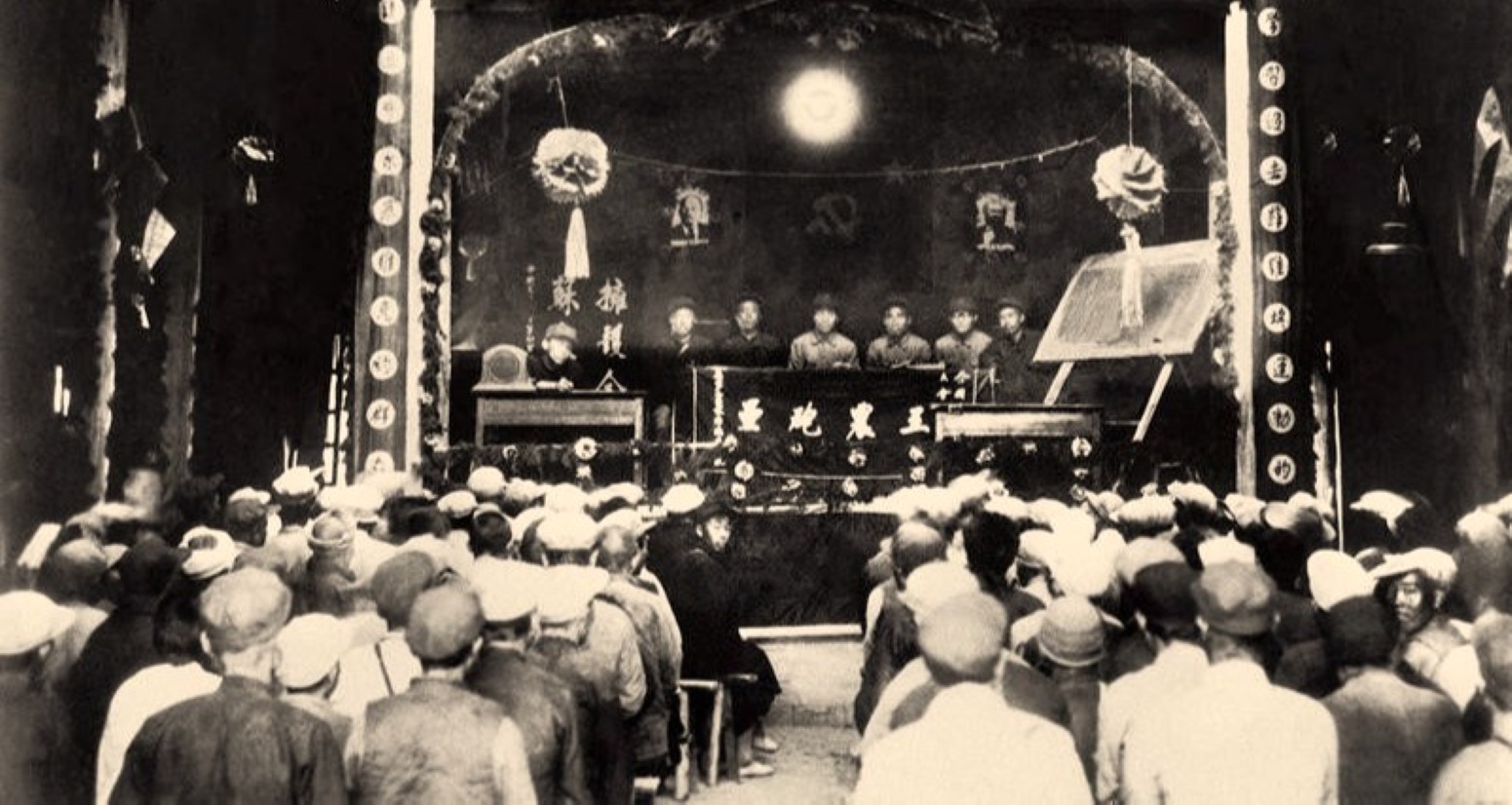
The fall of C.C.P. leader Li Lisan for ‘semi-Trotsyism’ and the coming to prominence of the ’28 Bolsheviks’ trained in the Moscow’s University of the East and Stalin’s partisans in the Soviet Union’s factional struggles of the late 20s.
‘The Struggle for the Bolshevisation of the Communist Party of China’ by V. Kuchymov from Communist International. Vol. 8 No. 6. March 15, 1931.
“Our European Philistines do not dream that the future revolutions in the incomparably denser populated countries of the East, with their incomparably greater variety of social conditions will undoubtedly present them with more peculiarities than the Russian Revolution. There is no disputing that the school book written after Kautsky was a very useful article at its tire. But it is now time to give up the idea that this school book foresaw all the forms of further development of world history. It is high time to simply declare as fools all who think so.” (Lenin “On Our Revolution,” Collected Works,” Vol. XXVII.)
I. CHARACTER OF THE BOURGEOIS DEMOCRATIC REVOLUTION IN CHINA.
The Chinese Revolution has many individual features which distinguish it not only from Western European Revolutions but from the Russian Revolution. In the 1905 epoch, the Russian proletariat was struggling under the conditions of a bourgeois democratic revolution, getting itself the task of bringing about the democratic dictatorship of the proletariat and peasantry.
This democratic dictatorship was established in 1917, after the February Revolution but, owing to a number of circumstances, the chief of which was the attitude of classes and of the Party to the imperialist war, it was established only for a short time, and in a particular limited and “opportunist” form, viz.: the form of double government, in the form of collaboration of the Soviets of Workers’ and Peasants’ Deputies (who voluntarily surrendered power to the bourgeoisie) with the bourgeois Provisional Government.
The tasks of the bourgeois democratic revolution were finally carried out by the Russian proletariat, as it were in passing, in the course of a Socialist revolution.
The revolution in China at the present time is taking a different course.
The democratic dictatorship of the proletariat and peasantry in the form of Soviets exists, grows and develops, gathering millions of workers under its banner and striking mortal terror into the hearts of the bloody dictatorship of the landlords and bourgeoisie which still exists in fairly great strength in non-Soviet China, chiefly owing to the energetic support of imperialism.
The decisive problem for this developing dictatorship of the proletariat and peasantry is the correct solution of the agrarian question, which requires first of all that the proletariat should seize the leadership of the peasant movement.
The Communist Party of China headed the peasant movement for the confiscation of landed estates and for the equal division of all land. If it can extend the struggle, raise not millions but tens and hundreds of millions of Chinese peasants, and not only raise but organise them in the struggle for land, against the Kuomintang, against the imperialists, the bourgeoisie and the landowners,—then the success, the tremendous success, of the Chinese revolution will be finally secured.
However, although the proper decision of the land question and the proletarian leadership of the peasant war is the key to everything in this relatively prolonged stage of the Chinese Revolution (its bourgeois democratic stage), nevertheless, the current moment of the Chinese Revolution and the difficulties under which the new revolutionary tide is taking place confront the Chinese Communist Party and the proletariat with organisational and political tasks of tremendous importance, which make concrete at the present moment the central problem of the leadership of the anti-imperialist agrarian revolution.
The new revolutionary upsurge headed by the Communist Party of China has already obtained considerable successes:—Soviet districts with a population of 40,000,000, a Red Army a hundred thousand strong and the most numerous strike movement in the world. These successes of the mass movement, these successes of the Communist Party can be neglected only by enemies or absolutely incurable opportunists.
However, the Soviet Government does not yet exist as a mighty force victoriously leading on an all-China scale in the armed struggle against the Kuomintang and the imperialists, and at the same time putting into life revolutionary measures on the territory where it rules. Moreover the Red Army, while growing and gathering strength, still bears a deep impression of its origin from peasant guerilla detachments and the hired armies of the militarists. It cannot yet enter a decisive struggle against the Kuomintang, still less against the imperialists.
Besides this, the revolutionary tide is growing unevenly. Although the Southern provinces are seething with peasant wars, nevertheless the peasants of the North have not risen. And what is still more important, the workers’ movement in the industrial centres is greatly lagging behind the sweep attained by the peasant movement. The special features of the present moment are that only in some districts has the mass movement reached the point of an insurrection, but that in these districts, under the correct leadership of the Communist Party, it has conquered and commenced to form a revolutionary army and Government, without being in a condition, however, to inflict a decisive defeat on the Kuomintang and the imperialists, as a result of which we are now in a more or less lengthy interval “between big battles in the Civil War” (Lenin).
The words of Lenin, foreshadowing the possibility of the development of the 1905 revolution, are applicable to a great extent to the situation which has arisen at the present time in China.
“It is natural and inevitable that the uprising takes on the higher and more complex form of a long drawn out civil war embracing the whole country, i.e., of an armed struggle between two parts of the nation.
“Such a war cannot be conceived otherwise than a series of big battles occurring at comparatively lengthy intervals and a mass of small skirmishes during these intervals. If this is so—and there can be no doubt of it—the social democracy” (the article was written in 1906—V.K.) “must unquestionably set itself the task of forming such organisations as will best be adapted to lead the masses in these big battles, and as far as possible, in these small skirmishes.” (Lenin, “Guerilla War.” Collected Works, Vol. X. p. 87.)
The answer to the question as to what are these organisations which can best lead the masses both in big battles and in small skirmishes was given earlier by Lenin, when the Russian Revolution of 1905 first reached the “last stage of development of the peoples’ uprising”— the formation of detachments of the Revolutionary army.
“The duty of these detachments (i.e., the revolutionary army) is to proclaim the uprising to give to the masses the military leadership which is necessary in civil war, as in every other war, to form points of support for the open struggle of the people, to extend the uprising to neighbouring districts, to secure complete political freedom, if only on a small territory of the country at first, to commence the revolutionary reorganisation of the rotten autocratic system, to develop to the full the revolutionary creative powers of the rank and file masses who take little part in this creative work in peace times. It is only after having become conscious of these new tasks, only after having faced them boldly and extensively, that the detachments of the revolutionary army can be completely victorious and serve as the support of the revolutionary Government.
“But a revolutionary Government is just as urgently necessary at this stage of the national revolt as a revolutionary army.” Lenin, “The Revolutionary Army and the Revolutionary Government.” Collected Works, Vol. VII., p. 383.)
In the 1905 revolution, this perspective (the formation of a revolutionary army and a revolutionary government “even on a small part of the territory of the country”) was not actually realised.
In modern China, Communists, when deciding on current tasks, must proceed from the fact of the presence of a revolutionary army and Soviet centres which are in the process of birth and growth.
The peculiar features of China, such as the separation of China into spheres of influence by the imperialists, its feudal disintegration, the absence of a united central Government of the Chinese counter-revolution, the uneven character of the maturing of the revolutionary situation in various parts of the country, the very great size of the territory on which the movement is developing and the enormous population, all these determine the particular special ways of the development of the revolution, the forms and methods of the revolutionary struggle, which differ, for instance, from Western European ways and methods.
In accordance with the peculiarities of the Chinese Revolution, the difficulties which lie before it and the successes which have already been achieved in the mass movement, the Chinese Communist Party set itself at the current stage of the revolution the following fundamental tasks:
(1) The formation of a regular disciplined Red Army, composed of workers and peasants and led by Communists, and having a firm base in revolutionary Soviet territory.
(2) The formation of an authoritative Soviet Government, which continuously carries into effect in the region of its domination the basic slogans of the anti-imperialist and agrarian revolution, uniting and mobilising the working masses of China by its activity for the struggle with the Kuomintang and the imperialists.
(3) The further unleashing of partial economic struggles of the proletariat in all the big industrial centres, their further revolutionising, linking up these proletarian struggles with the struggle for the defence of the Soviet districts and for the victory of the Soviet Government as the form of the democratic dictatorship of the proletariat and peasantry.
The realisation of this triple task will assure such a progressive development of the Chinese Revolution and such a gigantic sweep of the mass movement, reinforced by the hegemony of the proletariat assuming shape as a Government (the Red Army, the Soviet Government—the leadership of which is in the hands of the Communist Party) as will assure in advance the victory of the workers and peasants in the great battles of the civil war against the forces of the bourgeois-landowning Kuomintang and international imperialism.
II. THE TROTSKYISM OF CHEN-DU-SIU.
Both the counter-revolutionary Trotskyists and the Chen-du-siuists expelled from the Communist Party attack in a united front the general line of the latter, sometimes hiding behind hypocritical “left” phrases, sometimes rejecting them as unnecessary and unsuitable, according to the tastes and the moods of each of the participators of these attempts to defeat the developing attack of the Chinese workers and toiling mass of the peasants.
The false and hypocritical “socialist” phrase of the “permanent revolution” merely conceals the single counter-revolutionary slogan of the Trotskyists and the right liquidators—the slogan of the convocation of a general Chinese Constituent Assembly, a “full powered national assembly” (Trotsky). This slogan was already put forward by the reactionaries (the Kuomintang at its last Plenum) as the alternative to the only revolutionary slogan under the present conditions—a revolutionary workers’ and peasants’ Red Army and a Soviet Government.
It is clear to every revolutionary proletarian that, if anyone at the present time of fierce civil war, when Chang Kai Shek is attacking the Red Army and the Soviet Districts, brings forward a platform which tries to turn the revolutionary masses away from the task of defending their own government and their own army into the channels of “peaceful” and “legal” struggle within the framework of the yet non-existent but already highly counter-revolutionary, militarist, murderous and half-breed “parliament,” he is an open enemy, an irreconcilable enemy of the workers and peasants.
The advanced Chinese workers and peasants, who are carrying on a revolutionary war against the Kuomintang government and Chang Kai Shek’s armies will describe not otherwise than as counter-revolutionary and specially intended to deceive the people the following ideas of Trotsky:
“The slogan of Soviets, as a practical slogan, is at present nothing but adventurism and empty talk. The struggle against the military dictatorship must inevitably take on the form of provisional revolutionary-democratic demands, amounting to the demand for a Chinese Constituent Assembly, elected on the basis of general, equal, secret and direct suffrage, for the solution of the most important problems which face the country: the introduction of the eight-hour day, the confiscation of land and the guarantee of national independence.”
The revolutionary masses, led by the Communist Party, are fighting for the Soviet power, they are forming their own workers’ and peasants’ revolutionary army, they are dividing up the land, creating revolutionary courts and dealing with the agents of reaction. The creative initiative of the masses in the Soviet districts is bursting forth, giving rise to examples of mass heroism and mass revolutionary enthusiasm at every step. The history of the struggle of the Red Army of Chu-de and Mao-Dze-dun, the history of the struggle of the millions in the “Young Guard” and the “workers and peasants’ self-defence” show pages of exceptional heroism and boundless loyalty to the revolution.
At such a time, the counter-revolutionary extinguisher of revolutionary enthusiasm, hiding behind lying “socialistic” phrases about his “permanent revolution,” calls on the workers and peasants to betray this titanic struggle and, what is more important, this successful struggle, and enter the Kuomintang full-powered Constituent Assembly, expecting from it the introduction of the 8-hour day, the solution of the question of land and even the “guarantee of national independence.”
It is no accident that the leader of the Chinese right wing, Chen-du siu, now expelled from the Communist Party, agreed with Trotsky on a common platform of struggle against the Soviet power and the Red Army, easily accepting the slogan of the “permanent revolution” which bound him to nothing revolutionary.
Therefore, an absolutely necessary condition for the growth of the Communist Party, for the achievement of further successes in the leadership of the mass movement, is an irreconcilable struggle both against Trotskyism and Chen-dusiuism.
Ill. THE “LEFT” ERRORS OF LI-LI-SHAN.
The peculiar features of the revolutionary upsurge in China, and the whole of the internal and international! conditions of its development, demand that the Communists shall be exceptionally disciplined, shall possess exceptional proletarian stamina and organisation, and shall, in a Bolshevist manner, combine revolutionary boldness with a sober estimate of their own forces and the forces of the enemy.
It is now more than ever necessary to solve the tasks of the bourgeois-democratic anti-militarist and agrarian revolution by proletarian methods, making use of all the organisational abilities of the proletariat.
Further decisive successes in the revolutionary upsurge are only possible on the basis of a solution of such great organisational and political tasks as the formation of a regular workers’ and peasants’ Red Army out of the semi-guerilla detachments (accompanied by a further development of the peasant guerilla movement), and along with this, the formation of revolutionary Soviet points d’appui on which to gather and weld together the forces of revolution in the future, and the further development of the strike struggle of the workers, which can impart to the movement an all-Chinese sweep and strengthen the hegemony of the proletariat over the movement.
These tasks cannot be solved at one blow, simply by revolutionary feeling, by a short revolutionary effort. Proletarian discipline, stamina, stubbornness, organisation—these qualities are absolutely needed at the present time to transfer the movement to a new stage. It was exactly under these conditions of passing to the solution of new tasks of the Chinese Revolution, that waverings were discovered among some of the leaders of the C.P. of China (headed by Li-LiSan). which led these comrades to formulate a special line which was really semi-Trotskyist and at the same time adventurist, hostile to the principles of the C.P. of China and of the Communist International.
This part of the leadership, headed by Li-LiSan, split away from the revolutionary mass of workers and peasants, without having even once been in the districts where the heroic struggle with the Kuomintang was developing most sharply, still less in the Soviet districts. They spent their time on paper creations, the composition of “most revolutionary” circulars, articles, “most revolutionary” fantastical plans, and got into a state of sharp conflict both with the Communist International and with their own party, which they unsuccessfully tried to drag into a struggle against the Communist International. The estimate given by Lenin regarding the “lefts” in 1918 in Soviet Russia (a time absolutely different from the present period in China) is very applicable to the ideas of this group of comrades headed by comrades Li-Li-Shan.
“Our ‘left’ wingers have no understanding of iron proletarian discipline and its preparation. They are saturated with the psychology of the de-classed petty-bourgeois intelligentsia.” (Lenin, “On Left Childishness and the Petty-Bourgeoisie.” Collected Works, Vol. XXII).
It is very interesting too, that at the time when the right-“left” bloc of Lominadze and Syrtsov in the C.P.S.U. were making their double-faced attack on the general party line, the follower of Lominadze in China, comrade Tsu-Tsu bo at the third Plenum of the Chinese Communist Party was formally recognising “individual practical organisational mistakes,” and in the most unprincipled manner glossed over the essence of the differences, without disclosing and exposing the semi-Trotskyist line of Li-Li-Shan and the grossest examples of right opportunism, both in the work of the Party organisation and in the platform of Li-Li-Shan. Under such conditions, the words of comrade Stalin, uttered in other circumstances with regard to other tasks, are of vital significance for the Chinese Communist Party at the present moment:
“The characteristic feature of the period in which we are living is that the struggle against the mistakes of the ‘Lefts’ is the prerequisite and the special form of a successful struggle against Right Opportunism.” (Stalin, Answer to the Comrades from Collective Farms.)
What is the essence of this anti-Leninist semi-Trotskyist line of Comrade Li-Li-Shan, which he has now himself condemned and repudiated.
The strategic plan of the Chinese Revolution which is given above was opposed by Comrade Li-Li-Shan with another semi-Trotskyist plan.
According to this latter, the anti-imperialist agrarian Chinese Revolution could not be victorious without a simultaneous world proletarian revolution, the conditions for which he considered to be everywhere fully mature. From this it followed that the Communist International must undertake an “aggressive policy” all over the world. To correspond with this, Comrade Li-Li-Shan thought it possible to carry out in China itself absolutely unprepared actions, which, had they taken place, would have broken up the revolutionary organisations of the working class.
The “putschist” elements of this theory were easily liquidated by the C.P., and the C.C. did not carry them out in the practice of the revolutionary work. What remained from this theory was the Trotskyist denial of Lenin’s teaching concerning the uneven development of capitalism, the uneven maturing of the revolution, and the disbelief in the very possibility of the victory of a bourgeois-democratic Chinese revolution otherwise than in circumstances of a world revolution following immediately after it or conquering simultaneously with it. But this theory, which dooms the Party to opportunist passivity, had already been rejected by the Communist Parties and is condemned as having nothing in common with Leninism.
On the basis of the Trotskyist idea that it is impossible to set up a Soviet Government except in some big industrial centre, Comrade Li-Li-Shan in reality repudiated the task of forming a Soviet Government, of building up a regular Red Army on a revolutionary territorial basis, and so doomed the army to permanent guerilla “attacks” on the provincial centres, and in a Trotskyist manner accuses the line of the Party and the Comintern of deviating in the direction of “territorial prejudices.”
A part of the leaders of the Chinese Communist Party, headed by Comrade Li-Li-Shan, could not resist the Trotskyist point of view that a Soviet Government can only be successfully formed after gaining power in big industrial centres, and that without this the peasantry can build up neither a Soviet system nor a Red Army. Comrade Li-Li-Shan could not resist this theory because he had not understood the huge political organising effect exercised already now (when the movement in the towns still lags behind) by the Chinese proletariat and the peasant movement.
Through its Communist Party, the proletariat has given political effect to the demands of the peasantry (the confiscation of the estates of the landlords and the redistribution of the whole of the land in favour of the poor and middle peasants). Its advance guard, the Communist Party of China, is guiding the battles of the Red Army and will undoubtedly gain a majority in the Soviet Government of China.
In the face of the strengthening in terms of State power of the hegemony of the proletariat in the organs of the democratic dictatorship of the proletariat and peasantry—in the Soviets and in the Red Army—how miserable and capitulatory are the conceptions of Trotskyism that the Soviet power must first originate and gain strength in the large industrial centres and that only after this can it spread to the periphery formed by the villages! What is true for, say, industrially advanced Germany, is found in practice to be wrong for a country where, as Lenin foresaw, the revolution will “produce peculiarities” more than in Russia. Thus, in the course of the Chinese revolution too, Trotskyism has displayed itself not only as a menshevik denial of the revolutionary role of the peasantry, but also as deeply distrustful of the strength, the organising role and the political leadership of the proletariat.
In view of his semi-Trotskyist attitude, Comrade Li-Li-Shan ignored all the tasks connected with the strengthening of the power of the Soviets on the territory under the control of the agrarian revolution.
It is obvious that this semi-Trotskyist position made it impossible for Comrade Li-Li-Shan to raise in a Bolshevik manner, to put as the most important task of the present stage, the task of the formation of a regular workers’ and peasants’ army based on revolutionary localities and to solve the tasks of “giving the masses military leadership,” of “securing complete political freedom…even if only on a small part of the country at first,” of developing to the full the revolutionary creative powers of the rank and file masses (Lenin).
This is the exact reason why Comrade Li-Li-Shan and later Comrade Su-Su-bo (at the III. Plenum of the C.P. of China) did not take account of the important lessons of the attack of the Red Army on Changsha, but limited themselves to a formal and bureaucratic recognition that the Chinese Revolution was “officially (!) at war with the Kuomintang” (quoted from the concluding remarks of Su-Su-bo) why they did not raise in its entire complex the question of the relation of class forces, which at the present moment and at the present stage of organisation of the forces of workers and peasants prevents frontal attack on the citadels of imperialism and the Kuomintang.
Further, Comrades Li-Li-Shan and Su-Su-bo did not raise the question of the scandalous rightwing actions manifested by the leaders of the Party organisation in Changsha, the bureaucratic ignoring of the independent initiative and creative powers of the masses, the ignoring of the task of organising the working class and setting up a mass genuinely elected Soviet of workers, soldiers and poor farmers.
Not being able to solve the task of the proletarian leadership of the peasant war by a regular and disciplined Red Army, by a Soviet Government, Comrade Li-Li-Shan could not offer any direct solution to the problems of the agrarian revolution, the struggle of the peasants for land.
The “line” of Comrade Li-Li-Shan on the agrarian question consisted of vacillating between open Right opportunism (the slogan of “alliance with the kulaks,” refusal to give land to the farm labourers and soldiers, etc.) and attempts to proclaim at once, at the present stage of the bourgeois democratic revolution, the “growing over of the revolution into a socialist revolution” and in honour of Trotsky’s permanent revolution, to set up collective farms and State farms in the Soviet districts.
It is quite clear that Comrades Li-Li-Shan and Su-Su-bo have no understanding of the problems of the confiscation of the property of all landowners, both “benevolent” and “malevolent,” the task of dividing the land in the interests of the poor and middle peasants, of organising groups of poor peasants and the strengthening of the alliance with the middle farmers. They could not grasp what was already grasped by the advanced peasants, they could not deal with the landowners in a plebian way and divide the land on the principle of the number of persons to be “fed” instead of the principle of the ownership of the means of production.
Precisely in the central question of the Chinese Revolution, the question of land, was it clearly manifested that the “Left” phrases were a mask for right deeds, a mask for an opportunist hindering of the agrarian revolution in the interests of the “benevolent” landowners and the equally “benevolent” kulaks.
The mistakes of Comrade Li-Li-Shan in the sphere of the movement of the workers were just as important and just as dangerous for the revolutionary movement. Here he contrived to formulate a theory which excused the backwardness of the movement and converted this backwardness into a revolutionary virtue.
Everyone knows the great ideological and political influence of the Communist Party among the working masses of China.
Everyone knows also how weak is the organisational consolidation of this influence, how weak and how few are the illegal Red trade unions, how comparatively insignificant are the proletarian strata in the Party itself.
Under these conditions, instead of using every effort to raise the level of the organisation of the working class, or adding the least contribution to making the organisational influence of the Party correspond with its political influence, Comrade Li-Li-Shan in his articles in the Chinese “Bolshevik” and the “Red Flag” put forward the idea of the unimportance of “subjective forces” in an objective revolutionary situation, and thus bowed down to the force of events. In addition, at the time when his adventurist plans were most widespread, he brought about a practical liquidation of the trade unions and the Y.C.L., and replaced them by a bureaucratic central “Committee of Action” composed of leaders separated from the masses.
The complete lack of attention to the trade union organisation of the working class was also accompanied by a complete neglect of the development of the partial economic struggles of the proletariat, an impermissible gambling with unprepared “general” political strikes, which undoubtedly reduced the initiative of the working class and weakened the position of the Party in the movement. It is natural that on the basis of such an anti-Leninist line, the Party could not liquidate this backwardness of the workers’ movement as compared with the peasant war which exists at present, a backwardness which has to be liquidated at all costs, so as to assure a really victorious advance of the revolution.
It is evident that if we do not overcome the Li-Li-Shan relapse into semi-Trotskyism and the “putschism” in our ranks, if we do not simultaneously carry on an irreconcilable struggle with Right opportunism, which remains the chief danger in practice, and which was concealed by the “Left” line of Li-Li-Shan, the Communist Party cannot bring about the correct Bolshevist leadership of the Chinese Revolution. This line the Party is carrying out. It is carrying out the direction of Lenin:
“To throw out loud sounding phrases is a quality of the declassed bourgeois intelligentsia. The organised proletariat will punish such ‘mannerisms’ by scorn as well as by driving those guilty from every responsible position.”
In this way, the Communist Party of China rises one stage higher in its bolshevisation, in the process of welding together its ranks under the Leninist leadership of the Communist International.
The ECCI published the magazine ‘Communist International’ edited by Zinoviev and Karl Radek from 1919 until 1926 irregularly in German, French, Russian, and English. Restarting in 1927 until 1934. Unlike, Inprecorr, CI contained long-form articles by the leading figures of the International as well as proceedings, statements, and notices of the Comintern. No complete run of Communist International is available in English. Both were largely published outside of Soviet territory, with Communist International printed in London, to facilitate distribution and both were major contributors to the Communist press in the U.S. Communist International and Inprecorr are an invaluable English-language source on the history of the Communist International and its sections.
PDF of full issue: https://www.marxists.org/history/international/comintern/ci/vol-8/v08-n06-mar-15-1931-CI-riaz-orig.pdf
 Revolution's Newsstand