
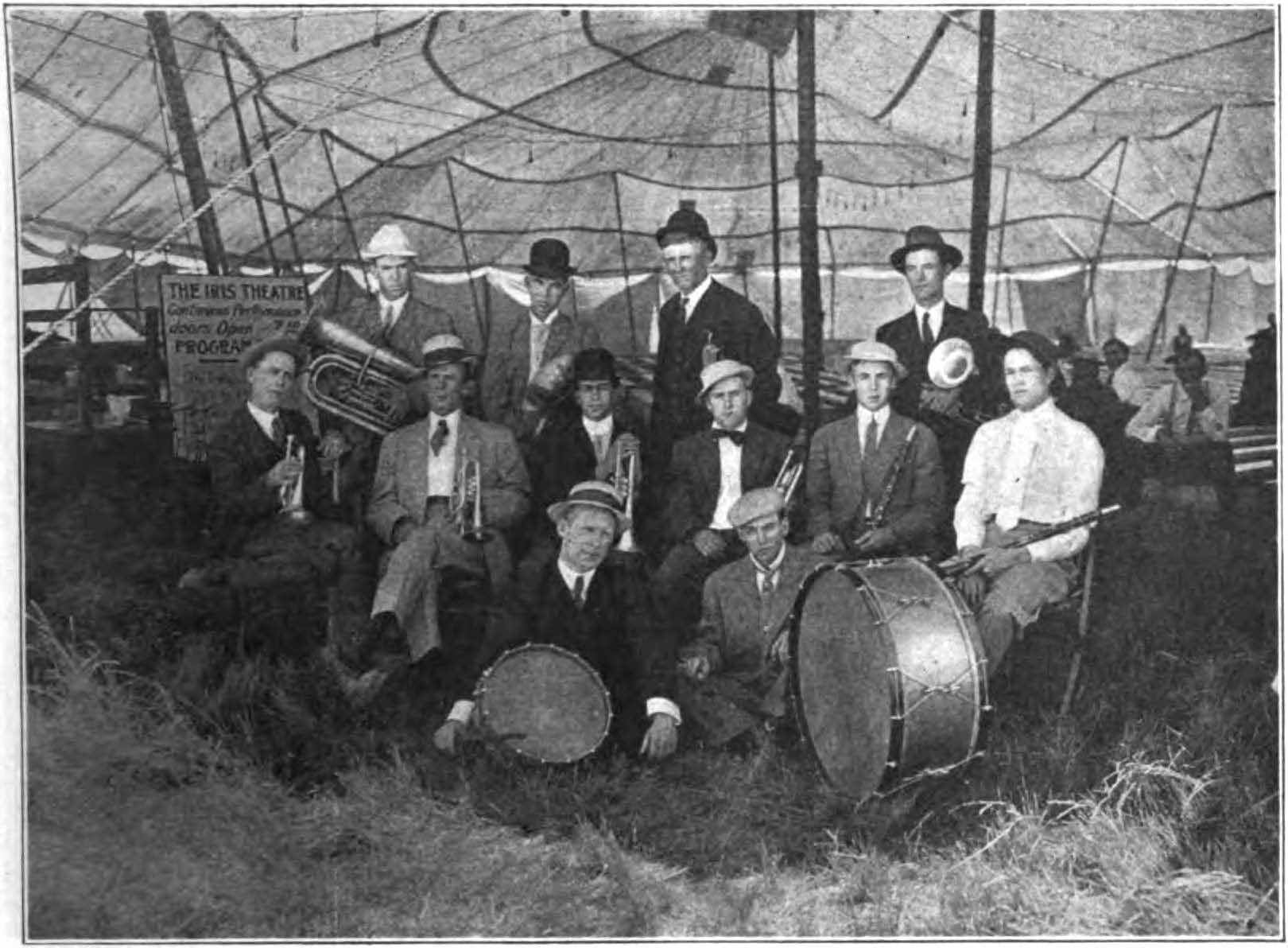
A lost Socialist tradition once widely practiced in the U.S., especially in the West were summer encampments where hundreds, sometimes thousands, would gather over several days for politics and comradeship. Here, the 1910 encampment for the Oregon and California Socialist Parties in Klamath Falls.
‘Big Double-State Encampment On’ by Cloudesley Johns from The New York Call. Vol. 3 No. 179. June 28, 1910.
Socialists of Oregon and California Rally Under Big Tent at Klamath Falls, Oregon–Great Enthusiasm.
KLAMATH FALLS, Ore., June 27. Greeted with the blare of brass bands and the cheering of multitudes, a thousand red and white lights flashed up last night, illuminating the great tent city. The “big top,” 100 by 200 feet, serving as an auditorium for the great Socialist gatherings, glowed like a monstrous fire balloon half inflated with the many lights within.
A loud hum of excited voices broke the quiet of the night, and under the spell of the occasion each of the onlookers spoke to the one nearest him without regard to knowledge or acquaintance.
Thus it was that a banker of Klamath Falls found himself saying to a stranger:
“I don’t hold with these Socialists at all. They may have some good ideas, but they go too far, don’t you think so? But they sure got this thing up in good shape. I’ll say that for them.” And he did not know that he was speaking to an organizer of the Socialist Party.
Many were the comments of the kind, not only by the people of the town, for of more than one thousand visitors to Klamath Falls on the ground, at least two hundred were not Socialists, but residents of the three counties comprised in the judicial circuit which holds court here this week.
Practically the entire population of the town, about three thousand turned out for the opening of the Oregon-California Socialist Encampment, swelling the crowd which assembled last night on the grounds on Main street, opposite the Southern Pacific depot, to more than four thousand.
For some time the assembled people, feeling the charm of the scene and the sense of good-fellowship which sometimes is found in great multitudes, were loath to enter the great tent where the speaking was to begin at 8 o’clock. Many wandered away from the stronger glow of the lights across the grass-grown fields, looking back at the camping ground, with its 300 white tents, and turning from them to the distant crest of Mount Shasta, white with never melting snows, towering above the far horizon and gleaming in the light of the yet unrisen moon.
At length, however, the interest which has been aroused in the speakers brought from far and near to the encampment, supplemented by the efforts of the committees, brought the crowds into the big tent, and the speaking began.
After a brief address of welcome by D.E. Burrell, secretary of Local Klamath Falls, of the Socialist party, a short talk on the encampment was given by Cloudesley Johns. Edward Adams Cantrell then delivered the main address of the evening taking as his subject “The Next Step in Democracy.” The crystal clearness of his thought, and the terse simplicity of his speech charmed the great audience winning applause from many who have no sympathy with the speaker’s conclusions.
Among the Socialists gathered at the encampment are more than a hundred from Dorris. Cal., just across the state line, headed by E.L. Burris: twenty from Seaside, Ore., marshaled by J.N. Hughes: fifteen from Cottage Grove, with T.F. King: a hundred from Dunsmuir, the party being organized by Lynn McMichael; N.S. Richards, of Albany, brought twenty “reds” with him: J.C. Smith came with sixty from Medford, and A.L Munroe brought a party of thirty which he gathered together in Fort Rock and Silver Lake. Ore.
The committee in charge of the encampment raised $2,000 in Klamath Falls for the expenses of the affair, more than three-fourths of the business men of the city contributing to the fund. When the last contribution had been received. Local Klamath Falls had cards printed stating that the possessors had contributed. As soon as these appeared in the store windows, many who had refused donations, hunted up some member of the committee, and announced that they had changed their minds and would like to give $5 or $10 for the encampment. These belated offers were refused.
Besides the “big top” and 300 small tents furnished with cot beds and small tables, there is a cook tent and large dining tent on the grounds. J. Stitt Wilson, Socialist candidate for governor of California, will be the speaker of the evening tonight. Tom Lewis, well known as an agitator of great power throughout the West, who had meetings in Portland canceled in order that he might accept the invitation to address the immense crowds at the Klamath Falls encampment will follow.
The New York Call was the first English-language Socialist daily paper in New York City and the second in the US after the Chicago Daily Socialist. The paper was the center of the Socialist Party and under the influence of Morris Hillquit, Charles Ervin, Julius Gerber, and William Butscher. The paper was opposed to World War One, and, unsurprising given the era’s fluidity, ambivalent on the Russian Revolution even after the expulsion of the SP’s Left Wing. The paper is an invaluable resource for information on the city’s workers movement and history and one of the most important papers in the history of US socialism. The paper ran from 1908 until 1923.
PDF of full issue: https://www.marxists.org/history/usa/pubs/the-new-york-call/1910/100628-newyorkcall-v03n179.pdf
 Revolution's Newsstand