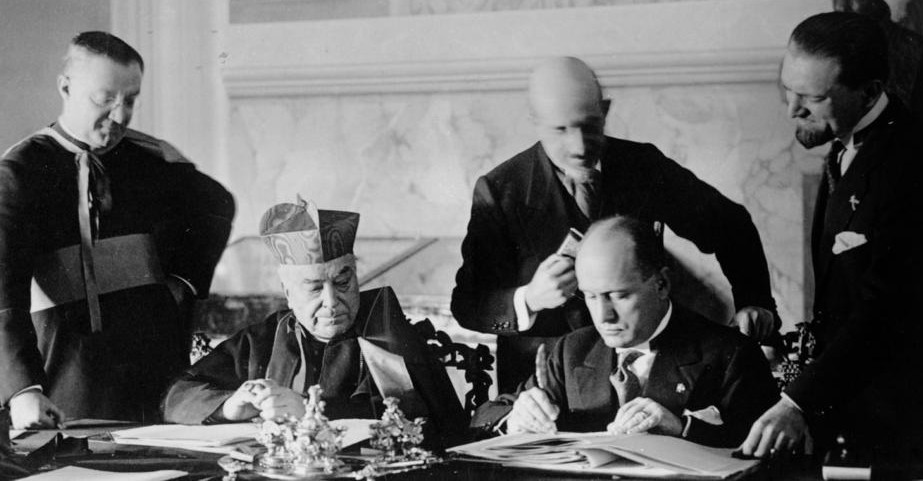
The history of the relations between Mussolini and the Church in the 1920s.
‘Fascism and the Vatican’ by G.A. from The Daily Worker. Vol. 6 No. 146. August 26, 1929.
THE outsider who wishes to study the development of Italian fascism on the basis of original documents and the irrefutable actions of fascism, but who knows only of the first half of the history of fascism, must shake his head with incredulity when he reads the reports of the reestablishment of the temporal power of the Vatican by the Italian fascist government. Is not the present “dictator” of fascist Italy the same Mussolini who demanded in the original program of the fascists “the expropriation of the property of the religious orders and the abolition of the episcopal benefices which are the privileges of the few?” Was it not Mussolini who agitated for years in the columns of the “Popolo d’Italia,” the central organ of the fascists, for the abolition of the privileges of the catholic church, for the separation of church and state, for the abolition of the property rights of the religious orders? Was it not Mussolini and the fascists who smashed the Popolari party (Catholic People’s Party) which stood under the wing of the Vatican and the clergy and drove its leader, the priest Don Sturzo, out of the country? Was it not Mussolini and the fascists who dissolved the catholic trade unions which had no less than 1,200,000 members, who suppressed the 4,000 catholic cooperatives, who destroyed the 3,000 catholic mutual aid societies in the villages and who dissolved all catholic youth organizations, declaring that the Italian youth must not be educated in a religious spirit but in the spirit of fascism, in other words in the spirit of militarism and chauvinism? Did not Mussolini and the fascists burn down dozens of rectories and demolish altars because priests refused to make fascist propaganda from the pulpits? Did not Mussolini permit his blackshirts to beat up priests and even bishops on the open streets, some of them being killed outright, as for instance the Archdeacon Don Minzoni? Mussolini is still holding a great number of catholic priests and politicians on the terrible deportation islands, for instance, the well-known theologian Bevilacqua, Caon Rolandi of Savona, Gori from Udine, the Archdeacon Gaspero from Tarcento, Concina from Pordenone, Colin from Spilimbergo, Moiano from Como, the 73-year-old Archdeacon Solizzo from Gemona, the priest Miani from Como, Galbiati from Iveruno, the catholic deputy Gavazzoni from Bergamo, Merizzi from Sondrio, Tupini from Rome and many, many others. Mussolini causes every sermon in every church, even in lonely districts, to be controlled by blackshirts and Carabinieri whose duty it is to make a written report concerning the tone of such sermon to the fascist authorities.
The puzzled consider need be puzzled no longer, it is one and the same Mussolini, and the whole situation which appears so contradictory and confused, is in reality not at all extraordinary. It can easily be understood in relation to the history of the Italian bourgeoisie in the last century.
Since the 20th of September, 1870, the Pope has been the voluntary “Prisoner of the Vatican.” On the 20th of September, 1870, the troops of the Italian bourgeoisie, entered Rome under the command of the head to the House of Savoy and the temporal power of the Papacy was solemnly declared to be abolished for all time. Historically considered, the troops which entered Rome were the troops of the North Italian bourgeoisie. In the first half of the nineteenth century Italian industry commenced to develop in northern Italy whilst southern and even central Italy to a certain extent, have remained preponderatingly agrarian districts down to the present day. The numerous petty states in central and southern Italy which existed in the second half of the last century, were the bulwarks of the agrarian interests. The rising class of bourgeois industrialists, etc., demanded the unification of Italy, partly in order to satisfy their immediate economic interests (each of the petty states had and exercised the right to impose customs, etc., and this was very damaging to the development of northern Italian industry and commerce) and partly in order to smash these powerful bulwarks of the agrarian interests. However, the greatest hindrance to the unification of Italy was the Vatican state which was at its greatest, stretching from Bologna to Ravenna. The Pope allied himself with the ruling class of agrarians against the bourgeois revolution, and it took decades of bloody fighting to break the military power of the allied reaction.
The taking of Rome achieved the unification of Italy and the first great stage in the development of the Italian bourgeois revolution was concluded. The military and political victory of the revolution did not, however, mean that the industrial bourgeoisie was the actual ruler of the country. For this its economic basis was too narrow. First of all Italian industry was, and remained for many decades, small and middle-scale industry and was able to develop only slowly in consequence of the lack of raw material and capital. Large scale industry began to develop seriously only at the turn of the new century. Secondly, the territorial basis of Italian industry was limited almost exclusively to northern Italy, whereas, the South, and partly also the centre of Italy remained, as has already been said, definitely agrarian. The struggle between the industrial bourgeoisie on the one hand and the agrarians allied with the clericals on the other, continued in different forms and with great bitterness. This fact has stamped itself indelibly upon Italian political life, and explains the fact that the whole of the Italian bourgeoisie and all its political parties, the conservatives and the liberals, the democrats and the radicals, were very definitely anti-clerical and remained so up to the victory of fascism.
The victory of fascism brought a decisive alteration in this situation. Historically considered the victory of fascism in Italy represents more than the temporary and bloody suppression of the working class, it represents the completion of the bourgeois revolution, a completion long delayed and accomplished under extraordinary circumstances, i.e., in the period of the proletarian revolution. The victory of fascism represented the unlimited dominance of the Italian bourgeoisie, industrial and finance capital. The historical reactionary opponents of the bourgeoisie, the agrarians and their clerical allies were finally defeated and the victorious bourgeoisie is in a position to make its old enemies far-reaching concessions without endangering its own victory. On the other hand, the bourgeoisie is compelled to make such concessions because the completion of its own revolution falls in a period when the working class and the peasants tending towards the workers, have themselves put forward the question of power. The concessions are necessary in order to form a united front of the possessing classes against the threatening danger of the proletarian revolution.
That is the significance of the great concessions which the fascist government has made in the name of industrial and finance capital to the agrarian and clerical interests. The concessions are intended to win allies in the countryside. This is the explanation of the apparently contradictory policy of fascism towards the church. The political and trade union mass organizations of the church, organization which embraced petty-bourgeois and even proletarian masses, were smashed by the fascists just as the “red” organizations were destroyed. The obstinate priests who were the chief officials of these organizations and who attempted to defend them against the fascists, not from any immediate material considerations, but because the activity of the priests in these organizations bound the “faithful” more strongly to the church, were compelled to bloody just as were the workers, swallow castor oil or were beaten though of course, the persecutions against the catholics were hardly comparable to the wave of exterminating terror which swept down upon the workers. Catholic priests were sent to the notorious deportation islands and housed in barracks together with criminals, just as were the socialists, Communists and liberal and democratic politicians.
As compensation the fascist government has offered the Vatican and the catholic clergy the fulfilment of all their wishes upon the religious field. Of course, that is a concession at all, for the interests of the catholic church in Italy and the Italian fascist bourgeoisie are identical. In its struggle against the working class the fascist bourgeoisie cannot and does not wish to abandon the old and effective opium of religion. The careful and wary Vatican hesitated for a long time. The victory of the bourgeoisie did not seem certain enough, further, the Vatican was subjected to pressure from below on the part of the petty-bourgeois and proletarian masses of the “faithful” which felt keenly the oppression of the fascists, whereby the lower priests acted as the channels along which this pressure was communicated to the higher priesthood and the Vatican. The first retreat of the Vatican in the face of fascism was greeted with a storm of indignation from the lower priesthood. Even such a highly disciplined religious society as the Jesuits was, and still is, split into two parts with regard to fascism, one section being anti-fascist and the other pro-fascist. It is a well-known fact that the extremely powerful Cardinal Gaspari, the cardinal-secretary of the Vatican, belongs to the anti-fascist tendency in the catholic church.
However, the power of the victor, that is in this case the victorious bourgeoisie, is and always has been irresistible for the church. The victorious fascist bourgeoisie has now trodden the most glorious traditions of the Risorgimento into the dust and permitted the resuscitation of the papal state, although within modest limits. The pope therefore no longer sees any reason without it since 1870.
In the interests of the Italian workers and peasants who misguidedly permitted themselves to be harnessed before the chariot of the clericals in the post war years, in the interests of their class-consciousness and a recognition of their real interests, the reconciliation between the pope and the fascist bourgeoisie must be welcomed!
The Daily Worker began in 1924 and was published in New York City by the Communist Party US and its predecessor organizations. Among the most long-lasting and important left publications in US history, it had a circulation of 35,000 at its peak. The Daily Worker came from The Ohio Socialist, published by the Left Wing-dominated Socialist Party of Ohio in Cleveland from 1917 to November 1919, when it became became The Toiler, paper of the Communist Labor Party. In December 1921 the above-ground Workers Party of America merged the Toiler with the paper Workers Council to found The Worker, which became The Daily Worker beginning January 13, 1924.
PDF of full issue: https://www.marxists.org/history/usa/pubs/dailyworker/1929/1929-ny/v06-n146-NY-aug-26-1929-DW-LOC.pdf
 Revolution's Newsstand