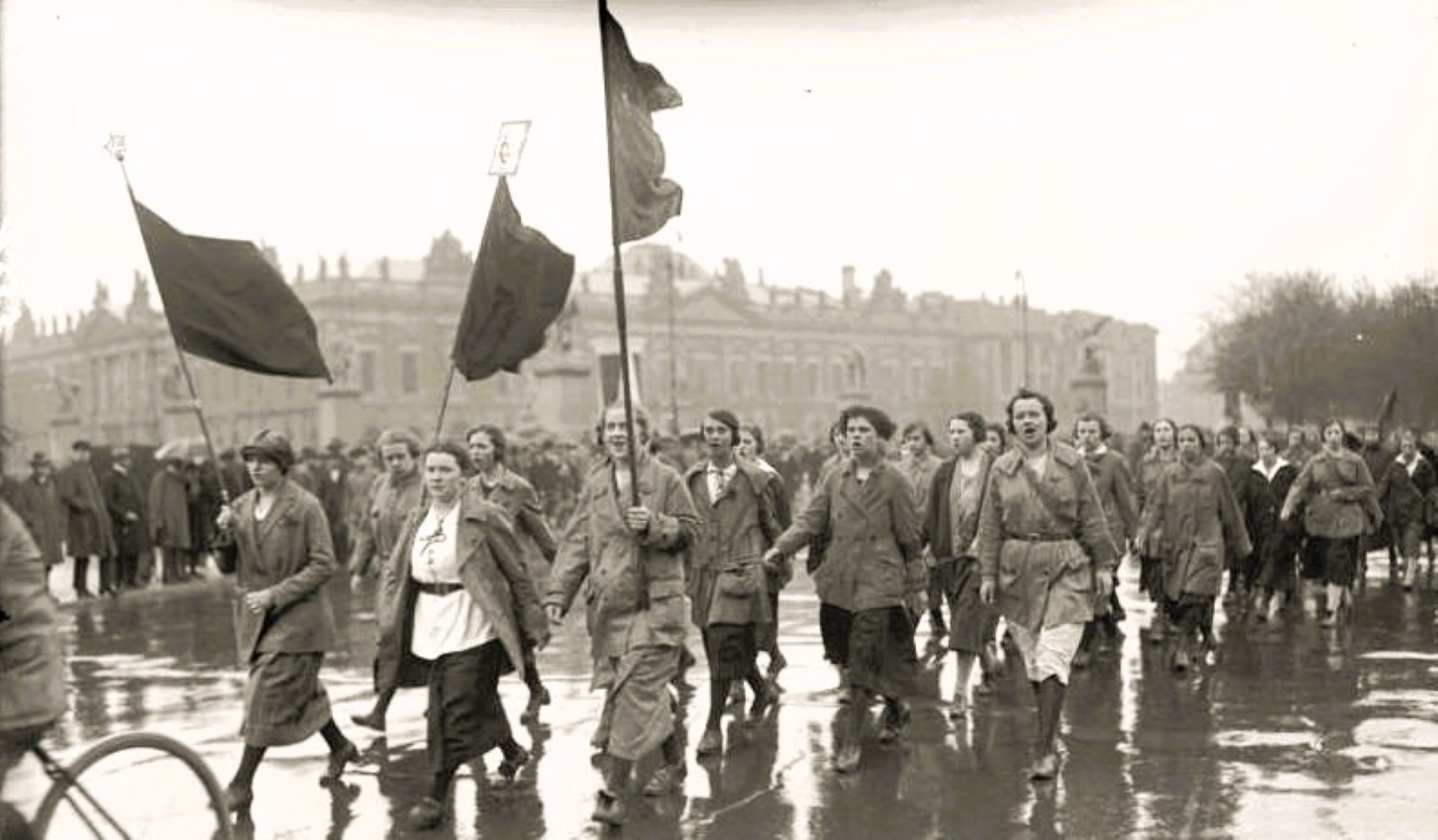
A clear warning and urgent tasks in this resolution on fascism from the July, 1923 meeting of the Young Communist International.
‘The Struggle Against Fascism and Reaction’ from Resolutions and Theses of the Fourth Bureau Session of the Young Communist International, July 1923.
1). The Young Communist Leagues carry on their struggle against Fascism on the basis of the decisions of the Enlarged Executive Committee of the Communist International and pledge themselves to render the strongest support to the Communist Parties for the carrying out of the practical measures contained in these decisions.
Fascism has spread to other countries after its victory in Italy. Suffering from the consequences of the war and the progressive dissolution of capitalist society broad sections of the population consider Fascism as an ideal which will make for an economic and political renovation of the conditions of the state and for an improvement of their standard of living. These are, above all, sections of the petty bourgeoisie, the officials, the intellectuals, the small peasants and ex-officers. As a consequence of the general pauperization in many cases these strata have been economically pressed even below the level of the working class. Also sections of the working class join Fascism, because they are discouraged by the treason of the reformist parties and the trade union leaders; by the failure of the labor organizations which formerly appeared to be so powerful; and because they have despaired of their own strength and the strength of the working class and of socialism. The slowly progressing development of the world revolution and the struggles of the working class outside of Russia which are not led with sufficient strength and clarity, and the insufficient inclusion of the masses by the Communist Parties in their propaganda and actions have also contributed to this development.
This mass which, in its social and political origin, is composed of the most contradictory elements, which have found themselves together in the hope that thru the vague promises of Fascism they may realize their own contradicting program, is dexterously utilized by big capital for its own purposes The bourgeoisie no longer considers its state apparatus strong enough to protect its right of exploitation towards those sections of the working class who are fighting for the rights of life and existence. It therefore uses Fascism as an organization of power for the suppression of the working class and draws from it shock troops for use against the latter.
2). Fascism is, particularly in its beginning, not like the reactionary and violent organizations of the ruling capitalist and militarist clique, although later it uses the same means as this clique for the suppression of its opponents. It develops as a large mass movement out of the economic and ideological needs of great strata of the population and seeks by its activities (the setting up of radical demands against profiteers and high prices etc.), and its forms (the formation of trade unions etc.) to bring its influence to bear upon the proletariat and induce it to join the fascist movement. Further in some countries its propaganda has an anti-semitic character. In the development of its nationalist propaganda it has the support of all organs of the state and educational institutions, by which especially the young proletarian generation is to be estranged from the interests of the working class. It is, furthermore, supported by the leaders of the social-democrats, who are bound up with the bourgeoisie by their coalition policy and are unable to fight Fascism unless they break with their present policy, and who directly support it by tolerating it in all its forms and actions, particularly where social-democrats participate in the government.
Fascism hopes to attain power as a broad mass movement with legal means.
The more the economic standard of the working class youth deteriorates thru the capitalist offensive against the working class and thru its still more determined attacks against the youth in particular, the better are the prospects of fascist propaganda amongst the masses of the young workers, and particularly amongst the young unemployed workers, the impoverished youth of the petty bourgeoisie and the students, as well as the youth of the working farmers. Fascism attempts to bring its influence to bear upon the youth of all social strata and to train it for the struggle of the bourgeoisie, by supporting itself, on the one hand, by a demagogic propaganda, which with radical phrases, promises to the youth an economic improvement of their situation and a fulfilment of their demands, and, on the other hand, on well organized, well financed youth organizations which include the most determined and active sections of the bourgeois youth.
By cleverly utilizing the miserable situation of the youth and its inclinations to romanticism and its urge to action, which are satisfied in its exercises, parades, processions and all its exterior trappings, Fascism wins also parts of the proletarian youth. Fascism has created for itself its strongest support and its most reliable troops from its youth organizations of all kinds (military, sport, trade, religious). Thus the fascist organizations consisted in the beginning of more than 50 per cent young workers; in Germany the fascist movement is represented by the Jung Deutschen Orden (Young German Order), the Jung Bismarck Bund (Young Bismarck League), the Bayrische Jungsturm (Bavarian Young Storm) etc.
Where, under a non-fascist rule, fascist organizations feel themselves strong enough, the bloody attacks and acts of terror against members or meetings of the organizations of the working class youth, and the attempts to prevent the young workers’ organizations from carrying on their activity, increase.
The social-democratic youth organizations carry on an actual ideological preparation for fascist propaganda and fascist ideas in the young workers’ organizations by rejecting a joint struggle against the reactionary youth organizations, by their “neutrality” with regard to the political controversy with Fascism, by their co-operation with bourgeois youth leagues. And even worse, among the German young socialists there has already developed the germ of a fascist group and in the Ruhr district members of the socialist youth render assistance to the Fascists in the distribution of leaflets.
3). Fascism must, in its attacks, meet with the determined resistance of the working class. The establishment of the united front of all political and trade union organizations of the proletariat for the purpose of a joint political defence and for the organization of a counter-action is therefore the first condition for a victorious resistance. united front, the winning of powerful positions of the working The struggle for the class by means of shop councils, control committees for the struggle against wage-cuts, increase of prices, reaction and the danger of war, and the establishment of a workers’ and peasants’ government, must develop the mass forces of the proletariat which in this struggle will defeat Fascism, its most dangerous class enemy, both ideologically and politically and simultaneously will bring about its military defeat. Drawing the conclusions from the experience that the defeat of the attacking Fascists is possible if the working class begins in time to prepare the joint struggle against Fascism, the working class must organize from its ranks defence organizations, which are ready, to defend to the last, the right and the life of the working class and to resist Fascism by force of arms. The defence organizations are the political expression of the united front struggle. As such they have not only the task of the military struggle but also of political propaganda for uniting all workers against Fascism. Therefore they should include workers of all political tendencies.
In order to carry thru in this spirit a general mobilization of the young workers against Fascism, the Young Communist Leagues address themselves to the proletarian youth organizations of all political and trade union tendencies for the purpose of joint action of the young workers on definite occasions and for definite demands, with the call for participation in the united militant front of the adult workers and for the entrance of their members into defence organizations.
The Young Communist Leagues must consider their activity against Fascism an important and daily League work and carry it on with particular vigor. In their economic and political work among the masses of the working class youth, in the strengthening of their struggle for the defence of the vital interests of the proletarian youth and for the revolutionization of the latter and in their struggle for the establishment of the united front of the young proletariat, lies the most effective means of barring the road to the working class youth against the Fascists. For this purpose the Young Communist Leagues must carry on extensive political enlightenment campaigns against Fascism and rouse the young workers ideologically against Fascism. It is of particular importance, to show to the young workers that Fascism in its essence is hostile to the working class; only thus will the young workers adopt a definite fighting attitude towards Fascism. With every success of our economic work, however small, we remove the working class youth a little further from fascist influence. The Young Communist Leagues also do everything in common with the entire working class to prepare the young workers for the violent struggle with the reactionary power of Fascism. Broad sections of the proletarian youth which hitherto were indifferent towards the Young Communist Leagues, are ready to take up this struggle. The practical beginning of the anti-fascist struggle by the Young Communist Leagues has already proved that it is an excellent means to bind ourselves up with the active, determined part of the working class youth and thus strengthen our organization.
4). The following are permanent tasks of the Young Communist Leagues in the struggle against Fascism:
(a) The Young Communist Leagues are to carry on, above all in their own ranks, an extensive work of enlightenment on the causes, the aims and the purpose of Fascism. To thisend, first of all among the officials, discussions are arranged on such problems as are connected with the question of Fascism (the national problem of Jews, etc.). The fascist programs will receive particularly critical consideration. In the enlightenment work it is not sufficient to outline the exterior characteristics of Fascism, but a definition of its deeper causes is essential. Of similar importance is the enlightenment work among the rank and file.
More than hitherto must we stress the political fight against Fascism. After having received such a training, the members of the Young Communist Leagues are reliable defence troops whose activity is being carried on under the continuous political influence of the League.
(b) The Young Communist Leagues are to carry on an energetic struggle against the reactionary youth organizations, which they consider to be the shock troops of Fascism. They must develop an extensive propaganda against the reactionary youth organizations in public, and in the press as well as by leaflets among the working class youth, thus destroying the ground for the propaganda of the fascist youth organizations. They must arrange branch meetings dealing with Fascism, to which the unorganized young workers are invited. Similar meetings of the nuclei with the support of the groups are to be arranged.
(c) The Young Communist Leagues are to demand the disbandment of the reactionary youth organizations, prohibition of their meetings, their press and their propaganda. In all meetings and arrangements of these organizations the branches of the Young Communist Leagues, if possible in conjunction with other proletarian youth organizations, should participate and send speakers. Wherever possible, the Young Communist Leagues are to arrange determined counter-actions together with other proletarian youth organizations and the adult working class against manifestations and public meetings of the reactionary youth organizations.
(d) Organizations of an extensive news service on the activity of the reactionary youth organizations. Passing on of all news to the defence organizations, committees of action, control commissions and parliamentary fractions.
(e) The anti-fascist propaganda of the shop nuclei is of particular importance. It must be carried on, apart from an intensified representation of the economic interests of the young workers, by a determined struggle against the employment of fascist elements in the shops (students, technical emergency helpers, workers who are members of reactionary organizations). In the shops the boycott of such fascist elements most, on the initiative of the shop nuclei, constitute an effective means of struggle.
(f) In the trade unions and trade union youth sections too, the fractions of the Young Communist Leagues must carry on an eager anti-fascist propaganda in order to drive the trade unions to the struggle against Fascism and prevent the penetration of fascist elements into the trade unions or the formation of fascist trade unions. Where fascist trade unions are in existence, the Young Communist Leagues support the work of the Party to decompose them, while paying special attention to the winning of the proletarian youth within these trade unions.
(g) The propaganda work in the country must be intensified considerably on account of the fact, that the Fascists utilize the peasant elements for their purposes. Expeditions of the Young Communist League together with the Party into the country must be utilized for the neutralization and the winning of the rural youth against Fascism.
h) Among the petty bourgeois and student youth, propaganda must be carried on together with the communist student fractions; and groups of anti-fascist elements must be formed.
(i) In order to overcome the complete lack of anti-fascist literature, the Young Communist Leagues, supported by the International, must issue leaflets and pamphlets which expose the aims and essence of Fascism. Furthermore in the press, of the Leagues (regularly and on special occasions) and in the Party papers material must be published on the work of the Fascists among the youth, and especially on its attitude towards the youth in those places where it has been victorious.
(j) For the combination and the strengthening of their daily activities, the Young Communist Leagues must carry thru carefully prepared demonstrations and propaganda days against Fascism.
5). The formation of general proletarian defence organizations and their armament has, as a concrete measure of struggle, found a great response among the workers, where such struggles were going on.
The most suitable form of the organization of proletarian defence organizations has proved to be the formation of “factory hundreds”. The Young Communist Leagues must in all countries actively participate in the formation of proletarian defence organizations or “factory hundreds”, or where such do not exist, initiate their formation. The Young Communist Leagues demand the enrolment of the working class youth from 17 years upwards into the general proletarian defence organizations. When “factory hundreds” are being formed it is the task of the shop nuclei of the League to ensure that all young workers of the shop participate in it. The young workers under 17 years may, under the leadership of the leader of the “factory hundreds” and the nucleus of the League be distributed among the “factory hundreds” for the special tasks and services.
The problem of the special treatment and combination of the young members in the general proletarian defence organizations must be dependent upon the conditions and be settled in agreement with the Party and the Executive Committee for each individual country. The manner of the special treatment of the youth on the general defence organizations depends upon the political and military necessities.
The Young Communist International instructs its Leagues to fight with determination against the formation of independent youth defence organizations which are isolated from the general defence organizations, and against all tendencies aiming at such formation. Independent youth defence organizations split the unity of the struggle, create a contradiction between adult and young workers and are themselves no organs which are able to carry on a serious struggle.
Also where, as in Saxony for instance, the youth are only admitted from 20 years upwards on the part of the social democrats, the Young Communist Leagues form no special youth defence organizations. After the rejection of our demands by the social-democrats they carry on an untiring propaganda for the inclusion of the young workers from 17 years in the organizations. In the meanwhile they may, in agreement with the Communist Party and sections of the workers of the other proletarian parties and trade unions, combine these youths into assistant troops under the leadership of a leader of the general defence organizations. Thus they are subordinated to the general defence organization for which they may do special services. By these assistant troops of the youth the propaganda for the complete enrolment must be continued. In the labor athletic and sport organizations the Young Communist Leagues must carry on a propaganda to induce these organizations to enroll their members in the general defence organizations. However valuable the members of the labor sports organizations may be for the physical defence against Fascism, experience has nevertheless proved that defence organizations formed by them in isolation from the general defence organizations are not fit for real struggle. This applies also to the proletarian scout organizations etc.
6). The variety of the stages of development of Fascism in the individual countries demands of every League a particular activity, for which the National Executive Committees must set up directives. The international cooperation of the fascist organizations, which demands the international defence of the working class, furthermore requires imperatively the collection of all experiences in the struggle against Fascism.
An extensive co-ordination of the work of the various Leagues in the ideological as well as in the practical fight against Fascism is urgently necessary in accordance with its international significance. Thus for instance the Leagues of Germany, Austria and Checho-Slovakia must act together against the “National Socialists”, must exchange material and information, must issue joint appeals, and possibly organize counter-manifestations against the international conferences and meetings of the National Socialists (August 1923).
In all countries the Leagues must participate in the formation of a national committee of the labor organizations for the struggle against Fascism; they must be continuously represented upon it and energetically collaborate in its work.
In the same manner the Young Communist International supports the work of the international organs for the struggle against Fascism and takes an active part in their work.
When committees of action are formed by the Amsterdam international trade union federations and red trade unions, the Young Communist International must see to it, that the young trade union members also participate in the action, receive a special representation in the committee of action and set up the demands of the young workers.
7). The Fourth Bureau Session of the Young Communist International heeds the warning of the thousands of victims of reaction in all countries and learns from the past. It states that the Young Communist Leagues and the Communist Par ties, as well as the entire proletariat have remained much too long inactive towards the doings of reaction. Since the defence of the proletariat has begun it has not been carried on with the same sharpness, quickness and ruthlessness as the attacks of the Fascists. The international proletariat must make up for this twofold neglect.
Do not forget the victims of the struggle! The proletariat must consider every class comrade behind prison walls as a chained limb of its own body. Untiringly must the working class and the working class youth fight for the liberation of all proletarian fighters from the prisons and jails. With devotion they must show their solidarity and as a sign of practical help to the imprisoned comrades support the “International Red Relief”. The Liebknecht Fund must become the strongest support of the International Red Relief.
Mutual assistance in the struggle. Every organization must rush to the help of each organization in danger. Material and moral support is necessary: sending of workers is a means to maintain the courage of the fighting comrades and contribute to the defeat of Fascism.
Crush Fascism! Where it has already celebrated its temporary triumph, the proletariat must reorganize its forces; where Fascism is on the march, it must be met by the great army of the working class. The power of Fascism must and will be broken by this iron phalanx.
The Young Communist International calls to the working class and peasant youth to fight together with the class conscious proletariat of all countries against its deadliest enemy. The mailed fist of the revolutionary proletariat must ruthlessly smash Fascism wherever it shows its head.
PDF of full book: https://www.marxists.org/history/international/young-communist-international/4th-bureau-session.pdf
 Revolution's Newsstand