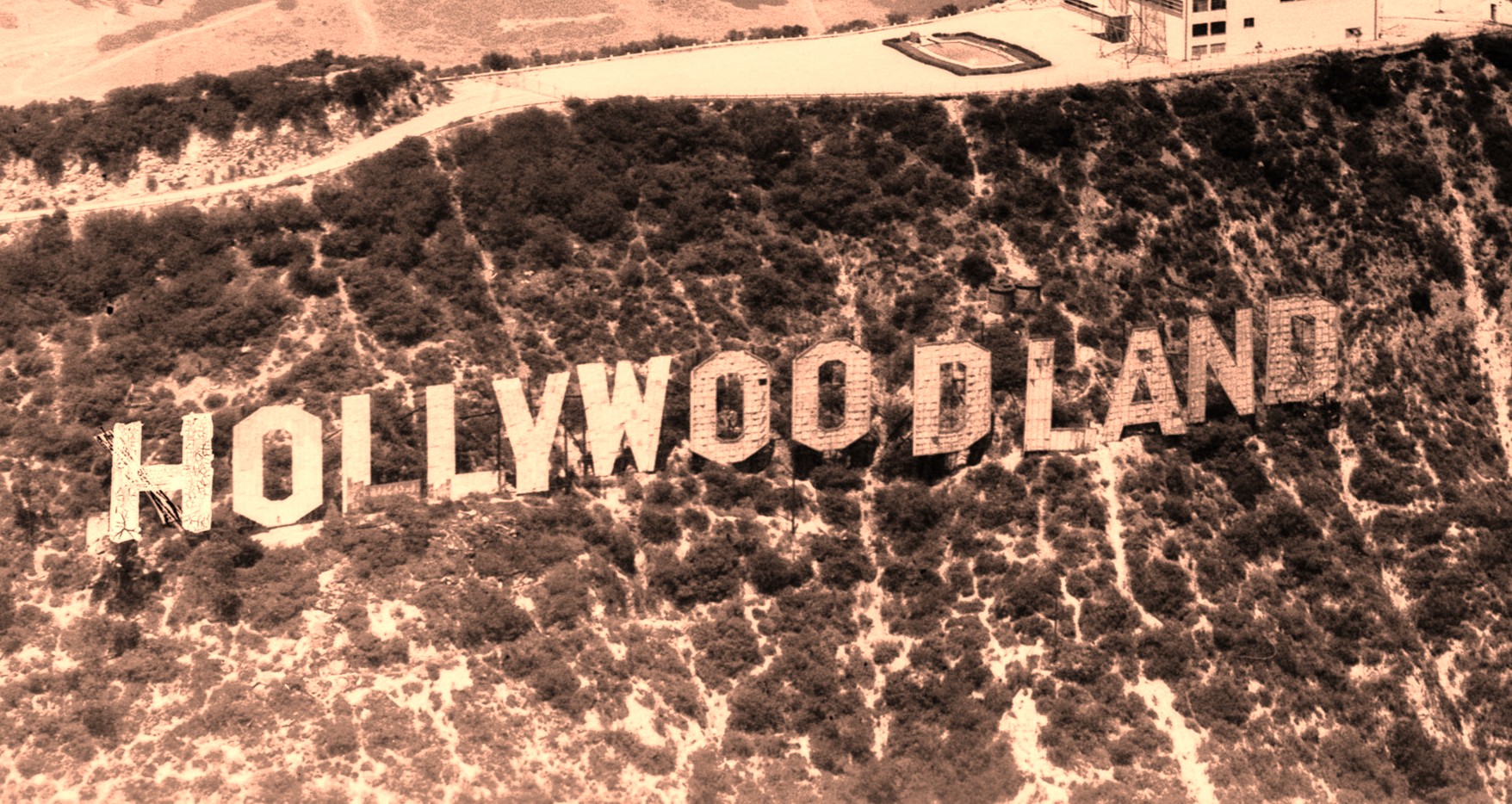
The history of how Rockefeller’s finance capital, through the Chase Bank, came to dominate nearly every major Hollywood company in the late 1920s and early 30s.
‘Wall Street Hollywood’ by Gertrude Armstrong and Ben Maddow from New Masses. Vol. 12 No. 7. August 14, 1934.
THE title, “Code of Fair Competition for the Motion Picture Industry,” is a mask by which the N.R.A. administrators conceal the almost complete ownership of the motion picture industry by the Chase National Bank, organ of the Rockefeller interests. The title, “Fair Competition,” is wilfully inaccurate. In reality, the code is an official charter sealed by President Roosevelt, giving a formal approval of Chase domination.
Nominally there are five major companies in the industry: RKO, Paramount, Warner Bros., M.G.M.-Loew, and Fox Film.
Examine the present status of the industry and you discover RKO, subsidiary of the Radio Corporation of America, which along with the towers of Radio City, is dominated by the Film Securities Corp. (a Chase creation). Whatever their direct holdings in RKO may be, the Chase domination of the entire Radio set-up, including the National Broadcasting Co. and RKO, was considerably strengthened by an arrangement made recently whereby the Radio Corporation of America ceded 100,000 shares of its Class “A” preferred stock to the Chase-Rockefeller group, in lieu of rental adjustments for space in Rockefeller Center. These 100,000 shares of Class “A” stock are equal in voting power to one million shares of common stock.
Of the second corporation mentioned, the Paramount Pictures Corporation, it must be stated that up to the time of its bankruptcy in January, 1933, it was the largest and most important single unit in the Motion Picture industry. As far back as 1919 it had shown its ingenious policy of expansion through the aid of large banking groups in Wall Street by enlisting the aid of no less a banking firm than Kuhn, Loeb and Co. Recently, however, despite the activities of the late Otto Kahn and Sir William Wiseman (both of the Kuhn, Loeb banking firm) in a “reorganization” plan for Paramount, it seems that the control of Paramount has been shifted to a different banking group–the Chase National. This fact can be realized if one examines the peculiar composition of the Board of Trustees in Bankruptcy: Charles D. Hilles, Eugene Leake and C.E. Richardson. The two latter are out and out Chase men; Eugene Leake is a director of Loew, Inc., and C.E. Richardson, up to the time of his appointment as Trustee of Paramount, was the vice-president of the Equitable Trust–the Rockefeller bank which merged with Chase several years ago. Thus by a simple mechanism, the Chase-Rockefeller group has managed to obtain the administrative control of the company.
However, it is through the historical conditions of the last corporation mentioned, the Fox Film, that we shall endeavor to show the various methods by which the Rockefeller-Chase Bank cleverly manipulated the circumstantial conflicts in the motion picture industry, unscrupulously jostled the equally unscrupulous independent producers from control, and finally paved its way to its present position in the industry–to monopoly control.
Before 1919 the production of movies was a freakish industry, sprouting tremendously but without substantial financial backing. Patent rights were considered insufficient and no sensible banker considered Pearl White, although the survivor of a thousand episodes, immortal collateral for a loan. It was Adolph Zukor who hit upon the correct technique for erecting a movie monopoly. Having begun to establish a chain of theatre properties, he was able with this as collateral to borrow finance-capital on a large scale. In this way he bought up whole chains of theatre properties, putting control of manufacture, distribution, and exhibition in one corporation’s hands and providing visible assets for the financiers. Such was the expansion under these methods, and so violent the cutthroat competition, that difficulties arose over the Sherman Anti-Trust Law. These difficulties were resolved by hiring Will Hays, Postmaster General under Coolidge and National Treasurer of the Republican Committee, to become the Supreme Wire-Puller and the Presbyterian Shirt-Front, with the virtual status of dictator and $150,000 annually. This choice at once obviated the difficulty with the local censorship boards who, under the guise of the preservation of morals, voiced their concealed chauvinism against the Jewish-controlled movie industry (Zukor, Fox, Goldwyn, Mayer, etc.).
J.P. Morgan never cared for the movies. But the Chase group, more “progressive,” viewed the 100 percent profit with a lust that increased with its great 1924-1929 surpluses, lying frustrate in its vaults. Early in 1929 there came the death of Marcus Loew, controller of M.G.M.-Loew, which had merged in 1921; his heirs were quarreling, ready to be bought out. The chains of theatres were so distributed and the balance of the industry such, that of the five major companies, any combination of two would control, not two-fifths or less of the industry, but much more; such a merger would dominate the whole field. William Fox, owner of Fox Film at the time, was encouraged through his bankers, Halsey Stuart and Co., to negotiate for the 660,000 Loew’s shares. Halsey Stuart gave Fox $100,000,000, secured by one year notes, to buy the Loew’s stock and in addition, British Gaumont, Ltd.
Fox, having been used by the bankers for their own purpose, was due to be removed. On a sick bed late in 1929, he was informed that his notes would be called in April, 1930. Since he didn’t have the $100,000,000 on hand, he got a rival banking group (Bank of America, Dillon, Read, and Lehman Bros.) to approve a refinancing; he gave them $1,000,000 merely for investigating his credit status. They promised to refinance the notes. Halsey Stuart and Co., however, threatened suit for breach of their contract, which gave them exclusive financing rights for ten years. They would not allow other banks to refinance the notes. In other words, they wanted their money back, but they refused to be paid! At the height of this struggle Fox’s branch offices, 129 of them extended over the world, found they could not withdraw money to meet their payrolls. Their respective banks would not pay out their accounts. Here at once it was clear that some tremendous power, capable of closing credit throughout the capitalist world, was preparing Fox’s death. It was evident the power was Chase’s.
Halsey Stuart, having prevented other rival banking groups from lending money to Fox, declared that they would not refinance the notes for Fox unless the Fox Film was submitted to a dependable trusteeship of three. Charles Evans Hughes, Fox’s lawyer, advised him to accept the plan. Consequently, a trusteeship including Halsey Stuart, Otterson of Electric Research Products (a Chase company through the American Tel. & Tel.), and William Fox, was organized. Here, Fox found himself opposed by Otterson and Stuart on every policy. Badly frightened by the voting opposition and at his loss of power, Fox, on the advice of Samuel Untermeyer, corporation lawyer, sold out to Harley S. Clarke, Chicago Utilities magnate, who was introduced to Fox by no other person than “Czar” Will Hays. Fox received $18,000,000 from Clarke, who was president of the General Theatres Equipment Corp. (Clarke had received the $18,000,000 with which he paid Fox, from Chase subsidiary corporations, who by financial manipulations watered the stock from $2,225,616 up to $38,285,000!) At this point, Halsey Stuart and Co., which had refused to renew William Fox’s notes, benevolently decided to renew the $100,000,000 notes now held by Chase–supporting Clarke–for another year, to April, 1931.
But it was time for Halsey Stuart to step out. In April, 1931, they gracefully forgot their ten year exclusive finance rights with Fox Film; Chase instead was to do the refinancing by a huge bond flotation. But the sale of these bonds required a certain ballyhoo. The Chase accountants, Price, Waterhouse and Co., investigated the Fox Film Corp. They found a polite falsification of profits, by the use of accounting methods which were accurate for silent pictures, but fraudulent for talkies. Did Chase, the shrewdest finance capitalists in the world, withdraw? They could not–they were too deeply involved already, through Clarke, through Halsey Stuart, through their whole comprehensive scheme for dominating the movie industry! They got the Fox accountants to set up a sham controversy against their own accountants in the financial press. Price, Waterhouse and Co. published their findings; then Fox Film’s accountants replied with speciously convincing arguments that inspired public confidence. Chase was now able to float the bonds. They sold a million and a half of them.
After this there is simply the story of intricate thievery, the everyday practice of finance capital, details of super-holding corporations and receivership practices. But we are properly concerned with the now evident result: Rockefeller, through his Chase companies, owns Fox Film; its directors are his men, and their resignations already signed are in his locked files. M.G.M.-Loew, Paramount, RKO, Fox Film; he owns them all. An illustration of this control: million and a half of interest on the Chase Bonds fell due early in 1933, Fox Film had not the ready cash. It was decided by the clever directors that a 50-percent wage-cut for eight weeks on all employes would be a fair way to get money to reimburse Chase for all their difficulties. But the bankers were cleverer. It was pointed out that such a wage-cut would lower the Fox prestige in the industry, exhibitors would demand of Fox lower rentals for movies made at lower costs. Therefore there was summoned a grandiose private conference of the potentates of the movie industry, Czar Will Hays presiding; it is said that Herbert Hoover sat at his right hand. The boys were told that for the good of the industry it was necessary for every company to decree an eight-week 50-percent cut. This was accomplished. The strike wave which was the resistance of the American workers to the program of wage-cuts decreed by monopoly capitalism in every industry, rose to the gilded props of the Hollywood studios. Six thousand technicians refused to accept the cut; but the strike was broken.
It is our view that the Rockefeller acquisition of Hollywood has hardly changed the nature of its product—so far. Despite the change of theatre property from the independent producers to the monopoly of Rockefeller-Chase interest, there is no essential difference in the class ownership. But the important factor to be considered is that the potentiality for wielding an instrument of mass propаganda, like the moving picture industry, lies in the safe of a single Wall Street Company. Suppose the Rockefeller interests in China reached an acute stage in their conflict with Japanese imperialism, and it became necessary to defend Standard Oil tankers on the Yangtse with the bodies of American workers then we would find the “Yellow Hordes” menacing us with child murder, rape, arson and the destruction of Radio City from tens of thousands of screens, all controlled by Chase National. We have here not an isolated phenomenon, but one which is connected with the development of monopolies in the imperialist stage of capitalism. The N.R.A. as the governmental agency for the giant industries has also for example taken the initiative to unite all the organs of communication such as the telephone and telegraph, and radio companies into one unit that will be easily manipulated for Capitalist purposes. in times of war and for super-profits in times of peace.
The New Masses was the continuation of Workers Monthly which began publishing in 1924 as a merger of the ‘Liberator’, the Trade Union Educational League magazine ‘Labor Herald’, and Friends of Soviet Russia’s monthly ‘Soviet Russia Pictorial’ as an explicitly Communist Party publication, but drawing in a wide range of contributors and sympathizers. In 1927 Workers Monthly ceased and The New Masses began. A major left cultural magazine of the late 1920s and early 1940s, the early editors of The New Masses included Hugo Gellert, John F. Sloan, Max Eastman, Mike Gold, and Joseph Freeman. Writers included William Carlos Williams, Theodore Dreiser, John Dos Passos, Upton Sinclair, Richard Wright, Ralph Ellison, Dorothy Parker, Dorothy Day, John Breecher, Langston Hughes, Eugene O’Neill, Rex Stout and Ernest Hemingway. Artists included Hugo Gellert, Stuart Davis, Boardman Robinson, Wanda Gag, William Gropper and Otto Soglow. Over time, the New Masses became narrower politically and the articles more commentary than comment. However, particularly in it first years, New Masses was the epitome of the era’s finest revolutionary cultural and artistic traditions.
PDF of full issue: https://www.marxists.org/history/usa/pubs/new-masses/1934/v12n07-aug-14-1934-NM.pdf
 Revolution's Newsstand