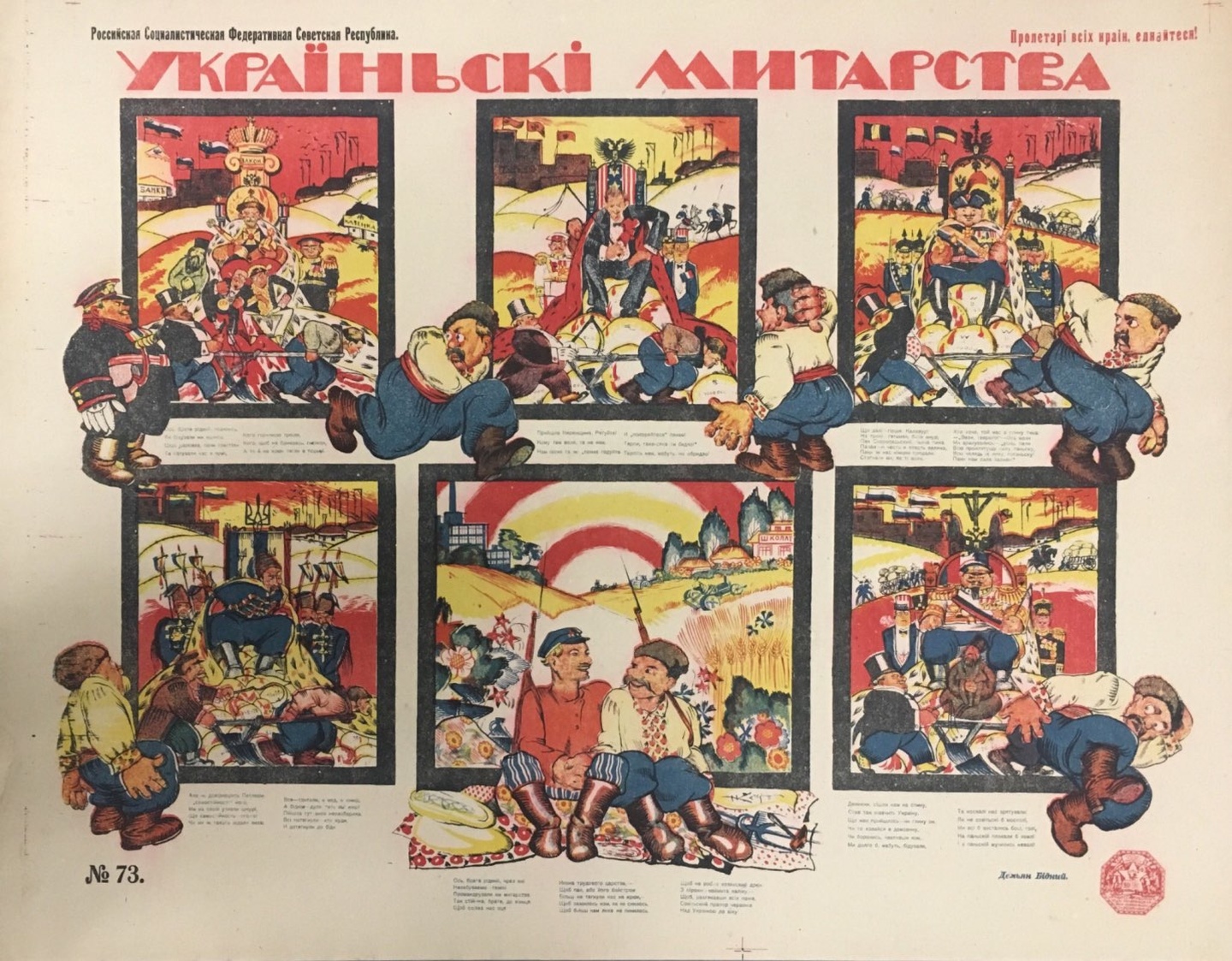
A central factor for victory in the Russian Civil and Polish Wars was the attitude and allegiance of the mass of poor Ukrainian peasants.
‘The Ukrainian Peasants’ from Soviet Russia (New York). Vol. 3 No. 22. November 27, 1920.
The peasantry is the weak spot of Soviet Ukraine. In all the periods of Soviet power in that country, the greatest difficulties were found among the Ukrainian peasants, who were largely under the influence of the rich peasants and the Makhnovists.1 Class differentiation did not appear at all in the Ukrainian villages, in spite of the large number of poor peasants.
To obtain a firm foothold among the Ukrainian peasants, the Soviet power had, first of all, to win over the village inhabitants, freeing them from the influence of the rich peasant elements. It was absolutely necessary to destroy the mainstay of banditism and Makhnoism in the Ukrainian villages.
It was hard to accomplish anything in this direction by force of arms. At any rate, the methods of armed struggle alone were insufficient. There was only one choice left: to carry out in the Ukrainian villages the experiment with the committees of the poor peasants, which had produced good results in its day in Central Russia.
A recapitulation of the progress in the organization of Committees of Poor Peasants in eight Ukrainian provinces for the period July 1-September 10, which we have before us, gives eloquent testimony to the fact that class alignment has commenced in the Ukrainian villages, and has already produced visible results, leading to the entrenchment of the Soviet power in the very midst of the Ukrainian peasantry.
The following figures show the number of Committees of the Poor (on September 10): in the province of Kharkov, 945 committees; in the Donetz province, 1,139; in the Poltava province, 1,280; in the province of Yekaterinoslav, over 200; in the province of Chernigov, 237; in the province of Kiev, 869; in the province of Odessa, 442; in the province of Nikolaiev, 1,000. The total number of Committees of the Poor in Ukraine is 6,510.
These data are far from complete, but they are enough to show the growth of class consciousness among the poorest Ukrainian peasants. Not only have committees been formed, but, in many cases, they carry on active work to strengthen the Soviet power. Thus, the above-mentioned report mentions, for instance, that in the Kupiansk county two conferences of the Committees of the Poor have already been held, accompanied by splendid revolutionary enthusiasm; the second congress declared itself mobilized as a body for the Wrangel front. In the Izum county the delivery of grain for the quota increased under the influence of the Committees of the Poor. The Committees of the Poor in the Bogodukhov county give aid to the families of the Red soldiers, and take part in the confiscation of the property of the rich peasants. A large number of congresses of the Committees of the Poor adopted resolutions showing whole-hearted support of the Soviet power and determination to fight the rich peasants. In the Priluki county the Committees of the Poor are taking the lands of the rich peasants and are distributing them among the poor peasants. In the Bogdanov volost (township) of the Pavlograd county, the Committees of the Poor divide all the goods that are received from the city among the poorest peasants. And so on.
Of course, in many localities, these Committees of the Poor have to deal with the hostility of the rich peasants; in some places the extensive brigandage hinders the organization of Committees of the Poor. There are also cases where the poor peasants have been terrorized by the rich peasants and are afraid to form committees. But on the whole the Committees of the Poor will play an important part in the work for a class alignment in the Ukrainian villages, and will create a firm foundation for Soviet construction in Ukraine.
Izvestia, October 2.
1. Partisans of the Ukrainian leader Makhno who, according to recent reports from Moscow, has declared his allegiance to the Soviet Government.
Soviet Russia began in the summer of 1919, published by the Bureau of Information of Soviet Russia and replaced The Weekly Bulletin of the Bureau of Information of Soviet Russia. In lieu of an Embassy the Russian Soviet Government Bureau was the official voice of the Soviets in the US. Soviet Russia was published as the official organ of the RSGB until February 1922 when Soviet Russia became to the official organ of The Friends of Soviet Russia, becoming Soviet Russia Pictorial in 1923. There is no better US-published source for information on the Soviet state at this time, and includes official statements, articles by prominent Bolsheviks, data on the Soviet economy, weekly reports on the wars for survival the Soviets were engaged in, as well as efforts to in the US to lift the blockade and begin trade with the emerging Soviet Union.
PDF of full issue: https://www.marxists.org/history/usa/pubs/srp/v3n22-nov-27-1920-soviet-russia.pdf
 Revolution's Newsstand