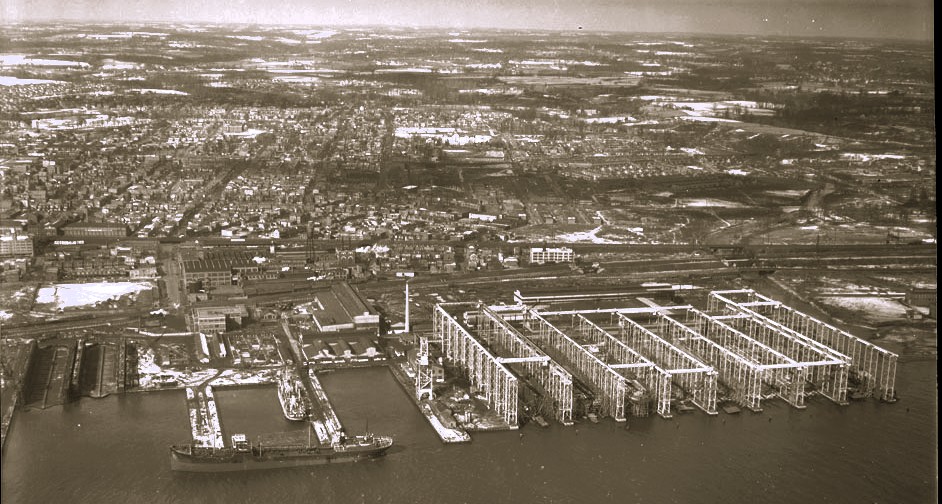
Lena Rosenberg looks at the heavily industrial Delaware River suburb of Philadelphia with shuttered factories and mass unemployment in the early Great Depression.
‘Chester, the City of Heavy Industries—And Poverty’ by Lena Rosenberg from The Daily Worker. Vol. 9 No. 96. April 22, 1932.
CHESTER has a population of over 60,000. The overwhelming majority of whom are workers in basic industries. 10 percent of the entire population are Negroes. A large percentage are foreign born. Every industry in Chester can be turned into a war industry overnight while some of them produce war materials now.
The Sun Ship Yard is now employing about 1500 workers full and part time, on two new ships and repair work on the S.S. Bidwell, an oil tanker on which 19 workers were killed when she exploded. The conditions under which the workers are forced to work are unbearable as one worker expressed himself “It is a madhouse”. Daily, workers are injured and often killed as a result of the maddening speed up and lack of safety measures to safeguard the life and health of the workers. The Sun Ship Yard has been announcing that they would employ many workers. This brought thousands to the gates not only from Chester but many from far away cities. The Sun Ship Yard management used these starving job seekers to force greater speed up on those still working, which makes it possible for them to continue on the two new ships with very few additional workers.
The General Steel Casting Co., a Morgan Concern, moved its plant from St. Louis a few years ago and in order to prevent competition they bought up and closed down practically every other steel mill in Chester. This resulted in at least 5000 workers being laid off, some of whom were hired by the General Steel: Now they have about 500 workers working from one to three days a week and some of them not even that much. At the same time wages are being slashed regularly. Workers who at one time made $15 a day working for this company, now make $4 and $5 a day when they work full time. In the chipping department ten workers received $9 for a 9 hour day leaving 90c a day for each worker. In the core department they pay for core boxes that used to run from $1.50 to $2 at present 80c to 90c. Cores on slingers that were $1.50 now are made at 25c.
The General Chemical has in two years cut its force from 800 to 400 workers. But even this small force works only from 1 to 7 days a week one out of two weeks. The wages run from 45 to 60c an hour.
The Ford plant employed about 5,000 workers a year ago, now only about a thousand are employed, who work from a few days to a week out of every 3 weeks. Because of trouble in the employment office at various occasions when many workers came looking for jobs but could not find them they changed their method of employing new workers. In order to apply for a job at the Ford plant a worker must write a letter to the company. In response to this an investigator or better said a stool pigeon is sent to the workers’ home, who snoops around and if his report is satisfactory the worker is notified to come to work which usually means that some other worker will be laid off. In this manner the administration is able to find out just how their workers live, what organizations they belong to, etc. It often happens that a worker after receiving a letter to come to work, he spends car-fare and when he gets there is told that there is no work for him.
The Wisco Rayon plant in Marcus Hook, one of the largest rayon plants in the world, employs about 2,000 out of 6,000 they formerly employed. The speed up and terror is record-breaking. For distributing leaflets in front of the mill two workers were arrested and given long jail terms.
The Aberfoyle cloth weaving factory employs mostly women but the men too get practically the same wages as the women which is about $10 a week and most of them are working part-time and making even less. The speed up is unbearable, for the least bit of damage which is a result of the vicious speed up the workers are either fired immediately or threatened with being fired if it happens again.
In all of these factories as well as the smaller ones many workers are forced to come in every day without knowing whether they will work that day or not. Sometimes they do not even get a days work, still they must come in or lose their job. In this manner they are actually slaves to these mills and factories, the only difference from chattel slavery is that in those days the slaves were fed while now the masters don’t even have to feed them.
About 15,000 workers are completely unemployed in Chester, many of them for as long as two years. The City Welfare who gets most of the money, by each of them above mentioned factory forcing their workers to contribute out of their wages regularly gives food orders for from $2 to $8 for those who have 8 children and more. The Negro unemployed workers get $2 and $3 for families of 6 and even more. No provision is made for rent or other necessities. Single workers get no relief at all nor do married couples who have no children. Because the Unemployed Council prevented a number of constable sales and was becoming very popular among the Chester unemployed workers, the landlords are now using new schemes of forcing the workers to move out by themselves. One of the means used especially among the Negro unemployed workers is to get the minister or priest to get the family out. This results in two and three families moving together in houses that are hardly sufficient for one.
The part time workers get no relief at all and therefore are practically in the same condition as the unemployed.
Due to the threatening war on the Soviet Union Chester, where ammunitions and other war materials could be produced in practically every factory, is of great importance for our Party. Because of the great poverty among the employed as well as unemployed our Party could be built very rapidly. And when we consider that the majority of workers in Chester work in large basic industry we could see that shop nuclei could be organized in practically every factory with little effort. By the efforts of only two comrades two shop nuclei have been established and yet the same material out of which these two shop nuclei were built exists in the Sun Ship Yard, in Fords and the rest.
There are a number of fraternal organizations with a membership of about 200 who almost as a whole work either in these factories and mills or have worked there and are now unemployed Regularly speakers come to these organizations, who are leading Party members either from New York or Philadelphia. The lectures they give them are on the Soviet Union and other revolutionary questions but from the results we get for local struggles the Unemployed Council and the Party we could clearly see that the lectures must be abstract and never linked up with the tasks before these workers, who are in the main revolutionary.
Although we have succeeded in getting about 12 new members into the Party during the recruiting drive, only 3 come from those above-mentioned organizations. And yet during the recruiting drive many language speakers were in Chester, all of them Party members. This is a very serious situation and some measures must be taken by the leadership of the Party to overcome these serious shortcomings among our language leading comrades particularly. Ever amongst our local comrades here who work in those organizations a lack of faith in the American workers and pessimism generally exists, we can feel that there is something vitally wrong in the way we carry on work among the foreign-born workers.
A beginning can be made in Chester by the district and language fractions mobilizing the members of those fraternal organizations for May First. On April 24th we will have an Anti-Sedition Conference which will be linked up for the freeing of the Scottsboro boys and May 1st. All these organizations should send delegates and get others in their language to do the same.
On April 30th, a parade will be arranged in which these organizations should participate in order to make it a success. On May First we will have a mass meeting and concert at 2 p.m. in the Lithuanian Hall, 4th and Upland Sts. If we could get the full co-operation of all the language organizations we undoubtedly could build the Communist Party here.
The Daily Worker began in 1924 and was published in New York City by the Communist Party US and its predecessor organizations. Among the most long-lasting and important left publications in US history, it had a circulation of 35,000 at its peak. The Daily Worker came from The Ohio Socialist, published by the Left Wing-dominated Socialist Party of Ohio in Cleveland from 1917 to November 1919, when it became became The Toiler, paper of the Communist Labor Party. In December 1921 the above-ground Workers Party of America merged the Toiler with the paper Workers Council to found The Worker, which became The Daily Worker beginning January 13, 1924.
PDF of full issue: https://www.marxists.org/history/usa/pubs/dailyworker/1932/v09-n098-NY-apr-25-1932-DW-LOC.pdf
 Revolution's Newsstand