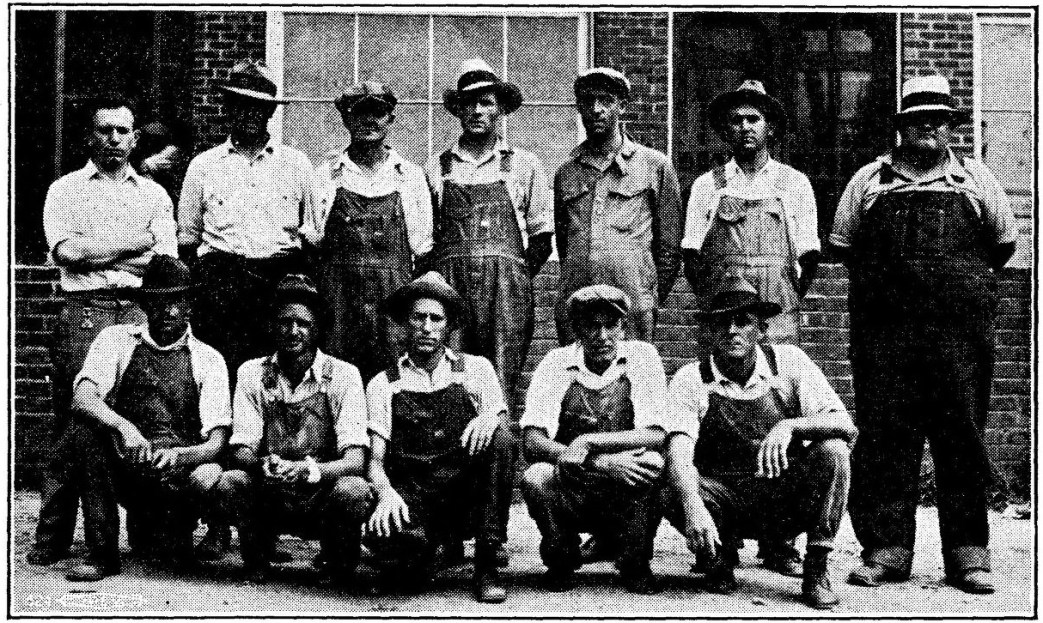
An insurgent union movement struck the textile mills of North Carolina in 1929 as unionism attempted to gain a southern foothold.
‘Militant Marion Strikes for Ten Hour Day!’ by John Herling from Labor Age. Vol. 18 No. 8. August, 1929.
A YEAR or so ago Paul Blanshard addressed a Baltimore audience on southern mill conditions. His remarks were directed specifically against the feudalistic conditions of the typical mill village, and the misery and poverty that prevailed among 200,000 mill workers of North and South Carolina.
Up rose from the audience, a short, fat, plaintive little man, Rignal W. Baldwin by name; he announced that he was president of a southern mill village; and said he, such conditions as the speaker described were not true of his mill village. He challenged Mr. Blanshard to come south and repeat his remarks before his happy people. That challenge Paul Blanshard accepted, then and later. Mr. Baldwin never replied.
But on July 11, 650 men and women of the Marion Manufacturing Company struck. They won Blanshard’s argument for him and proved that the harmony in Marion, N.C., reigned only in Mr. Baldwin’s befuddled mind.
What were the demands that the Marion Manufacturing Company refused? The supposedly contented village folk made these modest demands:
1. Men and women now work 12 hours and I2 minutes a day, 11 hours and 20 minutes at night. The grievance committee asked Mr. Baldwin for reduction to ten hours, both day and night shifts, with no reduction in pay.
2. Twenty-two men and women were fired for joining the union. These men were to be reinstated.
Three times did the committee of employees make their requests and when the third refusal came, Lawrence Hogan, Roy Price, and Dan Elliott, local leaders of the union, came to Alfred Hoffman, who had been their organizer for the past two months.
“Mr. Hoffman, we are going to strike.”
“There isn’t a cent of money for relief, fellows,” said Alfred. “You can’t strike now.”
“Hell,” said the committee, “we’ve done struck.”
And they had. Within fifteen minutes after word of refusal by the boss became known, loom-fixers, weavers, spinners, sweepers, came streaming out of the mill. Three hundred of the night shift awakened by the report were already on the outside of the mill waiting for them, and in half an hour the most inspiring mass meeting I ever attended was called to order.
Within a day the organization of the strike was planned. A committee of mill workers was sent out into the country side to enlist the farmers. Twenty-five women compose the “biscuit” committee. They regulate the menu of the community. It consists of flour, meat, lard, coffee, and corn meal. Strike headquarters were established; a speaker’s stand was built on a lot by three mill carpenters who came out on strike with the men; an eight piece string band was recruited from the strikers consisting of violins, guitars, banjos; and overnight East Marion has become a singing community.
Everybody sings. I’ve heard women hum “Solidarity” as they worked round their kitchens; men whistle it as they came on and off picket duty, and a crowd of 2,000 roar “The Union makes us strong.”
It took but little effort on the part of the leaders to bring out the drama of the strike. The strikers feel the class struggle because they are living it; and they would laugh at those who say that in America you have no class strife but merely friendly differences.
Alfred Hoffman is doing a great work here and the good job he has done can best be appreciated by those who have been to other strike areas in the south. He is running the strike on a militant, intelligent basis. There are no if’s and but’s in the speeches he makes. People here see life simply. It would be hard for them to understand men who view reality through a maze of qualifications and footnotes. Hoffman understands them and they know he does. Here as at Elizabethton they would go the limit for him.
An instance of the imagination he uses in the strike is his organization of over 25 of the strikers’ children into an auxiliary body. The kids make themselves useful in running errands, leading parades, helping in the singing, making lemonade. They won’t go to bed until you threaten them with dire punishment if they don’t. This “sling-shot gang” in its light moods sings the following song:
“Old man Baldwin is mighty fine,
Old man Baldwin is mighty fine,
Old man Baldwin is mighty fine,
Makes yellow dogs dig his sewer line,
O! Mr. Yellow Dog, take him away, take him away.”
(Far away).
It goes to the tune of “Hand Me Down My Walkine Cane.”
But Hoffman has not been alone in the work. Tom Tippett speaks every night. The cry for him is irresistible and Tom speaks. Jess Slaughter leads the singing. Bill Ross of Baltimore Labor College was here for four days, and the little lectures he delivered were listened to eagerly. They want him to come back.
One night, prayer-meeting night, we found that the majority of the people came down to the picket line instead of to church. The time was therefore auspicious for a sermon. Brother Tippett arose and delivered himself of a splendid talk on what Christianity is made of, and who the true Christians were. “The Pie in the Sky” theory of salvation was absolutely refuted. And many said it was “better preachin’ than in church.”
Eager for Knowledge
These men and women of Marion want education; they are eager to apply their political power and the eager self-sacrifice with which they picket and work indicate that to them a union is no business proposition. They are working to perfect a lever to freedom.

To them the position that the field of organized labor be separated from the political would seem queer. When the threats of the sheriff and of the courts come to them, they say, “Wait until next election.” I’ve talked to many strikers and without encouragement from me they have said, “We’ll have our own party and then we’ll show them.” At Elizabethton the same opinions were expressed. They would consider it false and unreal to divide their newly found power in organization, not to throw that strength into a political party of their own making.
But in the meantime there is the strike. Other mills are aroused. Clinchfield men are champing impatiently at the bit. Their conditions are just as rotten as at East Marion.
Here, in East Marion, Mr. Baldwin’s ideal village ‘s being made Exhibit A in the attempt of militant Southern workers to build from the start a real labor movement. But in this splendid effort two thousand people are dependent on relief from those who can give. With another strike imminent, they are living on the simplest rations, simpler than before the strike.
“That’s all right, buddy,” said one of the men as he leaned against the mill fence,” we’ll eat salt-pork till we sweat lard.”
P.S. Since I have mailed the above two injunctions have been issued. The latest was answered with a monster parade of strikers and sympathizers which swept out of the mill village and through the town yelling defiance at the injunction.
The parade passed the courthouse where Sheriff Adkins and his police stood helpless. Four weeks ago the town refused the strikers permission to parade through the streets. This time the strikers did not ask permission.
A mass meeting was held in the open following the parade. The strikers cheered Alfred Hoffman. A.J. Muste and Tom Tippett to the echo as they urged the strikers to stick fast.
Totally ignoring the injunction, strikers formed on the picket line and raised their voices in lusty singing of “Solidarity Forever.”
Labor Age was a left-labor monthly magazine with origins in Socialist Review, journal of the Intercollegiate Socialist Society. Published by the Labor Publication Society from 1921-1933 aligned with the League for Industrial Democracy of left-wing trade unionists across industries. During 1929-33 the magazine was affiliated with the Conference for Progressive Labor Action (CPLA) led by A. J. Muste. James Maurer, Harry W. Laidler, and Louis Budenz were also writers. The orientation of the magazine was industrial unionism, planning, nationalization, and was illustrated with photos and cartoons. With its stress on worker education, social unionism and rank and file activism, it is one of the essential journals of the radical US labor socialist movement of its time.
PDF of full issue: https://www.marxists.org/history/usa/pubs/laborage/v28n08-Aug-1929-Labor%20Age.pdf
 Revolution's Newsstand