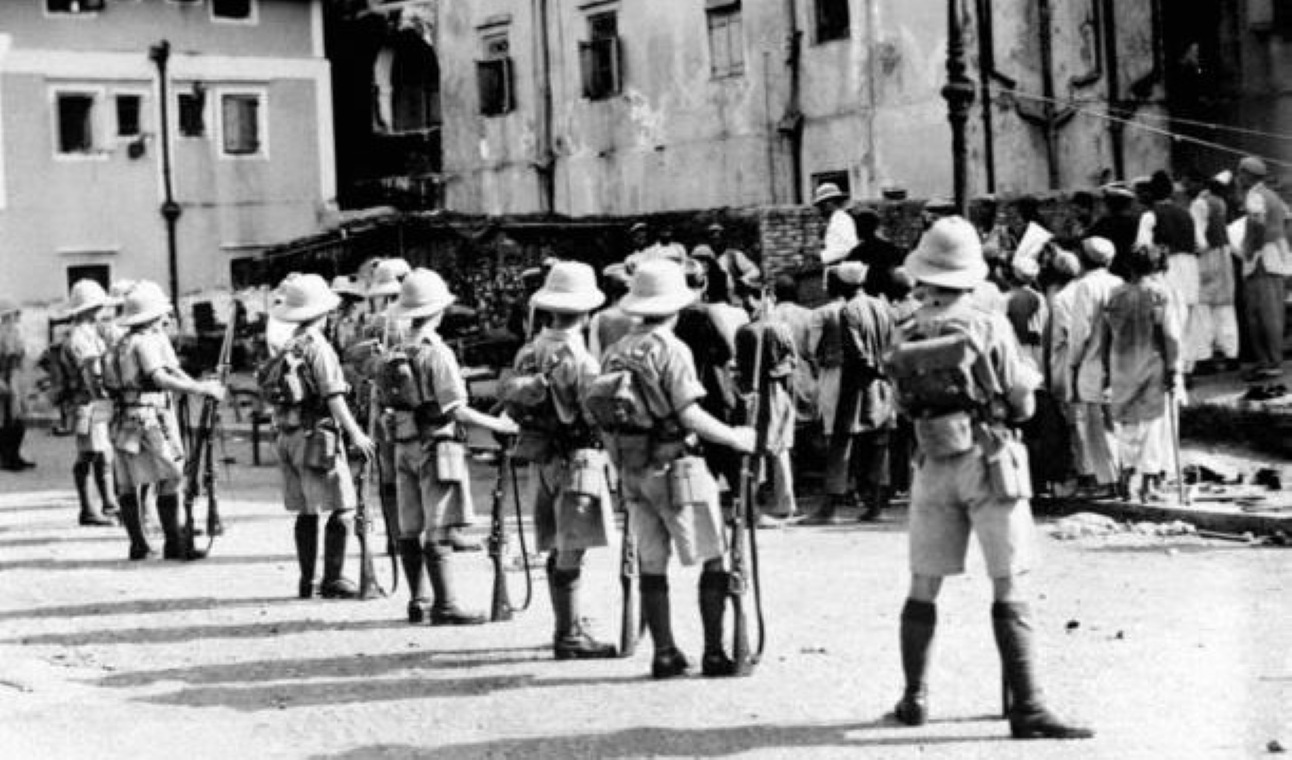
A report on the background of strikes and political repression to the sectarian violence that took hundreds of lives in Mumbai during May, 1932.
‘British Blood-Stained Rule in Bombay’ by Cepeda from International Press Correspondence. Vol. 12 No. 23. May 26, 1932.
In the middle of May there flared up suddenly in Bombay what is described as a “communal riot”, which in the course of the weekend has resulted in nearly 150 persons being killed and over fifteen hundred wounded. The disturbances are said to have begun as a clash between Hindus and Moslems arising over a trivial incident and spreading suddenly with lightning rapidity so as to produce mass conflicts, looting and arson all over the city. It is abundantly clear even from the very heavily censored news, that has been allowed to be sent out, that something very much deeper and more important is involved here than an outbreak of religious passion between members of different creeds.
In the first place, the present events have taken place in a very special situation and at a very significant time. They have taken place precisely in Bombay which is the biggest industrial city in India, where the working class movement is most developed and where the mass political struggle has reached a high level of development. Bombay at the present time is in a state of critical unrest and acute tension. The atmosphere in which the present outbreak has taken place bears considerable resemblance to that of three years ago when the last big outbreak of this kind occurred. At that time there was seething discontent among the masses after the brutal suppression of the strike movement and widespread political unrest in the period before the Indian National Congress was compelled to make its declaration of a “fight to a finish” with British imperialism. The communal riots were deliberately provoked as an attempt to divert attention from the mass struggle against imperialism and the class fight. At the present time, somewhat similar occurrences have taken place in a situation of rising political temperature and general uncertainty. A point was rapidly being reached when the existing situation could no longer be tolerated and the possibility of a mass revolutionary upheaval was becoming more and more likely.
The occasion was therefore especially appropriate for a diversion of this kind to be attempted. It is only necessary to note the main factors in the situation to understand how eagerly British imperialism would seize upon such an opportunity for attempting to drown the threatened upheaval in a sea of bloodshed. The acute economic crisis has given rise to extreme distress, unemployment and actual starvation. At the same time the government terror regime has been intensified to an unprecedented extent, while the political struggle against British imperialist rule, although reaching a more and more critical position, has clearly come to an impasse in which the way forward is not clearly marked. The attempt to suppress the mass movement has failed, in spite of the mass arrests, baton charges, shootings and police terror, owing to the growing spirit of resistance among the masses who refuse to be beaten into surrender, but at the same time the bourgeois Congress leadership has more and more obviously demonstrated its incapacity to lead the struggle. Disillusionment with the Gandhist policy and his sabotage of the mass movement is now widespread but the only possible alternative, viz, the independent leadership of the working class, has not yet been realised in practice.
The acute unrest among the masses has been shown by the growing strike movement during recent months. Particularly important in this connection is the Bombay dock strike which took place during March and early April and which ended in a complete victory for the workers, in spite of the fact that the authorities attempted to provoke religious and racial conflicts by importing Muslim blacklegs from North India. Note should also be taken of the recent statements by British Government officials, including that of the Secretary of State for India in the House of Commons, concerning the growth of Communist activities in India and the danger arising from growing Communist influence among the masses. Finally, it is highly significant that these disturbances have taken place in Bombay at a time when the special Ordinances for the crushing of the mass movement, which were issued for a period of six months, are shortly due to expire. British imperialism will be very glad of the excuse offered to it for declaring that the maintenance of “law and order” in Bombay and the rest of India obviously demands the employment of all possible measures of repression.
The imperialist spokesmen are already using the Bombay fighting as an excuse for advocating the renewal and even the extension of the special ordinances. The Government are also seeking to justify their determination to still further postpone the granting of the smallest measure of central self-government, by even saying that the communal outbreaks show the Indians to be unfit for any degree of responsibility.
Thus, everything has been pointing to the likelihood of an effort being made to produce such a conflict as has actually occurred. The atmosphere for a Hindu-Mohammedan conflict has been carefully prepared for a long time past. It is notorious that this conflict in India has been sedulously fostered by British imperialism in the interests of maintaining power on the principle of “divide and rule”. The whole history of India under British rule shows clearly that to the degree that the Indian masses unite to fight British imperialism and its reactionary allies, so does communal tension disappear. This naturally does not suit the imperialists and consequently, despite their crocodile tears over communal riots, they do all they can to divide the peoples of India. By creating separate electorates for Moslems and Hindus and promoting a competition between Hindus and Moslems for the fruits of political office, British imperialism largely succeeded in making the Mohammedan-Hindu question into a struggle for political privileges and power between the ruling elements of the two communities. Most of the communal faction fights, which have taken place in India in recent years, are known to have been artificially fermented by such political gangs. At the same time, of course, there are many circumstances, such as the existence of Hindu landlords and Mohammedan peasants, where a purely economic class struggle takes on the appearance of a religious fight.
In the present case, there is no doubt that opportunity was taken to excite religious passions in the usual way. The responsibility for this rests very heavily on the shoulders of those bourgeois national reformist politicians both inside the Congress and outside, who have combined to make the Hindu-Moslem question an “insoluble” problem. It is significant that not only was there a complete deadlock on this question at the Round Table Conference but that only a short time ago the Consultative Committee in India pronounced its inability to arrive at a solution. The vicious communal incitements contained in the speeches of Shaukat Ali and other so-called national leaders have played an important part in precipitating the present conflict.
The most important feature, however, about the recent Bombay events is the new character that it exhibits in comparison with previous occurrences of the kind. In the first place, it was made use of as an opportunity for instituting the most terrible massacre by police and troops. A very large proportion, if not the major part, of the victims have been struck down not by religious feudists but by the bullets of British troops. It is admitted, that the method used to restore order was by repeated firing on crowds causing numerous casualties. Big forces of troops were drafted into the city and free use made of large numbers of armoured cars. The descriptions that have been given indicate that the events took the form much more of a revolutionary mass outbreak which the British forces proceeded to drown in blood rather than of the usual sporadic individual stabbing affrays which have been characteristic of Hindu-Moslem conflicts in the past.
In the second place, the mass character of the outbreak was demonstrated in the setting fire to large parts of the city and the looting of shops on a very large scale. This betokens much more the action of starving masses goaded beyond endurance rather than anything in the nature of a religious conflict. It must be remembered that the economic crisis has given rise to mass unemployment in India for the first time and no provision of any sort is made for the unemployed.
The third new factor in the present so-called religious riot was the important part played by the working class. It is perfectly clear that the proletarian masses, instead of allowing themselves to be provoked into a religious riot, have succeeded to a large extent in converting the fight into a revolutionary struggle. Not only did the railwaymen and tramwaymen go on strike but a large number of the textile workers also came out. In the previous communal riots in Bombay, the fighting took place mainly in the form of individual affray and almost entirely in the middle class areas and the workers were not much affected. In this case, what has occurred has been rather a social upheaval in which the proletarian masses have engaged in fierce fighting with the British imperialist forces.
British imperialism attempted to provoke a religious conflict with the aid of its agents in the Indian bourgeoisie in order to have an excuse for repression. The present stage of the struggle in India, however, led inevitably to the development of a struggle of a different character. It is certain that in the future it will be more and more difficult to sidetrack the mass revolutionary struggle by means of religious provocation. Only the working class can show the way forward to a new social order in which religious and caste differences have no meaning and hence it is that the proletarian class movement already is able to rise above such efforts to divide its ranks. In Delhi in February Congress volunteers joined with a Moslem demonstration to protest against the N.W. Frontier Ordinance. In the N.W. Frontier elections last month, Hindu and Moslem joined to boycott the ballot box. In April Bombay dockers, mainly Moslems, fought side by side with Hindus, against Pathans, who are also Moslems. The Communist Party of India in its leadership of the mass struggle of the workers and peasants is demonstrating in practice how religious prejudices and backward social customs can be overcome and abolished.
The Daily Worker began in 1924 and was published in New York City by the Communist Party US and its predecessor organizations. Among the most long-lasting and important left publications in US history, it had a circulation of 35,000 at its peak. The Daily Worker came from The Ohio Socialist, published by the Left Wing-dominated Socialist Party of Ohio in Cleveland from 1917 to November 1919, when it became became The Toiler, paper of the Communist Labor Party. In December 1921 the above-ground Workers Party of America merged the Toiler with the paper Workers Council to found The Worker, which became The Daily Worker beginning January 13, 1924.
PDF of full issue: https://www.marxists.org/history/international/comintern/inprecor/1932/v12n23-may-26-1932-Inprecor-op.pdf
 Revolution's Newsstand