Nothing is more important for a human than health; the quality and quantity of life. For a capitalist, it is profit. To live, our class must put that health at risk everyday.
‘Building a Workers’ Health Defence’ by Iago Galdston from Labor Age. Vol. 11 No. 8. September, 1922.
How Can the Unions Successfully Attack Dust, Poisons and Strain?
THE sick and the poor have always been with us. Since the development of Capitalism, however, there has come upon poor pestered humanity a new poverty and a multitude of new diseases. The new poverty is that of the laboring class, which periodically suffers starvation in the midst of plenty. The new diseases are those which afflict the worker as a result of doing his job in making the things which all the world needs. The same forces which made the workers a class apart also brought down upon their bewildered heads the afflictions of job.
Today, more than ever before, the trade unions are challenging the right of these destroyers—dust, poisons and strain—to do their deadly work. War has been declared on tuberculosis in the printing trades, on lead poisoning among the painters and on the diseases of the garment trades. These unions are not satisfied to leave this work to the present state. They have taken it upon themselves as an act of justice to their members, which they alone can adequately perform. It is the little beginning of a big task, which must as a matter of necessity spread to other labor organizations.
Havoc of the “Industrial Revolution”
To appreciate how the problem of the Worker’s Health began, we must look back to the “Industrial Revolution,” when the machine process became supreme in the production of goods. Picture what happened then. A world, largely peasant in character, was rapidly converted into a huge industrial machine. During the change thousands of homes were disrupted and thousands of human beings dispossessed of their lands. Thousands of former land owners were disenfranchised, pauperized and rendered dependent for their existence on the good graces of those who might choose to employ them.
This new pauper class flocked to the industrial centers, the towns, which the Hammonds described as “not so much towns as barracks; not the refuge of a civilization but the barracks of an industry.” In this way did the slum come into being. For even the term “barrack” is descriptive of more comfort than fell to the lot of these workers. It was quite common for several families to be found living in one loft, each separated from the other by a curtain, with father, mother, and children sleeping in one bed—or all together on the floor. Food became as bad as the housing conditions. The cry of the early worker was in terms of wheat, meat, and ale—food which formerly he could enjoy even in his humblest state. Now, such as he could get was of the lowest quality, often rank and putrid beyond imagination. Epidemic followed epidemic, and thousands upon thousands of workers were spared through death, the sufferings common to their class.
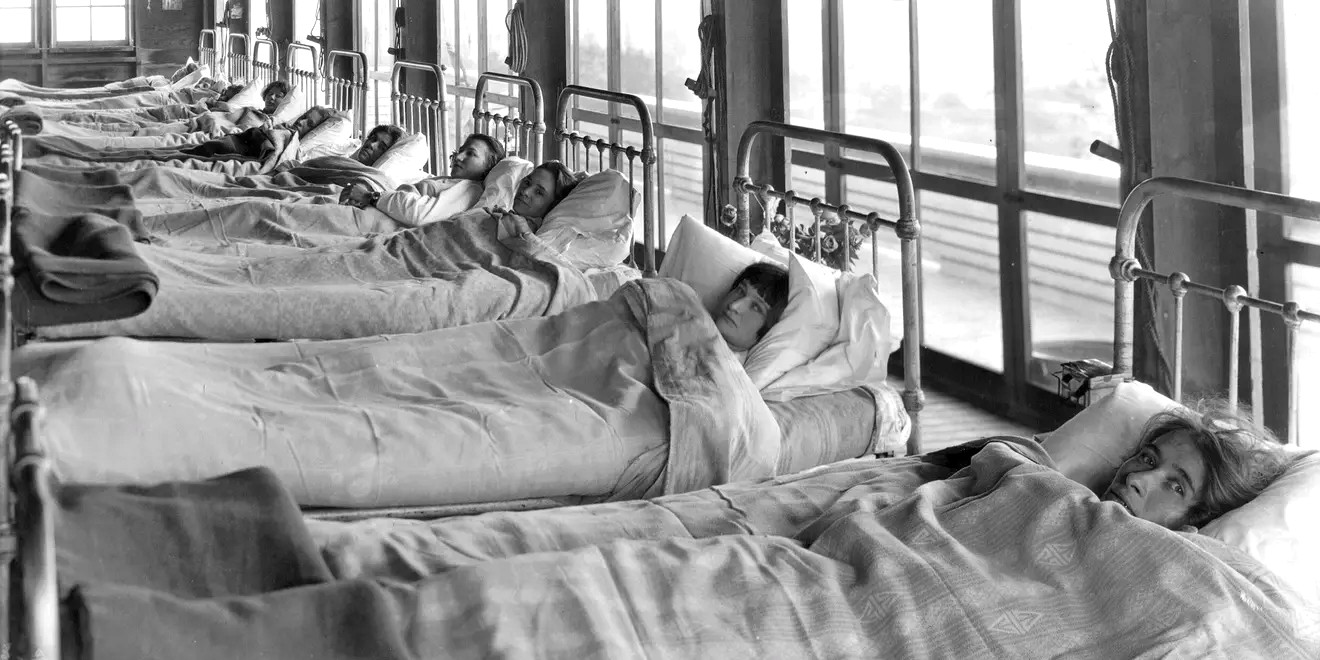
All the diseases of undernourishment afflicted the workers. Scrofula became so common that the spared worker was a rarity. Rickets distorted the worker’s body, tuberculosis, typhus, scarlet fever—all the carrion diseases known to man fed upon the suffering bodies of the workers. Over and above all these sufferings came the new diseases of industry—the nervous strain and discipline of the factory, the poisons used in the production of commodities; the gases, byproducts of the poisons. It was a real wonder that the whole race of workers was not wiped out.
Dust and Poisons Spread Death
Invention followed invention, and far outran the current knowledge of sanitation and poisons. Men began to work with new elements, the injurious nature of which was unknown. Even when poisons were detected, little was done to offset their bad effects. Take the first great industry—spinning and weaving—as an example. Thread had been spun and cloth woven throughout the ages, and nothing especially injurious to the health of the craftsmen was ever noted. In the new processes, however, we find the thread spun and the cloth woven literally out of the flesh and blood of the loom hands and weavers. In the spinning mills the air was filled with lint and fibrous dust, the inhalation of which produced blood spitting, chronic inflammation of the bronchi, chest pains, sleeplessness, asthma and ulcerative tuberculosis. In a spinning process known as the “wet spinning of linen yarn” the worker was constantly soaked to the skin, and stood in water up to the ankles. In addition, the peculiar nature of the work produced deformities in the spine and limbs of the workers which made them appear brutish and inhuman. Accidents of the most horrifying kind were common. Lockjaw not infrequently followed upon mutilation. And pus infections were everyday occurrences.
Today, conditions may not be as grossly horrifying as they were in 1830, but they are far more serious than even the workers themselves conceive them to be. The slums are still with us, but the worker born into that crowded, filthy world, knows of no better antecedent condition with which to contrast the lowliness of his environment. In the memory of the “old times” the early workers could complain:
“Have we not seen the commons of our fathers enclosed by insolent cupidity—our sports converted into crimes—our holidays into fast days? The green grass and the healthful hayfield are shut out of our path. The whistling of birds is not for us—our melody is the deafening noise of the engines. The merry fiddle and the humble dance will send us to the treadmill. We eat the worst food, drink the worst drink, our raiment, our houses, our everything bear signs of poverty, and we are gravely told that this must be our lot.”—Hammonds, “The Town Labourer.”
But the fathers of many of today’s workers—particularly in certain trades—were born in the slums, even as will be the children of their children.
Industrial Poisons at Work Today
The adulteration of food continues today as before. Ptomaine poisons, from canned food, kill on an average of 9,000 persons yearly in this country. The workers’ wages, also, do not purchase any greater quantity of food than in years past. The average income of the American worker still falls below the living standard set by the government.
And, to add to this, the evil of industrial poisons is greater by far than it ever was. This evil goes hand in hand with the modern methods of production. Lead and mercury, arsenic and silver, silicon and carborundum, pumice, sulphuric, hydrochloric, and nitric acids,—poisons poisons, poisons, injurious to human life—must be employed in the manufacture of goods needed today. It is not the use of these destructive things that makes the present situation so inexcusable, as the indifference to the things which the worker suffers and the unwillingness on the part of those in power to protect him with the safeguards created by science. It is, in the majority of cases, still cheaper to replace the sick worker than to guard his health.
It must not be thought that some progress has not been made. Large industrial concerns like the Western Electric and the General Electric Companies, the International Harvester Trust, the New York Telephone Co., and the Edison interests, have developed large and efficient medical departments responsible for the health of their workers. They have installed rest rooms, sanitary wash rooms, a medical examination system, etc., etc. They are not modest in singing of these things. But the motives in every case of such health work are the motives of Capitalism—profits. It is cheaper, where the worker represents an investment in training, to pay the physician, nurse and sanitarian to keep the worker healthy and on the job, than to have sick workers and a large labor turnover. The worker benefits, no matter what the motives be. But the motives limit the work, and make it fail often when most needed. There comes a point where further health work is no longer profitable; and there, no matter how urgent the need is, the work stops. Also, where there is no investment in the worker—where the work is crude and unskilled—there is nothing to be gained in safeguarding the workers’ health, and nothing is done.
Fifty-four specific poisons and hundreds of derivations are mentioned by Drs. Kober and Hanson—used in no less than 630 branches of industry today. In view of these facts, what worker can feel safe at his job and who can remain indifferent to the problem of the workers’ health?
The Workers Attack their Enemy
The history of the guilds and of labor unions shows that the workers were always sensitive to the suffering of their brothers, and practiced organized “mutual aid” in one way or another. Provisions for help to dependents in cases of sickness and death were made by practically all of the guilds; and as early as 1819, when workers’ organizations were banned in England, we find groups of workers forming Friendly Relief Societies. In the United States the oldest benefit established by a workers’ organization was that of the Society of Engineers, in 1851. Since then practically every union has one or more benefit features. The benefits given are those covering strikes, sickness, death, old age, and disability, with special provisions for the treatment of tuberculosis. The benefit sums collected and distributed by the unions each into the millions. The International Typographical Union, to cite but one example, in the last nine years paid out in mortuary benefits near to two and a half millions dollars. In strike benefits, the same union paid, in the last twenty years, near to five and a half million dollars. During the same period the union spent three million dollars in the erection, maintenance, and operation of the Printers’ Home, at Colorado Springs, Colorado—in the heart of the health-restoring Rockies.
Other large unions—such as the United Brotherhood of Carpenters, the Cigar Makers, Iron Moulders, Painters, Plasterers, Plumbers, and Steamfitters, Railroad Telegraphers, Switchmen, etc., etc.—add millions upon millions to the benefits paid out by the national and local unions of the country. Realizing the economic uncertainty of the worker—and the accidents of his work, the season, and strikes—they each seek to provide for these emergencies. All these measures—and this is an important thing to remember—are merely palliative, and in no way serve to solve the problem. Providing for the tuberculous individual worker does not prevent the disease; nor does supporting the sick worker keep the healthy one well. The value of these curative activities cannot be denied, and the afflicted worker who profits through these provisions must not be lost sight of; but in addition to these, preventive measures are surely needed, activities that will safeguard the worker against accident, sickness and death.
The Unions’ Health Efforts
How much can be done along these lines is well foreshadowed by the activities of the Union Health Center, carried on by the Ladies’ Garment Workers’ Union. Even in this case, most of the organization’s efforts are spent upon ‘cure,’ and but little upon prevention. This organization, however, is still far in advance of others in safeguarding the workers’ health, and if the other unions but did as much, progress in the solution of the problem should be rapid and substantial. Several other unions have also developed health work. Chief among these are the International Typographical Union and the International Printing Pressmen, with their sanitariums, and the six New York locals of the Painters, whose work is just begun. All of these activities embrace no more than a very small part of the workers’ army. In order that progress may be made, the battle front must be widened and the campaign intensified.
In this campaign, first and foremost comes the education of the worker. All who have worked in the field of industrial medicine know that little can be hoped for until the worker himself appreciates the problems that confront him. All of the sources of information may be at hand, but if he will not regard them as important and make use of them, they will be of small use.
Prolong the Worker’s Life!
Along with the awakening of the individual worker to the importance of his health problem goes the concerted action of the “collective worker” represented by the union. The working conditions, in terms of the health of the workers, must become as much the guarded domain of the union as are wages and hours. From my experience with union health work, I should recommend that each union have a medical department, responsible for that side of the workers’ welfare. The sanitation of the workshop, the prevention of industrial poison, industrial diseases, deformity and accident, should be the work of this medical department. The education of the members on the prevention of disease and advice in case of illness should be provided for by this department. How much could be done in this way to prolong the worker’s life!
Certainly, this appears to be but a mere patch on the rotten frame work of our economic system. Certainly, health work must suffer from limitations in the “profit-seeking” scheme of things. Granting those facts, health work by unions is still working for a fundamental change. No matter what the social plan may be, we can hardly conceive of any state in which the production of goods is not its very foundation. All the problems of production will come up—among them the health problems of the producer. These problems must be solved. The present state is not interested, few of the employers are, but all workers must be. In such health work as has been hinted at here, the workers can attain the solution of the health problem in industry. They will not only help their brothers and themselves, but also their sons and daughters who may live tomorrow in a world more enlightened and humane.
Labor Age was a left-labor monthly magazine with origins in Socialist Review, journal of the Intercollegiate Socialist Society. Published by the Labor Publication Society from 1921-1933 aligned with the League for Industrial Democracy of left-wing trade unionists across industries. During 1929-33 the magazine was affiliated with the Conference for Progressive Labor Action (CPLA) led by A. J. Muste. James Maurer, Harry W. Laidler, and Louis Budenz were also writers. The orientation of the magazine was industrial unionism, planning, nationalization, and was illustrated with photos and cartoons. With its stress on worker education, social unionism and rank and file activism, it is one of the essential journals of the radical US labor socialist movement of its time.
PDF of full issue: https://www.marxists.org/history/usa/pubs/laborage/v11n08-sept-1922-LA.pdf
 Revolution's Newsstand