Another in ‘L. Alfred’s series on working class street and defense organizing in an environment of rising fascism. Here he looks back at the experiences of the last decade from Munich in 1919 to China in 1927, and speaks to how the working class and its organizations might respond to another “Z” plan of the French General Staff to suppress a rising proletariat. Again, I would very much like to know who ‘L. Alfred’ is.
‘Some Experiences of the Armed Class Struggle’ By L. Alfred from International Press Correspondence. Vol. 9. No. 9. February 22, 1929.
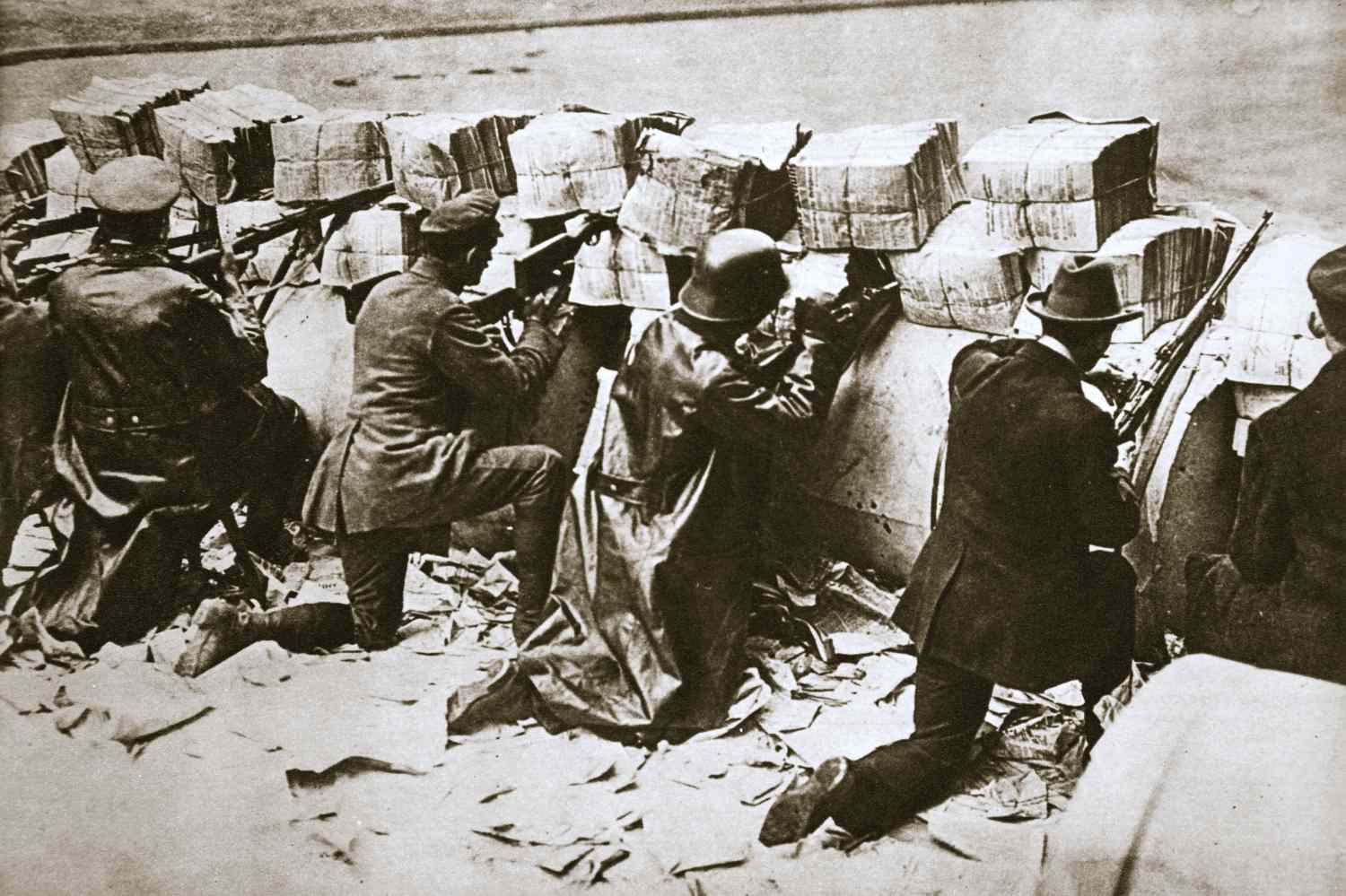
During the ten years’ existence of the Comintern the class struggle has assumed in the various countries its sharpest form, that of armed insurrection. We wish merely to recall a few of the most important episodes of these struggles: insurrections and Soviet Republics in Munich and Hungary, 1919, occupation of enterprises and estates in North Italy, 1920, Ruhr struggles, 1920, (Kapp-Putsch), March struggles in Central Germany, 1921, insurrection in Hamburg and Bulgaria, 1923, insurrection in Reval, 1924, July-struggles in Vienna, 1927, struggles in China, 1927-28, (Shanghai, Canton).
Shortly before the formal establishment of the Comintern, mighty armed class struggles took place, such as the big victorious October insurrection in Russia, 1917, the civil war in Finland, 1918, the mutiny in the army and the transformation of the imperialist war into a civil war in Germany and Austria, 1918, the January struggles, 1919, in Berlin. The leaders of Social-Democracy “repudiate” the armed class struggle. They are advocates of armed insurrection only in the countries of proletarian dictatorship (see Kautsky: “The International and Soviet Russia”), whereas in the capitalist countries they are for brutal suppression of the revolutionary mass movements (Ebert, Scheidemann, Noske). Sometimes the Left Social-Democrats pay even lip service to the proletarian revolution. But when it really comes to the struggle, and especially when the struggle ends in defeat for the struggling masses, they declare “that one should not have taken up arms”. An eloquent example of this was given in the July days, 1927, when the Austrian Left Social-Democrats who were certainly very “red” shortly before the struggle, condemned already in July, 1927, the demolition of the High Court of Justice by the excited masses as a dastardly action, and hastened to dissociate themselves from the “incendiaries”.
Class-conscious proletarians, Communists, take up a different attitude to armed class struggles. They cannot simply “repudiate” such struggles, because they are unavoidable historic phenomena which cannot be ordained or forbidden at will. They cannot desert the oppressed masses who are fighting for their rights a such a critical moment (in contradistinction to the social-democratic leaders who in such cases do not want to desert their own bourgeoisie). They cannot dissociate themselves from such struggles because this would mean cowardly betrayal of the cause of the international proletariat. They declare themselves for these struggles regardless of whether they end in victory or defeat, even if serious errors were committed in their leadership. They look upon the positive as well as the negative experiences of these struggles as a source from which lessons can be drawn for the future inevitable struggles.
This was exactly the attitudes of Marx and Engels to armed revolutionary struggles. They were not only enthusiastic believers in such struggles, they also thoroughly investigated the experience of these struggles. (See “Civil War in France”, “The 18th Brumaire”, “Revolution and Counter-Revolution in Germany”). At the same time, they did not neglect careful study of the practical questions of the carrying out of an armed insurrection. Theirs is the expression “art of insurrection”. They elaborated the fundamental rules of this art, repeatedly quoted by Lenin. (See “Revolution and Counter-Revolution”).
The doctrine of Marx and Engels on armed insurrection was further developed by Lenin, who was not only a great theorist of armed insurrection but also the leader and organiser of the great October insurrection. It is characteristic of Lenin’s genius that he did not give his mind only to “high” political and strategical problems, to the “universal line” of the insurrection, but took a great interest in the smallest technical details of the preparation and carrying out of the insurrection and was a greater adept at this than anyone else. We merely draw attention to an instruction elaborated by him in October 1905 “on the tasks of the groups of the revolutionary army” in which he goes into the tasks, the equipment, the training etc. of the revolutionary “groups of three” and “groups of five”, and also to the article “The Moscow Insurrection” in which he explains, among other matters, in great detail the methods of struggle for the army.
Lenin’s numerous articles on this question are a reliable key to a proper understanding of the experiences of armed class struggles, but they cannot take the place of a careful study of these experiences themselves. It is a regrettable fact that so little is done by the Communist Parties for the investigation of the wealth of civil war experiences in the last decade. On the other hand, these experiences are busily studied in the camp of the bourgeoisie and utilised for its civil war preparations. There exists an extensive literature, especially in Germany, on struggle against “internal unrest”. Everywhere detailed regulations are being worked out for the event of “internal unrest”. We would like to mention here only the famous plan “Z”, the plan of the French General Staff for the suppression of an eventual insurrection of the Paris population.
Although plan “Z” is already “obsolete” as a sensation. it is still very much alive because it hangs continually like a sword over the heads of the French workers. Moreover, it is not a purely French phenomenon, but a typical example of the civil war plans of the bourgeoisie throughout the world. Therefore there is every reason to make a careful study of plan “Z”.
To put it briefly, this plan “Z” is: that in case of serious unrest in Paris when it seems hopeless to nip the rebellion in the bud, the government troops be for the time being withdrawn from Paris and concentrated in Versailles together with the reinforcements drawn from the various provincial garrisons, in order to reconquer Paris with the concentrated forces.
Thus, the French General Staff wants to repeat today the tactic applied by Monsieur Thiers in the slaughtering of the Paris Commune. That a similar plan exists for the “defence of Berlin” was admitted in 1926, at the arrest of several leading German fascists (Col. Luck and others). According to this plan the Reichswehr and the fascist leagues were to be removed from insurgent Berlin, to be concentrated in Potsdam for the purpose of reconquering Berlin from outside.
What is the meaning of the tactic that in a civil war the counter-revolutionaries are prepared to abandon towns and even whole regions to the insurgents? This is due to the fact that the reaction is, above all, afraid of direct contact between its soldiers and the insurgent masses. To quote the German General Löffler who has written a pamphlet on the experiences of the Reichswehr in the Ruhr struggle of 1920, “under the pressure of the growing excitement of a hostile working class population, hundreds of thousands strong, the troops sink as into a morass”.
Thus, this tactic is dictated, first and foremost, by concern for the reliability of the soldiers, by fear that the revolutionary “infection” will spread to the cannon fodder at the disposal of the counter-revolution. Within the framework of big concentrated forces, in a war with proper fronts against the strongholds of rebellion, it is easiest to isolate the soldiers from the revolutionary masses.
Suppression of an insurrection of Paris workers provided for in plan “Z”, certainly explains the efforts of the French bourgeoisie to create a thoroughly reliable army (with the help of Paul Boncour and Co.). An army composed of patriotic, declassed and utterly unconscious (coloured) elements is to defend France against the “internal enemy”.
The cases of fraternisation which took place this January between the French soldiers and the miners in Grand Combe show that the French bourgeoisie needs very much a reliable army. The government was compelled to substitute the conscripted forces who proved themselves unreliable by coloured troops.
The efforts of the bourgeoisie to create mercenary cadres on whom it can rely, not only in the case of proletarian insurrections, but also in the labour struggles, as blind tools against the working population, are an international phenomenon. This phenomenon can be very dangerous to the proletariat if it shows itself incapable of enlightening the professional soldiers, including the coloured troops, by suitable methods, and of shaking their confidence in the bourgeoisie.
The highest tactical principle of the counter-revolutionary side consists in not letting their forces be defeated singly, but to concentrate them, to form regular fronts against the insurgents, to liquidate one by one the various hotbeds of rebellion. Having “restored order” in one rebel centre, it will be possible to proceed against another with concentrated forces. This tactic is, no doubt, the most favourable to the bourgeoisie; it is bound to lead to the suppression of the insurrection if the insurgents do not succeed in preventing the concentration of the counter-revolutionary forces, in disorganising them already before their concentration, in neutralising them or drawing them to the side of the revolution, in disuniting and defeating the already concentrated troops. But this presupposes maximum activity on the part of the insurgents, from the beginning. They are lost if they do not assume a relentless offensive. “The defensive is the death of every armed uprising” (Marx).
It is said in plan “Z” that armed forces are to be drawn from the provincial garrisons to suppress an insurrection in Paris. Certainly, if the insurrection feared by the bourgeoisie is to become a repetition of the Paris Commune in the sense that it will be limited to the capital, that it will be impossible to extend the insurrection to the provinces, the insurrection in Paris will be a failure if the counter-revolution were really successful in employing also the provincial garrisons for the suppression of the insurrection. But if the insurrection takes place simultaneously in various parts of the country and if the insurgents, first and foremost in the provinces, succeed in getting the best of the armed forces of the counter-revolution in their own regions and then immediately make an energetic attack on other counter-revolutionary troops, the issue of the struggle will be different.
Such a simultaneous insurrection everywhere, when there will be no “Vendees where the counter-revolutionary forces can be concentrated undisturbed, can certainly only be vizualised under the leadership of a revolutionary Party, well established among the masses not only in industrial districts but also in the countryside and among the rank and file of the army, and only if this Party has acquired the art of controlling the insurrection.
This is the most important lesson of the armed class struggles of the past decade.
International Press Correspondence, widely known as”Inprecor” was published by the Executive Committee of the Communist International (ECCI) regularly in German and English, occasionally in many other languages, beginning in 1921 and lasting in English until 1938. Inprecor’s role was to supply translated articles to the English-speaking press of the International from the Comintern’s different sections, as well as news and statements from the ECCI. Many ‘Daily Worker’ and ‘Communist’ articles originated in Inprecor, and it also published articles by American comrades for use in other countries. It was published at least weekly, and often thrice weekly.
PDF of full issue: https://www.marxists.org/history/international/comintern/inprecor/1929/v09n09-feb-22-1929-inprecor.pdf
 Revolution's Newsstand