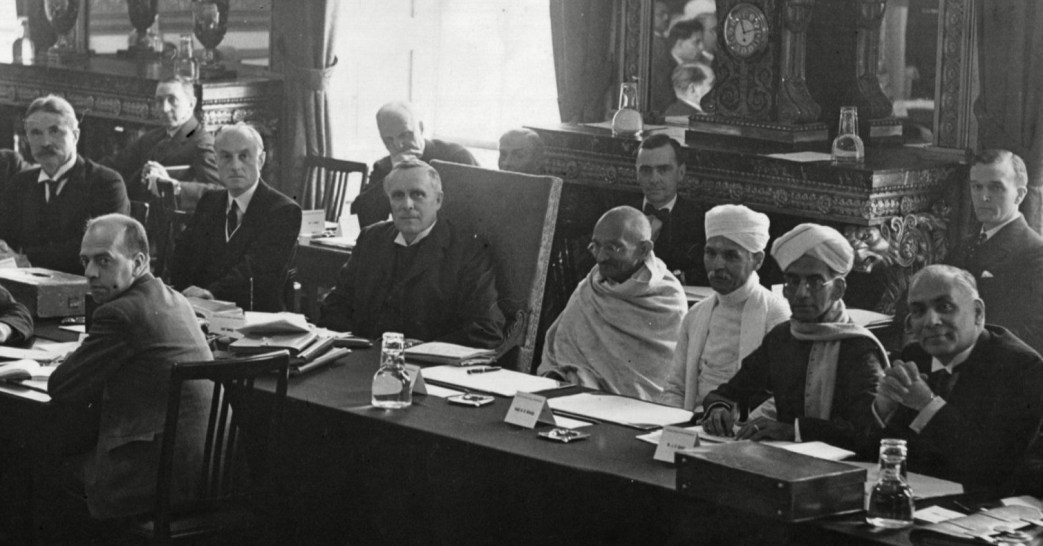
After 1927’s Simon Commission, how the British love their commissions, deliberated for several years on what to do for India, it was decided to call the India Round Table Conference to keep to discussion going for a couple of more years. Chattopadhyaya surveys the figures leading Congress, those heading to London for the first October, 1930 meeting with British government, as well as those imprisoned by that government.
‘The Indian Revolution and the Nationalist Leaders’ by Virendranath Chattopadhyaya from Pan-Pacific Monthly. No. 37. June-July, 1930.
At a secret meeting of the All-India Congress Committee, of whose three hundred members over one hundred already are in prison, it was resolved to stiffen the struggle against British imperialism by resorting to the non-payment of taxes and by intensifying the boycott of British goods. And the Congress Committee in the provinces and villages are carrying out the mandate of their Executive to the best of their ability.
Meanwhile the great Congress leaders can in no way be regarded as sincere. They have taken up the slogan of independence outwardly, because otherwise they would have lost their hold on the masses immediately and because they were astute enough to realize that it is only with the help of the revolutionary mass movement that they can obtain acceptable concessions from British imperialism.
For the purposes of the bourgeois leaders, the Congress movement was divided into two parts. The Civil Disobedience campaign was to be under the dictatorial guidance of Gandhi, who was empowered to nominate his successors in the leadership, while the Congress itself was under the leadership of its President, now Pandit Motilal Nehru.
This division of labor has proved to be very wise and convenient. Jawaharlal Nehru is in prison for the trivial offense of having violated the salt laws, and his father Motilal, who has succeeded him, has maintained a somewhat suspicious silence during the whole campaign.
The more one studies the Indian political situation the more one is forced to the conclusion that the Congress leaders are anxious to enter into negotiations with the government as soon as possible. This is not at all surprising. Not only did they never intend to participate in a really revolutionary mass movement, but they never even wanted in- dependence or believed that it was more desirable than a “responsible” place within the British Empire. It is instructive in this respect to recall the recent history of the chief Congress leaders.
Above all, Gandhi himself. His famous letter to his “dear friend,” the Viceroy, left no doubt as to his definition of the word independence. That was on the eve of launching his salt campaign. But that his view has never changed is proved by his own articles in his paper Young India, in which, in the issue of April 24th, i.e. 18 days after he had begun his campaign for “independence,” Gandhi stated:
“The present campaign is not designed to establish independence, but to arm the people to establish Swaraj.”
His successor, the old Abbas Tyabji, was a political nonentity who never declared himself for independence, and since he too was given the usual Congress term of imprisonment of six months, the leadership has fallen to Mrs. Sarajini Naidu. This fact alone suffices to show the political standard of the Congress leaders. When the Labor Congress passed the resolution on independence, she and Dr. Ansari declared that they considered that resolution to be against the interests of the “country.”
Mrs. Naidu, however, is a mere puppet who is placed in charge of the theatrical side of the campaign, while the wiser and cleverer heads are keeping their hands free for negotiations with the imperialist government. Among the most important Congress leaders who are in touch with the Viceroy through the back door are Motilal Nehru, Patel and Mohammed Ali.
The way in which these negotiations are managed is shown by the history of the notorious Delhi Manifesto of last November which was signed not only by Motilal Nehru and Gandhi, but also by the advocate of independence, Jawaharlal Nehru.
Writing immediately after the Delhi meeting at which the Manifesto was issued, the Tribune of Lahore pointed out the role played by Sir Tej Bahadur Sapru, the agent of Lord Irwin. Sapru was “receiving frequent communications from the Viceroy” during the Delhi meeting, and he influenced Motilal Nehru and Gandhi, who in their turn brought pressure to bear on Jawaharlal.
The same Tej Bahadur Sapru has been continually at work again not only to bring about the All-Parties’ Conference which met at Bombay on May 16th, but to act as a go-between between Motilal and Lord Irwin. Motilal has never concealed his opinion that he prefers dominion status to independence, nor does anyone suppose that the astute lawyer does not realize the real danger of the mass movement to his class.
A number of “distinguished” Indians are expected in London early in June, the date of their arrival almost coinciding with the publication of the first volume of the Simon Commission’s report. Among these Indians is also Pandit Motilal Nehru. The Mahratta of Poona, a nationalist weekly, writes in its issue of April 27th:
“Pandit Motilal’s projected visit to England is the topic of much banter, not altogether good-natured, in the press. With Pandit Nehru in London, there is no knowing what turn Indian politics and the Gandhi campaign may take. Last time Pandit was there, he was far from revolutionary in his political outlook.”
As for Patel, who is the friend and actual representative of Gandhi, there can be no doubt whatsoever as to his real aims. When he remained in the Legislative Assembly in disobedience of the Congress mandate, when he then suddenly resigned from the position of speaker of the Assembly, when he addressed his letters to the Viceroy and began his boycott of foreign cloth–he had but one object in view, and that was to enhance his own popularity and importance in order to make it easier to betray the movement. In his second letter to the Viceroy, Patel says:
“It is true that the Congress has now adopted complete independence as its object, but I am not without hope, if with any further delay India is offered complete responsible government within the British Commonwealth of Nations, she would be prepared to accept it, and perhaps such responsible government is more to her advantage than isolated independence.”
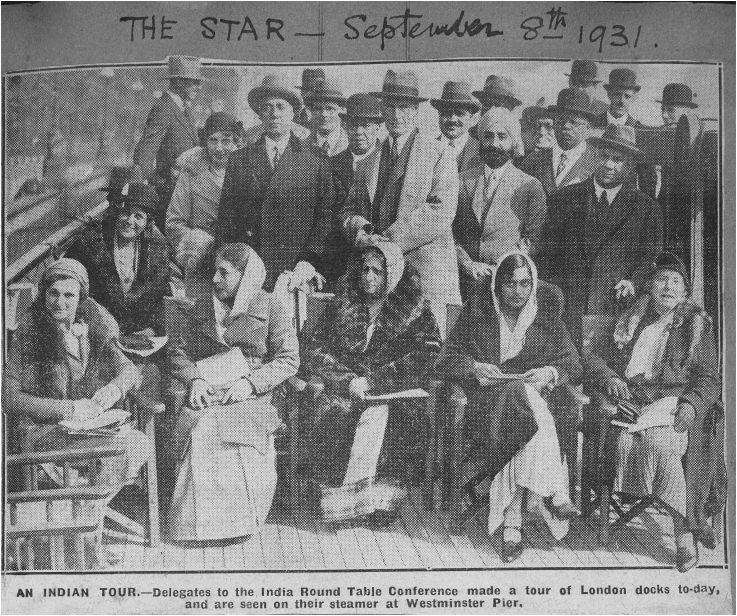
And the Mohammedan elements that were the allies of Gandhi a few years ago, are now openly against independence. Their leader and spokesman, Mohammed Ali, wired to the Viceroy a couple of days before Gandhi’s arrest, advising the government to come to terms with Gandhi. He has now asked permission to visit Gandhi in prison and there is no doubt that he will persuade Gandhi also to come to terms with the Viceroy. This Mohammed Ali, who is actively working for Muslim participation in the coming negotiations, is at the same time clamoring for independence for the Arabian countries!
All these Congress leaders will take part in some form in the Round Table Conference which has been called to London on October 20th. The “Liberals” and the princes will also be there, together with the Right Honorable Srinivasa Sastri, the lackey who has done the dirtiest work for British imperialism in South Africa.
But special attention should be paid by the British working class to the Labor leaders who are also coming to London in June to betray the Indian workers and their splendid struggle for independence: N.M. Joshi, the man who broke up the Indian Trade Union movement and accepted a position on the imperialist Whitley Commission set up by the Labor Government; Shiva Rao, the notorious theosophist-reformist, who has exercised so disastrous an influence on the labor movement in Madras, and S.C. Joshi, the secretary of the G.I.P. Railway Employees’ Union, who betrayed the splendid railway strike. The presence in Europe of these three enemies of the working class, at the same time as the political representatives of the landlords and the bourgeoisie, is a clear proof that a betrayal of the Indian revolution is being planned.
The British labor traitors are delighted that an Indian Labor Committee has been formed in London by Purcell to “look after” their Indian colleagues, while they jointly devise schemes for selling the Indian workers to MacDonald’s masters. The British workers must frustrate their plans by paralyzing the MacDonald government and giving more active support to the Indian workers and peasants in their struggle.
The Pan-Pacific Monthly was the official organ of the Pan-Pacific Trade Union Secretariat (PPTUS), a subdivision of the Red International of Labor Unions, or Profitern. Established first in China in May 1927, the PPTUS had to move its offices, and the production of the Monthly to San Francisco after the fall of the Shanghai Commune in 1927. Earl Browder was an early Secretary of tge PPTUS, having been in China during its establishment. Harrison George was the editor of the Monthly. Constituents of the PPTUC included the Australian Council of Trade Unions, the All-China Federation of Trade Unions, the Indonesian Labor Federation, the Japanese Trade Union Council, the National Minority Movement (UK Colonies), the Confédération Générale du Travail Unitaire (French Colonies), the Korean Workers and Peasants Federation, the Philippine Labor Congress, the National Confederation of Farm Laborers and Tenants of the Philippines, the All-Union Central Council of Trade Unions of the Soviet Union, and the Trade Union Educational League of the U.S. With only two international conferences, the second in 1929, the PPTUS never took off as a force capable of coordinating trade union activity in the Pacific Basis, as was its charge. However, despite its short run, the Monthly is an invaluable English-language resource on a crucial period in the Communist movement in the Pacific, the beginnings of the ‘Third Period.’
PDF of full issue: fau.digital.flvc.org/islandora/object/fau%3A32140/datastream/OBJ/download/The_Pan-Pacific_Monthly_No__37.pdf
 Revolution's Newsstand