The opening chapter of Mary Marcy’s first book, ‘Out of the Dump: A Story of Organized Charity,’ illustrated by Ralph Chaplin and originally serialized in the International Socialist Review. Telling of an orphaned girl of the working class having to navigate Chicago’s charity system to survive, the story is close to Mary’s own. While still a teen she lost both of her parents becoming the primary care-giver for her two younger siblings, Hazel and Roscoe, as they were shuttled between family and ended up in Chicago with Mary working as a telephone operator. Later in life, after being fired as a whistle blower from the pork-packing industry, she worked for Kansas City charities, which she would be severely critical of and also certainly informed this story. Tellingly, she dedicated this work to her brother Roscoe. Chapter two to follow.
‘Chapter I–Dad’s Finish’ by Mary E. Marcy from Out of the Dump. Charles H. Kerr Co-Operative, Chicago, 1908.
Out of the Dump: A Story of Organized Charity.
ONE MORNING, ten years ago, when I was a little snip of a girl, Dad kissed us all goodbye, from mother down to the baby, and went off to work as usual. He never came back. It was this way. The third floor chute from the Can to the Canning Rooms down at the yards, had begun to give way and father was the first man sent over with a load, after one of the braces had been knocked out. He told the foreman how shaky the beams were, but that’s as far as it went. Two of the men working near him told mother about it afterwards. But mother says one reason Dad held his job with the company so long was because he never backed away from risky jobs; nor kicked for safety appliances; nor harped on unsanitary conditions. I suppose that’s why he didn’t balk when it came to wheeling a great load over that broken chute.
He was always game, Dad was. Not at fighting the boss but game in the face of flying belts and broken machinery and death and disease and doing what the other men were afraid to do. He had been at Carton’s for fifteen years, so perhaps that’s why he didn’t pit his staying qualities against the packing company. Fifteen years is long enough to make most anybody knuckle, especially when it’s to the man who hands out the life-saving pay envelope every Saturday night. Well, father was game once too often, for the beams supporting the old chute gave way and threw him head first into the yard. His spine was injured and the packing house doctor hustled him off in a delivery wagon to a hospital where the company (philanthropically?) supported a private ward. The House Attorney did what he was there for and kept his stenographer busy writing out affidavits which the canning floor workers were required to sign, showing how the accident had occurred through Daddy’s own carelessness and the company wasn’t to blame at all.
The same men that signed these papers came over to tell mother about the accident. You couldn’t blame them for signing. It doesn’t help much for two or three men to line up against the boss. They’d only be “laid off”. It takes numbers to gain anything that way.
They wouldn’t let mother see father when she applied for admission at the hospital. She cried and begged but they told her he would get along nicely if he was not disturbed. But the packing house lawyer was admitted at once. You see, it paid the hospital authorities to stand in with the packers. And it paid the Carton Packing Company to keep their attorney at father’s side to get a statement from Daddy that would free them from liability. Nobody can accuse them of not looking after their own interests.
Perhaps, if his friends had been able to reach father’s bedside, mother might have gotten a few thousand dollars damages from the packing company, and we children could been sent to school, which would have equipped us to bring better returns when we were put on the labor market later on. But if is a big word. Nobody saw father during his last moments but the callous packing house lawyer who brought away a paper which he claimed father signed, releasing the company from liability.
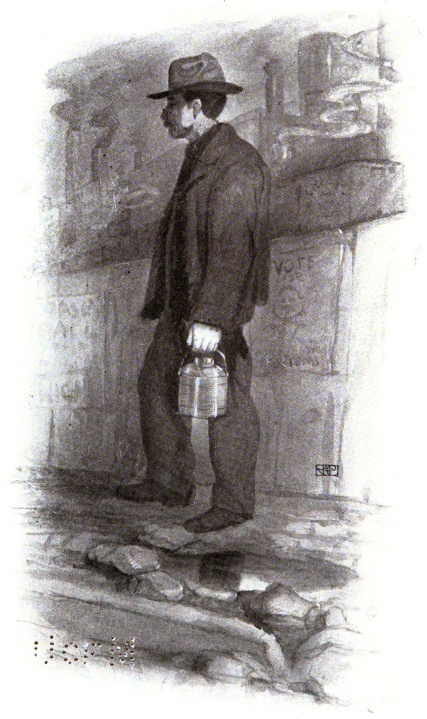
Life was very different for us all after that. Before the accident we had been tolerably sure of the two rooms over Mike’s, saloon which we called Home. And there was always bread and potatoes and sometimes soup and a stew for dinner. Mother had managed to send Bob and me and Katie and Tim to school a part of the time at least.
But after Dad went, life was a regular Lottery and a good many days were blanks. Mother took in so many washings for awhile that the walls of the basement room turned green with mold. But the Undertaker with his bill camped on her trail.
Bob was only eleven but he said clever things even in those days. We were twins—the eldest—Bob and I. But everybody guessed him to be fourteen when they heard him talk. He always had a way of breaking through shams and hitting the weak spots.
“Mother,” he would say whenever the Undertaker appeared, “the Wolf is at the Door.” I am sure old Shepard must have heard him.
It’s a barbarous custom that saddles the already fainting poor with further burdens for the Dead, and mother almost washed herself into the grave paying father’s funeral bills.
One day the Undertaker offered to let Bob work out the balance of the bill. He said he’d put up for Bob’s bed and meals and mother was too tired to refuse. I remember he made her sign a paper saying Bobbie was over fourteen, and they both told Bob he’d have to say the same thing or the Inspector wouldn’t let him work.
It seems to me these Child-Labor-Laws are the craziest jests in the Big Joke Book. “You mustn’t work if you are under fourteen”, they say; but nobody cares whether we eat or not! A law that says “mustn’t” ought to make it possible for a person not to. But there never was a law, so far as I know, that contained that much common sense.
Well, Bobbie went away with the Undertaker and for a time mother cried as if none of us other children was worth thinking about. The first young Piper had been forced out of the “home” nest that was already fast falling apart and the pain of it brought a stony look into mother’s eyes; but when Sammie and the baby grew hungry, she forgot about everything but taking care of the rest of us. She didn’t even have a day off to be miserable in when father died.
And I have heard folks say working women have no feelings! Would their own sensibilities remain fine, I wonder, with Cold and Hunger pressing ever at their heels ready to seize them if they stopped to think, or weep, or fall ill! Bob would put it, “Poor folks are too busy chasing the elusive Flop and the evasive Meal Ticket to have time for Fancy Feelings!”
At last, of course, the little mother gave up. She had worked several days in the steam filled room with a pain in her chest that kept her face white and drawn, but when the fever came on, she was forced to lie down on the old bed. When she found she was unable to rise, she said over and over again to herself.
“The babies, the babies! O my poor little babies! What can I do!” I made her a cup of tea; fed the younger children and put them to bed.
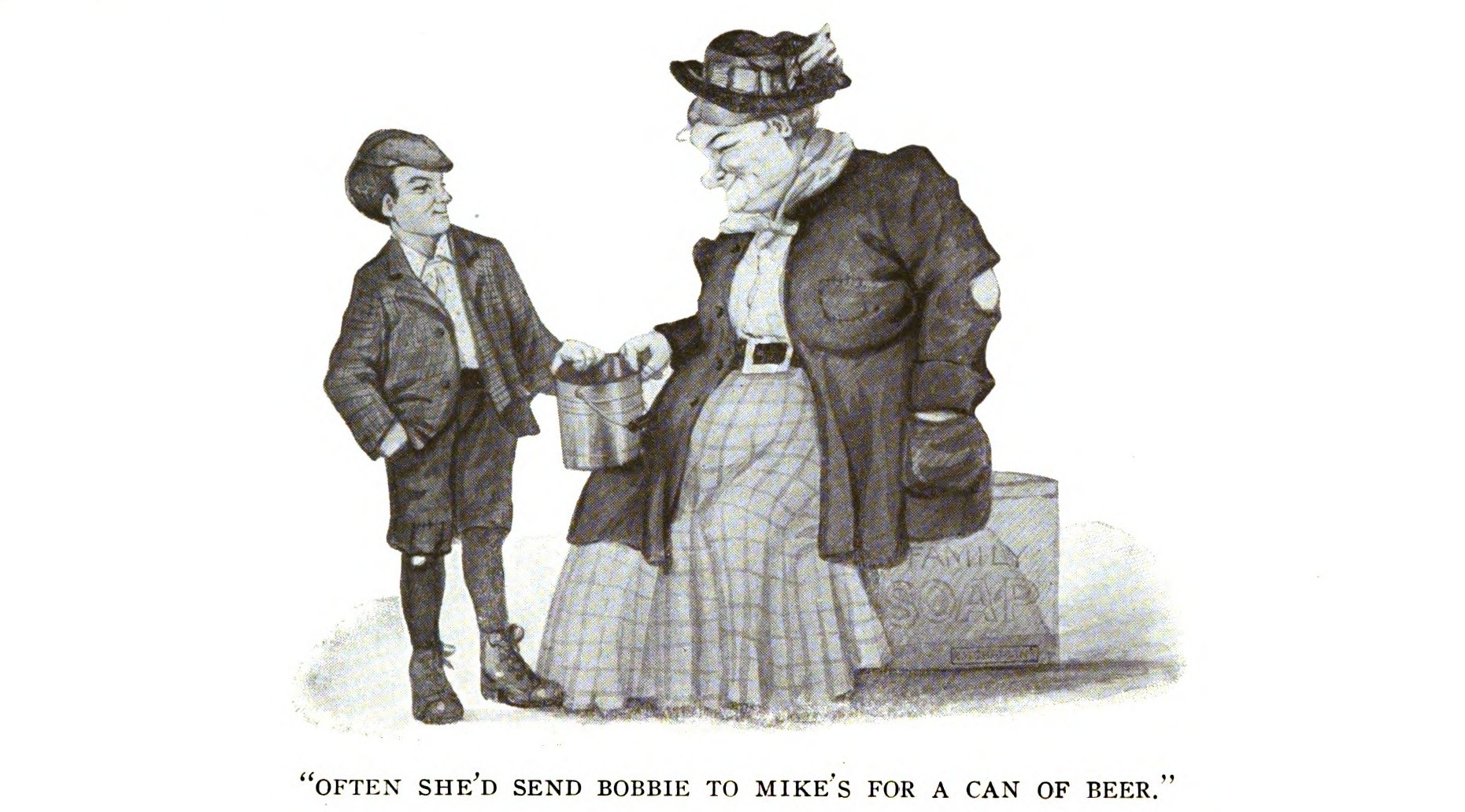
In the night mother was delirious. She woke me calling for somebody to look after Sammie and screaming for them not to take us away from her. She said she “would soon be able to work again.” I ran up stairs and woke Mrs. Nome. Mrs. Nome was a lame old woman who sold shoe strings at the “U” Station. Often she’d send Bobbie to “Mike’s” for a can of beer and the Flynns said she got tipsy and went to sleep on the stairs. I don’t know about that. But she was very good to us.
When I told her mother was sick, she hopped down stairs and took charge. It was time somebody did. She was kind to mother for a long time. She didn’t wash often; that’s true, and she didn’t believe in manicurists of any kind. She’d have ‘lifted” a watch from a rich man with her right hand, and spent the proceeds on us kiddies with her left, and been proud of it. That’s the kind of a woman she was.
Mrs. Nome was almost as poor as we were. She couldn’t feed five hungry waifs, nurse the mother and sell shoe strings. But she stuck to the little mother and assumed command. The wood was nearly gone; the rent was due and we had nothing to eat in the room, but Mrs. Nome was a woman of resources. Since she couldn’t feed and warm us herself, she used the materials at hand. She just wrapped me up in a shawl and put one of Bob’s old coats on little Sammie and hustled us up to a corner on the boulevard to beg.
We were hungry, Sammie and I, and all the other children were hungry too. Mrs. Nome chose to send Sammie because he was such a pale, wee little imp she thought nobody could turn him down. She said nobody but a “Charity woman” would do it. I know now that she meant the “Scientific Charity Worker” who is hired to nose around the shacks of the poor, hunting for evidence that will enable the charity officials to pronounce the verdict unworthy, from which there is no Appeal, upon the miserable ones. But I’ll tell about them later on.
Mrs. Nome knew I’d take care of the kid. I suppose Sammie and I made a pretty pair, as we stood on the corner of a fashionable quarter, huddling as close together as we could and muffling our hands beneath the coat and shawl to keep warm. It was snowing and blowing the typical Chicago January gale and Sammie wept like a leaky drain, audibly and in a way that Mrs. Nome would have said was worth a bank account. His toes stuck from the holes in his shoes, and my stockings were a match for them. We were purple with the cold in ten minutes.
The first well-dressed man that passed, stopped and asked me what Sammie was crying for.
“He’s hungry,” I said. And my lips quivered and the tears started to my eyes. “So am I.” I was very much frightened. Mrs. Nome had cautioned me to look out for the “muggs” and I knew that meant dangerous ground. But the man gave us half a dollar and made us promise to go home. Then he hurried on his way. Sammie brightened up when he saw the money, but when he found it didn’t mean dinner, he resumed his wails and would not be comforted.
A stream of well-clad men began to flow steadily from the station toward the great apartment houses on the boulevard, and nearly everybody tossed us a quarter or a dime. Sammie kept up his accompaniment of woe. Mrs. Nome said he was great “Beggars’ Capital.”
The wind blew the sleet and snow down our necks and it cut our faces like glass. The men passing were too eager to gain shelter in the big houses to pause and question us in the storm. They tossed us the first coins they found in their pockets and hurried on.
Nobody asked where we lived and I had no need of the story Mrs. Nome had invented.
“Don’t never let them Charity people know where ye live,” she said, “Er they’ll be down en takin’ all you kiddies away from yer maw en sendin’ ye to the ‘Friendless’. Tell ’em yer name’s Jones, Mary Jones, en thet ye live in the Alley. Don’t never say nothin’ about the Dump.”
But nobody asked and by and by I sat down in the snow by Sammie and cried too, till Mrs. Nome came to the rescue and took us home.
My pocket was half filled with quarters and dimes. Old “Granny” took us into a saloon where she counted them. We had $4.75 altogether and she said Sammie was “sure a winner.” Her breath smelled strongly of whiskey but she was very kind. And when we got home she made us a supper of stewed rabbit fit for the President. She put the money away for us carefully in her old bag and never spent one penny on herself.

That night she sat up taking care of the little mother.
It is apparent that Old Granny Nome believed in making hay while the sun shone. The day after Sammie and I were initiated into the ways of the beggar fraternity and landed $4.75, the snow continued. Again she conducted us to a fashionable quarter during the dinner hour and again Sammie’s tears affected the well-to-dos to the tune of handsome returns. My fears were in abeyance this time and I grew bolder with the happy result of putting the Piper family $5.25 ahead in the game. We began to eat regularly once more.
Mrs. Nome was always worried with fear of the Charity Organization Society. It seems they’d have shoved her into the poor house long before had it not been for the inevitable shoe strings which she hawked. They could never catch her asleep. Always she patently vended her small wares. As there was nobody to prove she didn’t earn her own living it was impossible to chuck her away on the County and she remained a lasting eyesore to “Scientific Charity.”
Every outcast on the Dump was her ally and she served us all unaccountable good turns. Equally true were the Rich her bane and her abomination. And unbelievable too were the many small ways she found to beat them.
The days passed and she stuck to the helm of the Piper household, nursing the little mother through long nights of pain and feeding us children like a hen-mother come into her own. The rent was paid; we children were clothed and mother was supplied with medicine. Sammie continued to wail disconsolately every time we went out on business and I had advanced to the point where I did not try to comfort him.
We were never out long; we always worked on a new corner and invariably at the dinner hour when everybody was in a hurry to get home. By this time we lived riotously and ate three meals a day. And there were eight round silver dollars tucked away for the Piper family in an old pasteboard box in the cupboard. No wonder we all learned to love Granny!
But all good things come to an end. Sammie and I met our finish when we ran into Charles K. Copperthwaite, Superintendent of the Board of Organized Charities. A smug Board of Trade man had just given us a quarter and was hurrying away when up comes Old Copperthwaite. It was the very end. I had six dollars in my pocket when he started out to take us home and “investigate.” He counted them.
I’ll tell about Copperthwaite later on. Just here he turned on the flashlights and wrote us up in the papers. He roasted the people who had given us money instead of paying it to the Charity Organizations for “investigating” us, and he boosted his own particular organization way up and over. He proved that we had eight dollars in cash in the basement when Sammie and I went out to “impose on a noble-hearted but careless-minded Public.”
And then he sent Katie and Tim to the Home for the Friendless and persuaded Mrs. Chauncey Van Kleeck to take me into “her beautiful home” as a watch-dog for her baby, for my board, clothes and schooling. You can go into the Office of the Bureau to this day and read how “charitable” Mrs. Van. was; and see the notes she sent in to the officers every month reporting the moral progress and ability to work shown by the little “beggar.”
Copperthwaite got all the philanthropically inclined society ladies to “take such an interest” in mother that before she could raise her head off her pillow, she was nearly smothered with family washings—which the dear ladies sent her out of the kindness of their hearts—at half the rates usually paid for such work. “It will enable her,” said Copperthwaite in the papers, “to maintain an honest living and keep the two younger children at home.” Then he painted a halo around the heads of the financially elect, and I suppose the society ladies glowed with virtue when they read the papers, thinking they saw themselves as others see them.
Charles H Kerr publishing house was responsible for some of the earliest translations and editions of Marx, Engels, and other leaders of the socialist movement in the United States. Publisher of the Socialist Party aligned International Socialist Review, the Charles H Kerr Co. was an exponent of the Party’s left wing and the most important left publisher of the pre-Communist US workers movement. It remains a left wing publisher today.
PDF of full book: https://archive.org/download/InternationalSocialistReview1900Vol08/ISR-volume08_text.pdf
 Revolution's Newsstand