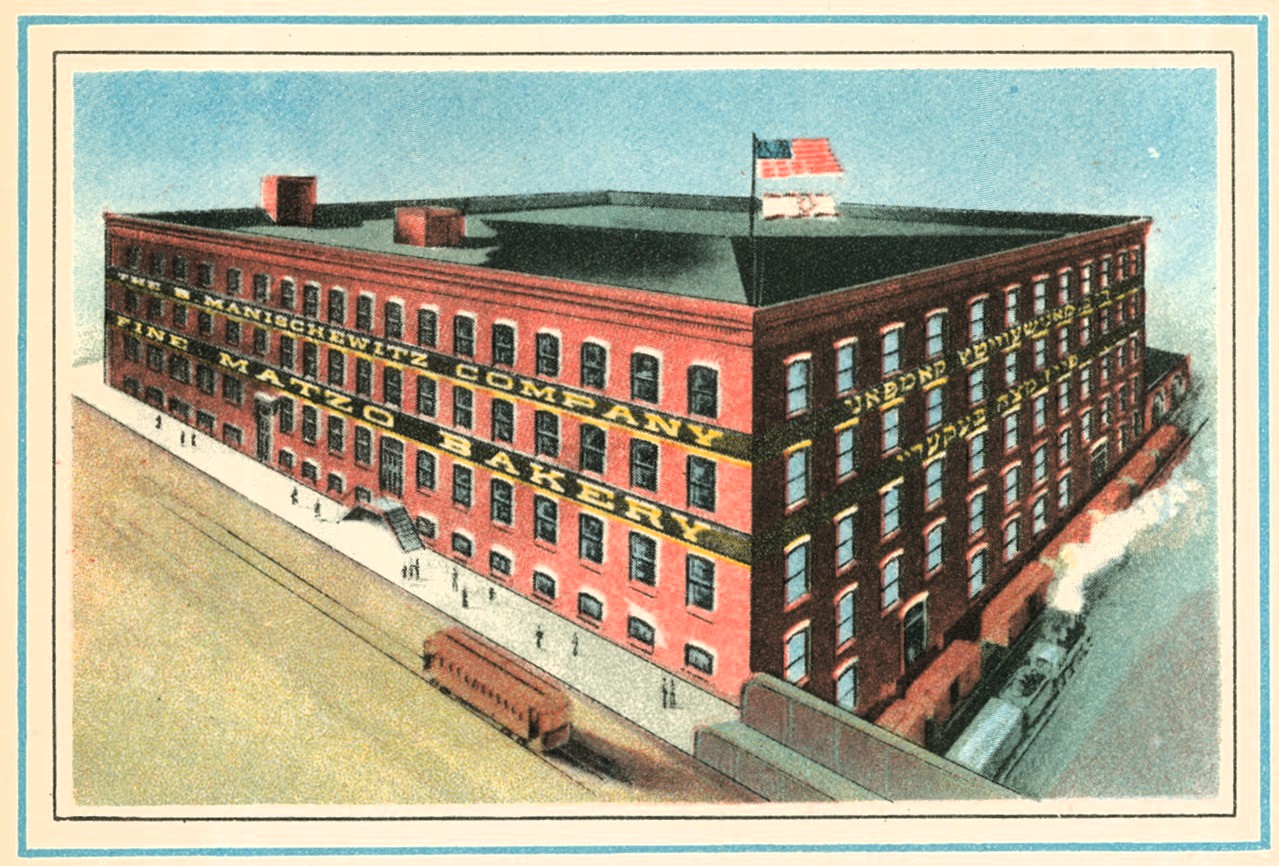
Class war within the Jewish community; a worker at Cincinnati’s Manishewitz plant dishes on conditions there and the boss’ Palestine racket.
‘Pious Cloak Over Matzo Slave Driver Manischewitz’ by A Matzo Slave from The Daily Worker. Vol. 6 No. 136. August 14, 1929.
CINCINNATI, Ohio (By Mail). The Israelites did not slave as hard under the Egyptians as their descendants in the matzo bakery of the Manischewitz Company in Cincinnati. The irony of it is that the matzos are intended as a reminder during the Passover feast, as a memorial to the Jews that their forefathers were slaves and that they must never tolerate slavery in any form.
The ‘‘Rabbi’’—Slave Driver.
Manischewitz has the title of “rabbi” although that is known to be simply for advertising purposes. Jews are so accustomed to revere one with the rabbinical degree they do not question his connections, political or economic and thus some of latter day prophets are getting away with pious frauds of the most contemptible sort.
The matzo slaves work for one hundred and fifty pennies a day—there really is no other way to make a dollar and a half ($1.50) appear as small as in this place. The Israelites in Egypt had to gather straw for their bricks, here the slaves must augment their earnings with four or five hours of outside work to make a bare living. Old men slave for this alms house dole while Manischewitz donates thousands to Palestinian “drives” and endows synagogue steeples with money he has stolen from the sweated labor of his slaves at the ovens.
The “Holy” Task of Slavery.
The Jews are cheated both ways. Those that work in the plant acquire merit at the “holy” task of baking the “sacred” unleavened bread. Those that buy it pay from 17 cents to 20 cents per pound. This highway robbery can be better appreciated when one learns that ordinary flour and plain Ohio River water are the sole ingredients of the “holy” matzos for which the Jews pay so handsomely.
One family man of my acquaintance, with three small children and a sick wife is sick from worry over his plight. He recently got a “raise” of $2 a week and still he is an object of charity for it is. Absolutely impossible for him to exist on the starvation pay.
An important item in “Rabbi” Manischewitz’s racket is his ostentations and openhanded hospitality to visiting rabbis. His home is a sort of hang-out for the great and the near great of Judea and every Jew arriving in America for a drive for the orthodox crowd of the old country or for some pet charity in the Holy Land, puts up at the Manischewitz home during his stay here.
The Rabbis Root for Him.
The object of this is of course the publicity and advertising that accrues to the Manischewitz slave pens and their matzos. When the rabbis return to their homes they talk Manischewitz’s matzos with the skill of an American drummer selling prison made overalls to a doubting customer. Manischewitz came by his frauds through inheritance. His dad, who founded the matzo industry here, made a much advertised trip to Palestine for the purpose of fetching several spade-fulls of the “ould sod” to be mixed with the ground in his grave at his burial. The “holy” ground might have been brought out of the Manischewitz backyard for all that the world knew, but it was great “Copy” for the papers, Jewish and English, and it gave the house much prestige at a time when it was just getting started.
A Sacred Cow.
The difficulty of organizing Manischewitz plant is in the divergence of types, opinions and what Jews call religion. Old men without the slightest idea of social consciousness, young immigrants still steeped in the prejudices of Old World Jewry and Yiddish tramps as best they can through several weeks at the ovens for the purpose of getting ahead by ten or twelve dollars comprise the material that the employment department prefers over the eager, youthful native Jewish worker who is anxious to make the world a decent place to live in. The Manischewitz plant is one of the sacred cows here and no one has so much as dared breathe a word of criticism against it.
—MATZO SLAVE
The Daily Worker began in 1924 and was published in New York City by the Communist Party US and its predecessor organizations. Among the most long-lasting and important left publications in US history, it had a circulation of 35,000 at its peak. The Daily Worker came from The Ohio Socialist, published by the Left Wing-dominated Socialist Party of Ohio in Cleveland from 1917 to November 1919, when it became became The Toiler, paper of the Communist Labor Party. In December 1921 the above-ground Workers Party of America merged the Toiler with the paper Workers Council to found The Worker, which became The Daily Worker beginning January 13, 1924.
PDF of full issue: https://www.marxists.org/history/usa/pubs/dailyworker/1929/1929-ny/v06-n136-NY-aug-14-1929-DW-LOC.pdf
 Revolution's Newsstand