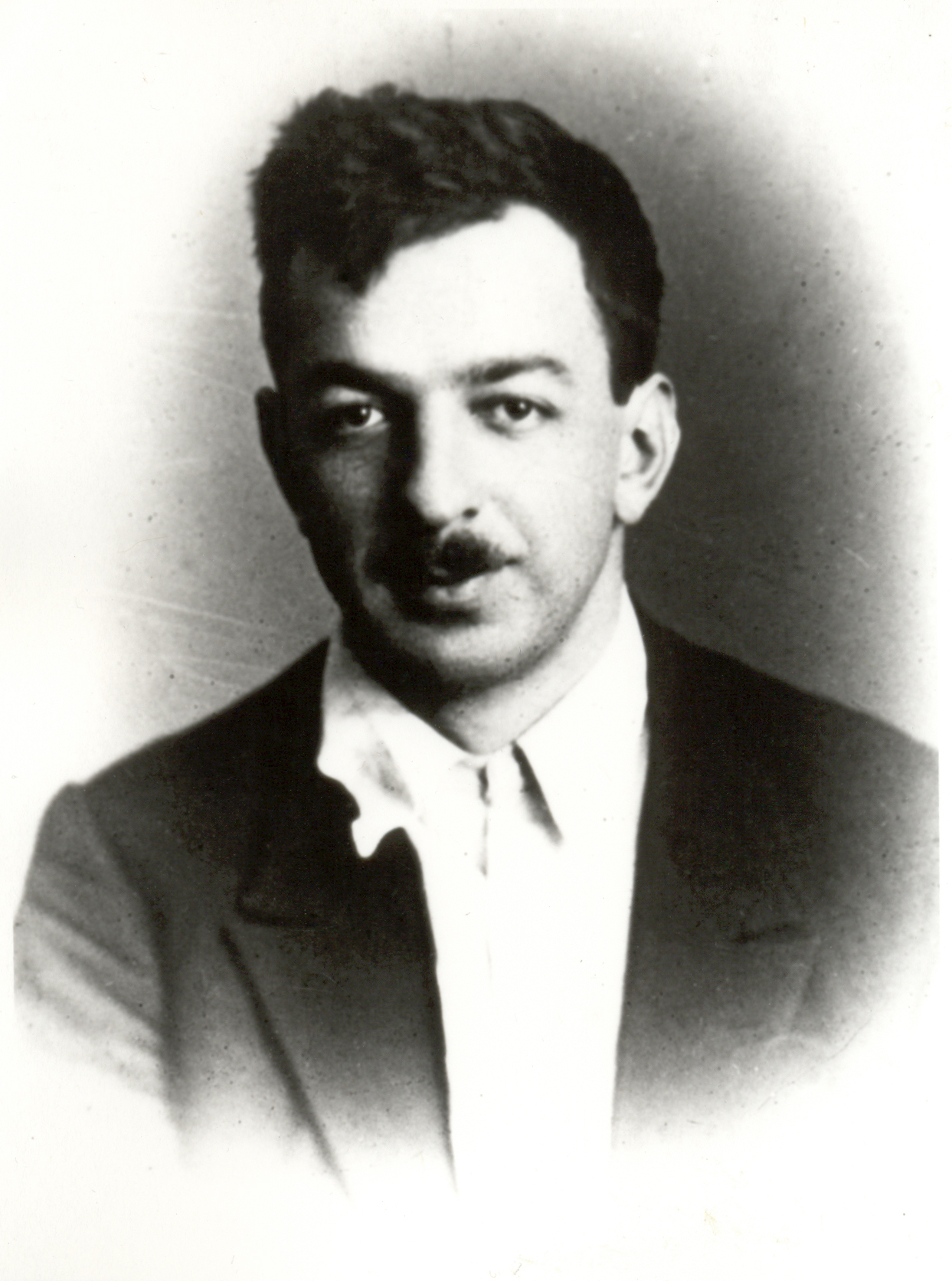
Lominadze defends the Guangzhou Uprising, to which he was tasked in organizing, against Trotsky and other’s criticisms of the policy. Veteran Georgian Bolshevik Vissarion Lominadze was in 1927 a Comintern representative to China where in August he facilitated the removal of C.P. leader Chen Duxiu, who was blamed for the failure of the Comintern’s own policy of working within the Koumintang, and promoted a new leadership around Qu Qiubai. That new leadership was tasked with organizing an uprising, which would take place that December and would be known at the time as the Canton Commune. The crushing of the commune would forever alter the Communist struggle in China, and its consequences on the Comintern were equally profound. A member of the ‘Young Stalinist Left,’ Lominadze’s position that China was ripe for socialist transformation was not shared either by Bukharin, who would shortly lose his leading positions, or by Stalin. By 1930 Lominadze found himself in sharp opposition to Stalin’s shift forced collectivization, being one of the few to criticize it at the 16th Party Congress, after which would be demoted to Party secretary in Magnitogorsk, a small city in the Urals. Involved in several oppositional currents in the early 30s, in January, 1935 he was summoned to answer questions in anticipation of the trial ‘Trotskyite-Zinovievite Terrorist Center’ and took his own life.
‘The Anniversary of the Canton Rising’ by Vissarion Lominadze from Communist International. Vol. 6 No. 5. February 1, 1929.
ON December 10th last, twelve months had passed since the Canton rising. The interval separating us from those great days in Canton now allows us quite objectively to estimate the importance and the character of that rising, its place in the development of the Chinese revolution, its strong and its weak sides. In its time the question of the lessons and particularly among the workers in the Chinese Communist movement, and that discussion was brought to a close only at the Sixth Congress of the Comintern. Now we possess authoritative decisions on all the basic questions bound up with the analysis of the Canton events. On the other hand, ail that was or seemed to be doubtful the day after the rising has now been weighed and tested on the objective scales of history. This makes it possible for us now to make final summaries of the disputes which went on for so long inside the Comintern around the question of Canton.
It is true that even at the present day we still do not have any full and systematic materials at our disposition concerning the course of the events in Canton day by day, hour by hour. The Canton rising still awaits its historian. One may hope that the first anniversary of the Soviet revolutionary rising in Canton will serve as a reminder to the comrades studying the history of the Chinese revolution of the pressing necessity of collecting, working over, and publishing all the materials for the historic days of December 10th to 13th, 1927. Further procrastination in the fulfilment of this task is quite unpardonable. But whilst we still do not possess a full and exact historical description of the Canton events, quite sufficient material has been accumulated for their political and their final political estimation.
LESSONS OF THE RISING
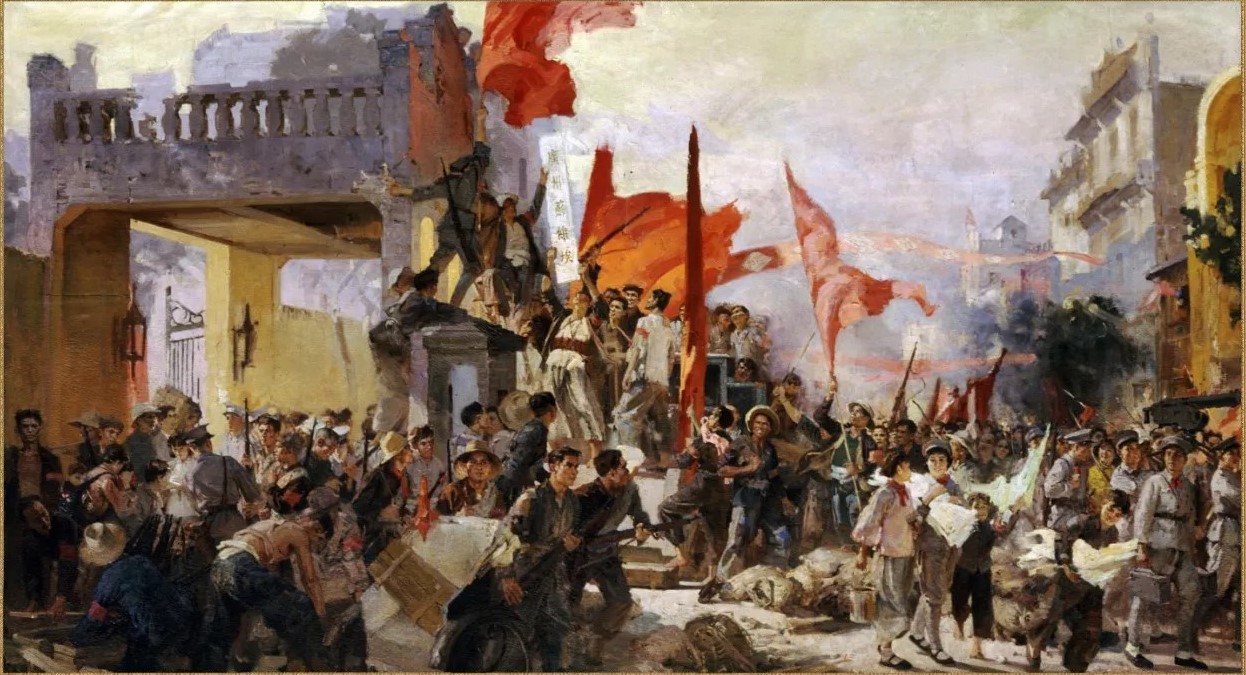
The Soviet power in Canton did not last three whole days. The rising of the revolutionary workers and soldiers of Canton was suppressed by the united forces of the Chinese bourgeois-militarist reaction and the imperialists within 58 hours. But those 58 hours achieved a truly universally historical importance. They represent a higher stage and simultaneously a complete historical break in the development of the Chinese revolution. During the Canton days through the tremendous historical activity of the masses, the Chinese revolution came for the first time, by a number of intervening and transitional steps, to the new, Soviet stage of its development. After December 10th to 13th, 1927, the revolution in China can develop only as a Soviet revolution, or it will not develop further at all. After Canton the slogan of soviets has ceased to be a merely “theoretical” slogan in the Chinese revolution. For the great masses of the Chinese toiling classes, it has now become a slogan which has been tested and applied in practice. The Chinese revolution cannot now go back from Canton. It can only advance from Canton, only go further than Canton. In this above all consists the universally historical importance of the Canton rising. The events of December, 1927, confirmed the genius of the theoretical position advanced by Lenin at the Second Comintern Congress, namely that the Soviets are the basic and historically inevitable form in which alone can be accomplished the revolutionary emancipation both of the proletariat of the leading capitalist countries and of the toiling masses of the backward and imperialistically oppressed countries. The Canton rising showed that China has now grown up, has matured to the Soviet form of development, that for the hundreds of millions of the Chinese people the Soviet system is not only in the historical sense of the words the only way out from under the pressure of triple serfdom and extreme indigence, but a decisive practical necessity at the first further rise of the revolution. The Canton rising has placed the question of the Soviet power in China as the next item on the historical agenda. It showed that in the Chinese toiling masses, there is already historically adequate strength for the resolution of this question. And now there is no power on earth which could remove that question from the agenda.
The events of December 10th to 13th, 1927 added the final touch to that period of the Chinese revolution during which the proletariat was still politically immature for independent historical action, and was not in a condition to effect its hegemony in the all-national revolutionary movement. It is true that the Chinese working class had carried on the struggle for hegemony from the very first days of the growth of the mass movement; it had carried on that struggle even during its alliance with the national bourgeoisie and after its rupture with the latter. But it is one thing to struggle for the leadership of a revolutionary movement, and another to have the mastery of that leadership. Even the final defection of the national bourgeoisie from the revolutionary camp (the Shanghai and Wuhan risings) could not of itself automatically decide the question of proletarian hegemony in China’s revolutionary mass movement. History never decides such questions automatically. In order to resolve this question the Chinese working class had in practice to demonstrate their capability of independent revolutionary mass action, and an action at that sufficiently strong to shatter or break down the dominance of the bourgeois militarist reaction. The Canton rising proved to be that activity. It was a decisive historical test, in which the Chinese proletariat finally assured to itself the role of the sole leader and director of the Chinese revolution. After Canton the hegemony of the proletariat was transformed from a historical possibility into the actuality of the Chinese revolution.
AFTER THE RISING
But after the Canton revolution we witnessed a strong ebb in the revolutionary wave in China. The peasant risings which broke out in the winter and spring of last year quickly died down. In any case, they to-day do not have that force and that sweep which they had several months back, and the workers’ movement in all the large centres of China, Canton included, still cannot rise out of the depression. Can our estimate of the importance of the Canton events be reconciled with these indisputable facts? Has not the very revolution ceased to be a reality of the present day in China, has it not been transformed into merely one of the possibilities, and a distant possibility at that, along which the further development of China may proceed? Would it not be more sound to consider the Canton rising not as a transfer to a new stage of the Chinese revolution, but as the end of that revolution?
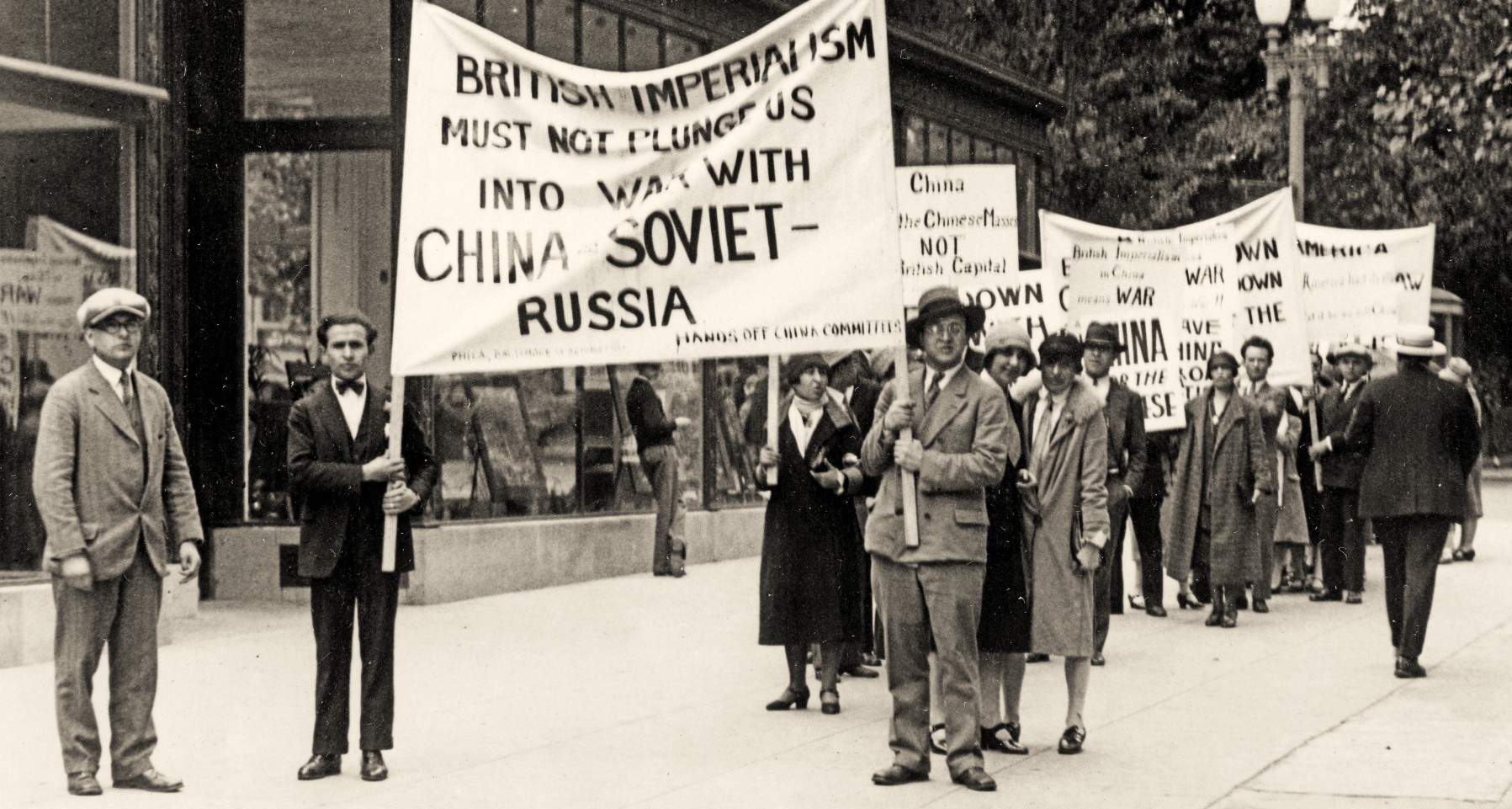
This conclusion, which we have deliberately set in an interrogative form, is openly insisted on by the Trotskyists. Not so very long since a letter by Trotsky on the Comintern Sixth Congress was published in the German “ultra-left” press. In this letter Trotsky pokes “fun” at the congress decisions which laid on all Communist parties the prime obligation of defending the Chinese revolution. What is there to defend, Trotsky venomously asks, when there is nothing left of the revolution? However, in a less open form this idea that the Canton rising was the last outbreak of the accomplished Chinese revolution is shared even in the ranks of the Communist movement by a certain circle of comrades. And this makes it all the more necessary to consider this question first of all. The manner of its. decision will predetermine a number of further political conclusions of secondary importance.
THE REVOLUTION CONTINUES
At the moment no one can deny the fact that the growth in the mass revolutionary struggle was broken off sharply after the suppression of the Canton rising, that from that date began a period of protracted decline of the revolutionary struggle in China. In the conditions of a revolutionary situation one year is an extraordinarily long period. At the present moment there can be dispute only over whether the very lowest point has been reached in this process of decline in the revolutionary struggle. The actual fact of an ebb in the revolutionary wave can be disputed by no one. The greatest political mistake of a number of Chinese and non-Chinese Communists (and of the author of the present article in the first place) consisted in their continuing for several months after the suppression of the Canton rising to regard it as the direct beginning of a new revolutionary rise throughout China, and in correspondence with this view insisting upon an orientation of the Chinese C.P. tactics around the direct organisation of an armed rising on as large a scale as possible. This profoundly inaccurate estimate of the situation arising after Canton was conditioned by indications of a growth of the elemental peasant risings in Central and Southern China. Moreover, the dimensions of the peasant insurgent movement at this stage of its development were greatly exaggerated, whilst the extent and depths of the defeat of the working class were still more underestimated.
The great service of the Ninth Plenum of the E.C.C.I. consisted in the fact that it resolutely rejected this erroneous opinion and with determination changed the tactical course of the Chinese C.P., recalling the general slogan of an immediate armed rising (in the post-Canton conditions this slogan would inevitably have condemned the Chinese Communists to hopeless adventures and complete break up) and replacing it by the slogan of the organisation of the masses and their preparation for the new, imminent revolutionary rise. The Ninth Plenum quite soundly evaluated the Canton rising as a rearguard struggle marking the end of the first revolutionary wave in China. But, of course, this evaluation has nothing in common with the Trotskyist theory anent the end of the Chinese revolution. After Canton the period of rise was replaced by a period, and even a prolonged period, of depression. But the revolution has not come to a halt in China. The revolution is continuing. This was, and this remains the starting point for all the decisions of the Comintern on the Chinese question.
The long series of heavy defeats and failures which overtook the workers’ and peasants’ revolution in 1927, would undoubtedly have interrupted the development of the Chinese revolution for many years (and then it would indeed have marked the end of the revolution) if the bourgeois-militarist counter-revolution had proved capable of ensuring the country any way out whatever, whether reactionary or reformist, from the gigantic antagonisms which engendered and which nourish the Chinese revolution. But a year has now passed since the defeat of the Canton rising—a period extraordinarily long in the conditions of a revolutionary epoch—and all the experience of this year witnesses to the fact that the bourgeois-militarist reaction has no power to resolve the problems upon the settlement of which the further development of China is bound up. Nor does the growing activity of the imperialists in China ensure such a sequel to the Chinese revolution. It was still possible to carry on theoretical discussions on these questions in 1927. But now the theoretical discussion is settled by the very development of the objective reality. Not a single step forward has been taken towards the decision of the basic social problems of China—the agrarian and social problems. [At the present time one feels even a little constraint in recalling that a year ago we still had to discuss the possibilities of realising an agrarian reform of the Stolypin type in China.] And this signifies that the antagonisms have in this regard grown enormously. From the aspect of China’s struggle for independence her international situation has not improved during the past year. The fact of America’s recognition of the Nanking government, and equally Britain’s recognition, does not in the least connote a weakening of China’s national oppression, but on the contrary, implies a further growth of actual oppression. The fact of increased aggression of foreign capital in China in all spheres is quite indisputable. This past year has led to a further intensification of the crisis in the agriculture of China, and it now has reached the extreme limits (one of the expressions of this fact is the condemnation of not less than twenty millions of the population to famine this year). A certain animation in industry, of a purely circumstantial nature, and also the increase in foreign trade, cannot, of course, resolve the severe economic crisis through which the country is now passing. The formal union of all China under the “single” government of the Kuomintang has made no essential changes in China’s political system; the struggle between the cliques of generals, the very character of the government and so on, have all remained as they were a year ago. The entire practice, and the entire experience of the past year demonstrate that the conditions for a stabilisation of the bourgeois-militarist regime in China do not exist, that at the present moment stabilisation is objectively impossible, that there are at the moment no indications of that stabilisation. Owing to this circumstance the defeat of the revolution in 1927 was not transformed and could not be transformed into the end of the revolution. Owing to this circumstance the revolution in China must inevitably continue.
A TRANSITION TO A HIGHER STAGE
Thus viewed, the Canton rising, despite the fact that it was immediately followed by a long period of depression in the revolutionary struggle of the Chinese toiling masses, cannot but connote a transition to a new, higher, Soviet stage of the revolution, in which the Chinese proletariat will become the leader of the whole revolutionary movement. This deduction is often objected to on the ground of the naive, abstractly schematic argument that it is impossible for it to mean a transition to a higher stage, when it is admitted that immediately after Canton a long period of triumph of reaction set in. That argument sounds convincing only at its first hearing. In reality where has it ever been proved that the transition from one stage of the revolution to another, higher stage must necessarily occur immediately without any interval in time? The rising line of revolution cannot be described as though it were geometrically straight. The Canton rising connotes a transition to a higher stage of the revolution, first and most of all owing to the form of revolutionary government which it established (the Soviet Government), then owing to the new disposition: of class forces (the proletarian hegemony in the struggle of the masses against the bloc of bourgeoisie, landowners and imperialists), and finally owing to the historical initiative of the proletariat in organising a mass revolutionary struggle, which is the prototype of imminent revolutionary battles on a much greater scale than that of December 10th to 13th, 1927.
So much for the general significance of the Canton rising and its place in the development of the Chinese revolution.
CONDITIONS OF THE RISING
In the discussion which developed in the Comintern on the question of the lessons of the Canton events, certain of the comrades attempted to prove that the rising in Canton was untimely organised by the Chinese Communist Party. Some of them held to the thesis that the rising had been started prematurely, whilst others argued that it was historically late. The adherents of the latter view based it on the assumption that the failure of the Canton rising was predetermined by the exhaustion of the forces of the revolutionary movement before the rising; the tendency to an ebb in the revolutionary wave was quite definitely indicated long before the Canton rising. The depression in the workers’ movement in China’s main industrial centres (Shanghai, Wuhan) a number of heavy defeats of the peasant risings (including the rising of Ho-Lung and Wei-Tin’s soldiers) on the very eve of the Canton rising predetermined the failure of any armed attack, and under such conditions the organisation of the Canton rising was a highly serious political error. “It would have been better not to take to arms.” (Plekhanov, after 1905.)
It is characteristic that this viewpoint, which produced Plekhanov’s estimate of the December armed rising of 1905 (Plekhanov also argued the untimeliness, the lateness of the Moscow rising) was in complete agreement with Trotsky’s views on the character of the Canton rising. Trotsky declared that rising to be a putsch, a consciously hopeless adventure, previously condemned to a cruel smash owing to the very fact that the revolution in China had clearly been on the ebb long before the Canton events. This coincidence in the view of the extreme right elements of the Comintern and the “left” Trotskyist opposition on a highly important political question is, of course, no fortuitous one. It shows how closely the two extreme deviations from the Leninist line of the Comintern coincide, and on a social-democratic platform at that.
It is not necessary to go into extensive demonstrations of the extreme inaccuracy of this essentially Menshevik “theory” of the “destiny” of the Canton rising. It is, to start with, contrary to the facts. And the facts declare that whilst by the date of the Canton rising the working class and peasantry of a number of Chinese provinces were actually rendered impotent by their defeats during the previous stages, in the Kwantung province, with its forty million population, and in the adjacent areas, the peasant revolution rose very swiftly during November and December, 1927. The mass revolutionary movement of the peasantry in Kwantung province itself was particularly extensively developed (the establishment of soviets in a number of Kwantung districts). In Canton itself there was a rapid growth in the revolutionary agitation of both the working masses (the demonstrations and strikes of October 14th, November 7th, and so on), and among the garrison divisions. The elemental mass movement in Kwantung was on the rise. To deny this proved and confirmed fact is now quite impossible. Under such conditions the Canton Communist Party was bound not to constrain and hinder the elemental movement, but organisedly to carry it on, forward to the decisive struggle: decisive because its result was to determine the further development of the revolutionary struggle throughout China, and its success would undoubtedly have raised the forces of the all-China revolution to an enormous degree. A struggle and only a struggle could determine the question whether a real turn in the development of the revolution had now come. Any other decision of this question would have been a fatal capitulation and the self-destruction of the Chinese Communist movement.
MARXISM AND REVOLUTION
“A Marxist,” said Lenin, “is the first to foresee the arrival of a revolutionary epoch, and begins to arouse the people and to sound the alarm while the philistines are still sleeping the slavish sleep of the faithful. Consequently the Marxist is the first to take the road of direct revolutionary struggle, he moves towards the direct struggle, towards the revolutionary seizure of power, unmasking the reconciliatory delusions of all the social and political mediocrities. Consequently the Marxist is the last to abandon the road of direct revolutionary struggle, and abandons it only when all possibilities are exhausted, when there is not the faintest shadow of hope of a shorter road, when the call to prepare for mass strikes, for a rising and so on has clearly lost all basis. Consequently the Marxist replies with contempt to all those innumerable renegades of the revolution who cry that ‘we are more progressive than you, we gave up the revolution earlier.’”
These words of Lenin are a blow between the eyes to those opportunists and “ultra-left” Mensheviks who scream of the predetermined destiny of the Canton rising, and who are proud of the fact that they either before or after that rising considered that “it would have been better not to take to arms.” In December, 1927, the working class of Canton and the Chinese Communists were, in Marx’s words, faced with the following alternative: “either to accept the challenge to struggle, or to yield without struggle. In the latter case the demoralisation of the working class would be a much greater misfortune than the loss of any number of leaders.”
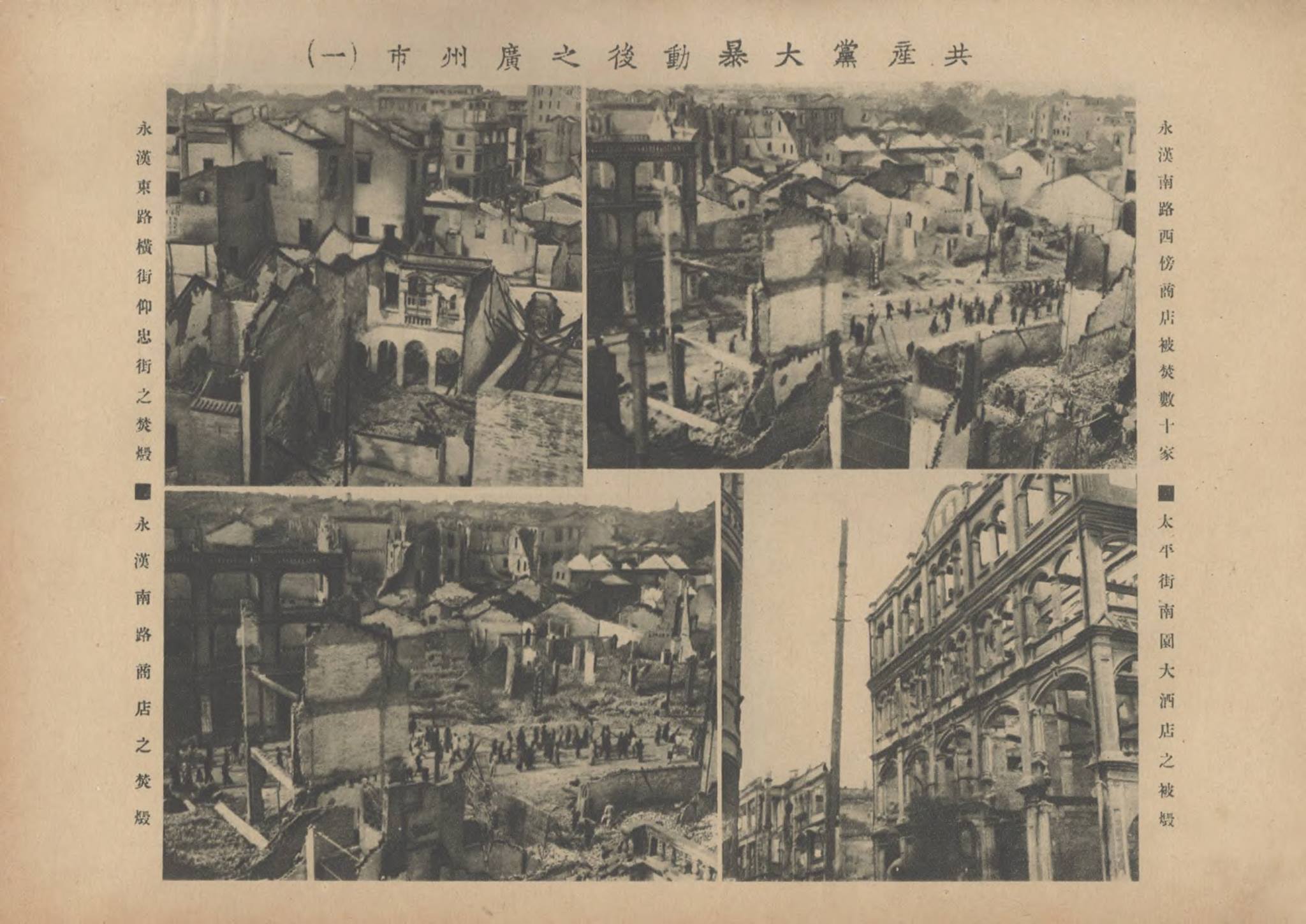
The heroic proletariat of Canton accepted the challenge to struggle and suffered defeat. The struggle cost the Canton workers enormous sacrifices. But even the shattered Canton rising has taken on a universal historical importance and was a great achievement of the Chinese revolution. Capitulation without a battle would not in the least have protected revolutionary China from the horrors of the white terror, and would simultaneously have been the greatest misfortune for the entire revolutionary movement of China.
We shall not stop to consider in detail the arguments of those who consider the Canton rising was premature. The advocates of this view, wise after the event, start with the assumption that the Canton Communists ought to have waited a few more weeks, in order to allow the cliques of generals fighting for Canton time to fight among themselves, and only then to have raised the revolt. These “sage” politicians leave out of account “only” the fact that any postponement of the rising would have left the Canton workers without the aid of the garrison (the order for the disarmament of the revolutionary divisions was issued on December 10th, and this circumstance forced a precipitation of the Communists’ attack by a day or two, i.e., it would have condemned them to defeat in the very first hours of the rising. These ‘‘strategists” also do not realise that in a revolutionary situation the conditions of struggle change from day to day and sometimes from hour to hour, that any neglect of the favourable moment for an armed rising may prove to be fatal. Nothing can be made of the stupid view that it would have been better if the Canton Communists had waited a few weeks with their attack. The date of the rising was forced on the Canton Communists by the objective conditions (the growth in the elemental movement of the masses, the threat of disarming the revolutionary garrison for their persistence in the question of an armed rising, and so on), and, of course, the cause of the defeat of the Canton rising cannot be attributed to the choice of dates.
ERRORS OF THE LEADERS
In addition to the objective causes, which had enormous importance but none the less did not necessarily predetermine the unsuccessful result of the rising, the defeat of the Canton workers was conditioned by the great errors committed by the leaders of the rising. To the honour of the Chinese Communist Party it has to be said that these errors were not in the fundamental political line, which was absolutely sound during the Canton days. The slogans of a rising, the establishment of a Canton Soviet, the Soviet Government’s decrees on the power, on the land, etc., the policy in relation to the imperialists, the bourgeoisie and the petty bourgeoisie, were all unimpeachably sound during the days of the rising. In this the Canton rising is an excellent example of how the Chinese Communists ought to proceed in future. The errors of the Canton Communists lie in another direction. In the first place, the political preparation of the masses for the rising was inadequate. The revolutionary work among the soldiers was developed only in the town of Canton. No attempts were made to carry it on among the divisions situated outside the town. And this mistake brought its own retribution. A still greater political error consisted in the Canton Communists continually regarding the workers united in the yellow, fascist “mechanics’ union” as a “solid reactionary mass.” By so doing the Communists completely isolated themselves from an albeit not numerically, but qualitatively important part of the industrial workers of Canton, and afforded the reactionary leaders of this union the possibility of exploiting its forces in the struggle against the insurgents. The military tactics employed at the very moment of the rising were also quite unsatisfactory. Instead of concentrating all their forces and inflicting a powerful, crushing blow on the main base of reaction, the island of Honan, on which a large part of the Kuomintang forces was situated, the leaders of the rising scattered their armed forces over separate operations, which had no decisive significance, inside the town; they let pass the moment for a surprise attack and allowed the enemy to take the offensive. This is perhaps the greatest and the most fatal mistake of all that the Canton workers committed during the rising. As one had to expect, defence instead of a decisive attack connoted the end of the rising, despite all the heroism of the defenders of Soviet Canton. Such are the chief mistakes from which the Chinese ought to and will learn, so as in future to know not only how to seize, but how to retain power. And these mistakes afforded the Canton revolutionary workers no opportunity of holding out for even a few days longer, when help from the peasantry, risen at Canton’s signal in a number of areas of Kwantung, could have been expected. As it was, the peasants were unable to throw forces towards the town in time to repulse the blows of the Kuomintang soldiers, who by the third day of the rising had completely surrounded Canton.
THE QUESTION OF SUPPORT BY THE MASSES
In all the discussions over the lessons of the Canton events the most doubtful question of all was that of the participation of the masses in the rising. This discussion was settled finally at the Comintern Sixth Congress, in whose labours the question of the Canton rising occupied no small place. The statements of a number of Chinese comrades, participants in and organisers of the rising, did not dispel the legend of the Blanquist character of the Canton rising, of a putsch, and so on. Now it has been finally demonstrated that December 10th to 13th was the work of the masses of Canton themselves, that any talk of the non-participation of the masses in the rising has not the least basis. Of course, given a sounder political preparation of the rising it would have had more of a mass character; of course the errors of the leaders hindered the maximum mobilisation of all the revolutionary forces for the immediate armed struggle. But the discussion did not circle around this, but around the question whether the masses participated in the Canton rising at all, and whether it was not an adventurist conspiracy, organised only by an upper group of the Communists. The Sixth Comintern Congress put an end to this discussion once for all. But to what monstrous absurdities individual comrades who gave themselves over to the “criticism” of the Canton rising descended, are evident from the following passages by Comrade Reyberg:
“When we turn to a consideration of the causes of the defeat of Red Canton we have quite categorically to lay down the following position: the Canton rising suffered, and could not but suffer, defeat, in consequence of the fact that the social bases of the rising in Canton and the Kwantung province were insufficiently mature that the real inter-relations between the military forces of the revolution and the counter-revolution were not sufficiently favourable to the rising, that the moment of the rising (i.e., the 11th December specifically) was a bad choice…
“The rising was suppressed by the superior forces of the enemy. It is this circumstance plus the absence of an adequately wide mass movement both in Canton itself and especially in the peasant areas closest to the town, that was the decisive cause of the crushing of Red Canton.
“The military and organisational-technical errors committed by the leaders of the rising unquestionably also had great influence on the result of the Canton struggle, but none the less, by comparison with the above specified objective conditions they were only of a secondary, and not of a decisive importance.”
After all that we have already said, comment on these views which represent the Canton rising as a putsch (without mentioning the word, which, however, is quite unimportant) is absolutely superfluous.
The greatness of the Canton rising consists in the fact that it was a mighty revolutionary activity of the masses. This is to us Bolsheviks the clearest of all that occurred during 1927. This aspect was always given the highest estimate by Marxism in the revolutionary struggle. Concerning Marx, Lenin wrote the following penetrating words, with which we will conclude our article:
“When the masses have risen, Marx wishes to move with them, to learn together with them, in the course of the struggle, and not to read office instructions. He places highest of all the fact that the working class is heroically, devotedly, initiatively making world history. Marx looked at that history from the viewpoint of those who are making it without having the possibility of previously infallibly estimating the chances, and not from the viewpoint of an intelligent suburbian, who moralizes, ‘it is easy to foresee…it would have been better not to take arms.’ Marx knew how to estimate also the fact that there are moments in history when the desperate struggle of the masses even for a hopeless cause is indispensable in the name of the education of those masses and their preparation for the succeeeding struggle.”
The Communist International has been and remains faithful to this revolutionary spirit of Marxism. Consequently the Communist International proudly takes on itself all the responsibility for the great Canton Commune.
The ECCI published the magazine ‘Communist International’ edited by Zinoviev and Karl Radek from 1919 until 1926 irregularly in German, French, Russian, and English. Restarting in 1927 until 1934. Unlike, Inprecorr, CI contained long-form articles by the leading figures of the International as well as proceedings, statements, and notices of the Comintern. No complete run of Communist International is available in English. Both were largely published outside of Soviet territory, with Communist International printed in London, to facilitate distribution and both were major contributors to the Communist press in the U.S. Communist International and Inprecorr are an invaluable English-language source on the history of the Communist International and its sections.
PDF of full issue: https://www.marxists.org/history/international/comintern/ci/vol-6/v06-n05-feb-01-1929-CI-grn-riaz.pdf
 Revolution's Newsstand