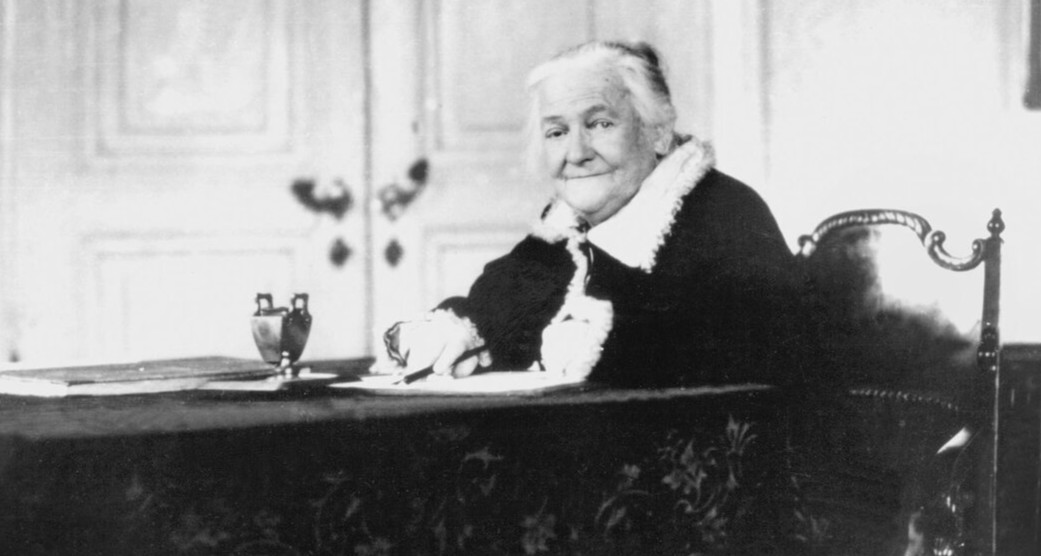
As part of a fact-finding tour investigating the place of women in the new Soviet society, Jessica Smith visits the Clara Zetkin clothing factory in Moscow.
‘The Clara Zetkin Factory’ by Jessica Smith from the Daily Worker Magazine. Vol. 1 No. 329. February 2, 1924.
BEFORE the war, the only factories in Russia that made clothing were military, and in all Russia there were only a few of these. I have seen in Moscow a number of clothing factories for civil work, organized since the revolution, and found them modern, well-equipped buildings, fitted out with electric cutting and pressing machine equipment from America and Germany, and employing the most up-to-date production plans. I was anxious to compare with these one of the old factories that had existed before the war. Through the All-Russian Clothing Syndicate, I secured permission and a guide to visit the “Clara Zetkin” factory, a private factory of the Mande-Raitz firm, founded some twenty years before the revolution, and called in those days the “Mars” factory. The son of the old owner, by the way, is now one of the financial experts in the State Clothing Syndicate, has worked with them faithfully for two years, and is one of the most valuable members of the staff.
The factory is on the outskirts of Moscow, a large group of buildings standing together and making a whole community in themselves. Inside the big gates we found the yard clean and well swept. The group of buildings looked a bit weather beaten, but in good repair. In the first was the manager’s office. Here were remnants of bygone splendor–a large, cracked peer-glass faced the top of the stairs, with an ornate gilt frame in a rather disreputable state. I noticed, however, that everything necessary for practical use–windows, stairways, etc. had been kept repaired, even though the decorations had been sadly neglected. In the office of the manager the same thing was noticeable. The former director had evidently been a man of elegant, if not artistic tastes. There were remnants of it in the wall decorations, an absurd chandelier and several luxurious, but dilapidated, chairs pushed back against the wall. In contrast, the present director’s desk, a simple wooden affair, and a few ordinary office chairs, stood by the window, bearing witness to the Spartan simplicity of the new regime.
The director himself we found to be a plain, friendly man in the prevalent well-worn black leather suit of the Soviet worker. He formerly had been a skilled craftsman in the clothing trade, and was well acquainted with the practical end of the business. He had come straight from his work bench to the directorship without any special training except the work he had done with his hands, but it was evident that he made a good administrator.
During the course of the conversation, the director had occasion to send out for some production and wage figures we had requested. The man who brought them was an aristocratic-looking old fellow in brown suit, with a black ribbon on his glasses. He came in with a big ledger containing the wage records. We discussed wage scales with him and learned that workers at that time were receiving on an average of 22.50 tavarne rubles (a ruble based on purchasing power and worth somewhat more than the old ruble–50 cents) to which was added 25 per cent or more every month, according to the amount of piece-work done above the required minimum. The man in the brown suit assured us that this came to more than before the war, when from 12 to 15 gold rubles a month was the military uniform work, in addition to the benefits in the way of medical care, cheap living accommodations, etc., now received by all organized workers in Russia. The increase of wages in this factory during the past year, he informed us, had been about 200 per cent. Later, we learned that our informant was the former director of the factory. When it was first nationalized, he had fled with the rest of the management, but, as he had applied to return to Russia, and was willing to work, they had taken him back ag assistant director. He and the new director had now worked together without any friction for over a year.
In pre-war times 2,000 workers were employed in this factory. During the war 5,000 toiled on uniforms, working in two shifts. Later, when the factory was nationalized, they had cut down to 2,000. Recently, with the reduction in military work, only 1,200 workers are employed full time, 950 in the clothing department, the remainder at shoemaking. In spite of this fact, there is very little unemployment in the clothing industry, as many of the emergency workers were un-skilled and have gone into other industries. Indeed, in the last month, the applicants for new workers have exceeded the number of applications for work.
Formerly the working day was 10 and 12 hours. With the present 8-hour day and the smaller number of workers, total output runs under the pre-war figure. However, they produced in those days a lower quality of goods. Now their uniforms are of a more complex pattern, to secure greater durability. Although total production is less, individual productivity has more than doubled over pre-war.
This has been due chiefly to the introduction of the American system of dividing work into a great many separate processes, which has been substituted for the old method of each worker tailoring a whole garment.
The director himself took us through the various departments of the factory. It was not as light and airy or well constructed as the factories for civil clothing which I have visited, and they are still using the same clumsy machinery used in the old days, for they have not been able, as yet, to replace it with new. An interesting department of the plant was a machine shop, where a number of mechanics are constantly at work repairing machinery in order to keep it working at capacity. They have found this much more satisfactory than sending out for extra parts, or for outside mechanics, especially since the old machines are in such frequent need of repair.
The general atmosphere was not as efficient and “American” as in the Comintern factory, or the Moscow Experimental, which have the advantage of comparatively new buildings, fresh machinery and a fair number of American trained workers. Still they have done remarkably well at the Clara Zetkin. The workers seem a happy lot and turn out a high grade of work.
The director told us that when he had first tried to introduce the American mass production methods some of the workers had cursed and raged at him. In fact, a meeting was held to protest against giving up their old slow, wasteful, but familiar, process. At last, however, he convinced them, and now they are proud of their new way of workers.
We were particularly interested in one room, where only women worked, all engaged in specially light work. “These,” said the forewoman of the department, “are our mothers.” This special department is reserved for nursing mothers when they come back to work after the four months’ leave of absence allowed for child-birth. These mothers, for nine months thereafter, work only six hours a day, (at full pay) and may go home to nurse their babies three times a day. The special department was organized for them in order not to interfere with the other work of the factory. They work on the very lightest operations.
“And these are our factory children,” they told us, as we came upon some young operators at work. These were orphans the factory had adopted at the time of the famine. The workers had fed them and housed them out of their own slender means, and now they had become skilled workers, employed four hours a day, and studying the remainder of the time in the factory school.
Most of the workers seemed to enjoy their work, and several of the older ones who operated special machines, stopped their work to explain the operations to us with parental detail. Several of the workers engaged on the more noisy and difficult machines were required to work only six hours a day.
One of the most interesting aspects of a Soviet factory is always the community life of the workers springing up around it. Near the factory one finds the community house, where living accommodations are secured at a very low rate, varied according to the salary. The Clara Zetkin has an unusually fine home, divided into small apartments, where most of its workers live. Here I found a fine day nursery, full of the younger children, who are kept while their mothers work, and are returned to them at night, fed, bathed and happy. Nearby was a workers’ club, formerly an officers’ club, run jointly by the workers of several factories in the district. Here there is a library, classrooms, and a large auditorium, where plays and entertainments are given every week.
From the living conditions of the workers, it may be seen how the new regime, through all its difficulties and struggles, tries always to adhere to the principle of giving the workers the product of their work. While the clothing plants might develop faster and state industry grow richer if they kept wages lower and reduced the worker’s health, cultural and living advantages, the first call on the industry beyond the fundamental needs of production is always the welfare of the workers. It is not always possible to raise wages fast enough to keep pace with all the workers’ needs, but it is a rule never to lower wages, and a standard once attained is adhered to. In the clothing industry, in spite of its comparatively recent development, the management is able to look after the needs of the workers, pay them comparatively good wages, and still run at a fair profit. As capital accumulates, or is received from the American workers thru the Russian-American Industrial Corporation, all the clothing industry employes in Russia will benefit by the improved standards which will then be possible.
The Daily Worker began in 1924 and was published in New York City by the Communist Party US and its predecessor organizations. Among the most long-lasting and important left publications in US history, it had a circulation of 35,000 at its peak. The Daily Worker came from The Ohio Socialist, published by the Left Wing-dominated Socialist Party of Ohio in Cleveland from 1917 to November 1919, when it became became The Toiler, paper of the Communist Labor Party. In December 1921 the above-ground Workers Party of America merged the Toiler with the paper Workers Council to found The Worker, which became The Daily Worker beginning January 13, 1924.
PDF of full issue: https://www.marxists.org/history/usa/pubs/dailyworker/1924/v01-n329-supplement-feb-02-1924-DW-LOC.pdf
 Revolution's Newsstand