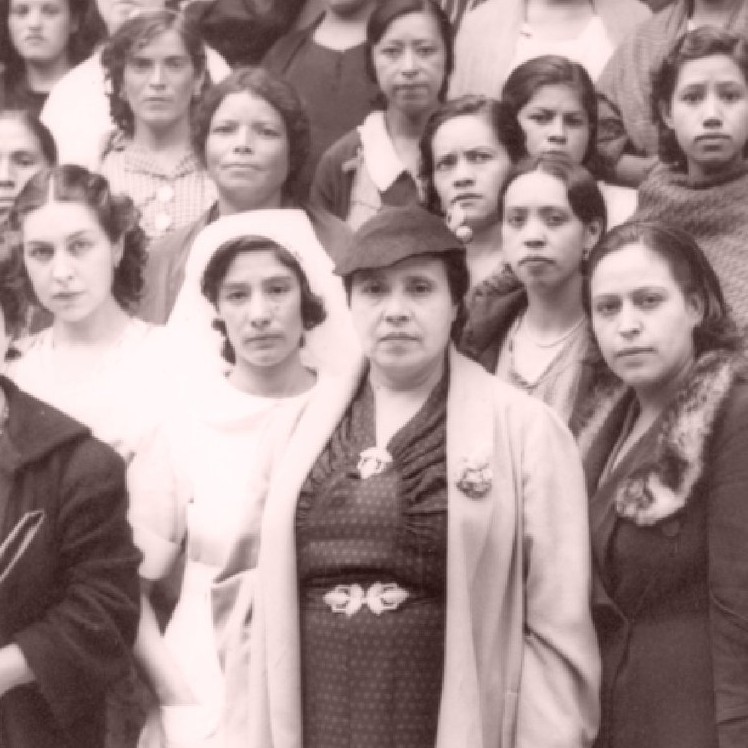
The leading Mexican feminist and Communist gives and overview of the women’s movement.
‘The Women in the Class Fight in Mexico’ by María del Refugio García from International Press Correspondence. Vol. 9. No. 29. June 21, 1929.
For many years the women of Mexico were under the influence of the Catholic Church, that evil legacy which Mexico received from its Spanish “civilisers”, and they were confined to work of a menial character and particularly to house-work, which compelled them to live a life of misery and humiliation.
It was only at the beginning of the present century that the women of Mexico began to play a part in the growing industry, and then only a very modest part. The textile industry, which developed fastest, employed most of them, and then came the millinery trade. Gradually, however. the women found their way into commercial and banking houses, and also into the printing trade, which at the present moment employs a relatively large number of women. The large majority of the women are still engaged in household work, for which they get a miserable wage of three to five dollars a month and poor food, etc.
In spite of the high rate of illiteracy among the working class (up to the year 1910, the schools were accessible to the upper classes only), the idea of the trade-union spread even in those early days, despite the influence of the church, and women, too, joined the unions in order to protect their class interests.
On January 7th, 1907, the employers in Rio Blanco, Santa Rosa and Nogales, in the Mexican Federal State Vera Cruz, moved down the textile workers of that district. Women courageously took part in the fight of defence of the workers, distributed arms and ammunition, looked after the wounded and even handled weapons usefully themselves.
In the year 1913 the Workers Club was founded, and this became the agitation and propaganda centre of the revolutionary proletariat of Mexico. On May 10th, the workers organised a big demonstration of protest against the military dictatorship, and the woman took part in it. This action led to the closing of the Workers Club.
At the end of June, 1916, the workers were forced into a fight for higher wages, owing to the steady depreciation of the paper money issued by the government. When their demands were rejected, they proclaimed a general strike in protest and stopped industrial activity throughout the Federal State of Vera Cruz and other Federal States of Mexico. The government took the most drastic measures and despatched soldiers to the disaffected areas. At the big Labour demonstration of protest, the women marched in the van and persuaded the soldiers not to turn their weapons upon the workers.
In the meanwhile, the trade-union movement continued to develop in Mexico. In May, 1919, the workers declared their solidarity with the teachers in their strike, whereby the working women zealously participated in the relief committee work for the teachers. In places where there was a failure of the professional teachers, the working women themselves took in hand the education of the children.
In the year 1919, the textile mill girls took an active part in the fight of the tenants associations, especially in the capital, Mexico City, in the harbour town of Vera Cruz and in the other towns of the Federal State of Vera Cruz. Side by side with the workers they fought for the reduction of rents and for the improvement of dwellings. In Vera Cruz the bourgeois government of Obregon slaughtered proletarian tenants. But in spite of this sacrifice and in spite of the imprisonment of tenants, including several women, the fight continued until the government issued rent decrees in the Federal State of Vera Cruz and of other parts of Mexico, limiting rents to 6 per cent of the registered value of the property. The administration of this decree is entrusted chiefly to women, who undertake all the necessary revolutionary tasks for the defence of the interests of their class.
The participation of the wives of the workers was no less important in times of strike, and especially during the strike of the tramway workers in Mexico City, which ended in a blood bath for the strikers and the destruction of their organisation. This defeat was chiefly due to lack of foresight and to bad leadership of the strike by the anarchists in charge of the trade union federation, to which the tramway workers’ organisation, one of the most revolutionary trade unions of the proletarians of the metropolis, was affiliated. In this strike the working women belonging to the organisation played a prominent role.
In the strikes of the miners of the Federal State of Jalisco and in Parhuca in the State of Hidasgo, in the textile strikes at Puebla, Atlixco and other places, the working women, under the influence of the women Communists, have recently participated energetically in all the activities of the revolutionary class movement.
Under the slogans of the Communist Party of Mexico, the working women also took part in a lively manner in the anti-imperialist fight. In the international campaign for Sacco and Vanzetti the work of the women was very noticeable.
The Workers International Relief and the International Red Aid also enjoy the keen support of the working women of Mexico in all their activities and campaigns.
International Press Correspondence, widely known as”Inprecor” was published by the Executive Committee of the Communist International (ECCI) regularly in German and English, occasionally in many other languages, beginning in 1921 and lasting in English until 1938. Inprecor’s role was to supply translated articles to the English-speaking press of the International from the Comintern’s different sections, as well as news and statements from the ECCI. Many ‘Daily Worker’ and ‘Communist’ articles originated in Inprecor, and it also published articles by American comrades for use in other countries. It was published at least weekly, and often thrice weekly. The ECCI also published the magazine ‘Communist International’ edited by Zinoviev and Karl Radek from 1919 until 1926 monthly in German, French, Russian, and English. Unlike, Inprecor, CI contained long-form articles by the leading figures of the International as well as proceedings, statements, and notices of the Comintern. No complete run of Communist International is available in English. Both were largely published outside of Soviet territory, with Communist International printed in London, to facilitate distribution and both were major contributors to the Communist press in the U.S. Communist International and Inprecor are an invaluable English-language source on the history of the Communist International and its sections.
PDF of full issue: https://www.marxists.org/history/international/comintern/inprecor/1929/v09n29-jun-21-1929-inprecor.pdf
 Revolution's Newsstand