
A look at the first two years of revolution that won independence from China and transformed the massive formerly feudal country.
‘Revolutionary Mongolia’ by Buriat from International Press Correspondence. Vol. 3 No. 60. September 13, 1923.
Until the year 1921 Mongolia could be regarded as a country of the middle ages and of serfdom, a country under the despotic rule of a group of feudal lords. It was not until the year of the revolution, the year in which the Chinese military occupation was removed, the White Guards of Baron Ungern driven away, and a new revolutionary government created–the year 1921–that the people of Mongolia was given the possibility of beginning a new, free, and independent life.
The new Mongolian government has existed for about two years. During this time it has succeeded in making a large number of reforms, making many radical changes in the old manner of living of the Mongolian people. Up to this time serfdom prevailed in Mongolia. About 30% of the Mongols lived under the yoke of their feudal lords, who had all power in their hands. The new Mongolian government emancipated all citizens from feudal dependence, and deprived the lords of yesterday of any power whatever over the Mongolian people. All former lords, and also the clergy, were deprived of many privileges, including that of exacting forced labor.
A progressive and general system of taxation has now been imposed on all the citizens of Mongolia. The monasteries and the clergy are not exempt from this taxation. This reform is a considerable alleviation of the unhappy position of the broad masses of Mongolian workers, as in many places half of the total taxes are now being paid by the rich feudal lords and the clergy. All payments in cash and in kind due under the feudal system and representing a sum of several million gold roubles, are now abolished.
The Mongolian revolutionary government is undertaking the most energetic measures against the unlimited rule of Chinese usurious capital, and against all its accompanying phenomena. For this purpose a national cooperative was founded in Mongolia over a year ago, since when it has been operating successfully.
The military service obligation was formerly a burden borne by the broad masses of the people. Almost one half of the population, including the monks, were entirely exempt from military service. There is now universal conscription, and those monks not living in the monasteries, as well as all other citizens, are called up.
A national revolutionary army on the model of the Red Army has been organized, and possesses a wide-spreading network of political schools. The council of war of the Mongolian revolutionary government makes it its task to teach all its soldiers reading and writing during the three years of active service required of them, in order that they may become enlightened citizens.
A special department for public enlightenment has been established, and this has been able to train a number of primary school teachers, to lay the foundations of a uniform and democratic school system, to decide upon the opening of secular schools, and, finally, to open a secondary school entirely independent of the clergy. A people s university has also been established at Urda, the capital of Mongolia, and lectures will be begun there in the course of the present year. Special courses of instruction have been provided for the practical training of organizers and functionaries for local self-administration. A scientific organization has also been formed–the future Mongolian academy of science.
The revolutionary Mongolian government has substituted the feudal system by a decree providing for local democratic self-government; this has been thoroughly worked out and is being energetically put into practice. A special commission has been appointed for the codification of Mongolian laws, and urgent measures are being taken to organize the financial-economic system of the country. Finally, the revolutionary government of Mongolia, thanks to its state apparatus, has been able to get over a thousand dessatines of land sown, a fact signifying a considerable advance in agriculture for a country which is just emerging from feudalism, and has hitherto only reared cattle.
The largest and most influential groups in Mongolia are the Revolutionary People’s Party and the Revolutionary Youth League, both supported by the broad working masses and the intelligenzia. The next group is that of the Theocrats (the clerical party), now in a state of complete dissolution.
Another group also in a condition of complete dissolution is that of the feudal lords, who have been deprived of all economic and political foothold. Another insignificant group is actively reactionary, and the remaining mass simply forms a rotting. “feudal rubbish heap”.
There is also a small group of princes and clergy of liberal-national views, who are not only not hostile to the new regime, but even express sympathy with it.
The influence of the Revolutionary People’s Party and of the Revolutionary Youth League is in general very powerful. These bodies are at the present time the actual rulers of the country. Thanks to the new Mongolian government, supported by this Party and the League, it was possible easily and painlessly to suppress all conspiracies attempted by the reaction. Within the last year and a half four conspiracies have been discovered and nipped in the bud.
The Mongolian counter-revolutionists have derived a certain amount of support from the presence of the remnants of White bands in the frontier districts of Mongolia and Mandschurei, these bands having forced their way into Mongolia with the object of inflaming a counter-revolutionary movement in the Mongolo-Russian frontier districts. But in the course of the past year the Mongolian government and its internal protective aparatus were successful in rendering innocuous all the White Guard bands in the country. The chiefs of these bands have been taken prisoner, for instance the sub-lieutenant Prochorov, the captain Otscharov, Andrej Schubin, the “renowned” bandit Tubanov, who completely destroyed several Russian border settlements on R.S.F.S.R. territory, and massacred the whole of their peasant inhabitants, during Baron Ungern’s offensive in the year 1921, and a number of other White Guard leaders.
The internal position of Mongolia has therefore been firmly consolidated, and is secure from all dangers of reaction and counter-revolution.
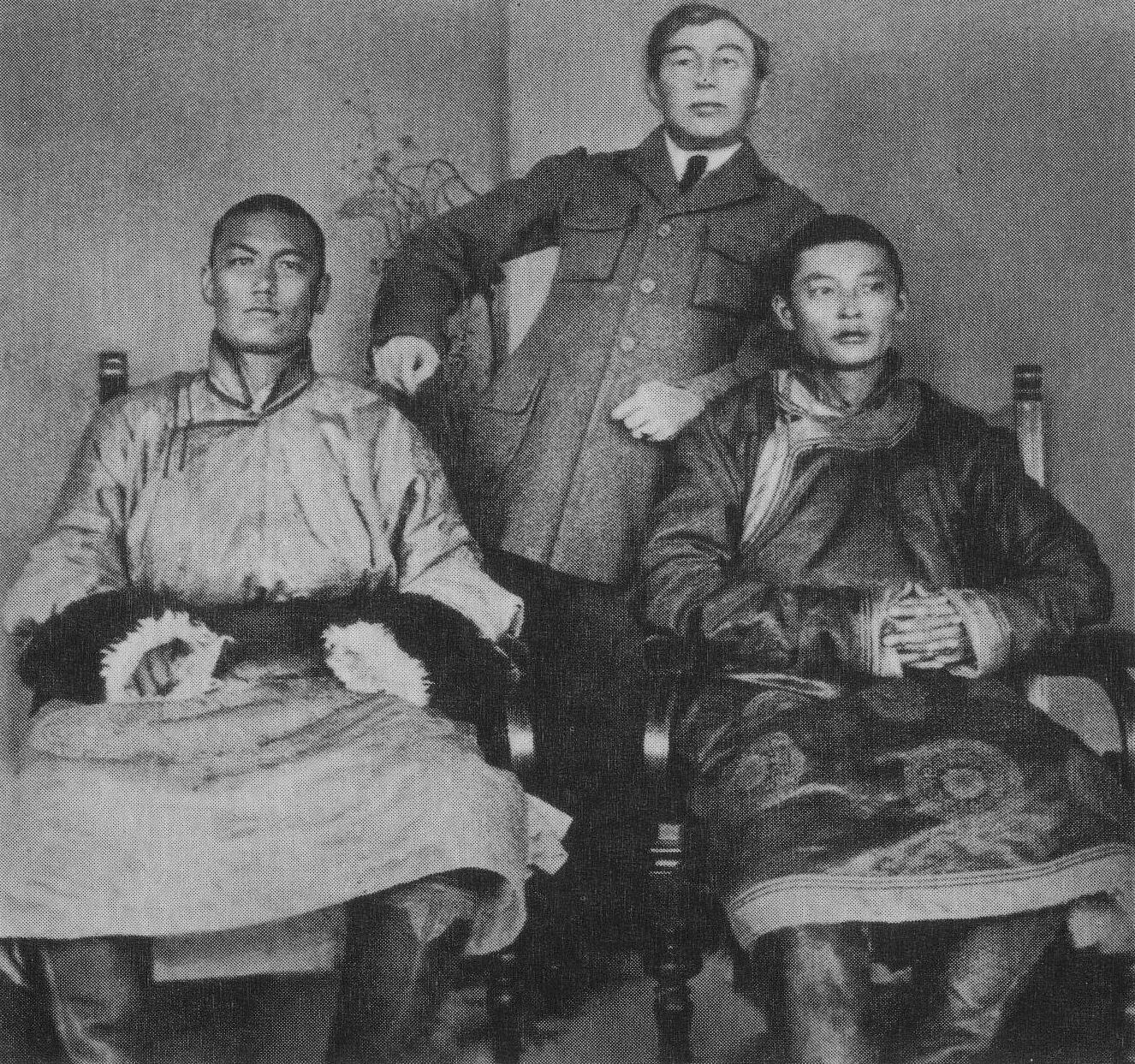
The carrying out of all the above measures has made severe demands on the strength and energy of the Mongolian government, since the conditions under which it has worked have been extremely difficult: tremendous backwardness of the population of a country whose structure was that of the middle ages, great shortage of workers, sabotage and conspiracy on the part of reactionary elements, and constant threats to the country from Chinese imperialism and Russian White bands.
The rapprochement of new Mongolia to Soviet Russia has given new prospects of development to the creative powers of the Mongolian people. Soviet Russia has awakened the Mongolian people from its slumber, and has given it fresh forms of thought and social development. The isolation of Mongolia from Soviet Russia would be a great misfortune for the Mongolian people, for it would then inevitably fall beneath the yoke of the imperialists of China, Japan, and other countries. The rapprochement of revolutionary Mongolia to Soviet Russia, and the internal creative work which it is accomplishing, will doubtless have the effect of awakening the other sections of the Mongolian people, hitherto subjugated by the imperialists of the East and West.
And, on the other hand, the friendship and close relationship between Soviet Russia and Mongolia will doubtless give them, in the immediate future, the opportunity of finding a common language, and of joining hands for the defence of the working masses of the East and West against their common oppressors.
International Press Correspondence, widely known as”Inprecor” was published by the Executive Committee of the Communist International (ECCI) regularly in German and English, occasionally in many other languages, beginning in 1921 and lasting in English until 1938. Inprecor’s role was to supply translated articles to the English-speaking press of the International from the Comintern’s different sections, as well as news and statements from the ECCI. Many ‘Daily Worker’ and ‘Communist’ articles originated in Inprecor, and it also published articles by American comrades for use in other countries. It was published at least weekly, and often thrice weekly.
PDF of full issue: https://www.marxists.org/history/international/comintern/inprecor/1923/v03n60[38]-sep-13-1923-Inprecor-loc.pdf
 Revolution's Newsstand